
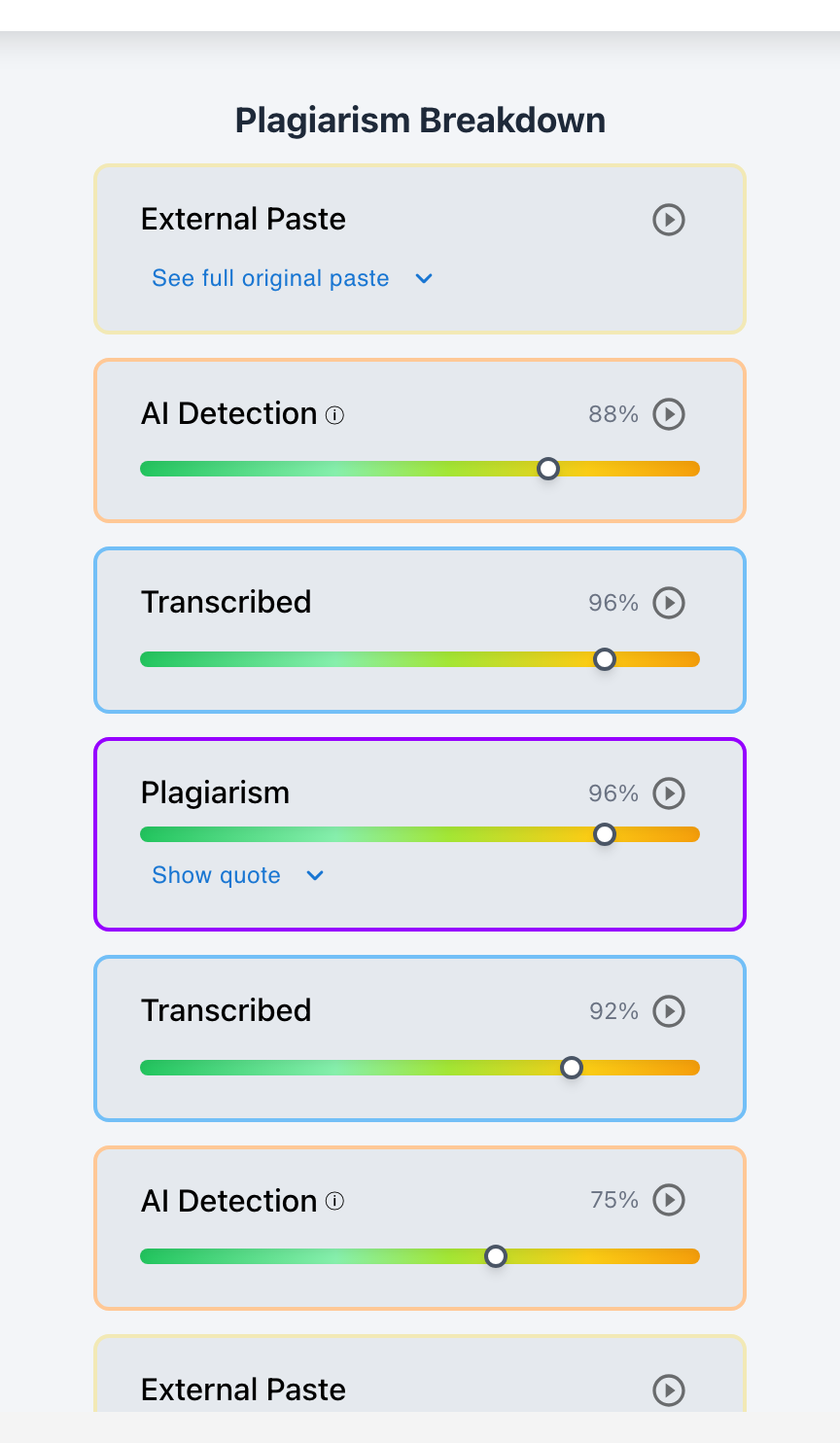
When two students submit nearly identical essays, teachers can definitively determine who copied from whom by running Checkmark Plagiarism's Peer Directionality Protocol: 1) Drafting Duration Comparison (the original author displays multi-hour incremental drafting over days, while the copier displays a single 0.05-second paste payload); 2) Structural Evolution Audits (the original author has organic pre-writing, discarded sentences, and backspaces); 3) Typo & Formatting Inheritance (the copier faithfully replicates unique misspellings or odd margins from the original); and 4) Diagnostic Oral Conferences.
Discovering two essays with a 90% peer similarity match is one of the most frustrating scenarios in grading. Both students will often deny copying, pointing fingers at each other: "I let them borrow my notes and they stole my whole essay!" vs. "No, we just worked together in the library!" In the past, teachers had no objective way to prove directionality, often forcing them to split the penalty unfairly. Process telemetry solves peer-to-peer directionality definitively by uncovering the chronological and physical origin of every paragraph.
Below is a comprehensive forensic guide on determining plagiarism directionality between student submissions.
Checkmark Plagiarism resolves peer plagiarism disputes by pairing plagiarism detection with essay writing playback, AI detection, autograding, and integrations with Canvas and Google Classroom.
The 4 Forensic Tests for Peer Directionality
1. The Timeline & Active Hours Test
Student A (Original): 4.5 active typing hours across 4 days.
Student B (Copier): 11 minutes total editing time; 1,400 words pasted in one second.
2. The Structural Evolution Test
Student A: Version history reveals the messy origin: changing thesis drafts, 22% backspaces.
Student B: Text appears instantly in its final polished form.
3. The Typo Inheritance Fingerprint
Student B copies Student A's unique idiosyncratic errors (e.g., misspelled historical names or broken citation formatting) without realizing they are incorrect.
4. The Oral Diagnostic Defense
Student A explains every source and argumentative pivot effortlessly; Student B is unable to explain the rationale behind matching sentences.
How Typo Inheritance Proves Copying Directionality
Understanding the forensic power of copied idiosyncrasies:
- The "Trap Street" Principle: Just as cartographers inserted deliberate minor errors into maps to catch copyright infringement, a student author's unique accidental typos serve as forensic fingerprints.
- Exact Citation Formatting Errors: If Student A mistakenly typed "(Smith, 2024, p. 999)" instead of "p. 99", and Student B's essay contains the exact same erroneous page number, directionality is established.
- Clipboard Timestamp Corroboration: Checkmark logs the exact second Student B pasted Student A's text, matching the time Student A shared document access.
Read more in how Checkmark writing process analysis works.
Comparison: Original Author vs. Peer Copier Telemetry
Original Author (Student A Telemetry)
- Drafted across 4 distinct writing sessions over 5 days.
- 18% to 25% organic backspaces and revisions.
- Shows gradual paragraph construction from outline.
- Passes oral defense with 100% conceptual mastery.
Peer Copier (Student B Telemetry)
- Document created 2 hours before submission deadline.
- Single 0.05-second clipboard paste payload.
- Inherits Student A's unique typos and formatting errors.
- Fails oral defense on core essay arguments.
A 5-Step Educator Protocol for Investigating Peer Copying
Peer Plagiarism Investigation Checklist:
- 1. Open the Side-by-Side Peer Comparison View in Checkmark inside Canvas SpeedGrader.
- 2. Compare Active Drafting Hours: identify which student spent hours typing vs. minutes pasting.
- 3. Inspect Typo Inheritance: look for identical unusual misspellings or citation anomalies.
- 4. Hold separate 2-minute conferences with each student using the diagnostic script.
- 5. Review the findings: exonerate the original author (or address unpermitted sharing) and sanction the copier.
How Checkmark Plagiarism Powers Peer Directionality
Checkmark Plagiarism combines **AI detection, essay writing playback, static AI detection, plagiarism detection, autograding, and Canvas/Google Classroom integrations** to automatically compare intra-class submissions and map drafting timelines side by side.
Frequently Asked Questions
What if both students claim they wrote the essay independently?
Comparing their Checkmark Playback logs immediately reveals the truth: one student will have hours of keystrokes while the other will have an instant paste payload.
What if Student A voluntarily shared their essay with Student B?
School honor codes treat facilitating academic dishonesty (sharing work) differently from plagiarism (submitting someone else's work as your own); both receive appropriate tiered responses.
Can Checkmark compare submissions across different class periods?
Yes. Checkmark cross-matches student submissions across all course sections, teacher rosters, and past academic semesters automatically.
How does Checkmark Plagiarism integrate with Canvas LMS?
Checkmark embeds side-by-side peer diff viewers directly inside Canvas SpeedGrader, highlighting matching sentences in red.
What if Student B retyped Student A's paper instead of pasting it?
Checkmark Playback detects the robotic, uninterrupted transcription cadence, lack of thinking pauses, and typo inheritance.
Should teachers meet with the two students together or separately?
Always interview students separately first to allow each student to explain their drafting process without peer pressure or intimidation.
How does typo inheritance hold up in parental meetings?
Showing parents the exact matching unique typographical error appearing in both essays alongside playback timelines resolves disputes immediately.
How does Checkmark Autograder handle peer matches?
Autograder automatically flags both papers with high Peer Similarity indices, routing them to the teacher's directionality review queue.
Can students see who they matched with in their report?
To protect FERPA privacy, student-facing reports show matching text but conceal the classmate's name, while the teacher view displays full roster identities.
Why is proving directionality essential for student justice?
Because innocent authors who were victimized by file theft or over-generous sharing should not receive the same severe disciplinary penalty as the copier.
Definitive Truth in Peer Investigations
When two essays collide, guessing who copied whom is unnecessary. By utilizing Checkmark Plagiarism's peer directionality telemetry, drafting timelines, and typo inheritance forensics, educators resolve peer copying disputes with absolute certainty, total fairness, and complete transparency.
Checkmark Plagiarism supports this comprehensive approach with AI detection, essay writing playback, static AI detection, plagiarism detection, autograding, and integrations with Canvas and Google Classroom.
See how Checkmark resolves peer-to-peer plagiarism directionality in Canvas SpeedGrader. View a sample report or request a demonstration.