
Yes. Teachers should unequivocally retain student writing samples—specifically 1 to 2 proctored, in-class diagnostic writing tasks completed at the beginning of the school year. Maintaining an authentic writing baseline is the single most reliable way to identify unauthorized AI use, detect contract cheating, and protect articulate students from false positive AI flags.
In an educational landscape flooded with generative AI tools, statistical detection percentages alone can create uncertainty during grading. Having a verified, proctored writing sample creates an empirical "ground truth" anchor for every student. By comparing out-of-class essay submissions against this verified baseline, teachers can instantly determine whether an advanced paper represents authentic human skill or machine-generated text. Checkmark Plagiarism automates baseline portfolio management directly within Canvas and Google Classroom.
Below is a comprehensive guide on building, maintaining, and using student writing portfolios to safeguard academic integrity.
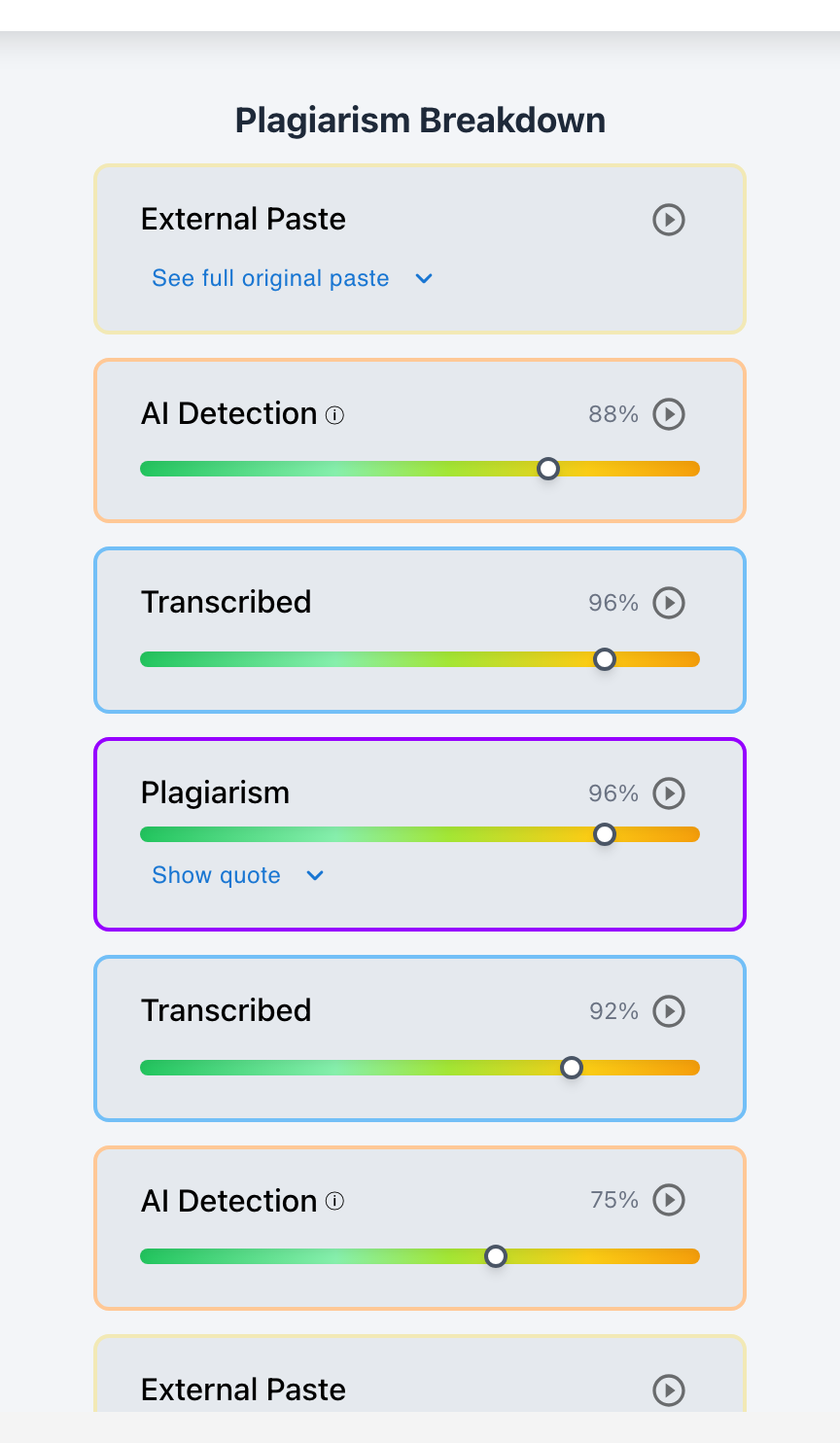
Checkmark Plagiarism manages writing baselines by pairing AI detection with essay writing playback, plagiarism detection, autograding, and integrations with Canvas and Google Classroom.
The 4 Critical Reasons to Retain Student Writing Samples
1. Creates an Empirical Diagnostic Anchor
A 40-minute handwritten or proctored in-class diagnostic captures a student's unassisted vocabulary range, syntax habits, and punctuation idiosyncrasies.
2. Protects Against False AI Accusations
When an exceptionally articulate student triggers an 80% AI score on a static detector, their baseline portfolio proves they have always written with collegiate eloquence.
3. Unassailable Due Process & Parent Defense
In parent conferences and administrative appeals, placing the in-class sample side-by-side with an unassisted paper provides undeniable visual clarity.
4. Powers Automated AI Discrepancy Scoring
Checkmark automatically cross-references every new submission against the student's historical baseline to highlight statistically improbable leaps in complexity.
How to Establish a Clean Writing Baseline in Week 1
Creating an effective diagnostic baseline requires a controlled setting:
- The Proctored Diagnostic Prompt: Administer a 45-minute in-class writing prompt during the first week of school (e.g., analyzing a short article or reflecting on a personal challenge).
- Device Security: If typing on Chromebooks, use locked-browser mode or require drafting directly in Canvas with Checkmark Playback enabled.
- Zero External Aids: Ensure students write without internet access, spellcheck add-ons, or external assistance to capture true baseline ability.
Read more in how Checkmark writing process analysis works.
Comparison: Evaluating Submissions With vs. Without Writing Baselines
With Verified Writing Baseline (Checkmark Enabled)
- Immediate empirical proof of authentic vocabulary range.
- False AI flags cleared in seconds for gifted writers.
- Defensible, objective evidence for parent meetings.
- Focuses student conferences on learning and revision.
Without Writing Baseline (Isolated Scoring)
- Reliance on abstract statistical AI percentages alone.
- High risk of falsely accusing advanced students.
- Subjective "he said / she said" disputes during appeals.
- Teachers left second-guessing student authorship.
A 5-Step Educator Protocol for Managing Baseline Portfolios
Baseline Portfolio Management Checklist:
- 1. Administer a proctored in-class diagnostic writing assignment in Week 1.
- 2. Tag the assignment as "Diagnostic Baseline" in Checkmark Plagiarism.
- 3. Let Checkmark index the student's unique stylometric profile (lexical diversity, sentence length, and syntax).
- 4. For future out-of-class essays, review the automated Baseline Discrepancy Index alongside AI scores.
- 5. If a discrepancy occurs, use the baseline sample as a non-adversarial teaching tool during conferences.
How Checkmark Plagiarism Powers Automated Portfolio Forensics
Checkmark Plagiarism combines **AI detection, essay writing playback, static AI detection, plagiarism detection, autograding, and Canvas/Google Classroom integrations** to automatically maintain FERPA-compliant longitudinal portfolios for every student.
Frequently Asked Questions
Why is an in-class writing sample the best way to verify AI use?
Because a proctored in-class sample captures an authentic snapshot of unassisted student ability, creating an immutable benchmark to evaluate future essays.
How many writing samples do teachers need to keep?
One proctored in-class diagnostic sample plus one standard homework essay provides a comprehensive baseline for the entire semester.
Does keeping student writing samples violate FERPA privacy laws?
No. Retaining student work within an institutional LMS or FERPA-compliant platform like Checkmark is completely legal and standard educational practice.
How does a baseline protect students from false AI flags?
If an advanced writer triggers a high AI detector score, comparing the paper to their equally sophisticated in-class baseline instantly clears the flag.
Can students see their writing baseline in Canvas?
Yes. Students can view their writing portfolio and stylometric growth over time to track their progress and reflect on feedback.
How does Checkmark Plagiarism integrate with Canvas LMS?
Checkmark provides certified LTI 1.3 integration, SpeedGrader sidebar embeds, two-way grade passback, and single sign-on (SSO).
What if a student genuinely improves their writing during the semester?
Genuine improvement is accompanied by multi-hour active drafting and high backspace rates in Playback, distinguishing it from instant AI text.
What type of prompt should be used for a baseline assignment?
Use an analytical response prompt (e.g., evaluating an argument in a short article) rather than a simple personal narrative to gauge academic vocabulary.
Can writing baselines help in parent conferences?
Yes. Showing parents a side-by-side comparison of the in-class diagnostic and a suspicious submission resolves authorship questions objectively.
Why is longitudinal profiling superior to single-paper detection?
Because evaluating writing as an evolving historical body of work eliminates false positives and ensures fair, evidence-based integrity reviews.
Building Trust Through Longitudinal Transparency
Academic integrity is not about catching students; it is about honoring authentic student growth. By maintaining diagnostic writing samples with Checkmark Plagiarism, educators protect honest scholarship, clear false accusations with ease, and foster a classroom culture grounded in transparency and trust.
Checkmark Plagiarism supports this comprehensive approach with AI detection, essay writing playback, static AI detection, plagiarism detection, autograding, and integrations with Canvas and Google Classroom.
See how Checkmark pairs automated baseline portfolios with multi-signal detection to evaluate student writing. View a sample report or request a demonstration.