
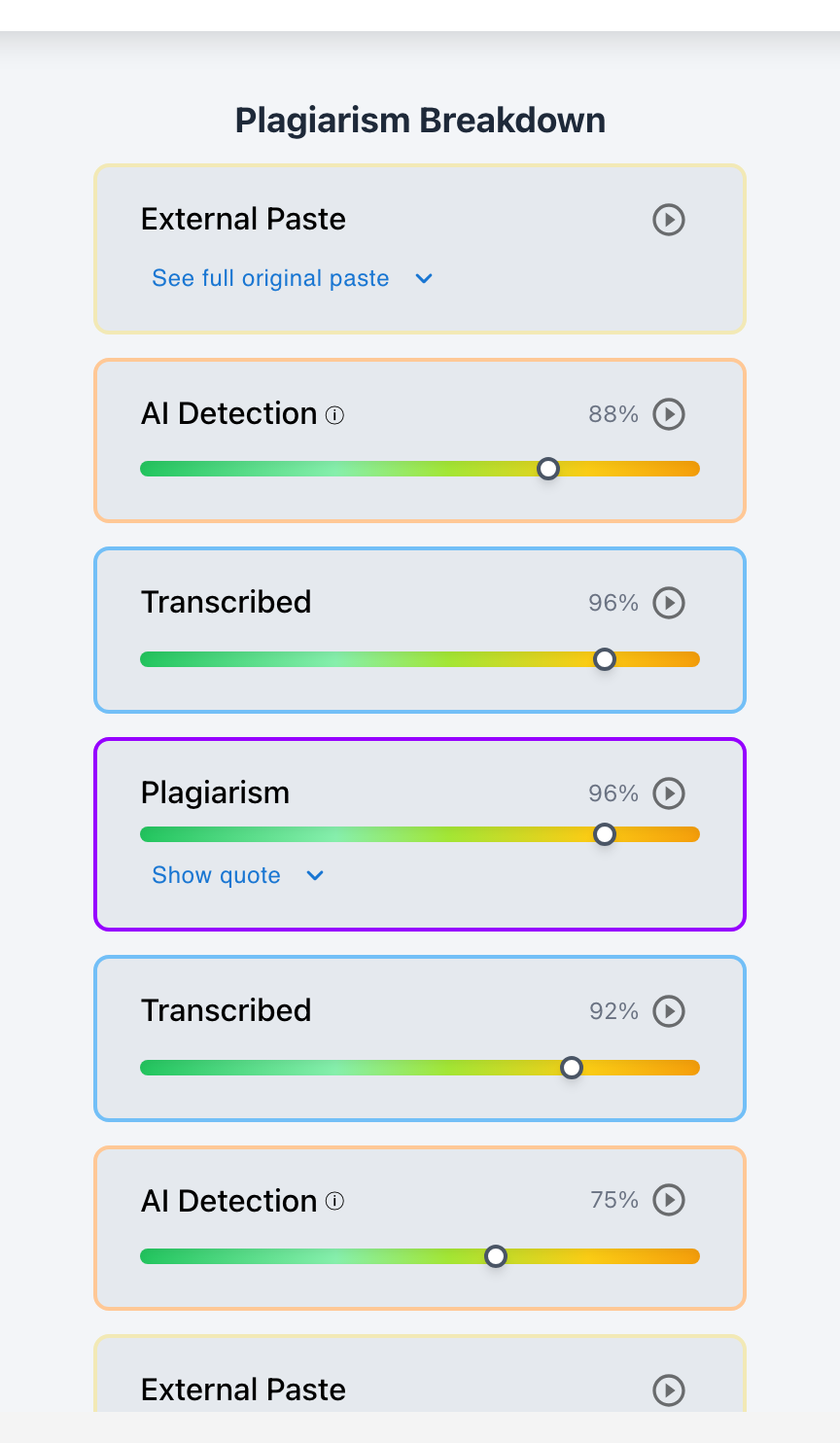
Requiring students to provide access to their document drafting history is a valuable integrity practice, but standard Google Docs version history has severe technical and logistical limitations.
As concerns over ChatGPT have grown, many educators have adopted a policy of checking Google Docs version history to verify student authorship. While version history can expose obvious overnight copy-paste shortcuts, manually clicking through revision snapshots for 100 students is overwhelmingly time-consuming. Furthermore, Google Docs batches revisions periodically, often obscuring active typing time, keystroke cadence, and paste character counts.
Understanding what Google Docs version history can and cannot show—and how automated essay writing playback streamlines verification—helps educators verify authorship efficiently without administrative burnout.
Checkmark Plagiarism elevates revision analysis by pairing automated essay writing playback with AI detection, plagiarism detection, autograding, and integrations with Canvas and Google Classroom.
What Google Docs Version History CAN Show
1. Major Snapshot Jump Cuts
Version history clearly shows when a blank document suddenly gains 1,200 words between 11:15 PM and 11:20 PM with zero intermediate saves.
2. Basic Multi-Day Session Dates
Confirms whether the document was opened and edited across multiple days or created in a single sitting hours before the deadline.
The 4 Major Limitations of Google Docs Version History
1. Batching Obscures Active Typing Time
Google Docs does not record every keystroke individually; it bundles text changes into periodic snapshot intervals (often several minutes apart). A teacher cannot easily determine whether a student spent 45 minutes actively typing or 45 minutes looking at a phone while the document sat idle.
2. Severe Teacher Grading Burden
Opening version history, expanding collapsed snapshot trees, and manually stepping through 30 revision states for each student takes 5–10 minutes per essay. For a teacher with 90 students, this adds 12+ hours of administrative grading time per assignment.
3. No Automated Paste Analytics
Google Docs highlights added text in color, but it does not calculate paste-to-keystroke ratios, paste event character counts, or typing velocity analytics automatically.
4. Easily Disrupted by External Drafting
If a student drafts their essay in Microsoft Word, Scrivener, or Google Docs on a personal account and copies it over, the entire authentic essay appears as an "instant paste," creating false suspicion.
How Essay Writing Playback Solves These Limitations
Rather than relying on clunky, manual Google Docs snapshot trees, modern platforms like Checkmark Plagiarism provide automated, video-like essay writing playback:
- Instant Video-Like Replay: Watch a 10-second accelerated visual replay of the entire drafting session directly inside your LMS grading view.
- Precise Keystroke Metrics: Automatically calculates total active typing duration, typing speed (WPM), pause frequencies, and backspace counts.
- Automated Paste Highlighting: Instantly flags the exact timestamp and character count of any external paste event without manual hunting.
Read more in how Checkmark writing process analysis works.
Comparison: Google Docs Version History vs. Checkmark Writing Playback
Google Docs Version History (Manual)
- Batched snapshots every few minutes.
- Requires 5–10 minutes of manual clicking per student.
- No automated metrics for active typing vs. idle time.
- Lacks integrated AI and plagiarism scanning.
Checkmark Essay Writing Playback
- Granular, keystroke-by-keystroke video replay.
- Instant automated analysis inside Canvas/Google Classroom.
- Calculates exact active drafting hours and paste ratios.
- Simultaneously runs AI detection and citation checks.
A 5-Step Policy Guide for Teachers
Educator Document History Protocol:
- 1. Require all essays to be drafted within your integrated LMS document environment.
- 2. Clarify that offline drafting (Word) requires retaining early drafts and timestamp logs.
- 3. Use automated writing playback to screen submissions for instant paste events at a glance.
- 4. Reserve manual revision inspections only for flagged or highly suspicious submissions.
- 5. Pair timeline observations with citation audits and brief student conferences.
How Checkmark Plagiarism Streamlines Revision Verification
Checkmark Plagiarism combines **AI detection, essay writing playback, static AI detection, plagiarism detection, autograding, and Canvas/Google Classroom integrations** to turn document history analysis into an automated, 5-second LMS check.
Frequently Asked Questions
Can teachers see my Google Docs revision history?
Yes. Anyone with edit or view access to a Google Doc can open File > Version History to review past revision snapshots and timestamps.
Can Google Docs version history prove a student used ChatGPT?
It can prove a wholesale paste event occurred (e.g., 1,500 words appearing in one snapshot), but corroborating evidence like citation audits and student conferences is needed to confirm AI use.
What if a student copies and pastes an essay they wrote in Microsoft Word?
It will appear as a wholesale paste in Google Docs. Instruct students to keep their original Word document with version metadata to verify authentic drafting.
How does writing playback differ from Google Docs version history?
Writing playback captures granular keystroke analytics, active drafting time, and automated paste detection in an accelerated video replay, saving hours of grading.
Why is manual Google Docs checking impractical for teachers?
Stepping through version snapshots for 100 students takes over 10 hours of manual clicking per assignment, creating teacher burnout.
Can students fake Google Docs revision history?
Some students attempt to type out ChatGPT text by hand, but writing playback reveals continuous linear typing cadences without natural drafting pauses or revisions.
How does Checkmark Plagiarism integrate with Google Docs and Classroom?
Checkmark Plagiarism tracks drafting history automatically inside Google Classroom assignments, presenting visual replays directly in the grading interface.
What should a teacher do if version history is missing?
Check whether the student created a new document at the last minute and ask them to share their original working file or early draft notes.
Can version history protect students from false accusations?
Yes. A multi-day revision history showing natural typing and sentence restructuring is undeniable proof of authentic student authorship.
How does process tracking improve student writing habits?
It encourages students to work incrementally over multiple sessions, reducing procrastination and fostering genuine revision skills.
Automate Process Verification to Save Time and Uphold Rigor
Document creation history is essential for academic integrity, but teachers should not have to spend hours clicking through manual snapshot trees. By leveraging automated essay writing playback, educators gain instant, unassailable visibility into student drafting.
Checkmark Plagiarism supports this comprehensive approach with AI detection, essay writing playback, static AI detection, plagiarism detection, autograding, and integrations with Canvas and Google Classroom.
See how Checkmark transforms clunky version history into instant, automated essay writing playback inside your LMS. View a sample report or request a demonstration.