
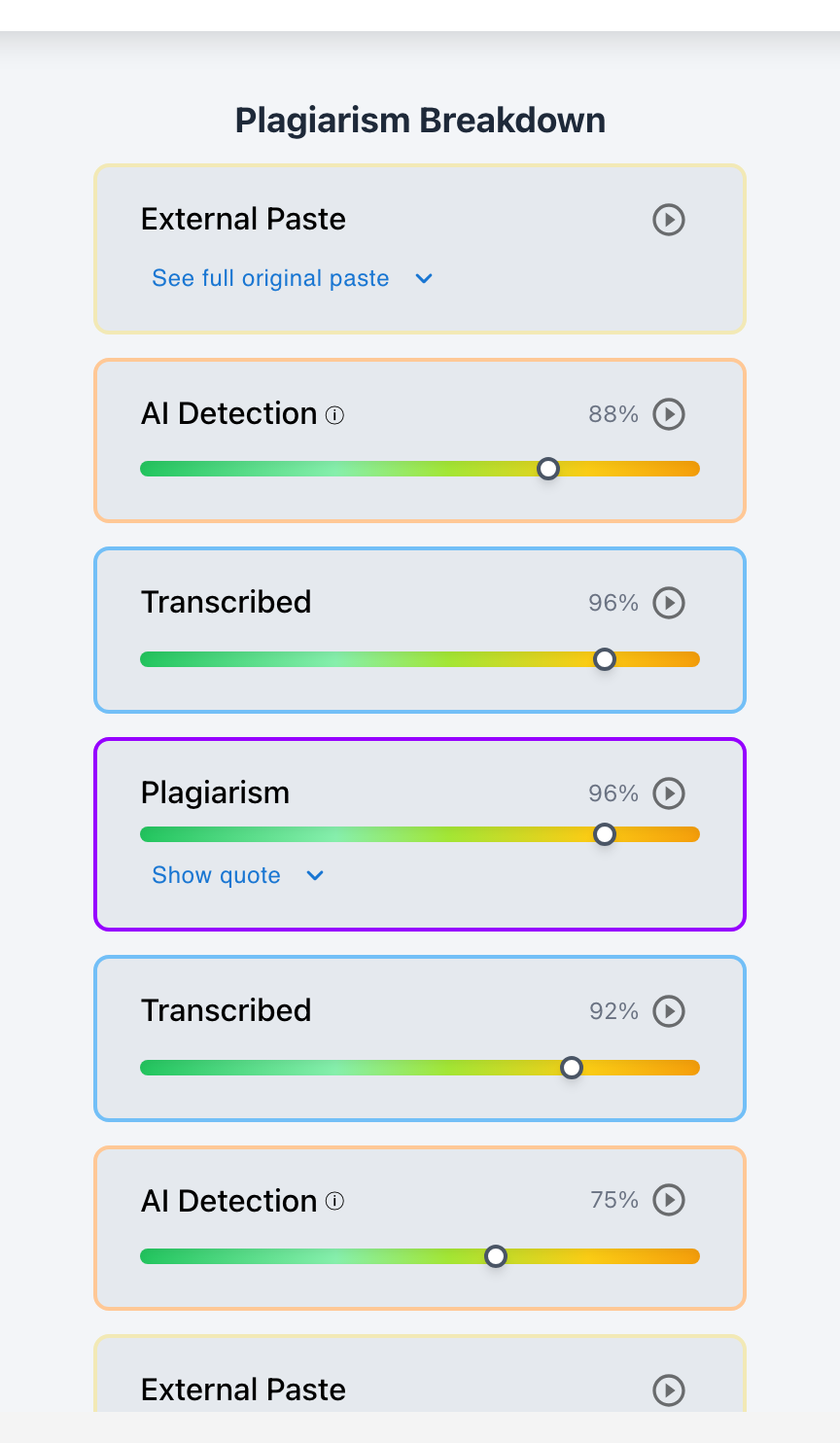
Yes. Schools must strictly require corroborating evidence beyond an AI detection score before issuing any academic penalty. An AI detector percentage is merely a probabilistic estimate—not definitive physical proof. To ensure legal defensibility, ethical due process, and student fairness, institutional policies must mandate multi-signal corroboration: pairing neural detector flags with physical keystroke writing playback (paste event logs, typing duration), citation verification (hallucinated DOIs), and a diagnostic oral check-in.
As academic integrity disputes increasingly involve school boards, administrative appeals, and legal representation, relying on a single number from an AI detector (e.g., "88% AI Detected") has proven to be an indefensible liability. When a parent or attorney asks: "What specific physical evidence proves my child did not write this essay?", an opaque statistical percentage cannot hold up to scrutiny. Requiring a robust, multi-signal standard of proof protects schools from administrative reversals while ensuring that genuine academic dishonesty is addressed with incontrovertible physical evidence.
Below is a comprehensive guide on why multi-signal evidence is essential and how schools define this standard.
Checkmark Plagiarism provides multi-signal proof by pairing AI detection with essay writing playback, plagiarism detection, autograding, and integrations with Canvas and Google Classroom.
The 3 Pillars of Defensible Academic Integrity Evidence
Pillar 1: Process Telemetry
Physical Evidence: Checkmark Playback logs 0.05-second clipboard paste payloads, zero active typing hours, and <3% backspace deletion rates.
Pillar 2: Citation Verification
Factual Evidence: Checkmark flags non-existent DOIs, phantom journal volumes, or hallucinated academic authors created by LLMs.
Pillar 3: Oral Defense Alignment
Pedagogical Evidence: Inability of the student to explain central arguments, vocabulary words, or source connections during a 2-minute conference.
The Legal and Ethical Risks of Single-Score Penalties
Understanding why statistical detectors alone cannot sustain academic sanctions:
- The "Preponderance of Evidence" Standard: Academic honor codes require clear and convincing evidence. A statistical probability from a proprietary algorithm does not meet this legal standard on its own.
- Vulnerability on Appeal: Single-score accusations are routinely overturned on appeal when students produce draft files, handwritten notes, or outline brainstorms.
- The Checkmark Multi-Signal Standard: Requiring at least two of the three evidence pillars creates an airtight case that parents, deans, and honor councils can uphold with 100% confidence.
Read more in how Checkmark writing process analysis works.
Comparison: Single-Score Accusations vs. Checkmark Multi-Signal Standard
Checkmark Multi-Signal Standard (Incontestable & Fair)
- Combines AI score with 0.05s paste telemetry logs.
- Identifies hallucinated DOIs and phantom citations.
- Corroborated by structured oral check-in notes.
- Withstands administrative appeals and legal scrutiny.
Single-Score Accusations (Vulnerable & Speculative)
- Relies entirely on a single percentage number (e.g., 85%).
- No physical record of typing time or clipboard actions.
- Easily challenged by parents and overturned on appeal.
- Damages student-teacher trust and school reputation.
A 5-Step Leadership Protocol for Enforcing Multi-Signal Standards
Multi-Signal Evidence Protocol Checklist:
- 1. Amend school integrity policy: mandate that no penalty can be issued on an AI score alone.
- 2. Require corroboration from at least 2 of the 3 Evidence Pillars (Telemetry, Citations, Oral Defense).
- 3. Train faculty to use Checkmark Writing Playback in Canvas SpeedGrader to capture paste timestamps.
- 4. Require teachers to attach a standardized Checkmark PDF dossier to all formal misconduct reports.
- 5. Conduct Honor Committee reviews strictly using the multi-signal audit dossier.
How Checkmark Plagiarism Powers Multi-Signal Evidence
Checkmark Plagiarism combines **AI detection, essay writing playback, static AI detection, plagiarism detection, autograding, and Canvas/Google Classroom integrations** to automatically generate comprehensive multi-signal evidence dossiers for every submission.
Frequently Asked Questions
Why is a 99% AI score still not enough on its own?
Because even a 99% score is a statistical prediction of text patterns; fair due process requires physical proof of how the text entered the document (e.g., a paste log or transcription cadence).
What if a student has an AI score of 95% but typed for 4 hours?
The 4 hours of physical keystrokes in Playback proves human composition, proving the 95% score is a false positive and completely clearing the student.
What if a student has an AI score of 95% and a 0.05-second paste log?
The combination of the high AI score AND the physical paste payload provides clear, multi-signal proof of external generation.
How does Checkmark Plagiarism integrate with Canvas LMS?
Checkmark embeds multi-signal cards—combining similarity %, AI %, active typing hours, and paste logs—directly inside Canvas SpeedGrader.
What is considered 'Pillar 2' citation evidence?
Finding cited academic DOIs or journal articles that do not exist in published literature (hallucinated sources generated by LLMs).
Can teachers export the multi-signal evidence for parents?
Yes. Checkmark exports standardized, FERPA-compliant PDF dossiers containing all multi-signal charts, video links, and timestamps.
How does multi-signal evidence protect teachers?
It shields educators from accusations of bias, providing undeniable physical data that supports their professional evaluations.
How does Checkmark Autograder align with multi-signal rules?
Autograder automatically flags submissions meeting the multi-signal threshold, routing them for teacher inspection before finalizing marks.
Can students view their multi-signal telemetry?
Yes. Students can view their writing analytics to see the verifiable proof of their drafting process and effort.
Why is the multi-signal standard the gold standard of modern academic integrity?
Because it unites technological sophistication with timeless legal principles of fairness, transparency, and empirical evidence.
Defensible Integrity Grounded in Truth
Justice in education requires empirical certainty. By mandating multi-signal evidence beyond AI detector scores with Checkmark Plagiarism, schools protect honest students, hold true misconduct accountable, and uphold academic standards with unquestionable integrity.
Checkmark Plagiarism supports this comprehensive approach with AI detection, essay writing playback, static AI detection, plagiarism detection, autograding, and integrations with Canvas and Google Classroom.
See how Checkmark provides multi-signal integrity evidence in Canvas SpeedGrader. View a sample report or request a demonstration.