
Deciding whether to allow students to use ChatGPT on assignments is not a binary choice between an outright ban and unrestricted access—it is a pedagogical decision that depends on your learning objectives.
If the goal of an assignment is assessing foundational grammar, basic writing mechanics, or introductory reading comprehension, generative AI short-circuits the learning process. However, if the goal is high-level critical analysis, counterargument evaluation, or AI literacy, integrating ChatGPT with structured disclosure, citation rules, and essay writing playback tracking can provide meaningful learning experiences.
Below is a decision-making framework to help educators determine when to permit, restrict, or scaffold ChatGPT use in their courses.
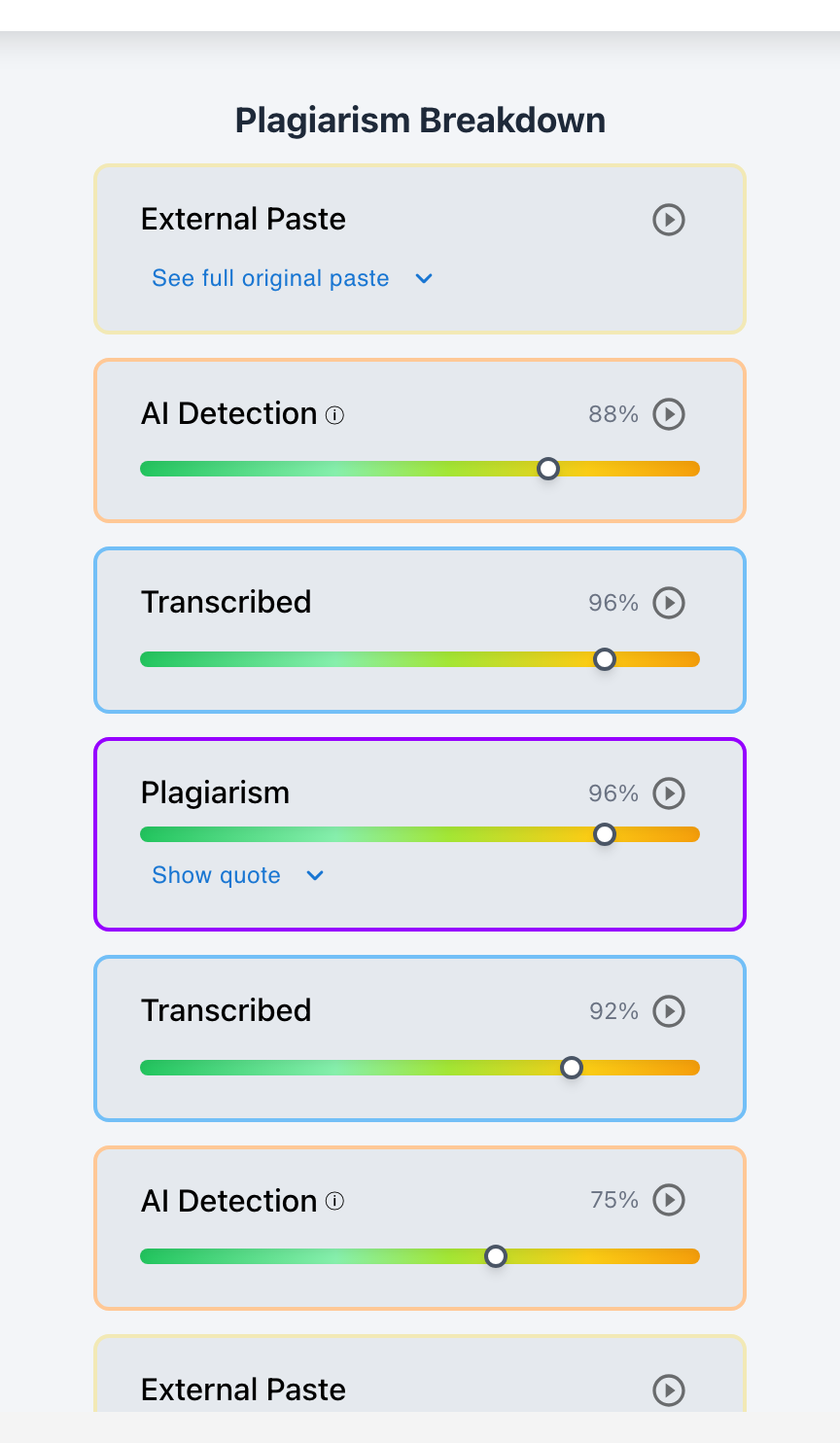
Checkmark Plagiarism supports flexible AI policies by pairing essay writing playback with AI detection, plagiarism detection, autograding, and integrations with Canvas and Google Classroom.
The 3-Tier Framework for AI Assignment Policies
Level 1: Prohibited (Zero AI)
Best for foundational skills: in-class diagnostic essays, grammar practice, reading quizzes, and timed exams where human mastery is evaluated.
Level 2: Scaffolded Assistance
Permitted for brainstorming, outline critique, and grammar review, but all drafting and paragraph composition must be 100% human-authored.
Level 3: Full AI Co-Creation
Students use AI to generate text, then critically analyze, fact-check, and annotate the AI output, submitting prompts and revision histories.
When to Restrict ChatGPT (The Red Zone)
Prohibit AI when it replaces the core cognitive competency being evaluated:
- Foundational Mechanics: Learning sentence structure, paragraph organization, and introductory thesis formulation.
- Reading Verification: Testing whether the student actually read the assigned chapter or primary source.
- Proctored Diagnostic Writing: Establishing an authentic baseline of student writing style under teacher supervision.
When to Permit ChatGPT (The Green Zone)
Permit structured AI use when it acts as an intellectual sparring partner:
- Brainstorming & Topic Exploration: Using ChatGPT to generate 10 potential research questions or find opposing viewpoints.
- Critiquing AI Arguments: Generating an AI essay on a historical debate and having students identify its factual errors and logical fallacies.
- Reverse Outlining & Revision: Asking AI to identify weak transitions in a student's own human-drafted paragraphs.
The Role of Essay Writing Playback in Permissive Policies
If you allow ChatGPT for brainstorming or editing, Checkmark Plagiarism's essay writing playback provides transparent boundaries:
- Proving Human Drafting: Playback confirms that while AI may have provided ideas, the actual sentences and paragraphs were typed keystroke-by-keystroke by the student.
- Enforcing Limits: Instantly catches if a student crossed the boundary from brainstorming into pasting complete AI-generated paragraphs.
Read more in how Checkmark writing process analysis works.
Sample Assignment AI Disclosure Policy
Mandatory Student AI Disclosure Requirement:
"If you utilize ChatGPT or any generative AI tool for brainstorming or editing on this assignment, you must include an AI Disclosure Appendix at the end of your paper detailing: (1) which AI tool was used, (2) the exact prompts entered, and (3) how you revised the AI suggestions. Failing to disclose AI use constitutes academic dishonesty."
A 5-Step Educator Decision Checklist
Educator Policy Decision Protocol:
- 1. Identify the core learning objective of the specific assignment.
- 2. Determine whether AI use enhances or bypasses that learning objective.
- 3. Label the assignment clearly as Level 1 (No AI), Level 2 (Assisted), or Level 3 (Co-Creation).
- 4. Require writing playback tracking and an AI Disclosure Appendix for assisted tasks.
- 5. Review playback logs to verify that student composition boundaries were respected.
How Checkmark Plagiarism Supports Custom AI Policies
Checkmark Plagiarism combines **AI detection, essay writing playback, static AI detection, plagiarism detection, autograding, and Canvas/Google Classroom integrations** to enforce assignment-specific AI rules, giving educators complete transparency whether AI is restricted or permitted.
Frequently Asked Questions
Should teachers ban ChatGPT completely?
Complete bans are difficult to enforce on take-home assignments and miss opportunities to teach critical AI literacy. A tiered, assignment-specific policy is more effective.
How can I allow ChatGPT for brainstorming without students cheating?
Require students to draft all final sentences directly in the LMS editor with writing playback enabled, proving keystroke composition.
What is an AI Disclosure Appendix?
A short section at the end of a paper where students list the AI tools used, the exact prompts entered, and how they evaluated the output.
Can students use ChatGPT for grammar checking?
Basic grammar suggestions are generally acceptable, but students should not use AI to rewrite entire sentences or generate analysis.
How does writing playback help when AI is partially allowed?
Playback shows whether the student used AI for ideas but typed the essay themselves, or pasted AI-generated text directly into the document.
What if a student uses ChatGPT on an assignment marked 'No AI'?
Review the writing playback timeline, check for wholesale paste events, and follow your syllabus policy regarding unauthorized assistance.
How does allowing AI affect student writing development?
When used passively, AI weakens writing skills. When used critically as a brainstorming or critique tool, it can foster analytical reasoning.
Should school-wide AI policies be flexible across departments?
Yes. English, history, computer science, and mathematics require different policy boundaries depending on their distinct pedagogical goals.
How does Checkmark Plagiarism integrate with Canvas?
Checkmark Plagiarism allows teachers to set custom AI sensitivity thresholds and view visual writing playback directly inside Canvas SpeedGrader.
How can teachers teach ethical AI use?
By designing assignments where students fact-check AI outputs, identify bias, and reflect on the limitations of generative technology.
Clear Policies Create Ethical and Empowered Writers
By establishing clear, tiered AI boundaries for every assignment, educators eliminate ambiguity and teach students how to engage with technology thoughtfully, critically, and honestly.
Checkmark Plagiarism supports this flexible standard with AI detection, essay writing playback, static AI detection, plagiarism detection, autograding, and integrations with Canvas and Google Classroom.
See how Checkmark pairs essay writing playback with multi-signal detection to support custom, transparent AI policies in your classroom. View a sample report or request a demonstration.