
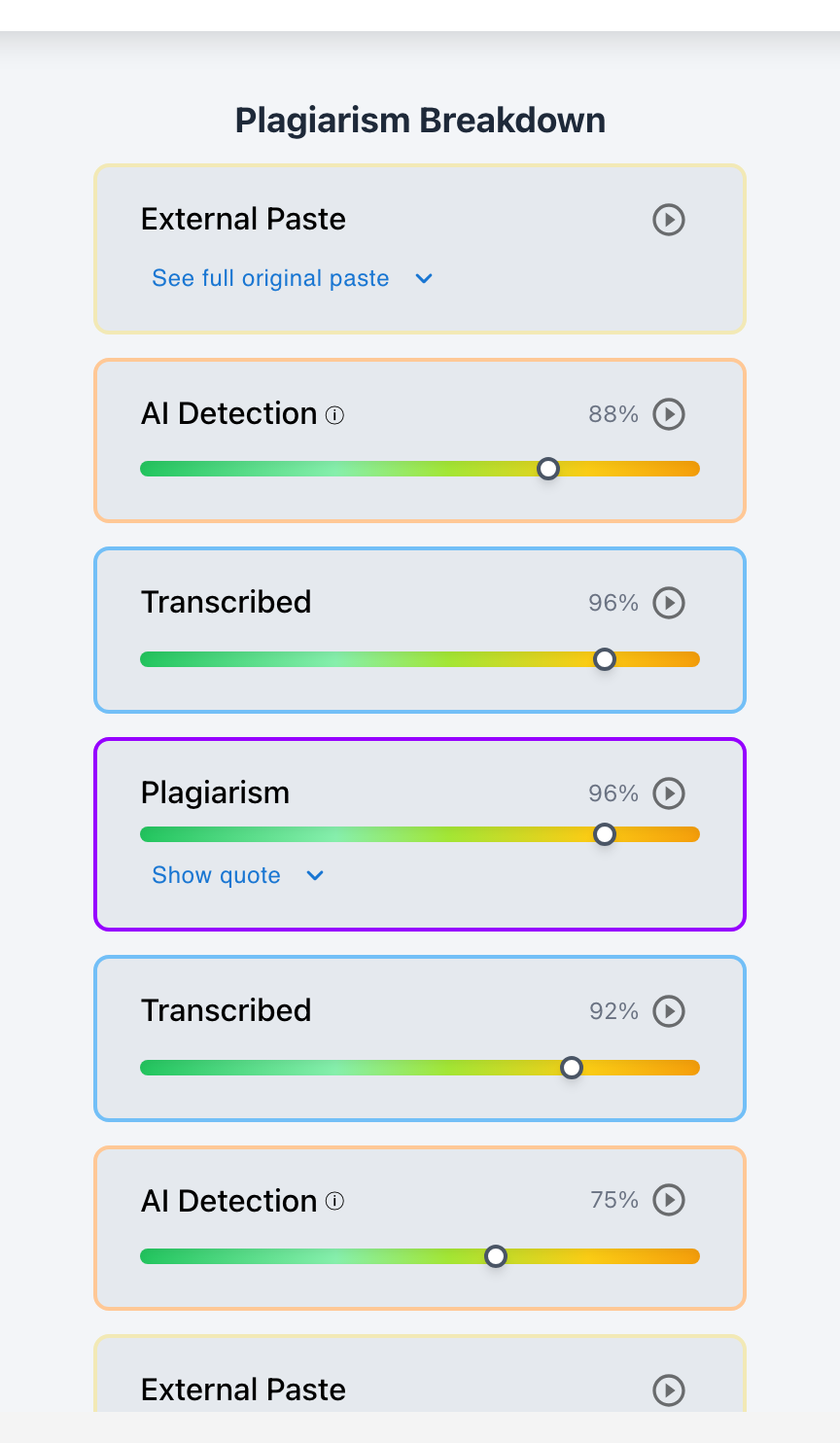
Yes. Every teacher at a school should follow the exact same standardized AI detection and investigation process. When individual teachers invent their own ad-hoc detection methods—such as using different random third-party websites or accusing students based solely on raw percentage scores—it creates severe institutional inequities, increases false positive risks, and exposes schools to legal and parental challenges. Standardizing on an enterprise platform like Checkmark Plagiarism guarantees equal due process and multi-signal evidentiary standards across all classrooms.
When schools lack a unified, institutional AI policy, students face an unpredictable "classroom lottery": Teacher A in Room 201 might penalize a student based on a 40% score from a free detector app, while Teacher B down the hall requires keystroke writing playback and citation verification before questioning a student, and Teacher C ignores AI altogether. This fragmentation destroys student trust, generates chaotic parental disputes, and leaves administrators without verifiable data. Standardizing the AI detection workflow across the entire faculty ensures that academic integrity is upheld fairly, consistently, and transparently.
Below is a comprehensive guide on why institutional standardization is vital and how schools implement it.
Checkmark Plagiarism standardizes school-wide integrity by pairing AI detection with essay writing playback, plagiarism detection, autograding, and integrations with Canvas and Google Classroom.
The 4 Dangers of Fragmented, Teacher-by-Teacher AI Detection
1. Severe Due Process Inequities
Students face inconsistent disciplinary thresholds depending on which teacher they have, violating foundational school fairness policies.
2. Rampant False Positive Vulnerability
Untrained teachers relying on free, uncalibrated web detectors disproportionately penalize eloquent writers and English Language Learners.
3. Conflicting Vendor & Privacy Violations
Individual teachers uploading student essays to unauthorized websites violates FERPA and student intellectual property protections.
4. Zero Institutional Oversight for Leadership
Principals and deans cannot track school-wide integrity trends or identify repeat offenders when data is trapped in individual teacher accounts.
The 4 Pillars of a Standardized School AI Process
Understanding the essential components of an institution-wide standard:
- Single Authorized Platform: All faculty use Checkmark Plagiarism integrated natively into Canvas SpeedGrader or Google Classroom, ensuring consistent algorithms and FERPA compliance.
- The "Two-Signal Rule": Mandates that no academic penalty can be issued based on a static AI score alone—corroborating keystroke playback telemetry or citation checks are legally required.
- Standardized 2-Minute Check-In: Every teacher uses the same structured, non-accusatory oral diagnostic questions when investigating anomalous work.
- Centralized Administrative Dossiers: Standardized PDF audit packages are generated directly from Checkmark for all formal disciplinary referrals.
Read more in how Checkmark writing process analysis works.
Comparison: Fragmented Ad-Hoc Checking vs. Standardized Institutional Process
Standardized Institutional Process (Fair & Defensible)
- Unified Checkmark platform deployed across all classrooms.
- Mandatory multi-signal evidence threshold for penalties.
- FERPA-compliant zero-retention data security.
- Centralized dashboard tracks school-wide trends and recidivism.
Fragmented Ad-Hoc Checking (Chaotic & High-Risk)
- Teachers use dozens of random, unverified web tools.
- Penalties issued arbitrarily on single detector scores.
- Student essays uploaded to untrusted public websites.
- Frequent parental disputes and administrative appeals.
A 5-Step Leadership Protocol for Standardizing AI Detection
School-Wide AI Standardization Checklist:
- 1. Adopt Checkmark Plagiarism as your institution's sole authorized academic integrity tool.
- 2. Publish an official AI Policy stating that multi-signal telemetry (writing playback + citations) is required for misconduct findings.
- 3. Prohibit faculty from pasting student work into unauthorized public commercial AI detectors.
- 4. Provide faculty professional development on interpreting writing playback and holding supportive 2-minute check-ins.
- 5. Establish a centralized appeals process utilizing Checkmark's standardized PDF audit dossiers.
How Checkmark Plagiarism Powers Institutional Standardization
Checkmark Plagiarism combines **AI detection, essay writing playback, static AI detection, plagiarism detection, autograding, and Canvas/Google Classroom integrations** to provide schools with an unassailable, unified academic integrity infrastructure.
Frequently Asked Questions
Why can't teachers choose their own favorite AI detector?
Because different detectors use conflicting algorithms with varying false positive rates, creating legal and disciplinary inequities for students.
How does institutional standardization protect student privacy?
Enterprise licensing of Checkmark guarantees full FERPA and SOC 2 Type II compliance, preventing student data from being harvested by unauthorized third-party apps.
What happens if a teacher penalizes a student using an unauthorized tool?
School policy should declare evaluations from unauthorized detectors inadmissible during academic appeals, upholding student due process.
How does Checkmark Plagiarism integrate with Canvas LMS?
Checkmark integrates via LTI 1.3 across the entire Canvas instance, deploying standardized integrity screening to all courses automatically.
Can department chairs monitor standardization compliance?
Yes. Administrative dashboards display school-wide screening metrics, ensuring consistent application of integrity standards across all departments.
How does standardization help resolve parental disputes?
When administrators present a standardized multi-signal audit dossier containing writing playback videos and paste timestamps, parental meetings are grounded in clear physical facts.
Does standardization restrict teacher pedagogical freedom?
No. Standardizing the integrity workflow ensures fair due process while leaving teachers complete freedom over curriculum, prompts, and grading rubrics.
What training should schools provide to teachers on AI detection?
Schools should train educators on viewing writing playback videos, reading cadence graphs, checking cited DOIs, and conducting non-adversarial student conferences.
How does Checkmark Autograder support standardized grading?
Checkmark Autograder applies department-approved rubrics with mathematical consistency, ensuring equal grading standards across all class sections.
Why is standardized AI detection essential for school culture?
Because transparent, uniform standards foster an environment of trust, psychological safety, and authentic intellectual growth for all students.
A Unified Standard of Fairness and Excellence
Academic integrity is an institutional commitment, not an individual teacher burden. By unifying your faculty around Checkmark Plagiarism's standardized multi-signal detection and due process workflows, schools protect student equity, eliminate false accusations, and foster a lasting culture of excellence.
Checkmark Plagiarism supports this comprehensive approach with AI detection, essay writing playback, static AI detection, plagiarism detection, autograding, and integrations with Canvas and Google Classroom.
See how Checkmark powers school-wide standardized AI detection and writing playback. View a sample report or request a demonstration.