
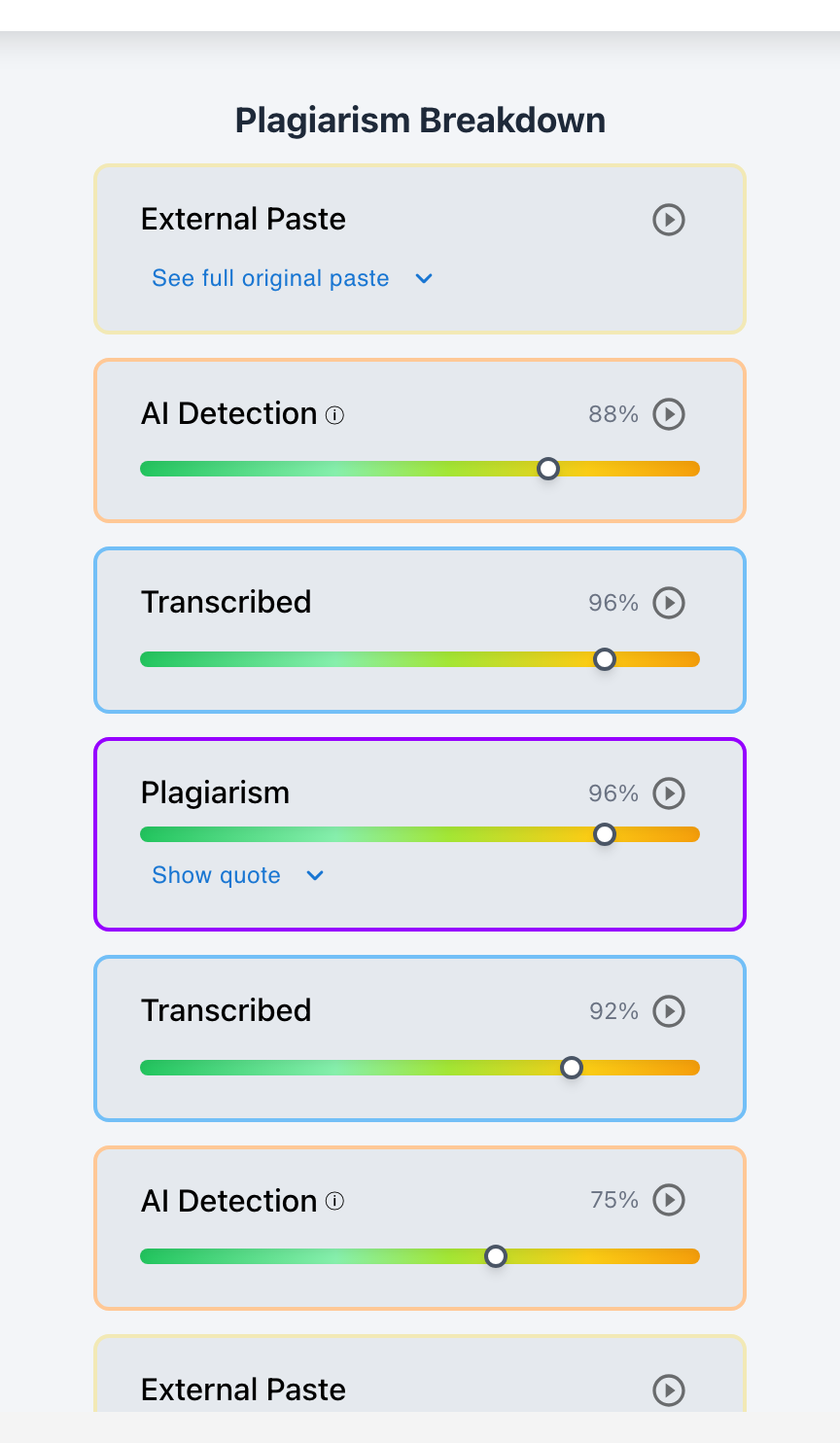
When a student's essay appears in a single revision snapshot or paste event, it does not automatically prove AI use. There are four distinct technical explanations: 1) Prohibited AI Generation (copy-pasting a complete ChatGPT response in 0.05 seconds); 2) Legitimate Offline Drafting (writing in Word, Pages, or an offline text editor and pasting into Google Docs/Canvas); 3) Peer File Copying (pasting from a classmate's document); or 4) Version History Reset ("Make a copy" in Google Drive). Checkmark Plagiarism determines the exact root cause by analyzing paste telemetry, citation validity, and writing process history.
Opening a student's Google Docs version history or Canvas submission only to find a 1,500-word essay that materialized in a single instant is a jarring experience for any teacher. While an instant paste is one of the most common signatures of generative AI cheating, immediately accusing a student can lead to a disastrous confrontation if the student legitimately composed the paper in Microsoft Word on a home desktop. Investigating a single-snapshot essay requires a structured forensic workflow to separate legitimate drafting workflows from academic misconduct.
Below is a comprehensive guide on diagnosing why an essay appeared all at once and verifying true authorship.
Checkmark Plagiarism resolves single-snapshot submissions by pairing essay writing playback with AI detection, plagiarism detection, autograding, and integrations with Canvas and Google Classroom.
The 4 Root Causes of Single-Snapshot Submissions
1. Synthetic AI Text Generation
The student prompted ChatGPT, copied the entire output, and pasted it into the document with zero prior keystrokes or research notes.
2. Legitimate External Drafting
The student drafted their essay offline in Microsoft Word, Pages, or Scrivener, and pasted the finished text into Google Docs for final submission.
3. Peer File Sharing & Collusion
The student received a shared Google Doc or Discord text payload from a peer and pasted the text directly into their own assignment file.
4. "Make a Copy" Version Log Reset
The student drafted legitimately in Google Docs, but created a clean copy via File > Make a copy before submitting, wiping the original revision history.
How to Forensically Distinguish AI from Offline Writing
The 3 diagnostic tests educators use to uncover the truth:
- Test 1: Citation Verification: Real offline human drafting contains verifiable, authentic sources. If the pasted essay contains non-existent academic journals or hallucinated DOIs, it is synthetic AI generation.
- Test 2: Source File Audit: If the student claims they drafted in Microsoft Word, ask them to upload the original
.docxfile or cloud link showing file creation dates and revision save timestamps. - Test 3: The 2-Minute Oral Check-In: Ask the student to define specialized vocabulary and summarize their core arguments. An authentic author explains their ideas effortlessly; a student who copied AI text falters.
Read more in how Checkmark writing process analysis works.
Comparison: Legitimate External Drafting vs. AI Paste Payload
Legitimate External Drafting (Authentic Human)
- Student can produce original Word/Pages file with save logs.
- Citations link to real, searchable journal articles.
- Student fluently explains thesis and sources orally.
- Matches student's historical in-class writing voice.
Synthetic AI Paste Payload (Misconduct)
- No prior drafting files or notes exist anywhere.
- Contains hallucinated DOIs and fake author citations.
- Student cannot explain complex vocabulary or claims.
- Sudden, uncharacteristic leap in rhetorical style.
A 5-Step Educator Protocol for Single-Snapshot Essays
Single-Snapshot Investigation Checklist:
- 1. Open Checkmark Writing Playback: confirm the exact timestamp and character count of the paste payload.
- 2. Run Checkmark Citation Verification: check if cited sources and DOIs exist in real academic databases.
- 3. Hold a private conference: "I noticed this essay was pasted in all at once. Can you show me the file where you originally drafted it?"
- 4. If the student produces an authentic Word draft with valid save logs, verify the file and clear the flag.
- 5. If no draft exists and citations are hallucinated, export the Checkmark PDF dossier for departmental referral.
How Checkmark Plagiarism Resolves Paste Investigations
Checkmark Plagiarism combines **AI detection, essay writing playback, static AI detection, plagiarism detection, autograding, and Canvas/Google Classroom integrations** to automatically flag paste anomalies and verify external drafts with absolute forensic precision.
Frequently Asked Questions
Does pasting an essay automatically prove cheating?
No. Many students legitimately compose offline in Microsoft Word or Apple Pages; teachers must request the source draft file before making a determination.
What if a student says they wrote the essay in a separate Google Doc?
Ask the student to share view access to the original Google Doc so you can inspect its full version history and active typing hours.
How does Checkmark Playback capture paste payloads?
Checkmark logs exact paste duration (e.g., 0.05 seconds), character length, and highlights pasted blocks in purple on the document canvas.
How does Checkmark Plagiarism integrate with Canvas LMS?
Checkmark displays paste badges directly in Canvas SpeedGrader, allowing teachers to see whether an essay was typed or pasted with one glance.
What if a student deleted their original draft file?
Conduct the 2-minute diagnostic oral check-in or offer a 15-minute supervised writing prompt on the same topic to verify writing ability.
How does citation verification expose AI paste payloads?
Generative AI frequently fabricates convincing but non-existent academic references; checking DOIs against Crossref immediately disproves claims of human research.
Can students bypass paste detection by typing text in quickly?
Checkmark Playback records continuous keystroke cadence, easily distinguishing natural human composition from manual transcription of an external screen.
How does Autograder handle pasted essays?
Autograder flags single-snapshot submissions with a high Integrity Risk Index, prompting the teacher to review writing telemetry before finalizing grades.
What policy should schools set regarding external drafting?
Schools should instruct students to draft directly in cloud documents with revision history enabled, or save all external draft files for verification.
Why is a calm, evidence-based approach essential when investigating pastes?
Because asking for source draft files neutrally protects honest offline writers while prompting dishonest students to acknowledge AI use without hostility.
Grounded in Evidence and Educational Care
A single snapshot is a signal to investigate, not an immediate verdict. By utilizing Checkmark Plagiarism's writing telemetry, citation audits, and structured conference protocols, educators resolve single-snapshot submissions with fairness, empathy, and incontrovertible empirical evidence.
Checkmark Plagiarism supports this comprehensive approach with AI detection, essay writing playback, static AI detection, plagiarism detection, autograding, and integrations with Canvas and Google Classroom.
See how Checkmark analyzes paste payloads and writing telemetry in Canvas SpeedGrader. View a sample report or request a demonstration.