
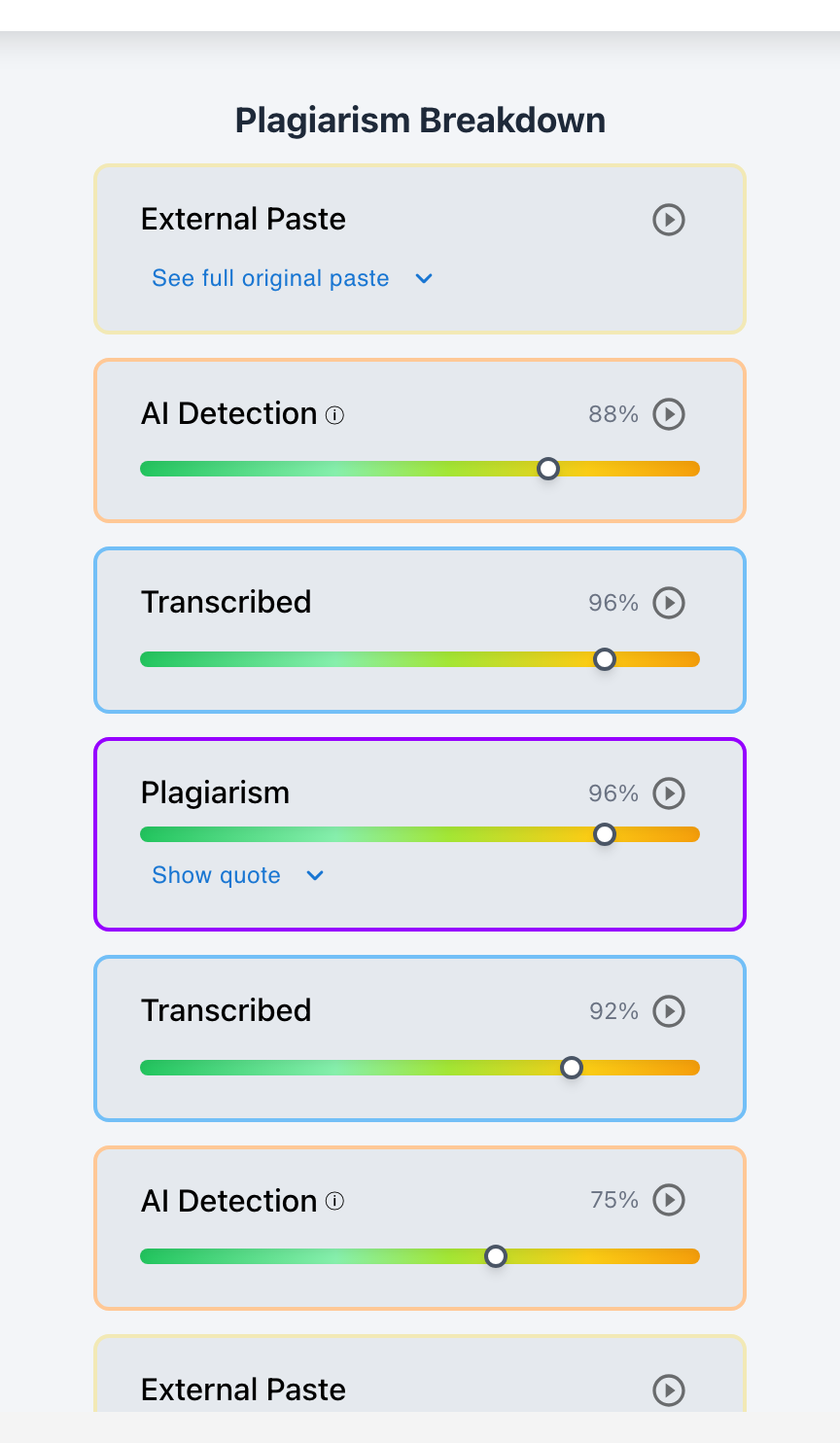
Deleting and replacing large sections of an essay is NOT inherently suspicious—in fact, major structural deletions and rewrites are often the hallmark of sophisticated, high-level human revision. However, it BECOMES suspicious when an entire paragraph is deleted and replaced with an external clipboard paste in 0.05 seconds to evade an AI detector.
Experienced writing teachers know that advanced students do not just fix commas; they restructure entire arguments. A student might realize their third body paragraph is weak, highlight 300 words, hit delete, and spend 45 minutes re-typing a much stronger point with new evidence. In document history, this shows up as a massive deletion event followed by new text. The key to evaluating large section replacements is looking at how the replacement text was created using Checkmark Playback: was it typed with genuine cognitive effort, or pasted instantly from an AI tool?
Below is a comprehensive guide on analyzing large block deletions and replacements in student writing.
Checkmark Plagiarism powers structural revision analysis by pairing essay writing playback with AI detection, plagiarism detection, autograding, and integrations with Canvas and Google Classroom.
The 4 Diagnostic Signals of Authentic Structural Revision
1. Realistic Replacement Velocity
The replacement paragraph takes 25 to 45 minutes of active typing to compose, reflecting genuine cognitive labor rather than an instant paste.
2. Healthy Revision Depth (15–30% Backspaces)
The newly drafted section shows active typing rhythms, typo corrections, reworded phrases, and natural thinking pauses.
3. Thematic Alignment with Surrounding Text
The new argument connects seamlessly with the surrounding paragraphs, maintaining the student's unique authentic voice and vocabulary level.
4. Response to Formative Feedback
The revision directly addresses teacher comments or peer review suggestions, demonstrating meaningful learning and reflection.
When Section Replacement Signals AI Evasion
In contrast, suspicious replacement patterns exhibit distinct technological fingerprints:
- The "Detector Evasion" Swap: A student tests their draft on a public AI checker, sees that Paragraph 2 triggered 95% AI, deletes Paragraph 2, and pastes a new 300-word block from an AI humanizer in 0.05 seconds.
- Voice Discontinuity: The replacement paragraph suddenly shifts from high school vocabulary to dense, hyper-formal collegiate jargon with 0% backspaces.
- Zero Typing Telemetry: Checkmark Playback logs a paste event with zero recorded keystrokes for the new section.
Read more in how Checkmark writing process analysis works.
Comparison: Genuine Structural Revision vs. AI Section Swapping
Genuine Structural Revision (Authentic Mastery)
- 300 words deleted after teacher feedback.
- Replacement text typed over 35 minutes.
- 22% backspaces with active sentence rewrites.
- Maintains consistent student voice and tone.
AI Section Swapping (Detector Evasion)
- 300 words deleted immediately after draft 1.
- Replacement text inserted in 0.05s via paste.
- 0% backspaces; zero keystrokes recorded.
- Abrupt shift to thesaurus-swapped AI vocabulary.
A 5-Step Educator Protocol for Auditing Section Replacements
Section Replacement Audit Protocol:
- 1. Open the student's submission in Checkmark Playback inside Canvas SpeedGrader.
- 2. Scrub to the major deletion event on the creation timeline.
- 3. Inspect the deleted text and compare it to the newly inserted text.
- 4. Check the replacement creation velocity: verify if text was typed over minutes or pasted in 0.05 seconds.
- 5. If the new text was typed with backspaces, celebrate the student's revision effort; if pasted, review raw clipboard logs.
How Checkmark Plagiarism Powers Structural Forensics
Checkmark Plagiarism combines **AI detection, essay writing playback, static AI detection, plagiarism detection, autograding, and Canvas/Google Classroom integrations** to give teachers complete visibility into deleted text, replacement velocity, and clipboard events.
Frequently Asked Questions
Is deleting a whole paragraph a sign of cheating?
No. Major deletions are common in authentic student writing as ideas are refined. Cheating occurs only if the replacement text was pasted from an external AI source.
Can teachers see what text was deleted from a document?
Yes. Checkmark Playback preserves complete revision history, allowing teachers to inspect the exact deleted words and compare them to the new draft.
What does a genuine paragraph rewrite look like in Playback?
It shows the text disappearing, followed by a steady 20- to 40-minute typing sequence with natural typos, backspaces, and thinking pauses.
Why do students swap paragraphs with AI humanizers?
Students often run flagged paragraphs through tools like QuillBot or BypassGPT to lower AI detector percentages before submitting.
How does Checkmark detect AI paragraph swaps?
Checkmark pairs semantic AI heatmaps with Original Paste Preservation and keystroke velocity tracking to catch replaced text instantly.
How does Checkmark Plagiarism integrate with Canvas LMS?
Checkmark provides certified LTI 1.3 integration, SpeedGrader sidebar embeds, two-way grade passback, and single sign-on (SSO).
What should a teacher do when authentic revision is verified?
Praise the student for substantive revision during grading—reinforcing that deleting and improving text is what great writers do.
Can students fake realistic typing when replacing a paragraph?
Simulating 30 minutes of natural typing rhythms and backspaces takes longer than simply writing the revision honestly.
How does Autograder evaluate student revisions?
Checkmark Autograder tracks revision lift between draft cycles, awarding rubric points for meaningful structural improvements.
Why is writing playback essential for evaluating revisions?
Because playback proves how the replacement happened, allowing teachers to reward genuine revision while catching dishonest AI swaps.
Rewarding Genuine Revision, Uncovering Shortcuts
Substantive revision is the heart of the writing craft. By using Checkmark Plagiarism to analyze deletion events and replacement velocity, educators can champion authentic student growth and ensure that honest revising is recognized and rewarded.
Checkmark Plagiarism supports this comprehensive approach with AI detection, essay writing playback, static AI detection, plagiarism detection, autograding, and integrations with Canvas and Google Classroom.
See how Checkmark pairs structural revision forensics with multi-signal detection to evaluate deleted text inside your LMS. View a sample report or request a demonstration.