
Executive Summary
As students discover that traditional automated clipboard monitors flag large block copy-pastes, a growing number turn to a more covert evasion strategy: manual optical transcription, where text generated by an external Large Language Model (LLM) on a smartphone, tablet, or secondary monitor is manually retyped into the document editor. Standard plagiarism scanners and static AI detectors struggle with these submissions because no paste event is logged and surface syntax may be modified. However, genuine human composition and optical transcription leave fundamentally different biometric and psycholinguistic footprints in document telemetry. Authentic writing is intrinsically non-linear—defined by high Inter-Key Interval (IKI) variance, production bursts (P-bursts) at syntactic thresholds, cognitive planning pauses (2–15+ seconds), and recursive revision bursts (R-bursts) that restructure sentences and delete whole thoughts (12%–30% friction ratio). Conversely, mechanical retyping exhibits a metronomic, invariant typing cadence, narrow IKI distributions, strictly linear progression (0 → N), and zero conceptual restructuring. Checkmark Plagiarism's patent-pending Essay Playback™ suite captures these dynamics through 1x–8x chronological video replay, automated Transcription Detection Indicators, full clipboard text preservation, and an integrated multi-factor verification triad. Grounded in the philosophy “Stop guessing, start trusting,” this telemetry equips educators to conduct supportive, evidence-based student conferences while offering bulletproof protection for honest students falsely accused by black-box detectors.
1. The Modern Evasion Dilemma: The Rise of Second-Screen Optical Transcription
In the initial wave of generative artificial intelligence in education, academic integrity inquiries typically focused on raw clipboard actions. A student prompted a conversational AI model, copied several paragraphs, pasted the entire block directly into their Learning Management System (LMS) essay box or Google Docs, and clicked submit.
Educators and basic integrity tools quickly learned to identify these submissions through straightforward indicators:
- Single-timestamp block insertions of 500 to 1,500 words appearing in under a second.
- Inconsistent font formatting, background HTML artifacts, or non-standard Unicode characters.
- Document edit histories showing a total active drafting time of under three minutes for a multi-page essay.
The Shift to Manual Retyping
As students shared evasion tips on peer forums, social media channels, and discord servers, bypassing clipboard listeners became a routine objective. The prevailing workaround became optical transcription (commonly termed the “retype bypass” or “second-screen copying”).
Raw Block Paste
- Direct Ctrl+V into editor
- 800 words inserted at 0.00s
- Easily caught by basic clipboard listeners
- Mismatched CSS/HTML formatting tags
Text Humanizers
- Surface synonym swappers & paraphrasers
- Attempts to evade perplexity / burstiness
- Still pasted into the editor as block text
- Produces unnatural sentence cadences
Second-Screen Retyping
- Prompt LLM on mobile device or 2nd monitor
- Manually typed character-by-character
- Zero clipboard paste events logged
- Simulates 30–60 min active drafting session
The Diagnostic Challenge: Zero clipboard paste events + 45 minutes active session time + Inconclusive static score = Unprovable by legacy tools. Only writing process telemetry reveals the biometric truth.
In an optical transcription workflow:
- The student prompts an LLM (e.g., ChatGPT, Claude) on a separate device—such as a smartphone resting on their desk, a tablet positioned below their screen, or an adjacent browser window.
- Rather than copying and pasting the generated text, the student reads the text off the secondary display in 4-to-8-word eye-span chunks and manually types it into their document editor.
- If they make a minor motor typo, they tap the
Backspacekey once or twice, fix the immediate character error, and continue typing forward in a smooth, continuous sequence from the first sentence to the bibliography.
Why Traditional Diagnostic Methods Fail
When evaluated by legacy academic integrity tools, optical transcription creates serious blind spots:
| Diagnostic Tool | What the Tool Sees | Why It Fails on Optical Retyping |
|---|---|---|
| Basic Clipboard / Paste Listeners | Logs zero onPaste DOM events. |
The text was physically typed character-by-character; no clipboard API was invoked. |
| Document Session Timers | Records 35 to 55 minutes of active document focus. | The physical act of manual typing takes real time, creating an illusion of standard drafting effort. |
| Static AI Classifiers (Whole-Doc %) | Generates an opaque probability score (e.g., “47% Likely AI”). | Static classifiers evaluate finished text in isolation. If the student swapped words or used a humanizer prompt, the score is ambiguous and indefensible in a conference. |
| Standard LMS Revision History | Shows periodic snapshots of text growing every few minutes. | Generic revision histories aggregate changes into broad 5-to-10-minute snapshots, obscuring micro-cadence, pause dynamics, and cursor movements. |
Despite evading superficial paste detectors, manual optical transcription cannot duplicate the cognitive psycholinguistics and biomechanics of authentic human writing. Composing original thoughts generates a distinct, measurable telemetry footprint of mental friction, planning pauses, and recursive structural revisions that differs fundamentally from mechanical transcription.
2. Psycholinguistic & Biomechanical Foundations: Composing vs. Transcribing
To understand how writing telemetry separates genuine authorship from mechanical copying, we must review how the human brain produces written language.
- Idea retrieval from long-term memory
- Rhetorical framing & outline structuring
- Assignment constraint evaluation
- Generates macro-planning pauses (2.0–15.0+ s)
- Lexical selection & syntactic assembly
- Motor execution (keystroke timing)
- Production bursts (P-bursts: 4–18 words)
- High Inter-Key Interval (IKI) variance
- Error monitoring & thesis evaluation
- Recursive revision bursts (R-bursts)
- Global re-ordering & non-linear jumps
- Friction ratio DIR = 12%–30%
In cognitive writing research—pioneered by John R. Hayes, Linda S. Flower, and Ronald T. Kellogg—authentic composition is established as a non-linear, recursive cognitive cycle. Writers do not produce fully formed prose in a single forward pass; they constantly loop between Planning, Translating, and Reviewing.
The Anatomy of Authentic Composing
When a student authors an original essay, their working memory experiences intense cognitive load:
- Central Executive & Long-Term Memory Retrieval: The student searches their memory for assignment requirements, historical evidence, rhetorical strategies, and subject knowledge.
- Lexical Selection & Syntactic Assembly: The writer formulates an idea, tests several sentence structures internally, hesitates over vocabulary choices, and translates conceptual thoughts into physical keystrokes.
- Continuous Evaluative Feedback Loops: As words appear on screen, the writer reads their own output, recognizes stylistic flaws, logical gaps, or grammatical misalignments, and immediately revises.
This cognitive friction manifests as two core biomechanical phenomena: Production Bursts (P-bursts) and Revision Bursts (R-bursts).
Production Bursts (P-Bursts)
A Production Burst (or P-burst) is an uninterrupted sequence of keystrokes produced between two cognitive pauses.
- Burst Length: In authentic student writing, P-bursts are relatively short, typically ranging from 4 to 18 words (or 20 to 90 characters).
- Syntactic Boundary Alignment: P-bursts end naturally at syntactic and conceptual boundaries—such as the end of a clause, before a complex prepositional phrase, or at a paragraph transition.
- Planning Pauses: Between P-bursts, the student enters a reflective pause of 2.0 to 15.0+ seconds to plan the next syntactic unit.
Revision Bursts (R-Bursts)
A Revision Burst (or R-burst) occurs when a student actively modifies, deletes, reorganizes, or restructures previously generated text.
- Non-Linear Cursor Navigation: The student leaves the current line of typing, navigates backward via mouse clicks or arrow keys to an earlier sentence or paragraph, and makes structural alterations.
- Conceptual & Syntactic Restructuring: R-bursts are not limited to single-letter typo corrections. They involve deleting whole phrases, splitting run-on sentences, swapping adjectives for precise analytical terms, and rewriting topic sentences.
- Friction Metrics: In authentic student drafting, the Deletion-to-Insertion Ratio (DIR) typically ranges between 12% and 30%. For every 1,000 characters present in the final submission, an honest student typically generates 1,150 to 1,450 total key actions due to active drafting and editing.
The Anatomy of Optical Transcription / Retyping
When a student transcribes text from a secondary screen, the entire cognitive architecture of planning, translating, and reviewing is bypassed. The task is reduced to a purely mechanical eye-hand transcription loop:
Because the LLM has already handled the vocabulary, syntax, structural coherence, and argumentative logic:
- Absence of Conceptual Planning Pauses: The student does not pause for 5 to 15 seconds at complex sentence boundaries or paragraph transitions because they do not need to construct the argument. The only pauses observed are brief, uniform eye-saccade pauses (0.8 to 1.8 seconds) as their eyes shift from the laptop screen back to their phone to read the next chunk.
- Metronomic Velocity & Narrow IKI Variance: Keystrokes are entered with mechanical regularity. The Inter-Key Intervals (IKIs) show almost zero variation between simple transition words and intricate disciplinary arguments.
- Monotonic Linear Growth (0 → N): Character insertion moves strictly forward from index 0 to index N. The cursor never navigates backward to restructure an earlier paragraph or rethink a supporting claim.
- Typo-Only Superficial Corrections: When deletions occur, they are exclusively immediate single-character backspaces (1–3 strokes) triggered by a physical slip of the finger (e.g., typing
tehinstead ofthe), followed immediately by resumed linear typing. The Deletion-to-Insertion Ratio drops to < 3%.
3. Keystroke Telemetry Metrics: Mathematical Modeling
Writing process telemetry converts continuous keyboard and mouse interactions into structured, millisecond-accurate event data. Every interaction is recorded as a discrete event tuple:
Where:
kirepresents the key code or input identifier (e.g., character,Backspace,ArrowUp,Enter).tdown, iandtup, irepresent millisecond timestamps for key press and key release.ciis the exact integer cursor index in the document text buffer.airepresents the mutation category: character insertion (I), character deletion (D), text selection (S), navigation (N), or paste (P).
From this raw stream, four core mathematical metrics separate authentic composition from mechanical transcription:
Measures typing rhythm fluidity vs metronomic uniformity. Authentic writing produces high standard deviation (σ > 0.70μ), whereas copy-typing produces tight Gaussian clustering (σ < 0.28μ).
Quantifies drafting friction and self-correction volume. Authentic writing ranges from 12% to 32%, whereas optical retyping drops below 3.5% (typos only).
Tracks cursor relocation away from the typing frontier. Authentic composition exhibits high NNR (0.08–0.25) across paragraphs, while transcription is strictly linear (NNR < 0.01).
Evaluates pause depth at paragraph and clause thresholds relative to within-word pauses. Authentic BPLR ≥ 3.5; transcription BPLR ≈ 1.0–1.4.
1. Inter-Key Interval (IKI) Variance and Distribution Skewness
The Inter-Key Interval is the latency between consecutive keystrokes:
- Authentic Drafting: Characterized by a heavy-tailed, multimodal distribution. High-frequency motor digraphs (e.g.,
th,in,er) execute rapidly (70 ms ≤ IKI ≤ 140 ms), while word retrieval transitions (300 ms ≤ IKI ≤ 800 ms) and syntactic pauses (1,500 ms ≤ IKI ≤ 8,000+ ms) introduce substantial variance:σIKI ≈ 0.70 · μIKI to 1.60 · μIKI - Mechanical Retyping: Characterized by a tight, unimodal, near-Gaussian distribution centered around the student's baseline copy-typing speed, with minimal variance:
σIKI < 0.28 · μIKI
2. Deletion-to-Insertion Ratio (DIR)
The Deletion-to-Insertion Ratio measures the overall drafting friction by comparing deleted characters against inserted characters:
- Authentic Drafting Benchmark:
DIR ∈ [12%, 32%]. In rigorous analytical essays, students regularly delete full clauses, test alternative topic sentences, and rework phrasing. - Optical Retyping Benchmark:
DIR ∈ [0.5%, 3.5%]. Deletions consist solely of immediate single-character backspacing to fix motor typos.
3. Non-Linear Navigation Rate (NNR)
The Non-Linear Navigation Rate calculates the proportion of cursor movements that jump away from the active typing frontier to modify or review preceding sections:
Where Δthresh ≥ 50 characters.
- Authentic Drafting: High NNR (0.08–0.25). The writer routinely returns to earlier paragraphs to insert transition sentences, align terminology, or add citations.
- Optical Retyping: Near-zero NNR (< 0.01). The cursor remains anchored exclusively at the end of the text buffer throughout the entire session.
4. Boundary Pause Latency Ratio (BPLR)
Syntactic boundary pauses reflect the cognitive effort of structuring paragraphs and complex arguments:
- Authentic Drafting:
BPLR ≥ 3.5. Pauses at paragraph and sentence thresholds are substantially longer than pauses within words or simple noun phrases. - Optical Retyping:
BPLR ≈ 1.0 – 1.4. Pauses at paragraph boundaries are roughly identical in duration to pauses within sentences, reflecting the steady rhythm of reading short chunks off a second screen.
Waveform Comparison: Jagged Composing vs. Flat Retyping
Dynamic, jagged peaks (P-bursts) reaching 85 WPM punctuated by deep cognitive valleys (0 WPM pauses of 4–15s) and red downward revision markers (-120 chars).
Completely flat horizontal line hovering steadily at 52 WPM from paragraph 1 to the bibliography, with uniform 1.2s eye-saccade pauses and zero structural cuts.
4. Telemetry Comparison Spectrum
The following matrix compares authentic writing against common evasion and drafting profiles:
| Diagnostic Dimension | Authentic Student Composition | Mechanical Optical Retyping (2nd Screen) | Direct External Block Paste | Paraphrased / “Humanized” AI |
|---|---|---|---|---|
| Keystroke Velocity Curve | Dynamic, jagged peaks (P-bursts) punctuated by deep cognitive valleys (0 WPM). | Uniform, flat horizontal line across the entire session (45–65 WPM). | Instantaneous vertical spike (>2,000 WPM equivalent). | Flat or block profile depending on paste vs retyping method. |
| IKI Variance (σIKI) | High (σ > 0.75 · μ); significant rhythm fluctuations. | Minimal (σ < 0.28 · μ); metronomic, clock-like regularity. | Undefined / Null (single event insertion). | Minimal if retyped; null if pasted. |
| Deletion Ratio (DIR) | High (12% – 32%); extensive phrasing experiments and rewrites. | Extremely low (0.5% – 3.5%); immediate typo corrections only. | 0% at time of insertion; variable subsequent edits. | Low to moderate if student tweaks individual words. |
| Cursor Navigation Entropy | High; frequent jumps across paragraphs and sections. | Strictly linear (0 → N); cursor stays at the text frontier. | Instant jump from offset A to offset B. | Primarily linear. |
| Boundary Pause Depth | Deep reflective pauses (3.0s – 25.0s+) at structural shifts. | Shallow, uniform pauses (0.8s – 1.8s) for eye saccades. | Zero elapsed drafting time within the document. | Shallow or missing structural pauses. |
| Clipboard Paste Records | Normal occasional quotes or research excerpts (<15% text). | Zero paste events recorded. | 100% text inserted in single paste operation. | Zero if retyped; block log if pasted. |
| Educator Action | Validate authenticity; provide formative rubric feedback. | Review Essay Playback™; conduct supportive inquiry conference. | Inspect preserved clipboard buffer; clarify citation rules. | Check passage-level sliders and playback telemetry. |
5. Checkmark Plagiarism: Essay Playback™ & Multi-Factor Verification Suite
Checkmark Plagiarism (checkmarkplagiarism.com) was engineered specifically to solve the limitations of opaque, whole-paper percentage scores. Guided by the core principle “Stop guessing, start trusting,” Checkmark provides educators, department chairs, and academic integrity officers with transparent, defensible, multi-dimensional evidence (“receipts”).
- 1x–8x scrubbable video replay
- Synchronized velocity telemetry curve
- Transcription cadence alerts
- Native Canvas & Buzz LMS player
- 100% clipboard history stored
- Preserves raw text after rewrites
- Direct jump-to-playback timecodes
- Uncited quote differentiation
- Sentence-by-sentence underlines
- Calibrated confidence sliders
- Short text guardrails (<150w = N/A)
- Confidential educator-only flags
- Quote-anchored justifications
- Teacher-in-the-loop approvals
- Custom rubric alignment
- Direct Canvas & Buzz LMS passback
1. Patent-Pending Essay Playback™ Suite
The centerpiece of Checkmark's writing process verification is Essay Playback™, an interactive tool that reconstructs the entire drafting session keystroke by keystroke:
- 1x to 8x Scrubbable Chronological Video Player: Educators can watch the document develop over time. Teachers can scrub through hours of drafting in minutes, watching where the student paused to think, where they struggled with a thesis statement, and how their ideas evolved.
- Burst-Velocity Telemetry Overlay: Synchronized directly beneath the playback window is a real-time velocity curve. Spikes represent rapid P-bursts; dips represent reflective planning pauses; red downward markers highlight deletion events.
- Transcription Detection Indicators: When a submission exhibits the statistical profile of optical transcription—low IKI variance (σ < 0.28μ), continuous linear insertion, and a near-zero deletion ratio—Checkmark surfaces a private Transcription Cadence Alert for the educator.
- Native Ecosystem Integration: Essay Playback™ captures authentic revision telemetry directly across Google Docs, Microsoft Word (via Checkmark integrations), and embedded LMS editors in Canvas LMS and Buzz LMS.
2. External Paste Buffer Tracking with Complete Text Preservation
When students paste text into a document, traditional tools often lose the original pasted string if the student subsequently edits, rewrites, or paraphrases the text to cover their tracks.
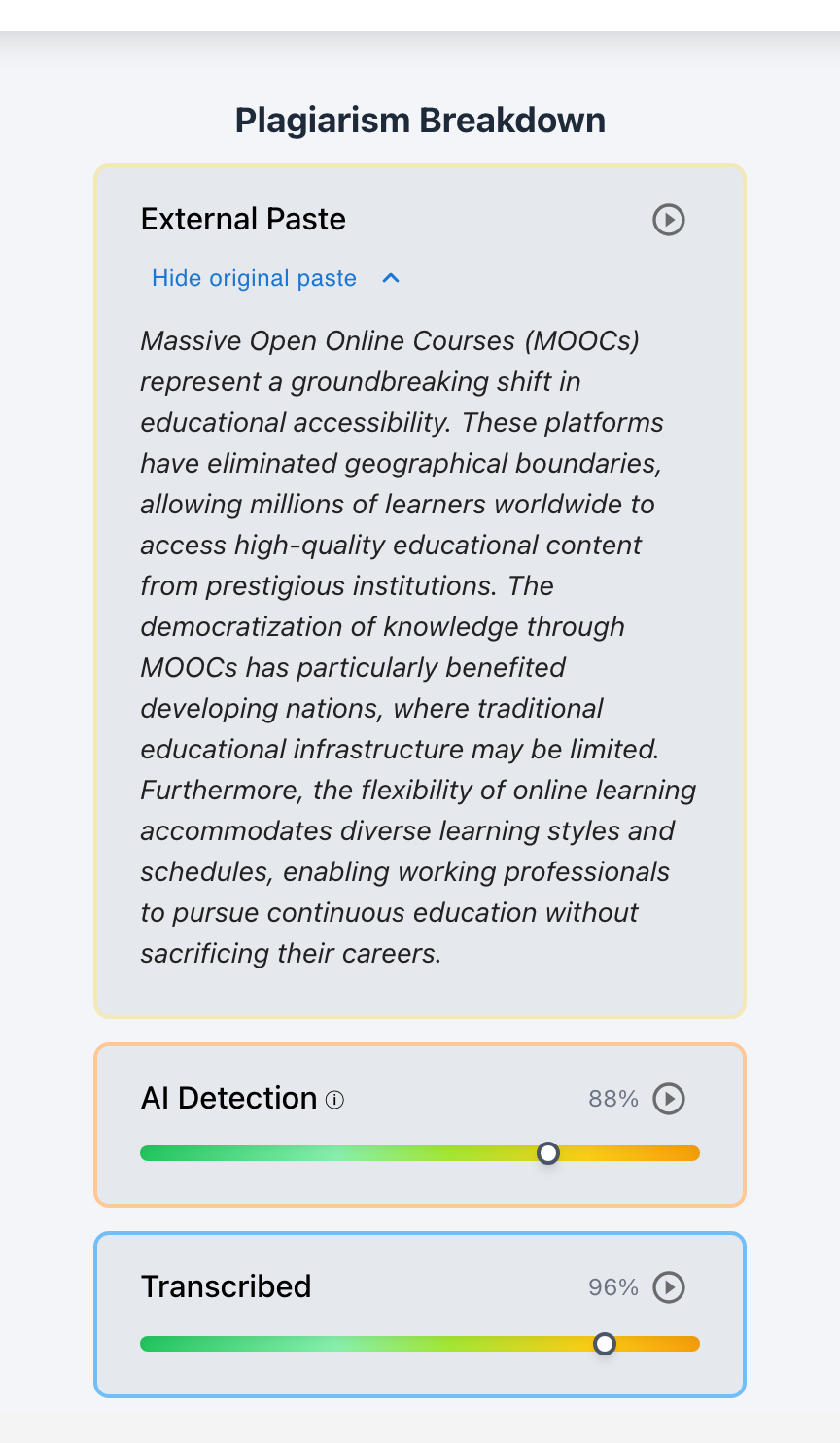
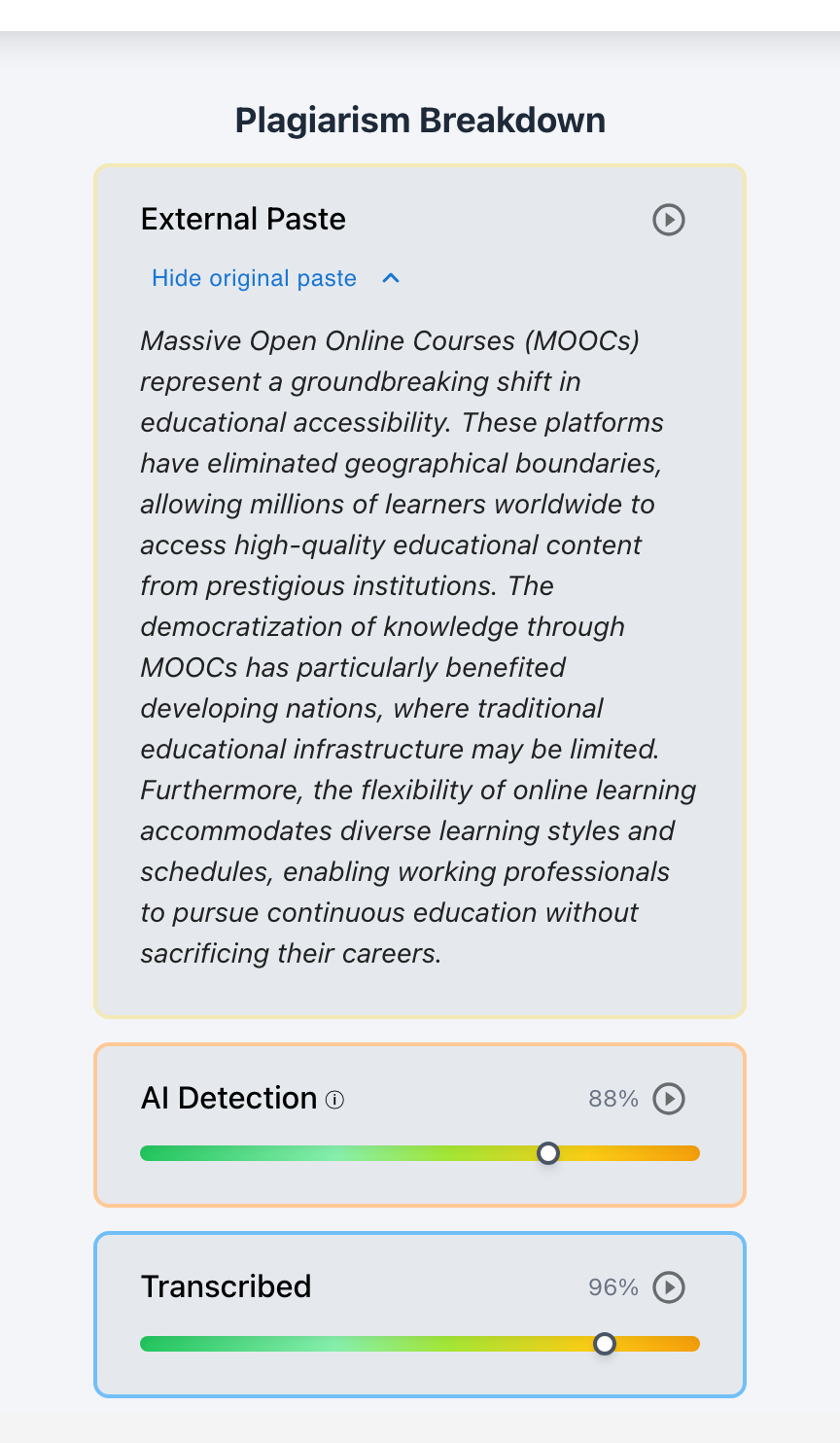
- 100% Text Buffer Preservation: Checkmark captures and permanently preserves the exact text copied into the clipboard at the precise millisecond of insertion.
- Post-Paste Edit Tracking: Even if a student pastes 800 words and spends the next 40 minutes swapping words and altering sentence structures, Checkmark retains the original raw paste string and displays it side-by-side with the final version.
- Jump-to-Playback Navigation: Clicking any paste alert in the report timeline immediately scrubs the Essay Playback™ player to the exact moment the paste occurred.
3. Multi-Factor AI Detection with Honest Guardrails
Checkmark rejects opaque, single-number whole-document percentages that lead to false accusations:
- Passage-Level Granularity: Rather than labeling an entire essay “65% AI,” Checkmark highlights specific sentences and paragraphs directly within the text buffer.
- Sidebar Evidence Cards & Confidence Sliders: Every highlighted passage links to an evidence card showing a calibrated confidence slider (distinguishing typical human writing variation from typical AI syntactic predictability/perplexity).
- Honest Guardrails on Short Text: For text fragments under ~150 words, Checkmark displays
N/Arather than generating unreliable guesses on statistically insufficient sample sizes. - Educator-Only Flag Statuses: Flag statuses (Flagged, Resolved, Not Flagged) remain strictly confidential to educators, preventing premature or automated disciplinary measures.
4. Side-by-Side Defensible Plagiarism Matching
- Live Web & Academic Indexing: Compares student writing against billions of live web pages, academic journals, open-access databases, and institutional repositories.
- Dedicated Uncited Source Differentiation: Separates intentional verbatim plagiarism from uncredited patchwriting and citation formatting errors, allowing teachers to provide targeted citation instruction.
- Internal Peer Match Network: Identifies unapproved text sharing between students in the same class, department, or school district repository without exposing student submissions to public LLM datasets.
- Two-Way Linked Evidence Navigation: Clicking any highlighted source passage in the essay instantly brings up the matching source excerpt with active links in the sidebar, and vice versa.
5. AI Autograder & Rubric-Based Feedback
- Teacher-in-the-Loop Grading: Checkmark's autograder evaluates submissions against custom rubrics, generating point suggestions and written justifications tied directly to specific quotes in the student's text.
- Editable Drafts: All AI-suggested marks remain provisional drafts until the instructor reviews, edits, and finalizes them.
- Direct LMS Grade Passback: With a single click, finalized scores, criterion breakdowns, and qualitative feedback push directly into the Canvas LMS or Buzz LMS gradebook.
6. Protecting and Exonerating Honest Students
The most vital pedagogical benefit of writing telemetry is protecting honest students from false accusations. Non-native English speakers (ESL/ELL) and students with structured, formal writing styles are disproportionately misclassified by generic static AI detectors.
When an ESL student is flagged by an external static detector because their vocabulary is formal and predictable, Checkmark's Essay Playback™ serves as their definitive defense. The educator opens Playback and observes:
- 45 minutes of genuine drafting effort.
- Multiple 10-second pauses while the student consulted a dictionary or wrestled with complex syntax.
- Active revision bursts showing recursive deletions and rewritten clauses.
The biometric process evidence completely exonerates the student, turning a potentially damaging disciplinary conflict into a moment of trust and validation.
“Furthermore, the sociopolitical ramifications...”
No external clipboard paste events registered during 28-min session.
Thesis demonstrates advanced vocabulary without drafting hesitation.
6. Real-World Classroom Case Studies
The following case studies illustrate how writing telemetry functions across secondary and higher education environments.
The Thesis Struggle
- Prompt: Rhetorical Analysis of Florence Kelley (950 words).
- External Static Flag: 62% AI Score due to clean syntactic structure.
- Checkmark Telemetry: 58 min session, σIKI = 1.18μ, DIR = 24.2%.
- Playback Evidence: Student spent 7 minutes drafting 3 thesis variations, deleting 38 words, and returning at min 44 to refine claim.
Cold War Historiography
- Prompt: Multi-source foreign policy essay (1,800 words).
- Dilemma: TA suspected advanced periodic sentences were generated.
- Checkmark Telemetry: 2h 15m session, 45s–4m research pauses at paragraph thresholds.
- Paste Buffer: 3 primary source quotes pasted directly; uncited source alert triggered.
Comparative Politics
- Prompt: Democratic backsliding paper (1,200 words).
- Static Flag: 18% (evaded via humanizer prompt).
- Checkmark Telemetry: 26 min session, flat 51.4 WPM curve, DIR = 0.6%, NNR = 0.00.
- Playback Finding: Metronomic copy-typing from phone; 0 planning pauses.
7. 4-Phase Restorative Educator Verification Protocol
When an educator observes suspicious telemetry or an automated transcription indicator, conversations should follow a supportive, pedagogical protocol designed to foster reflection rather than confrontation.
- Review Essay Playback™ at 4x speed
- Check IKI variance (σ) and DIR friction
- Inspect paste buffers & passage AI cards
- Select 2–3 key timestamps
- Formulate open-ended questions
- Focus strictly on the writing process
- Open Playback on shared screen
- “Walk me through your thinking here”
- Student explains drafting decisions
- Supervised in-class rewrite if copied
- Metacognitive 200-word reflection
- Update private flag in dashboard
Collaborative Playback Review (Conferencing Script)
Conduct the conference using a screen-share or shared monitor:
Educator: “Hi Alex, thanks for meeting with me today. I've been reading through your essay on democratic institutions, and you have some really interesting arguments here. In our class, I like to look at the writing process alongside the final draft so I can see how your ideas develop over time.
I want to pull up our Checkmark Essay Playback viewer together. Let's look at this section in paragraph 2 where you introduce the concept of institutional decay. Can you walk me through how you decided on this specific framing and how you developed this argument?”
Scenario A: The Student Authored the Paper
Student: “Yeah! I initially started by talking about electoral systems, but as I was typing, I realized that judicial independence was a much stronger point for this prompt. You can see where I paused for a couple of minutes to pull up the Levitsky article from our syllabus, and then I rewrote that transition.”
Educator: “That makes complete sense—I can see your revision right here on the timeline where you updated that claim. Excellent work on that transition.”
Scenario B: The Student Transcribed from a Second Screen
Educator: “Looking at this section, I notice that all 450 words of this theoretical overview were typed in a single continuous 7-minute burst without any pauses, outline notes, or phrasing adjustments. That's very unusual for a complex topic like this. Can you tell me what resources you were looking at while typing this paragraph?”
Student: [Hesitates] “Well... I had some notes on my phone.”
Educator: “Were those notes you wrote yourself, or did you generate an answer using an AI tool on your phone and type it in?”
Student: “I was running out of time before the midnight deadline, so I asked ChatGPT to explain the concept and I typed it out from my phone screen.”
8. Departmental AI & Writing Policy Template
Department chairs and curriculum coordinators can adapt the following boilerplate policy for inclusion in course syllabi and faculty handbooks:
Our department values the writing process as an essential medium for critical thinking, analysis, and personal voice. Clear writing reflects clear thinking, and the productive struggle of drafting, revising, and refining arguments is fundamental to your intellectual development.
- Authorized Uses (Permitted with Citation): Using AI tools for initial brainstorming, outlining alternative perspectives, or checking grammar rules is permitted provided all prompts and AI-assisted ideation are documented in an appendix.
- Unauthorized Authorship Fraud (Prohibited): Submitting text generated by an external Large Language Model as your own work—whether through direct copying and pasting, running text through paraphrasing/humanizing tools, or manually retyping generated content from a secondary screen, phone, or tablet—constitutes academic dishonesty.
To ensure fair assessment and protect students from false accusations, this course uses Checkmark Plagiarism and Essay Playback™. Submissions are evaluated using multi-factor evidence, including passage-level analysis, side-by-side source matching, and timestamped drafting process telemetry.
Your authentic drafting history—including typing rhythms, reflective planning pauses, and sentence-level revisions—serves as your permanent proof of authorship. In the event of any question regarding a submission, students and faculty will review the Essay Playback™ record together in a supportive, transparent conference.
9. Frequently Asked Questions (FAQs)
1. How does Checkmark detect manual retyping if no paste event occurred?
While standard clipboard listeners only register Ctrl+V or right-click paste events, Checkmark's Essay Playback™ analyzes the continuous biomechanical telemetry of the typing session. Optical transcription leaves an unmistakable signature: a flat, metronomic keystroke velocity curve (45–65 WPM), near-zero Inter-Key Interval variance (σ < 0.28μ), strictly linear progression (0 → N), and a near-zero Deletion-to-Insertion Ratio (<3%). When these metrics align, Checkmark generates a private Transcription Cadence Alert for the instructor.
2. Can a fast, skilled touch-typist be falsely flagged as a mechanical transcriber?
No. Skilled touch-typists produce high burst speeds (70–110+ WPM), but their typing is still governed by the cognitive demands of original thought. A fast typist composing an authentic essay exhibits high IKI variance, deep planning pauses (2–15+ seconds) at clause and paragraph boundaries, and frequent revision bursts where they backspace, delete phrases, and rearrange sentences. The difference between a fast typist composing and someone copying from a phone lies in the presence of cognitive pauses and structural revisions, not raw speed.
3. What if a student drafts their essay by hand in a notebook and then types it into the computer?
If a student types up handwritten notes, their telemetry will look similar to transcription (linear entry with few conceptual revisions). However, Checkmark's multi-factor approach prevents unfair penalties. During the Phase 3 conference, the student simply presents their dated handwritten notebook or outline. The teacher can inspect the notes, verify that the handwriting matches the student's work, and mark the Checkmark report as Resolved with full credit.
4. How does writing telemetry protect non-native English speakers (ESL/ELL)?
Static AI detectors frequently produce false positives on ESL/ELL students because their vocabulary can be formal, repetitive, or structurally uniform. Checkmark's Essay Playback™ protects these students by shifting the focus from statistical text properties to authentic drafting effort. An ESL student's playback will show authentic composing struggle: extended pauses while consulting dictionaries, recursive phrase rewrites, and organic P-bursts—providing definitive proof of genuine authorship.
5. Does Checkmark store or train AI models on student essays?
No. Checkmark maintains a strict zero-retention and zero-training policy. Student submissions are never used to train public or proprietary Large Language Models. Checkmark is fully compliant with FERPA and COPPA, and all telemetry data and submission files are encrypted in transit and at rest within secure cloud infrastructure.
6. How does Checkmark integrate with Canvas LMS and Buzz LMS?
Checkmark integrates natively into Canvas LMS (via LTI 1.3 Advantage) and Buzz LMS. Instructors can view multi-factor reports and scrub Essay Playback™ timelines directly within Canvas SpeedGrader or the Buzz assignment evaluation interface. Furthermore, grades and quote-anchored rubric feedback generated by Checkmark's AI Autograder can be synced straight back to the LMS gradebook with a single click.
7. What should a teacher do if a student denies transcribing from a second screen despite a flat velocity curve?
The educator should use the 4-Phase Restorative Protocol. Share your screen, open Essay Playback™, and ask the student to explain specific conceptual decisions at key timestamps. You can ask the student to define specialized vocabulary appearing in the essay, explain the historical context of a claim, or recreate a short paragraph on the spot during office hours. If the student genuinely understands and authored the material, they will easily demonstrate their knowledge in conversation; if they transcribed it without understanding, their inability to explain the text will guide an appropriate educational resolution.