
Executive Summary & Special Education Equity Mandate
Modern academic integrity enforcement faces an urgent educational equity crisis: traditional, statistical AI detectors and coarse document revision engines systematically mischaracterize the authentic composing habits of neurodivergent learners. Students with ADHD, Autism Spectrum Condition (ASC), dyslexia, dysgraphia, and executive dysfunction rarely write in a tidy, chronological sequence from introduction to conclusion. Instead, they engage in modular bricolage composition—drafting out of order, generating rapid hyperfocus typing bursts followed by extended reflective pauses, transferring rough bulleted notes from personal scratchpads, or refining raw speech-to-text dictation. When evaluated by black-box AI detectors or simplistic snapshot diffs, these non-linear cognitive patterns trigger false-positive AI flags, unfair plagiarism investigations, and acute emotional trauma. Guided by Checkmark Plagiarism's foundational philosophy of “Stop guessing, start trusting,” this comprehensive guide details how patent-pending Essay Playback™ and granular writing process telemetry provide transparent, undeniable proof of cognitive labor. By capturing 1x–8x scrubbable keystroke histories, external paste buffers with 100% text preservation, and modular revision journeys, educators can eliminate algorithmic bias, protect IEP/504 accommodations, and transform adversarial confrontations into supportive, restorative writing conferences.
As generative artificial intelligence becomes deeply woven into classroom workflows, academic institutions face a fundamental choice: double down on opaque, probabilistic AI checkers that penalize non-traditional cognitive styles, or adopt objective writing process forensics that honor and protect neurodivergent learners. Checkmark Plagiarism resolves this tension by uniting patent-pending Essay Playback™ process telemetry, passage-level AI confidence sliders, side-by-side plagiarism source quotation, and teacher-in-the-loop rubric autograding with seamless integrations for Canvas LMS, Google Classroom, and Buzz LMS.
The Neurodiversity and Equity Imperative in Modern Writing Pedagogy
In contemporary secondary and higher education, writing instruction has long been dominated by a rigid, neuro-normative assumption: that authentic human composition proceeds in an orderly, linear sequence. Standard composition curricula routinely instruct students to formulate a central thesis statement, construct a formal hierarchical outline, draft an introduction with a formulaic hook, sequentially develop body paragraphs with uniform topic sentences, and synthesize conclusions in a seamless, chronological progression.
For millions of neurodivergent students, however, linear composition is an unnatural, exhausting, and counterproductive cognitive constraint.
Student drafts disjointed bullet points in external notes (Notion/Keep) to reduce working memory load, then copies them in.
Writes complex evidence paragraphs first (e.g., Body Paragraph 2 at 75+ WPM), bypassing introduction and thesis.
Uses voice dictation for counterargument, followed by intensive manual keyboard restructuring, punctuation, and wording trials.
Cuts and swaps paragraph order to optimize logical flow based on emergent insights gained during drafting.
Discovers central argument only after analyzing evidence; returns to document top to craft custom thesis last.
Drafts introductory context and final conclusion last, aligning introductory claims with already-established conclusions.
Pedagogical Reality: Non-linear composition is not disorganization—it is a sophisticated, evidence-driven cognitive strategy. Static AI detectors fail because they mistake rhizomatic drafting for automated generation.
Understanding Neurodivergent Cognitive Modalities in Written Composition
The neurodiversity paradigm recognizes that neurodevelopmental variations—including Attention Deficit Hyperactivity Disorder (ADHD), Autism Spectrum Condition (ASC), executive dysfunction, dyslexia, and dysgraphia—are natural, valid expressions of human cognitive diversity. In the domain of written expression, these conditions manifest in distinct, highly effective, yet non-traditional drafting strategies:
ADHD & Hyperfocus/Bimodal Drafting
Dopamine regulation & cognitive surgingWriters with ADHD frequently experience fluctuations in dopamine regulation and executive functioning that manifest as either task-initiation paralysis or intense states of hyperfocus. During a hyperfocus episode, an ADHD writer may draft 600 words of dense, highly creative analysis in a 20-minute surge of rapid keystrokes, completely bypassing conventional outlining. Conversely, organizing transitions or structuring introductions may require hours of silent cognitive incubation, during which no visible typing occurs on screen.
Autism & Modular “Bricolage” Construction
Bottom-up factual synthesisAutistic writers often conceptualize arguments modularly or “bottom-up”—assembling detailed factual nodes, specialized domain evidence, and primary source analyses before determining the overarching thematic umbrella. They frequently write the most complex evidentiary sections first, only later drafting introductory scaffolding to connect the components.
Executive Dysfunction & Multi-Window Scratchpads
Offloading working memory frictionStudents with executive functioning challenges often struggle with working memory overload when drafting directly inside a formal, formatted document. To manage cognitive load, they distribute their drafting process across multiple lightweight scratchpads: Apple Notes, Google Keep, Notion workspaces, or personal Discord servers. They develop modular paragraph blocks in isolation and copy-paste them into the primary LMS or Google Docs submission file when ready to assemble the final paper.
Dysgraphia, Dyslexia & Speech-to-Text Dictation
Assistive voice transcription & micro-editingStudents with dysgraphia (fine-motor coordination and written expression impairments) or dyslexia frequently utilize assistive technologies, such as speech-to-text (STT) voice dictation software (e.g., Apple Dictation, Google Voice Typing, or Dragon NaturallySpeaking). This results in large blocks of transcribed prose entering the document rapidly, followed by extensive cursor jumping, phonological spell-checking, and sentence-level syntactical reordering via keyboard.
The Triple-Threat Failure: Why Legacy Detectors Flag Neurodivergent Writers
When school districts and universities rely on binary, whole-paper AI detection scores (e.g., “78% Probability of AI”) or coarse, periodic document revision histories (e.g., basic Google Docs version snapshots), neurodivergent students are placed in immediate, systemic jeopardy.
Legacy detection systems make three catastrophic structural errors when evaluating non-linear writers:
The Abrupt Insertion Illusion
Coarse delta snapshots capture periodic saves every 5–10 minutes. When a student with executive dysfunction pastes a 350-word paragraph developed on an external scratchpad, the delta tool sees an instantaneous block appear with zero preceding keystrokes, misdiagnosing it as an illicit LLM copy-paste.
Bimodal IKI Misclassification
Statistical classifiers assume typing velocity follows a continuous Gaussian bell curve (35–50 WPM). Neurodivergent drafting is inherently bimodal: rapid hyperfocus bursts (<140ms IKI) followed by extended 10-minute cognitive incubation pauses. Detectors misread these surges as automated token streaming.
Rejection Trauma & Destructive Masking
False AI accusations trigger severe Rejection Sensitive Dysphoria (RSD). Traumatized students begin "masking" by forcing unnatural linear drafting, deliberately inserting artificial spelling errors, or suffering executive task paralysis that leads to academic withdrawal.
Failure 1: The “Abrupt Block” Illusion in Coarse Revision Histories
Standard document management systems (such as default Google Docs version history or Canvas LMS document snapshots) do not record continuous, high-resolution writing telemetry. Instead, they capture periodic “deltas” or batched revisions every few minutes.
When a student who struggles with executive dysfunction drafts a 300-word paragraph in a separate note-taking application and pastes it into their primary essay document, the revision history records an instantaneous 300-word jump.
- The Incompetent Delta Scanner Conclusion: “A 300-word block was pasted with zero preceding keystrokes; therefore, the student pasted generative AI output or plagiarized text.”
- The Cognitive Reality: The student spent 90 minutes wrestling with ideas on a secondary scratchpad to avoid visual distraction, producing 100% authentic human analysis.
Because coarse tools fail to preserve the clipboard payload or visualize subsequent in-document micro-revisions, the educator is left with an alarming, misleading artifact that looks identical to an illicit ChatGPT copy-paste.
Failure 2: Hyperfocus Bursts and Bimodal Inter-Key Intervals (IKI)
Static AI classifiers and primitive keystroke loggers assume that human typing adheres to a smooth, Gaussian bell-curve distribution of velocity. They expect a student to type at a steady, continuous pace of 35 to 50 words per minute with evenly distributed pauses.
Neurodivergent drafting, however, is characteristically bimodal:
Probability Density Distributions of Inter-Key Intervals (IKI in milliseconds)
Exhibits extreme variance (σIKI > 1.2 · μ). Rapid keystroke bursts during intense ideation alternate with extended contemplative pauses as working memory reorganizes.
Exhibits invariant metronomic cadence (σIKI < 0.3 · μ). Student continuously transcribes from a second screen without cognitive stops or conceptual restructuring.
In writing telemetry research, the Inter-Key Interval (IKI) measures the millisecond latency between consecutive keystrokes:
Where tk is the millisecond timestamp of keypress event k.
- Hyperfocus Burst (IKI < 140 ms): When an ADHD or autistic writer reaches cognitive clarity, their drafting velocity spikes dramatically. Keystrokes are registered in rapid-fire bursts with near-zero latency.
- Deep Cognitive Processing Pause (IKI > 10,000 ms): Between these bursts, the writer may sit completely idle for 5 to 15 minutes—staring at the ceiling, pacing the room, rereading notes, or mentally constructing the next argument.
Opaque, statistical AI detectors misinterpret this high-velocity drafting as synthetic token streaming, while simplistic delta tools assume the text was injected via macro or clipboard automation. Without millisecond-level telemetry, authentic cognitive flow is condemned as algorithmic generation.
Failure 3: The Trauma of Algorithmic Invalidation & Destructive Masking
The psychological impact of false academic integrity accusations falls with devastating severity on neurodivergent learners. Many neurodivergent individuals suffer from Rejection Sensitive Dysphoria (RSD)—an extreme emotional sensitivity and physical pain triggered by perceived rejection, unjust criticism, or accusations of dishonesty.
Cognitive Exhaustion
Student expends massive executive functioning energy overcoming task initiation hurdles to draft an authentic essay.
False AI Positive Flag
Generic AI detector flags high-velocity hyperfocus bursts or external scratchpad paste as "84% Probable AI."
Accusation Trauma
Educator confronts student with percentage score; student experiences acute Rejection Sensitive Dysphoria crisis.
Destructive Masking
Student attempts to avoid future flags by intentionally inserting misspellings or forcing inefficient linear drafting.
Cognitive Paralysis
Writing anxiety escalates into profound avoidance: "If my genuine labor gets flagged as cheating, why try?"
IEP Accommodation Breach
Student stops using speech-to-text dictation or modular scratchpads, violating their documented 504/IEP civil protections.
Comparison Matrix: Static AI Detectors vs. Checkmark Writing Telemetry
To protect neurodivergent writers, educational institutions must transition from opaque, probabilistic text classifiers to verifiable, transparent writing process evidence.
| Evaluation Dimension | Generic Whole-Paper AI Detectors | Basic Revision Snapshots (Google Docs/Canvas) | Checkmark Plagiarism & Essay Playback™ |
|---|---|---|---|
| Underlying Evidence | Probabilistic text analysis (Perplexity & Burstiness of static prose) | Coarse periodic deltas saved every few minutes | Patent-pending millisecond keystroke telemetry & continuous process capture |
| Out-of-Order Modular Drafting | Misinterprets sudden shifts in syntactic perplexity as synthetic text | Records disconnected snapshot chunks; cannot show spatial cursor navigation | Modular Draft Replay: Visualizes full spatial cursor jumps, outline expansions, and structural swaps |
| External Note Pasting | Flags pasted blocks as 100% AI-generated with zero context | Shows an opaque paste block with zero contextual origin | Paste Buffer Tracking: Captures 100% of pasted clipboard text, preserving student scratchpads with jump-to-playback |
| Hyperfocus Typing Bursts | Misclassifies rapid bursts as programmatic LLM generation | Blurs velocity into a single generic 10-minute snapshot | High-Res Telemetry: Distinguishes human cognitive hesitation and revision from robotic transcription |
| Speech-to-Text Dictation | Frequently flags dictated spoken syntax as unnatural or AI-assisted | Records sudden block insertions resembling external copy-paste | Acoustic-to-Keystroke Tracking: Shows rapid verbal text entry followed by manual keyboard micro-edits |
| Short Text Guardrails | Generates wild, inaccurate guesses on excerpts under 200 words | No sample-size guardrails or analytical confidence scoring | Honest Guardrails: Displays N/A for passages under ~150 words to prevent false accusations |
| Educator Flag Privacy | Exposes punitive "Cheat/AI" scores to students immediately | No flag management or workflow integration | Educator-Only Flag Statuses: Flagged, Resolved, Not Flagged are private to educators to foster dialogue |
| LMS & Gradebook Sync | Requires manual score copying and separate tab management | Basic view embedded in LMS speedgrader without analytics | Direct LMS Passback: Syncs teacher-approved rubric scores and quote-anchored feedback to Canvas & Buzz |
Checkmark Plagiarism’s Patent-Pending Essay Playback™ & Neurodivergent Telemetry Suite
Checkmark Plagiarism eliminates the guesswork and algorithmic bias of legacy detectors through an integrated, multi-dimensional verification ecosystem. Rather than calculating an arbitrary statistical percentage, Checkmark provides educators with transparent, defensible receipts of the student's authentic writing journey.
Patent-Pending Essay Playback™ Telemetry
1x–8x scrubbable keystroke video • Cursor jump mapping • Bimodal IKI analysis • External clipboard preservation
- In-text sentence underlines
- Calibrated confidence sliders
- Short-text (<150w) N/A rule
- Immunity to AI humanizers
- Side-by-side web & peer doc match
- Direct clickable source links
- Uncited vs. cited quotation styling
- Strict zero data retention policy
- Formative first-draft criteria scoring
- Quote-anchored feedback cards
- Teacher holds final scoring authority
- 1-click passback to Canvas & Buzz LMS
1. 1x–8x Scrubbable Video Timeline & Essay Playback™
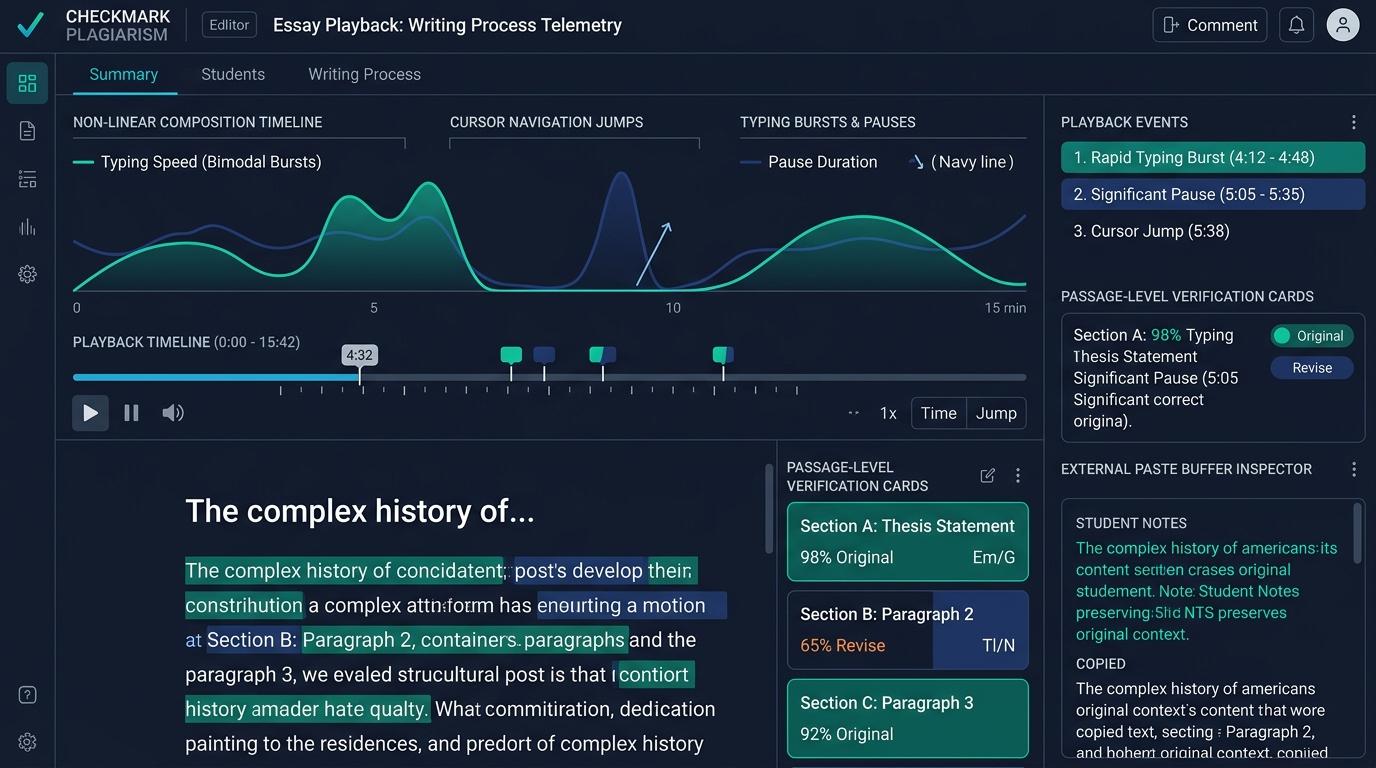
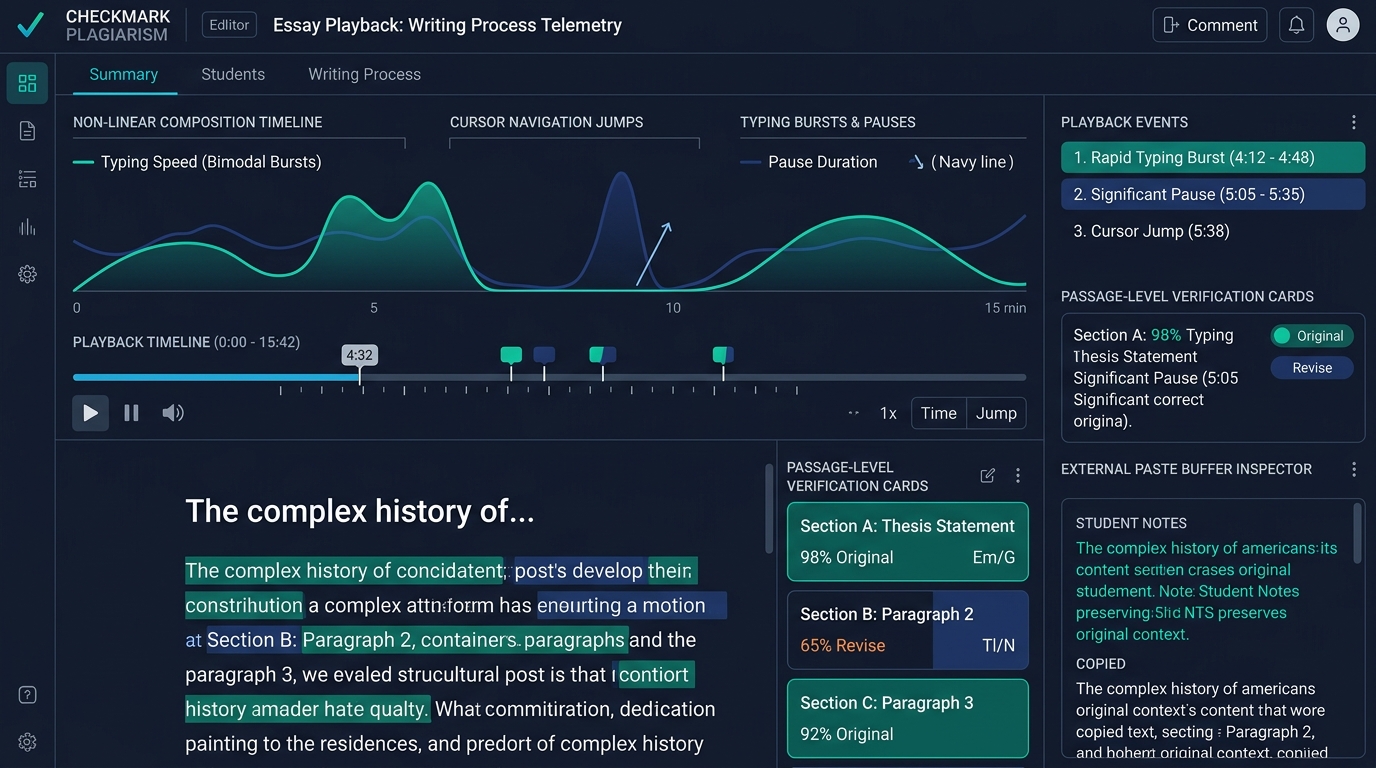
Checkmark's flagship innovation is Essay Playback™, a patent-pending telemetry player that reconstructs the complete lifecycle of a document keystroke-by-keystroke. Educators can watch an essay come to life in a fluid video timeline, scrubbing at 1x, 2x, 4x, or 8x speed.
For a neurodivergent writer, Essay Playback™ serves as undeniable visual proof of authentic cognitive labor:
- Visualizing Spatial Cursor Jumps: When a student with ADHD jumps from line 14 down to line 85 to flesh out an evidentiary example before returning to draft the thesis statement, the timeline visually renders these cursor movements as intentional navigational steps.
- Preserving Iterative Micro-Edits: The playback engine captures every recursive backspace, character replacement, synonym trial, comma relocation, and sentence restructuring. Even if a student drafts out of order, the presence of thousands of micro-revisions proves active human composition.
- Pause-and-Burst Playback Visualizer: The scrub bar features a color-coded activity ribbon displaying active drafting periods (green), macro-level editing (blue), and deep contemplative pauses (grey), instantly contextualizing irregular typing rhythms.
2. External Paste Buffer Tracking with 100% Text Preservation
One of the most frequent causes of false plagiarism and AI flags among neurodivergent writers is pasting personal brainstorming notes from external applications (e.g., Apple Notes, Obsidian, Notion, Google Keep, or phone text messages).
Generic tools simply flag the pasted chunk as an unexplained external insertion. Checkmark Plagiarism solves this through External Paste Buffer Tracking:
- idea: hamilton used federalist 78 to defend judicial review
- brutus 1 said judges would become too powerful and destroy state courts
- my thesis: lifetime tenure was necessary bc courts have no sword or purse (fed 78)
- quote: "neither force nor will, but merely judgment" check page 424
Student spent 28 minutes actively typing inside the primary document, transforming the 4 bullet points into two fully articulated body paragraphs with:
- 412 new keystrokes logged
- 38 backspaces and word substitutions
- 12 sentence-level structural reorganizations
- Zero external paste events during composition
- Timestamped Clipboard Capture: Checkmark securely logs the exact raw text that entered the clipboard at the moment of the paste event.
- Immutable Historical Preservation: Even if the student subsequently rewrites, replaces, or deletes every single word of the pasted text over the next two hours, the original pasted payload remains permanently viewable in the educator sidebar.
- The “Jump-to-Playback” Navigation Button: Clicking the paste event immediately jumps the Essay Playback™ video to the exact millisecond of insertion, allowing the teacher to watch how the student interacted with the pasted material—distinguishing a student expanding their own scratchpad notes from a student dumping an unauthorized ChatGPT response.
3. Multi-Factor Verification Triad: Passage-Level AI & Plagiarism Matching
Checkmark never relies on a single metric. It deploys an integrated triad of evidence:
- Passage-Level Granularity with Confidence Sliders: Rather than assigning a blanket “68% AI” score to an entire submission, Checkmark underlines specific sentences directly in the text. Each flagged passage is accompanied by an individual evidence card featuring a calibrated confidence slider comparing typical human writing styles against typical AI generation patterns.
- Honest Short-Text Guardrails (<150 Words =
N/A): Recognizing that statistical text analysis fails catastrophically on short samples, Checkmark automatically displaysN/Afor passages under 150 words rather than generating misleading probabilistic guesses. - Defensible Plagiarism Matching & Source Links: Checkmark cross-references billions of live web pages, open-access repositories, and peer-to-peer classroom submissions. Clicking a highlighted match reveals a side-by-side source quote comparison with direct clickable links, clearly distinguishing between uncredited patchwriting and legitimate cited quotations.
4. AI Autograder with Direct Canvas & Buzz LMS Passback
Checkmark bridges academic integrity with supportive pedagogy through its Teacher-in-the-Loop AI Autograder:
- Criterion-Anchored Draft Feedback: Generates formative rubric evaluations aligned to custom school district rubrics, providing written justifications tied directly to specific quotes in the student's text.
- Teacher Final Authority: All automated scores remain in draft status until reviewed, adjusted, and approved by the educator.
- 1-Click LMS Passback: Once approved, scores and formative feedback push directly into Canvas LMS SpeedGrader or Buzz LMS gradebooks without requiring manual data re-entry.
Real-World Case Studies: Protecting Neurodivergent Writers in Practice
To illustrate how writing process evidence functions in practice, consider three authentic classroom scenarios across different educational tiers.
The Junior with ADHD Drafting Out of Order
Marcus submitted a 1,200-word paper. A legacy commercial AI detector flagged it as "84% AI Generated" due to an abrupt 450-word middle block appearing without a preceding introduction.
Scrubbing at 4x speed revealed Marcus skipped the intro and hyperfocused on Section 3 (Railroad Monopolies), typing 450 words in 38 continuous minutes with 82 backspaces before returning to write his thesis last.
Flag was immediately dismissed. In conference, the teacher praised Marcus: "Your deep analysis of the Railroad Act helped you discover your thesis. That is authentic, sophisticated historical thinking."
The Undergraduate with Autism Expanding Modular Notes
Elena submitted a 2,500-word policy synthesis. A generic AI scanner flagged a 500-word recommendations section as "High-Risk AI" due to low perplexity and an abrupt paste event.
Professor opened the Paste Buffer Inspector, revealing Elena's original clipboard payload: 18 raw bullet points from Notion. Playback showed 75 minutes spent methodically expanding each bullet into academic prose.
Full exoneration. Professor noted in Canvas gradebook that Elena's modular drafting strategy was an exemplary accommodation for managing working memory load during scientific synthesis.
The 8th Grader with Dysgraphia Using Speech-to-Text
Jordan used Apple Dictation for initial drafting. A legacy tool flagged the essay as "Machine Generation / Script Injection" because multi-word chunks appeared without single letter keystrokes.
Checkmark identified the natural phrase cadence of voice dictation (20–40 words/burst), followed by extensive keyboard micro-editing: fixing homophones ("their/there"), adding punctuation, and deleting filler words.
IEP accommodation fully validated. The teacher used Checkmark's autograder to generate quote-anchored feedback celebrating Jordan's vivid descriptive voice, boosting his confidence as a developing writer.
The 4-Phase Neuroinclusive Educator Verification Protocol
To prevent systemic discrimination and establish a supportive, trauma-informed academic environment, institutions should adopt Checkmark’s standardized 4-Phase Neuroinclusive Verification Protocol.
Pre-Submission Setup
- Document IEP/504 tools in syllabus
- Normalize non-linear composing
- Enable Checkmark LMS editor
High-Res Audit
- Open Essay Playback™ (2x/4x)
- Audit external paste inspector
- Check bimodal IKI waveforms
- Bypass whole-doc % scores
Supportive Conference
- Screen-share playback timeline
- Validate student thinking journey
- Collaborate without accusation
LMS Synchronization
- Anchor feedback to rubric criteria
- Approve autograded draft comments
- 1-click Canvas/Buzz grade passback
Verbatim Restorative Dialogue Scripts for Educators
When meeting with a neurodivergent student regarding an unusual drafting pattern, educators should use restorative language that fosters psychological safety:
“Hi [Student Name], thank you for meeting with me today. I really enjoyed reading your arguments on [Topic]. Today, I want to look at our Essay Playback timeline together so you can walk me through how your ideas evolved from your initial notes to your final draft.”
“I noticed in the timeline around the 35-minute mark that you jumped down and wrote your third body paragraph before your introduction, and you brought in some notes from an external scratchpad. Can you tell me about the thinking process behind tackling that argument first?”
“That makes complete sense. Seeing your original bullet points in the paste inspector and watching how you expanded them into full analytical prose shows a tremendous amount of deep cognitive labor. I love how you organized those complex ideas.”
“I see your voice dictation stream right here, followed by all the careful punctuation and sentence polishing you did with the keyboard. That's a fantastic strategy for getting your thoughts down without letting motor fatigue get in the way.”
Neuroinclusive IEP/504 Syllabus Policy & District Implementation
School districts, English departments, and university academic senates should adopt formal policy language that protects non-linear writers while maintaining rigorous integrity standards.
ACADEMIC INTEGRITY & THE WRITING PROCESS: A PROCESS-FIRST, TRUST-BASED APPROACH
Our department operates under the foundational principle: “Stop guessing, start trusting.” We believe that authentic human writing takes many forms. We explicitly recognize that many writers compose non-linearly—including drafting out of order, expanding modular bullet notes from personal scratchpads, experiencing hyperfocus writing bursts, and utilizing assistive speech-to-text dictation.
To protect your authentic work and eliminate the biases of generic AI detectors, this course utilizes Checkmark Plagiarism and patent-pending Essay Playback™ technology.
What this means for you:
- Complete Protection for Your Process: Your keystroke and revision history serves as undeniable proof of your authorship. You will never be penalized for drafting non-linearly, pasting your own brainstorming notes, or utilizing documented IEP/504 assistive writing technologies.
- Transparent Evidence (“Receipts”): Our integrity reviews are based on transparent writing process telemetry—not opaque black-box AI percentage scores.
- Supportive Conferences: If any question arises regarding a draft, we review the Essay Playback™ timeline together in a supportive, restorative conversation where you have full agency to explain your thinking.
- Privacy & FERPA Compliance: Your writing is encrypted, secure, and NEVER used to train commercial AI models.
Universal Design for Learning (UDL) Writing Checklist for Educators
Frequently Asked Questions (FAQs)
1. Why do generic AI detectors fail so disproportionately on neurodivergent writing styles?
Generic AI detectors analyze static text using statistical metrics called Perplexity (word predictability) and Burstiness (sentence length diversity). Neurodivergent writers frequently produce prose with unique statistical signatures: autistic writers and individuals with ADHD who hyperfocus on specialized vocabulary often write with high technical precision and formal syntax, which detectors misclassify as "low perplexity" (AI-like). Students managing executive dysfunction may use predictable transitional formulas to anchor their thoughts, resulting in "low burstiness." Because generic detectors evaluate only the static end-product rather than the dynamic writing journey, they confuse focused, disciplined human drafting with machine output.
2. How does Essay Playback™ distinguish between a student pasting their own notes vs. pasting ChatGPT text?
Checkmark's External Paste Buffer Tracking captures the exact raw clipboard payload at the millisecond of insertion. If a student pastes their own rough notes, the inspector reveals disjointed bullet points, personal shorthand, grammatical fragments, and informal brainstorm queries. Furthermore, the Essay Playback™ timeline reveals what happens next: a student working from their own notes spends substantial time (e.g., 20–60 minutes) actively typing, expanding fragments, and micro-editing sentences. In contrast, an unauthorized AI copy-paste consists of fully polished, finalized paragraphs requiring zero subsequent compositional labor.
3. How does writing process telemetry protect students with dysgraphia who use Speech-to-Text (STT) dictation?
Speech-to-text voice dictation inserts text into a document in rapid, multi-word acoustic chunks rather than single keystrokes. Legacy delta scanners misinterpret these rapid block insertions as copied-and-pasted synthetic text. Checkmark’s telemetry engine identifies the specific tempo of natural voice dictation (bursts of 15–40 words matching human speech rhythms) and documents the extensive manual keyboard editing that follows—such as fixing voice-recognition errors, inserting punctuation, and reordering clauses. This provides indisputable proof of human authorship aligned with IEP/504 accommodations.
4. What should a teacher do if a student with an ADHD 504 plan is flagged by a legacy AI detector?
First, do not accuse or confront the student, as immediate accusations can trigger acute Rejection Sensitive Dysphoria (RSD) and severe writing anxiety. Bypass the legacy percentage score and open Checkmark's Essay Playback™ telemetry player. Review the writing timeline for non-linear cursor navigation, hyperfocus drafting bursts, and iterative micro-revisions. Inspect the paste buffer to confirm if pasted material was personal brainstorm notes. If needed, conduct a supportive screen-share conference where the student walks you through their creative process.
5. Does recording keystrokes violate student privacy or FERPA regulations?
No. Checkmark Plagiarism is fully compliant with the Family Educational Rights and Privacy Act (FERPA) and the Children's Online Privacy Protection Act (COPPA). Checkmark operates within a secure, encrypted cloud infrastructure (encryption in transit and at rest). Student keystrokes and document telemetry are captured strictly within authorized school environments (such as Canvas LMS, Buzz LMS, or Google Docs integrations). Most importantly, Checkmark has a strict zero-retention policy: student submissions and keystroke data are NEVER used to train commercial AI models or shared with third-party data brokers.
6. Can an "AI Humanizer" or paraphrasing tool bypass Checkmark’s detection suite?
No. Tools like QuillBot or Undetectable AI alter vocabulary and sentence syntax on static text to manipulate perplexity scores and fool basic detectors. However, these tools cannot fabricate an authentic, chronologically coherent, keystroke-by-keystroke human drafting journey. When an educator reviews Essay Playback™, a paper generated through an AI humanizer appears as an instantaneous external paste with zero authentic micro-revisions, immediately exposing the deception. Authentic writing process evidence is completely immune to text-spinning tools.
7. How does Checkmark integrate with learning management systems like Canvas and Buzz?
Checkmark integrates natively into Canvas LMS SpeedGrader and Buzz LMS through secure LTI enterprise protocols. Educators can view the complete integrity suite—including passage-level AI underlines, side-by-side plagiarism source matches, Essay Playback™ timelines, and AI-assisted rubric justifications—directly within their standard grading workflow. Once the teacher reviews and approves the autograded rubric scores, a single click syncs the finalized grades and quote-anchored feedback straight into the LMS gradebook.
Conclusion: Stop Guessing, Start Trusting
The rise of generative AI has created immense pedagogical challenges, but solving those challenges must never come at the expense of our most vulnerable students. Relying on opaque, punitive black-box detectors places neurodivergent learners in an unjust double bind—punishing them for the very non-linear, creative, and adaptive composing strategies that allow them to thrive.
By embracing transparent writing process evidence, educators can eliminate algorithmic discrimination, uphold the promise of individualized education accommodations, and transform academic integrity from an adversarial confrontation into a supportive, human-centered partnership.
Stop Guessing. Start Trusting.
Give your educators the objective, keystroke-level receipts they need to celebrate and protect every student's unique writing journey. Eliminate false AI accusations, support neurodivergent learners, and streamline grading with patent-pending Essay Playback™.