
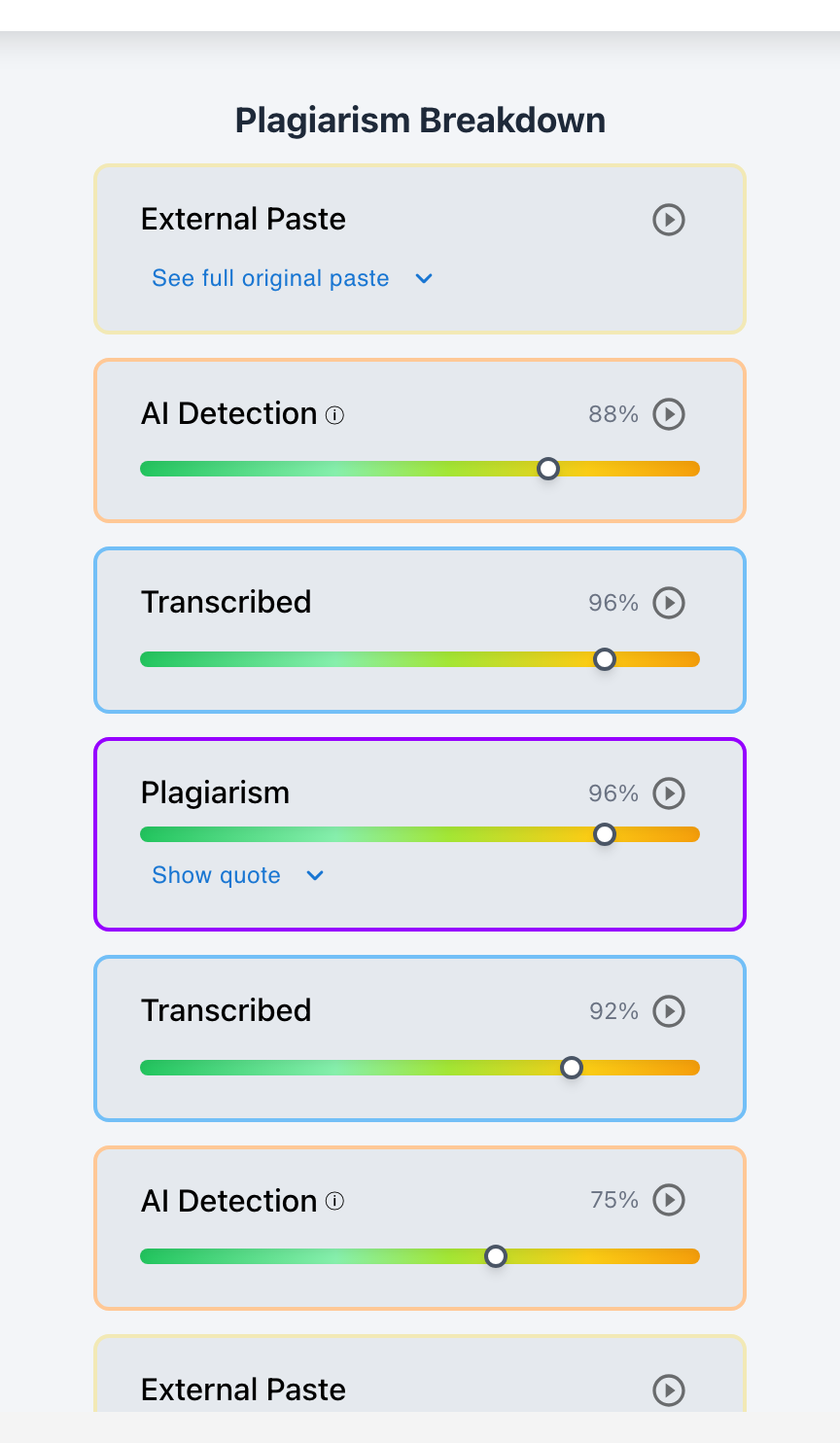
It is a common scenario in modern education: an instructor tests a suspicious student essay across three different AI detection tools and receives three completely contradictory results.
One detector reports 92% AI probability, a second indicates 15% AI, and a third flags 54% mixed content. When algorithms directly disagree, how should educators interpret the results? Which detector should be believed, and how can an instructor make a fair, defensible determination without getting trapped in algorithmic confusion?
Conflicting AI scores do not mean the investigation has reached a dead end. Rather, they highlight a fundamental reality: different AI detectors use different statistical models, training corpora, and sensitivity thresholds. When detection scores conflict, teachers must move beyond static percentage scores and resolve the question using essay writing playback, citation validation, writing baselines, and student dialogue.
Checkmark Plagiarism eliminates score confusion by combining AI detection with essay writing playback, static AI detection, plagiarism detection, autograding, and integrations with Canvas and Google Classroom.
Why Do Different AI Detectors Disagree?
Understanding conflicting results requires recognizing the technological differences between detection engines:
1. Different Heuristic Models
Some detectors calculate perplexity and burstiness; others utilize classifier neural networks or transformer embeddings trained on distinct model weights (e.g., GPT-4 vs. Claude 3).
2. Varied Sensitivity Thresholds
Platforms calibrate false-positive tolerances differently. High-sensitivity tools flag minor formulaic structures, while conservative tools require overwhelming predictability.
3. Aggregation vs. Sentence Mapping
Some tools report document-level averages, while others calculate paragraph-level probabilities, leading to drastically different final percentage displays.
Read our in-depth analysis in why do different AI detectors give different results? and what does an AI detection percentage actually mean?
What Conflicting Scores Actually Tell the Teacher
When detectors produce wide variances (e.g., 85% vs. 12%), it typically indicates one of three underlying realities:
- Hybrid or Edited Text: The student used AI for brainstorming or early drafting but manually edited and rewrote sections, creating a mixture of predictable and irregular syntax. Read more in can AI detectors detect edited ChatGPT text?
- Formal Human Writing with Formulaic Transitions: The student wrote authentically, but utilized structured academic templates that triggered high sensitivity on one tool while passing a more conservative engine.
- Writing Assistant Usage: The student used tools like Grammarly or QuillBot for sentence rephrasing, creating localized syntactic predictability that split detector algorithms. Read more in can AI detectors detect Grammarly or AI writing assistants?
How to Break the Stalemate: 5 Objective Verification Steps
When algorithms disagree, instructors should stop running more detectors and shift to physical, verifiable evidence:
Step 1: Check Essay Writing Playback
Review keystroke cadence and drafting duration in Checkmark Plagiarism's essay writing playback to verify whether text was typed incrementally or pasted wholesale.
Step 2: Audit Cited Academic Sources
Search JSTOR and Google Scholar to confirm that cited authors, journal titles, volume numbers, and direct quotations exist.
Step 3: Compare Historical Baselines
Compare the submission against 2–3 proctored in-class writing samples to evaluate vocabulary range, sentence complexity, and voice continuity.
Step 4: Conduct an Oral Concept Check
Ask the student to explain their thesis, argue key claims, and define advanced terminology in plain language during a brief conference.
How Essay Writing Playback Resolves Algorithmic Discrepancies
Document timeline analysis cuts through conflicting detector scores by examining how the assignment developed. When one tool flags 90% and another flags 20%, Checkmark Plagiarism's essay writing playback provides clarity:
- If playback shows 4 hours of active drafting across 3 sessions with detailed revisions, the 90% detector score is confirmed as a false positive.
- If playback shows an empty document receiving 1,200 words in one instant paste with zero subsequent editing, the 20% detector score is exposed as a false negative resulting from light paraphrasing.
Read more in how Checkmark writing process analysis works.
Educator Resolution Framework for Conflicting Scores
Scenario A: Resolution Supports Authenticity
- Detectors show 88% vs. 15% vs. 40%.
- Playback confirms multi-session drafting over several days.
- All cited academic sources exist and are verified.
- Student fluently explains all arguments and revisions.
- Action: Conclude authentic student authorship; no violation.
Scenario B: Resolution Supports AI Violation
- Detectors show 75% vs. 20% vs. 50%.
- Playback reveals wholesale paste event of 1,000 words.
- Two cited journal articles cannot be located in databases.
- Student cannot explain core arguments orally.
- Action: Refer for academic integrity review with multi-signal evidence.
A 6-Step Protocol for Handling Disagreeing Detector Reports
Educator Protocol for Conflicting AI Results:
- 1. Stop running the text through additional scanners to avoid score paralysis.
- 2. Note which specific paragraphs or sections triggered flags across each tool.
- 3. Inspect essay writing playback logs to evaluate active typing time and paste events.
- 4. Audit all cited sources and direct quotes in academic databases for hallucinations.
- 5. Compare the submission against verified historical student writing baselines.
- 6. Hold a supportive conference to test oral conceptual understanding and review external drafts.
How Checkmark Plagiarism Eliminates Algorithmic Guesswork
Checkmark Plagiarism combines **AI detection, essay writing playback, static AI detection, plagiarism detection, autograding, and Canvas/Google Classroom integrations** to replace conflicting percentage scores with clear, objective, and defensible timeline evidence.
Frequently Asked Questions
Why do two AI detectors give opposite scores on the same paper?
Detectors use different neural network classifiers, training datasets, perplexity algorithms, and sensitivity thresholds, causing divergent interpretations of complex or edited text.
Should teachers average conflicting AI detector scores?
No. Averaging conflicting scores (e.g., averaging 90% and 10% into 50%) is mathematically meaningless because the underlying models measure different linguistic features.
Which detector should I trust when results conflict?
Do not trust any detector in isolation. Use writing playback, citation audits, and student interviews to resolve the discrepancy with objective facts.
What does it mean when a detector score is in the middle (e.g., 40–60%)?
Mid-range scores usually indicate hybrid text: a mix of human writing and AI assistance, or human text edited with automated grammar rephrasers.
How does writing playback resolve conflicting AI scores?
Playback reveals the physical timeline of creation: showing whether text was typed keystroke-by-keystroke over hours or inserted in instant paste blocks.
Can a student pass one detector but fail another by using QuillBot or paraphrase tools?
Yes. Paraphrasing tools alter sentence burstiness enough to deceive some detectors while triggering high predictability on others.
What if a student with conflicting detector scores has no writing history?
Audit citations for hallucinations, compare the submission against historical in-class samples, and conduct an oral comprehension conference.
Should I mention conflicting detector scores to the student?
Focus the conversation on writing process and comprehension rather than software scores: ask how the thesis developed and where the research was conducted.
How do hallucinated citations clarify conflicting scores?
If citations are non-existent, it provides concrete proof of generative AI involvement regardless of low scores on certain detectors.
How does Checkmark Plagiarism help schools handle conflicting AI results?
Checkmark Plagiarism grounds academic integrity in essay writing playback, citation validation, and LMS integrations, removing reliance on conflicting statistical scores.
Move Beyond Conflicting Scores to Clear Process Evidence
Algorithmic discrepancies demonstrate why software scores should never serve as judge and jury. By grounding academic integrity evaluations in writing playback, citation validity, and student dialogue, educators resolve conflicts with fairness, clarity, and absolute confidence.
Checkmark Plagiarism supports this objective approach with AI detection, essay writing playback, static AI detection, plagiarism detection, autograding, and integrations with Canvas and Google Classroom.
See how Checkmark pairs essay writing playback with multi-signal detection to resolve conflicting scores with objective process evidence. View a sample report or request a demonstration.