
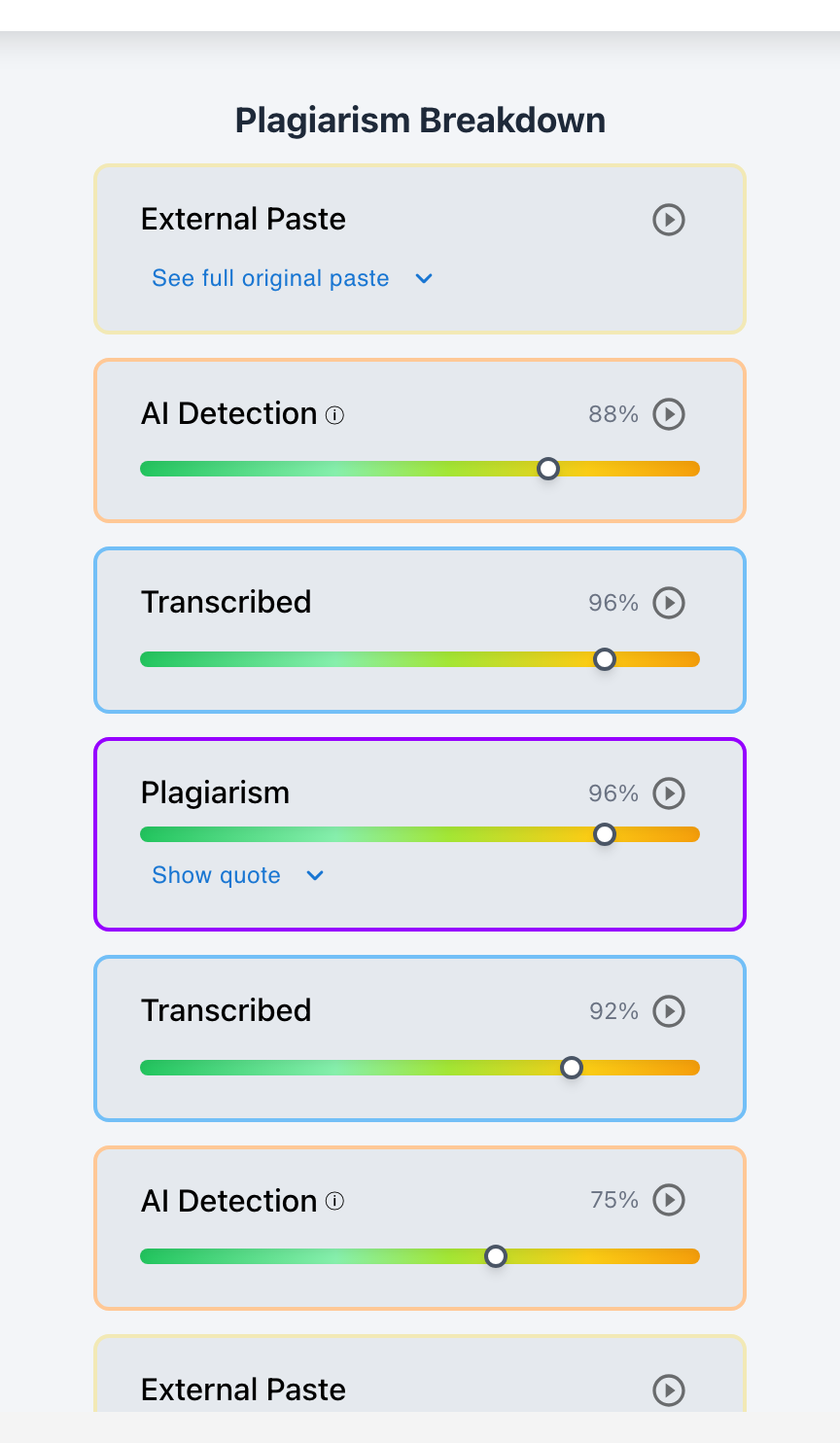
Teachers should handle assignments with mixed human and AI writing through a 4-step, calibrated pedagogical framework: first, quantify the exact breakdown using Checkmark's sentence-level heatmaps and writing playback telemetry; second, apply proportional grading (evaluating authentic human sections on merit while withholding credit for AI paragraphs); third, hold a supportive 2-minute conference to understand why the student turned to AI; and fourth, require a student-authored revision of the flagged sections.
In modern high schools and universities, pure black-and-white cases of 100% human or 100% AI submissions are becoming rare. Instead, educators routinely encounter "hybrid" papers: essays where a student wrote 70% of the body paragraphs by hand but used ChatGPT to generate the thesis statement or polish complex transitions. Handling these mixed submissions with an all-or-nothing punitive approach alienates students and overlooks genuine research effort. By establishing a proportional, evidence-based assessment framework, teachers can maintain rigorous standards while turning AI shortcuts into meaningful learning opportunities.
Below is a comprehensive guide on grading, managing, and resolving mixed human-AI submissions.
Checkmark Plagiarism manages mixed-authorship grading by pairing AI detection with essay writing playback, plagiarism detection, autograding, and integrations with Canvas and Google Classroom.
The 4-Step Framework for Managing Mixed Writing
Step 1: Quantify the Authorship Breakdown
Open Checkmark in Canvas SpeedGrader to review the Authorship Meter: see the exact percentage of authentic human drafting vs. synthetic text.
Step 2: Proportional Rubric Assessment
Score the authentic human sections on their analytical merits; award zero points for the specific rubric criteria fulfilled by AI generation.
Step 3: Supportive Restorative Conference
Show the student their writing playback replay in private: celebrate their 3 hours of real typing and discuss why they used AI on the remaining section.
Step 4: Targeted Revision Opportunity
Require the student to rewrite the AI-generated paragraphs by hand during office hours or study hall to earn back partial credit.
The "AI Traffic Light" Policy Model
Establishing clear assignment-level expectations for students:
- Red Assignments (100% Human Only): Diagnostic in-class essays, personal reflections, and timed exams where zero AI assistance of any kind is permitted.
- Yellow Assignments (AI for Brainstorming Only): Research papers where students may use AI for topic outlining or finding counterarguments, but all final sentences must be 100% human-drafted with an AI disclosure statement.
- Green Assignments (AI Co-Creation Permitted): Specialized technical communication or digital media projects where students co-write with AI and submit prompt logs alongside their final reflection.
Read more in how Checkmark writing process analysis works.
Comparison: All-or-Nothing Zero vs. Calibrated Proportional Grading
Calibrated Proportional Grading (Checkmark Standard)
- Rewards verified human effort and research.
- Pinpoints specific AI-generated paragraphs.
- Requires targeted revision of compromised sections.
- Encourages open student reflection and honesty.
All-or-Nothing Zero (Rigid & Adversarial)
- Assigns 0% to the whole paper over one AI paragraph.
- Ignores hours of authentic student research.
- Creates conflict with parents and administrators.
- Drives students toward deeper cynicism and evasion.
A 5-Step Educator Protocol for Handling Mixed Submissions
Mixed Writing Management Checklist:
- 1. Open the student's submission in Checkmark Plagiarism inside Canvas SpeedGrader.
- 2. Review the Authorship Breakdown and Sentence Heatmap: note which paragraphs are human vs. AI.
- 3. Inspect the Writing Playback timeline to verify drafting duration and paste logs.
- 4. Schedule a brief 2-minute conference to discuss the flagged paragraphs constructively.
- 5. Assign a targeted revision of the AI sections and record the calibrated grade in Canvas.
How Checkmark Plagiarism Powers Calibrated Assessment
Checkmark Plagiarism combines **AI detection, essay writing playback, static AI detection, plagiarism detection, autograding, and Canvas/Google Classroom integrations** to give teachers the exact granular data needed to grade mixed submissions with total fairness.
Frequently Asked Questions
What is proportional grading for AI writing?
Proportional grading is an assessment approach where teachers grade authentic human sections on merit while withholding credit or requiring revisions for AI-generated paragraphs.
How does Checkmark help teachers grade mixed submissions?
Checkmark highlights the exact sentences and paragraphs that are AI-generated, displaying an exact percentage breakdown in Canvas SpeedGrader.
What if a student used AI for 50% of the paper?
Evaluate the 50% human core on rubric criteria, deduct points for the missing independent synthesis, and require a rewritten draft for the AI half.
How does writing playback support student conferences?
Playback provides a neutral digital mirror, allowing the teacher to praise hours of genuine typing while addressing the moment a paste event occurred.
How does Checkmark Plagiarism integrate with Canvas LMS?
Checkmark provides certified LTI 1.3 integration, SpeedGrader sidebar embeds, two-way grade passback, and single sign-on (SSO).
What is the 'AI Traffic Light' policy framework?
It is a classroom system categorizing assignments as Red (no AI), Yellow (AI for brainstorming/outlining only), or Green (collaborative AI use allowed).
Can students resubmit after rewriting their AI paragraphs?
Yes. Many educators allow students to revise AI-generated sections by hand to earn back partial credit, turning misconduct into a learning opportunity.
How does Autograder evaluate mixed-authorship papers?
Checkmark Autograder evaluates human arguments against the teacher's rubric while automatically flagging synthetic sections for instructor review.
Why is a blanket zero counterproductive for mixed essays?
Because assigning an automatic zero for partial AI use ignores legitimate student research and discourages future academic effort.
Why is granular evidence essential for school due process?
Because showing the exact percentage and location of AI text eliminates subjective disputes and ensures transparent administrative documentation.
Balancing Accountability with Educational Growth
Navigating the AI era requires combining high standards with compassionate pedagogy. By leveraging sentence-level heatmaps and keystroke playback with Checkmark Plagiarism, educators can evaluate mixed submissions with nuance, reward honest effort, and guide students toward independent intellectual excellence.
Checkmark Plagiarism supports this comprehensive approach with AI detection, essay writing playback, static AI detection, plagiarism detection, autograding, and integrations with Canvas and Google Classroom.
See how Checkmark pairs sentence heatmaps with writing playback to grade mixed human-AI writing. View a sample report or request a demonstration.