
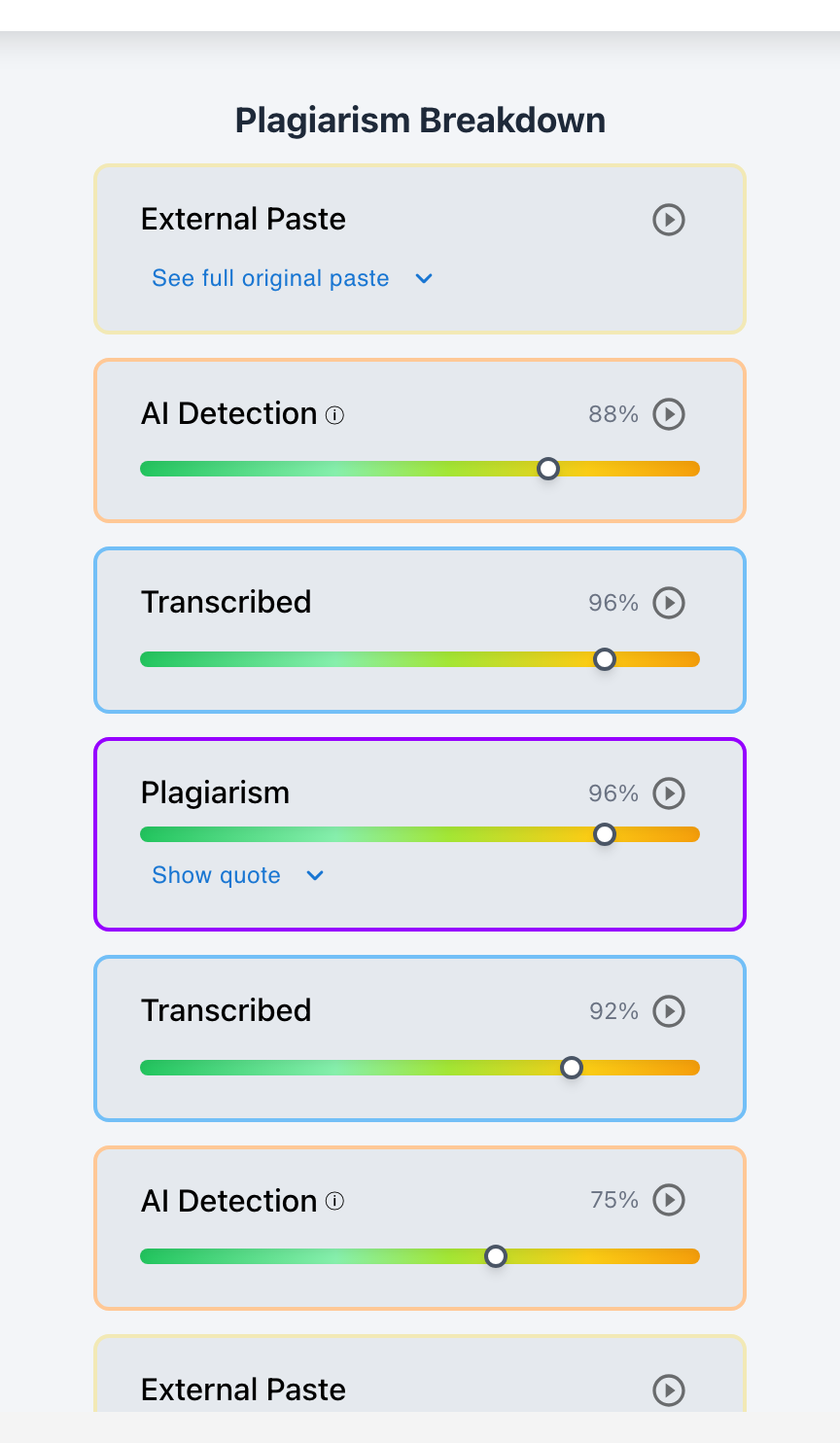
Schools should document AI misconduct cases using a standardized 4-part audit dossier generated directly from Checkmark Plagiarism: 1) Process Telemetry Records (active typing duration, 0.05-second paste timestamps, deletion ratios, and a secure 15-second writing playback video link); 2) Linguistic & Neural Heatmaps (sentence-level token perplexity distributions); 3) Citation Verification Logs (CrossRef DOI validation showing non-existent references); and 4) The Educator Conference Summary (notes from the 2-minute oral check-in).
When an academic integrity finding is appealed by a student or challenged by a parent, informal documentation—such as vague teacher emails, blurry phone screenshots, or raw percentage scores from an unknown web detector—routinely crumbles under administrative and legal scrutiny. Disciplinary decisions must be supported by an organized, tamper-evident, and FERPA-compliant evidentiary record. Comprehensive case documentation transforms subjective disputes into objective, fact-based resolutions. Checkmark Plagiarism compiles all multi-signal evidence into a standardized PDF audit dossier in one click.
Below is a comprehensive guide on creating defensible, professional AI misconduct documentation.
Checkmark Plagiarism streamlines case documentation by pairing AI detection with essay writing playback, plagiarism detection, autograding, and integrations with Canvas and Google Classroom.
The 4 Essential Components of an AI Case Dossier
1. Keystroke Telemetry & Paste Logs
Includes exact active typing minutes (e.g., "12 minutes for 1,800 words"), clipboard paste timestamps, character counts, and the writing playback link.
2. Multi-Signal Linguistic Heatmaps
Displays color-coded sentence overlays identifying low-perplexity synthetic text, formulaic AI discourse markers, and sudden baseline departures.
3. Citation & DOI Verification Card
Contains database verification records from Crossref and Google Scholar confirming that cited journal articles or DOIs do not exist in published literature.
4. Teacher Conference Summary
Structured notes documenting the date, time, diagnostic questions asked, and student responses from the 2-minute oral check-in.
How Standardized Documentation Protects Due Process
Understanding why structured audit packages withstand scrutiny:
- Tamper-Evident Integrity: Checkmark PDF dossiers are cryptographically timestamped upon export, guaranteeing that data has not been altered or manipulated after generation.
- FERPA Compliance: Student names and ID numbers are formatted securely, ensuring records comply with federal privacy regulations and school board policies.
- Parent Conference Clarity: Sharing a standardized multi-signal report transforms emotional parent meetings into collaborative, fact-based discussions centered around writing process telemetry.
Read more in how Checkmark writing process analysis works.
Comparison: Informal Screenshots vs. Checkmark Standardized Case Dossier
Checkmark Standardized Dossier (Defensible & Complete)
- One-click export from Canvas SpeedGrader.
- Contains physical keystroke logs and paste timestamps.
- Automated Crossref DOI verification status.
- Cryptographically timestamped and FERPA compliant.
Informal Screenshots (Fragile & Incomplete)
- Cropped phone photos of third-party detector scores.
- No physical record of typing time or clipboard actions.
- Easily dismissed by honor committees during appeals.
- Lacks structured conference notes or due process logs.
A 5-Step Educator Protocol for Case Documentation
Case Documentation Checklist:
- 1. Open the student's submission in Canvas SpeedGrader with Checkmark enabled.
- 2. Conduct the 2-minute oral check-in and record brief factual notes in the report summary box.
- 3. Click "Export Case Dossier (PDF)" to generate the complete multi-signal package.
- 4. Provide a copy of the PDF dossier to the student and their family as part of transparent due process.
- 5. Submit the dossier to the Academic Honor Committee or Department Chair for formal archival.
How Checkmark Plagiarism Powers Automated Case Reports
Checkmark Plagiarism combines **AI detection, essay writing playback, static AI detection, plagiarism detection, autograding, and Canvas/Google Classroom integrations** to generate comprehensive, professional case dossiers in seconds.
Frequently Asked Questions
How long does it take to generate a case dossier in Checkmark?
Checkmark compiles and exports the complete multi-signal PDF dossier in under 5 seconds with a single click in SpeedGrader.
Can students and parents access the dossier?
Yes. School policy should mandate sharing the dossier with the student and their family to ensure complete transparency during inquiries.
What makes a case dossier legally defensible?
Combining physical keystroke telemetry, paste event timestamps, and DOI database verification provides empirical, objective proof that withstands legal scrutiny.
How does Checkmark protect student data privacy?
Checkmark complies with FERPA, CSPC, and SOC 2 Type II standards; all student telemetry and case files remain encrypted in your school's private domain.
How does Checkmark Plagiarism integrate with Canvas LMS?
Checkmark embeds one-click dossier export buttons directly inside Canvas SpeedGrader, allowing teachers to document cases without leaving the LMS.
Should case dossiers be kept permanently on a student's record?
School policy should define retention timelines (e.g., maintaining records internally for graduation tracking, but expunging minor first offenses upon successful completion of restorative modules).
What if a student provides drafting artifacts that contradict the report?
The student's artifacts should be attached to the dossier and reviewed by the Honor Committee as part of formal due process.
How does Autograder integrate with case documentation?
Autograder automatically attaches the original rubric criteria and evaluation notes to the dossier, providing full instructional context.
Can department chairs view all archived case dossiers?
Yes. The administrative dashboard maintains an encrypted, searchable repository of all institutional case dossiers for compliance tracking.
Why is standardized documentation essential for school leadership?
Because professional, objective documentation protects the school from liability, ensures student due process, and upholds uncompromising academic standards.
Defensible Records for Fair and Lasting Decisions
Fairness requires truth, and truth requires documentation. By utilizing Checkmark Plagiarism's standardized, one-click PDF case dossiers, schools ensure that every academic integrity finding is grounded in empirical data, protected by due process, and resolved with total clarity.
Checkmark Plagiarism supports this comprehensive approach with AI detection, essay writing playback, static AI detection, plagiarism detection, autograding, and integrations with Canvas and Google Classroom.
See how Checkmark generates standardized AI misconduct case dossiers in Canvas SpeedGrader. View a sample report or request a demonstration.