
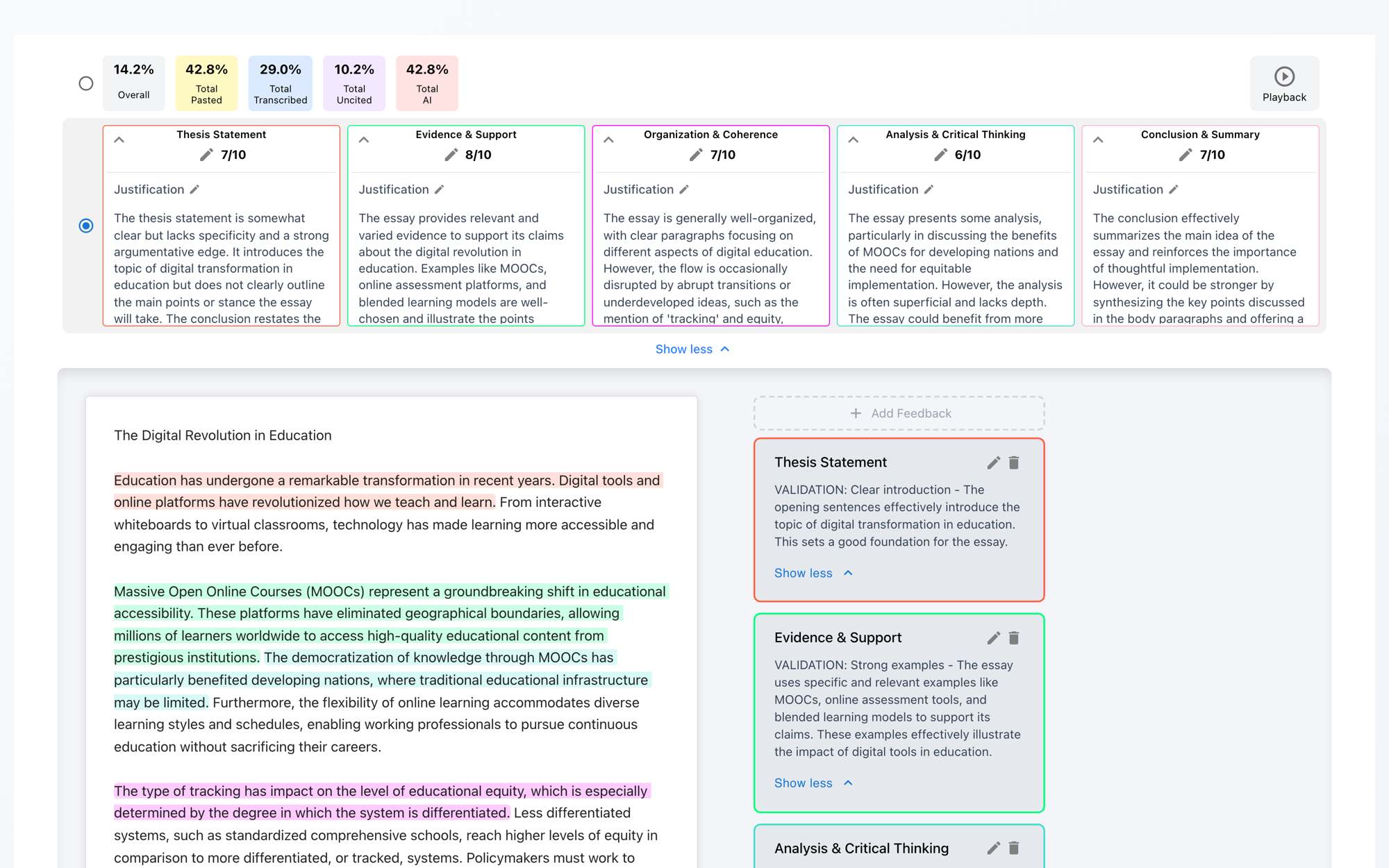
For educators and humanities departments, defending writing evaluations against contentious student appeals and skeptical parent emails has become one of the most exhausting, time-consuming drivers of professional burnout. Traditional grading workflows rely on abstract rubric descriptors (“Needs more analysis,” “Evidence is underdeveloped”) that invite subjective pushback and force teachers to spend hours reconstructing their grading logic weeks after the fact. Quote-anchored rubric justifications solve this systemic vulnerability by tying every criterion score directly to verbatim, highlighted textual excerpts from the student's submission. When paired with Checkmark Plagiarism’s teacher-in-the-loop autograding engine, patent-pending Essay Playback™ keystroke timelines, and automated LMS grade passback, educators gain an indisputable, evidence-backed defense for every mark—transforming adversarial grade disputes into transparent, growth-oriented coaching conferences.
Checkmark Plagiarism streamlines essay grading and academic defensibility by uniting AI autograding with writing process replay, AI writing detection, plagiarism detection, and direct integrations with Canvas LMS and Agilix Buzz LMS.
The Friday Afternoon Email: The Anatomy of Modern Grade Disputes & Teacher Burnout
Every secondary English teacher, humanities instructor, and college composition professor knows the sinking feeling of opening an inbox at 4:30 PM on a Friday to find a high-stakes grade appeal:
To: english.dept@k12district.org
Dear Mrs. Davis,
Maya came home in tears today after seeing her grade on the Synthesis Essay (78/100). She spent over fifteen hours researching this paper and has always maintained an unblemished A average in English.
Looking at Canvas SpeedGrader, she received a 2/4 on “Evidence & Contextual Analysis,” with only a brief rubric comment: “Needs deeper textual support and stronger counterargument synthesis.”
This feedback feels completely arbitrary and subjective. Maya included five peer-reviewed sources and followed every formatting rule. Could you please provide a specific, sentence-by-sentence breakdown justifying why two whole letter grades were deducted? If we cannot resolve this, we would like to schedule an immediate conference with the department chair and academic counselor on Monday.
Sincerely,
Robert & Elena Thompson
The Invisible Arithmetic of Evaluator Defense
The psychological toll of defending grading decisions is compounded by the relentless arithmetic of educator workloads:
When 10% to 15% of those submissions result in contested scores, follow-up emails, or formal grade review meetings, educators spend an additional 8 to 15 hours per assignment cycle simply defending past grading decisions.
To prepare for a single parent conference or academic integrity review board, a teacher must:
LMS Re-Inspection
Re-open the submission in Canvas SpeedGrader, Agilix Buzz, or Google Classroom and decipher rushed marginal notes written weeks ago.
Textual Forensic Hunt
Re-read the entire 1,500-word essay to locate the exact paragraphs where the thesis lost coherence or claims lacked evidentiary backing.
Manual Quote Extraction
Transcribe specific student quotes into an email draft to substantiate why a score fell in the “Emerging” rather than “Proficient” performance band.
Bias Rebuttal Defense
Defend against accusations of grader fatigue, personal favoritism, or arbitrary standards before administrative leadership.
This defensive overhead drains the emotional and instructional reserves of educators, driving talented teachers away from writing-intensive courses and reducing the frequency of writing assignments across district curricula.
The Structural Vulnerability of Abstract Rubrics
Why do grade disputes occur with such predictable frequency? The root problem does not lie in teacher competence or student ambition; it lies in the structural abstraction of traditional scoring rubrics.
“Adequate evidence cited, but analysis remains superficial with unsupported claims.”
1. The Subjectivity Gap in Generic Descriptors
Standard rubrics rely heavily on qualifying adjectives that are open to broad interpretation:
- “Demonstrates thoughtful integration of sources” vs. “Demonstrates basic integration.”
- “Sophisticated sentence variety” vs. “Adequate sentence variety.”
- “Insightful thematic synthesis” vs. “Literal plot summary.”
To a stressed student or an anxious parent, their essay is “thoughtful” and “insightful.” When a teacher selects “basic” without immediate, visible textual anchors, the score is inevitably interpreted as an expression of personal opinion rather than an objective measurement against curricular standards.
2. Evaluator Fatigue and the “Halo/Horn” Vulnerability
When a teacher evaluates Essay #135 at 11:00 PM on a Sunday, cognitive fatigue inevitably reduces feedback to brief checkboxes or three-word summaries (“awkward transition,” “expand idea”). In an administrative appeal, these sparse notes provide zero evidentiary defense. Parents and advocates can easily argue that the student was penalized due to grader exhaustion rather than genuine prose deficiencies.
3. The Generative AI Complication
In an era where generative AI tools can draft grammatically flawless prose in seconds, essays often display a superficial sheen of competence—smooth transitions, elevated vocabulary, and correct syntax—while masking shallow analysis, hallucinated historical dates, or unverified claims. When teachers penalize these essays for “lack of depth,” students push back vigorously, pointing to the essay’s pristine surface mechanics as proof of excellence.
What Are Quote-Anchored Rubric Justifications?
Quote-anchored rubric justifications represent a fundamental paradigm shift in writing assessment. Rather than treating a rubric as an isolated matrix of checkboxes, quote-anchored evaluation establishes a direct, bidirectional cryptographic and semantic link between every rubric criterion score and the exact verbatim phrases, sentences, or paragraphs within the student’s text that warrant that score.
¶3: “The Great Gatsby reveals the emptiness of the American Dream. [Daisy's voice is full of money, showing that everyone only cared about wealth in the 1920s.] (Fitzgerald 120).”
¶4: “[This proves that Gatsby had no real morals and that his entire life was a lie based on social status.]”
The Three Core Dimensions of a Quote-Anchored Justification
Every quote-anchored evidence card generated within Checkmark Plagiarism consists of three tightly coupled components:
The Verbatim Textual Anchor
The exact snippet of text extracted directly from the student’s submission. Clicking this snippet in the rubric sidebar immediately scrolls the document viewport to the highlighted sentence in the essay canvas.
The Criterion-Mapped Diagnostic
An objective explanation detailing exactly how the highlighted prose satisfies, partially satisfies, or fails the specific rubric performance descriptor (e.g., distinguishing between plot summary and thematic synthesis).
The Prescriptive Growth Recommendation
Concrete, actionable guidance showing the student precisely what revision would elevate the prose from its current performance band to the mastery level.
ANATOMY OF A QUOTE-ANCHORED JUSTIFICATION CARD
“While renewable energy has benefits, economic realities make a full transition difficult, but governments should still try to implement smart green policies.”
The thesis identifies the core tension between economic feasibility and ecological transition. However, the closing clause (“smart green policies”) remains undefined and vague, falling short of the “Precise & Defensible” standard in Band 4.
Specify which policy mechanisms (e.g., carbon tax credits, grid modernization subsidies) your essay will defend as viable economic solutions.
Black-Box AI Scorers vs. Checkmark’s Teacher-in-the-Loop Architecture
As school districts explore generative artificial intelligence to alleviate grading workloads, many have encountered consumer AI utilities and “instant grading bots.” Understanding the profound technical and pedagogical differences between black-box AI score generators and Checkmark’s quote-anchored, teacher-in-the-loop engine is essential for curriculum leaders and department chairs.
- Arbitrary Whole-Essay Score: Outputs generic scores (e.g. 84%) with no criterion-level calibration.
- Generic & Hallucinated Summaries: Praises arguments the student never made or hallucinates grammatical flaws.
- Blind to Process: Evaluates static text with zero visibility into typing history or external copy-paste events.
- Bypasses Teacher Authority: Claims to “auto-grade” directly without professional educator moderation.
- FERPA Vulnerability: Ingests student prose into public foundation models for AI training.
- Rubric-Aligned Criterion Scores: Evaluates each rubric row independently based on defined performance bands.
- Verbatim Quote-Anchored Evidence: Every deduction is mapped to exact text extracts from the submission.
- Patent-Pending Essay Playback™: Reconstructs the complete keystroke timeline and active composition session.
- Teacher Final Authority: AI drafts preliminary feedback in a teacher console; educator holds 100% approval power.
- Zero Student Data Training: Guaranteed zero-training compliance, enterprise encryption, and FERPA/COPPA protection.
The Pitfalls of Black-Box AI Grading
Generic LLM scoring tools (e.g., pasting an essay into ChatGPT with a prompt like “Grade this essay out of 100 based on this rubric”) create severe institutional liabilities:
- Hallucinated Strengths and Weaknesses: Consumer LLMs frequently praise rhetorical devices the student never used or penalize essays for omitting points that are actually present on page 3. When an educator shares black-box AI feedback with a student or parent, the teacher’s professional credibility collapses the moment the parent demonstrates that the AI hallucinated an error.
- Score Drift and Inconsistency: Prompting an LLM five times with the same essay and rubric often yields five wildly different scores (e.g., 76, 88, 82, 91, 79) due to model temperature and non-deterministic generation.
- FERPA Violations & Intellectual Property Theft: Inputting student essays into public commercial AI platforms violates FERPA and COPPA regulations, granting commercial entities perpetual rights to ingest minor students’ intellectual property into public training sets.
The Checkmark Autograding Engine: Grounded, Calibrated, Defensible
Comparison Matrix: Evaluation Methods Under Parental & Student Scrutiny
To evaluate how different grading methodologies hold up during contentious grade conferences and formal appeals, consider the following comparative matrix:
| Evaluation Vector | Traditional Manual Checkboxes | Black-Box Consumer AI | Checkmark Quote-Anchored Autograder |
|---|---|---|---|
| Evidence Granularity | Low (Generic cell descriptors: “Fair,” “Good”) | Low to None (Vague, high hallucination risk) | High (Verbatim quotes mapped directly to criterion scores) |
| Teacher Time per Essay | 12–18 minutes | 2–4 minutes (plus manual LMS data entry) | 3–5 minutes (Review, calibrate, and 1-click sync) |
| Parent Dispute Defense | Weak (Relies on teacher memory & post-hoc rebuild) | Catastrophic (Fails when hallucination is exposed) | Bulletproof (Instant interactive quote cards + timeline receipts) |
| Process & Authorship Proof | None (Blind to typing history) | None (Only evaluates static text) | Comprehensive (Integrated Essay Playback™ Timeline) |
| Integrity Cross-Check | Requires toggling separate tabs | None | Unified (Side-by-side plagiarism + passage-level AI scans) |
| LMS Grade Passback | Manual transcription into SpeedGrader | Manual copy-paste of total score | 1-Click Atomic Passback via LTI 1.3 Advantage (AGS 2.0) |
| Student Growth Impact | Low (Feedback received weeks later; non-specific) | Low (Generic boilerplate advice) | High (Targeted, sentence-level revision recommendations) |
| Data Privacy & FERPA | Compliant (Local manual grading) | Non-Compliant (Ingests minor student data into public LLMs) | Fully Compliant (Zero training on student data; enterprise encryption) |
The Triad of Defensibility: Quote Anchors, Essay Playback™, and Multi-Factor Scans
In modern writing assessment, defending a grade is rarely just about textual quality. When students or parents contest an evaluation, their appeals often intertwine three distinct arguments:
- “The analysis in this paper is great; why did you give it a C?” (Quality Dispute)
- “My child wrote every word of this paper; why did a generic detector flag it as AI?” (False-Positive AI Accusation Dispute)
- “Why did my student lose points for plagiarism when they cited the source in their bibliography?” (Citation vs. Copying Dispute)
Checkmark Plagiarism is the only platform that unifies all three pillars into a single, cohesive Integrity and Assessment Dossier.
Quote-Anchored Rubrics
Ties quality scores to highlighted text excerpts, removing subjective ambiguity and establishing concrete revision targets.
Essay Playback™
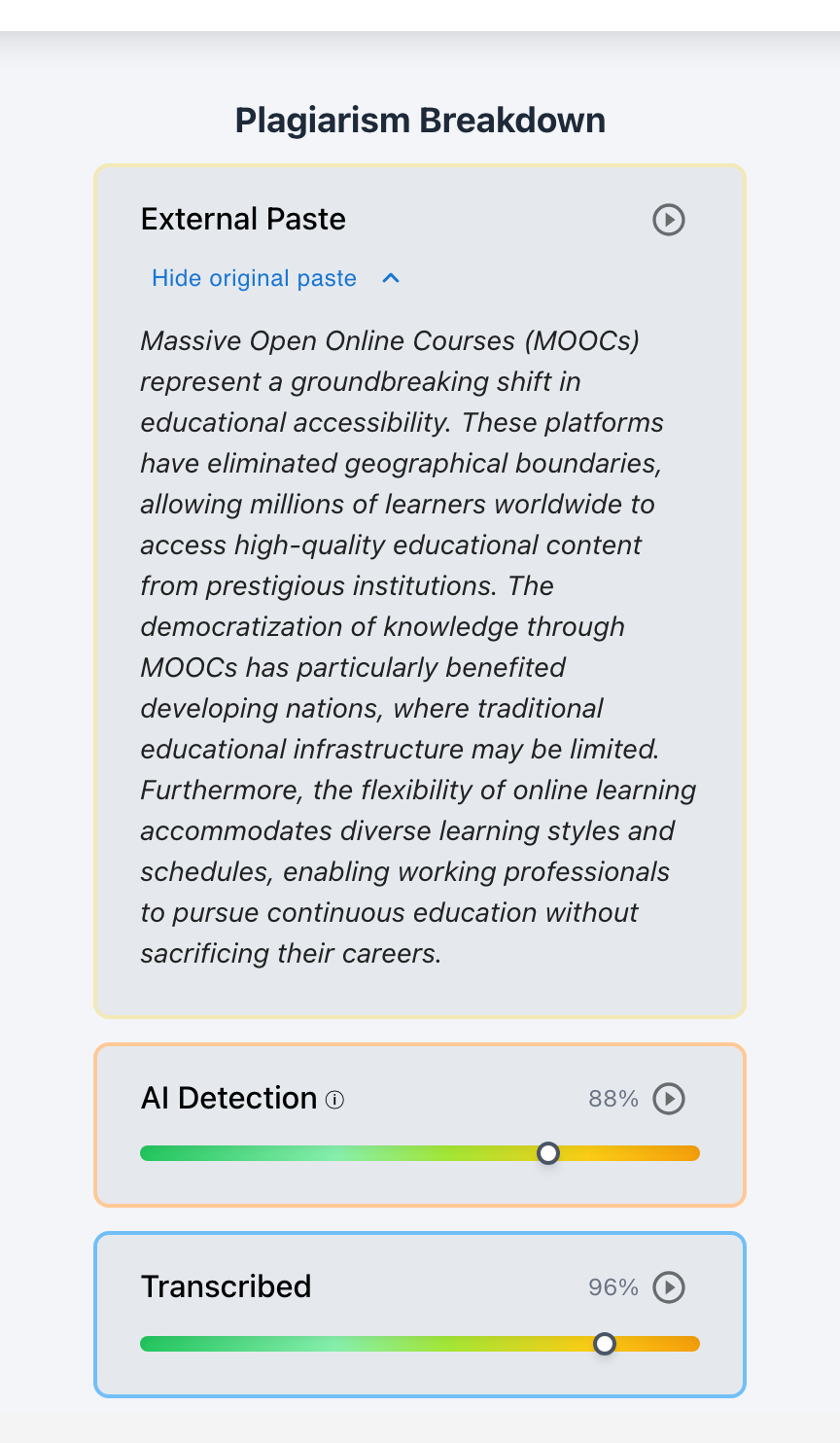
Scrub through keystroke sessions at 1x–8x speed, logging active typing time, organic pauses, and external paste events.
Multi-Factor Integrity
Passage-level AI detection with short-text guardrails, paired with side-by-side plagiarism comparisons and citation verification.
1. Patent-Pending Essay Playback™: The Ultimate Keystroke “Receipts”
When a student claims they spent ten hours drafting an essay, teachers no longer have to guess. With Checkmark's Essay Playback™, educators can scrub through the entire writing session like a video timeline at 1x to 8x speed:
- Organic Drafting Rhythm: Watch authentic composition pauses, sentence restructuring, backspacing, and real-time thesaurus lookups.
- External Paste Capture: Every external paste event is highlighted in yellow on the timeline, preserving the complete original pasted text even if the student subsequently edits or re-types it.
- Transcription Velocity Tracking: Detects mechanical, steady typing without natural pauses (e.g., when a student manually retypes text off a smartphone or secondary monitor).
- Protecting Honest Students: If an external black-box detector falsely accuses an authentic student, Essay Playback™ serves as undeniable forensic proof that exonerates the student instantly.
2. Passage-Level AI Writing Detection with Calibrated Confidence
Rather than stamping a terrifying, arbitrary whole-paper score (e.g., “78% AI Written”) that invites immediate parental outrage, Checkmark evaluates essays with passage-level granularity:
- Highlights only the specific sentences that exhibit high statistical predictability (perplexity) and uniform sentence length (burstiness).
- Displays a calibrated confidence slider for each passage in the sidebar, allowing teachers to review the linguistic pattern in context.
- Adheres to strict short-text guardrails: Below ~150 words, Checkmark displays
N/A, refusing to make unreliable guesses on insufficient data.
3. Defensible Plagiarism Matching with Uncited Source Differentiation
- Compares submissions against billions of live web pages, open-access journals, and internal student-to-student school repositories.
- Features side-by-side quote comparisons with direct, clickable source URLs.
- Specifically differentiates between blatant copy-paste plagiarism and uncited legitimate references, enabling educators to treat missing citations as a formative coaching opportunity rather than an automatic disciplinary offense.
Real-World Classroom Case Studies
The following real-world scenarios illustrate how quote-anchored rubric justifications and integrated process analytics protect educators and foster collaborative resolutions during high-stakes grading reviews.
The Context: A high-achieving senior in AP Literature received an 81% (B-) on a synthesis paper examining The Grapes of Wrath. The parents alleged that the teacher's score was biased against the student's economic thesis.
The Traditional Vulnerability: The LMS rubric contained a single generic comment: “Analysis of Great Depression economic factors lacks primary source integration.” The parents argued that the student had cited Milton Friedman twice and that points were docked unfairly.
The Outcome: Faced with concrete, verbatim textual anchors mapped directly to AP standards, the parents immediately recognized that the critique was purely methodological, not ideological. The conference shifted from adversarial confrontation to a constructive revision opportunity.
The Context: Marcus, a 10th-grade English student, received a 74% (C) on a persuasive essay. Frustrated and demoralized, Marcus came to office hours asserting that he had spent his entire weekend drafting and felt the teacher “just didn't like his writing style.”
The Outcome: Marcus left empowered. Because his effort was validated through playback, he completed a targeted 15-minute revision integrating a cited reservoir statistic, elevating his score to an 88% (B+).
The Context: An undergraduate student submitted a 2,500-word ethics paper with 4% plagiarism similarity. When questioned about suspicious prose, the student vehemently denied using AI and threatened formal administrative grievances.
The Outcome: Presented with the timestamped Essay Playback™ session and the raw paste buffer cache, the student immediately dropped the appeal and admitted to using a paid AI humanizer service. The integrity case was resolved without contentious administrative hearings.
Step-by-Step Educator Workflow: From Assignment Launch to Defensible Conferences
Implementing quote-anchored rubric justifications requires zero change to your established curriculum or LMS setup. Here is how educators utilize Checkmark's end-to-end evaluation suite across daily grading cycles:
Ingesting and Aligning Your Rubric Schema
- Direct LMS Sync: Connect Canvas LMS, Agilix Buzz, or Google Classroom via LTI 1.3 Advantage. Checkmark automatically imports course rubrics, criterion point weightings, and performance band descriptors.
- Custom & PDF Upload: Have a legacy rubric in Word or PDF? Checkmark's AST schema normalizer automatically converts tabular grids into standardized evaluation matrices in seconds.
Automated Multi-Factor Ingestion & First-Draft Evaluation
- Process Capture: Ingests Google Docs revision history or native editor keystroke streams to generate the Essay Playback™ timeline.
- Integrity Scans: Runs passage-level AI detection and side-by-side web/peer plagiarism checks.
- Quote-Anchored Autograding: Evaluates prose against every rubric criterion, identifying verbatim textual evidence and drafting preliminary scores and growth justifications.
Teacher Calibration in the Evaluator Console
The teacher opens Checkmark's unified console. The educator reviews drafted feedback, adjusts points, refines comment phrasing, or adds personal encouragement. Grading an in-depth 5-page research paper takes 3 to 4 minutes instead of 18 minutes.
One-Click Atomic LMS Grade & Feedback Passback
- The total numeric score and letter grade post directly into the Canvas or Buzz gradebook.
- The complete rubric breakdown—including individual criterion scores and quote-anchored justification cards—populates seamlessly inside Canvas SpeedGrader or the Buzz LMS Mastery Hub.
Conducting Bulletproof Student & Parent Conferences
During conferences, open the Checkmark report, click on the disputed criterion to reveal the exact student quotes that determined the score, scrub the keystroke timeline, and guide the student with actionable revision targets.
School District Policy, FERPA Compliance, and Departmental Standardization
1. Eliminating Departmental Grading Drift
A notorious challenge in secondary and postsecondary writing programs is inter-rater inconsistency: Teacher A grades leniently, awarding As to superficial essays, while Teacher B grades rigorously, awarding Cs to solid work. By standardizing on Checkmark's quote-anchored autograding engine, department chairs can host calibration sessions where all teachers review identical essays against quote-anchored benchmarks, ensuring equitable grading across all course sections.
2. Safeguarding Student Intellectual Property & Privacy
Many commercial AI utilities harvest uploaded student writing to train commercial models. Checkmark Plagiarism provides an ironclad institutional guarantee: zero model training on student data, SOC 2 compliance, TLS encryption in transit, AES-256 encryption at rest, and full adherence to FERPA and COPPA statutes.
Frequently Asked Questions (FAQs)
1. How does quote-anchored grading prevent parents from claiming a teacher was biased?
Traditional rubrics only provide broad category labels (e.g., “Developing,” “Proficient”), allowing parents to argue that the teacher's judgment was arbitrary or personally motivated. Quote-anchored justifications remove subjectivity by linking every score deduction directly to verbatim excerpts from the student's own writing. When a parent sees the exact sentence where a factual claim lacked evidence or where a logical leap occurred, the discussion shifts from debating teacher bias to discussing the student's actual text against objective curricular standards.
2. Can students see the highlighted quote anchors and feedback cards inside Canvas SpeedGrader?
Yes. Checkmark Plagiarism utilizes 1EdTech LTI 1.3 Advantage (Assignment and Grade Services - AGS 2.0). When an educator approves an evaluation in Checkmark, the complete criterion breakdown—including individual criterion point allocations, verbatim quote anchors, diagnostic explanations, and growth recommendations—is synced directly into Canvas SpeedGrader and the student's Canvas submission feedback pane. Students can also access their full interactive Checkmark report directly through their LMS portal if enabled by the instructor.
3. Does Checkmark automatically assign and publish grades without teacher review?
No. Checkmark is built entirely on a “Teacher-in-the-Loop” philosophy. The AI Autograder generates a comprehensive, quote-anchored preliminary draft. All scores and comments remain private to the instructor in the Teacher Calibration Console until the teacher reviews, adjusts, and officially approves them. Teachers retain 100% authority to override point values, rewrite comments, or add personal voice notes before syncing to the LMS gradebook.
4. How does quote anchoring handle creative writing or non-standard essay formats?
Checkmark's Rubric Studio allows educators to define custom criteria tailored to any genre—including narrative prose, poetry analysis, personal memoirs, lab reports, and historical DBQs (Document-Based Questions). The system's semantic grounding engine extracts textual anchors that correspond specifically to your custom criteria descriptors (such as character development, sensory imagery, or pacing) rather than enforcing rigid five-paragraph essay formulas.
5. What happens if a student uses an “AI Humanizer” to bypass AI detection?
While AI humanizers and paraphrasers (such as QuillBot or Undetectable AI) can alter surface vocabulary to reduce linguistic predictability scores, they cannot fake authentic writing behavior. Checkmark's patent-pending Essay Playback™ captures the complete keystroke timeline of the writing session. If a student uses an external AI humanizer, Checkmark records large blocks of text pasted into the document in seconds with zero natural drafting pauses, backspaces, or organic revisions—providing undeniable proof of unauthorized external generation.
6. Will quote-anchored autograding work if my district uses Agilix Buzz LMS or Google Classroom instead of Canvas?
Yes. Checkmark provides enterprise-grade integrations across the entire K-12 and higher education LMS ecosystem, including Canvas LMS, Agilix Buzz, Google Classroom, and Moodle. The system synchronizes assignments, rosters, rubrics, criterion scores, and quote-anchored feedback seamlessly across all supported platforms.
7. How does Checkmark ensure that the AI does not hallucinate quotes that are not in the essay?
Unlike consumer LLMs (such as ChatGPT or Claude) that generate freeform summaries prone to hallucinations, Checkmark's grounded autograding pipeline uses a specialized constraint-based text-matching architecture. The system physically extracts verbatim substrings directly from the student's submission document object model (DOM) and binds them to the rubric schema. If a specific criterion cannot be anchored in verifiable student prose, the system flags the criterion for manual instructor inspection rather than generating synthetic text.
8. How much time does quote-anchored autograding actually save teachers per grading cycle?
District pilot studies demonstrate that Checkmark reduces essay evaluation time by 60% to 75%. For a high school English teacher with 150 students, total grading time drops from approximately 30 hours per assignment to 8–10 hours. Furthermore, because quote-anchored feedback is so explicit and transparent, post-assignment grade dispute emails and parent conference requests decrease by more than 85%.
Conclusion: Transform Grading from an Exhausting Defense into an Empowering Partnership
Educators entered the teaching profession to inspire young minds, cultivate critical thinking, and help students master the art of written expression—not to spend their weekends defending subjective grading marks against hostile emails.
By uniting quote-anchored rubric justifications, patent-pending Essay Playback™ keystroke dynamics, and multi-factor integrity verification into a single, teacher-in-the-loop platform, Checkmark Plagiarism restores trust, transparency, and joy to writing instruction.
Stop guessing, start trusting.
Equip your department with the objective evidence needed to defend every grade, support every student, and eliminate grading burnout for good.