
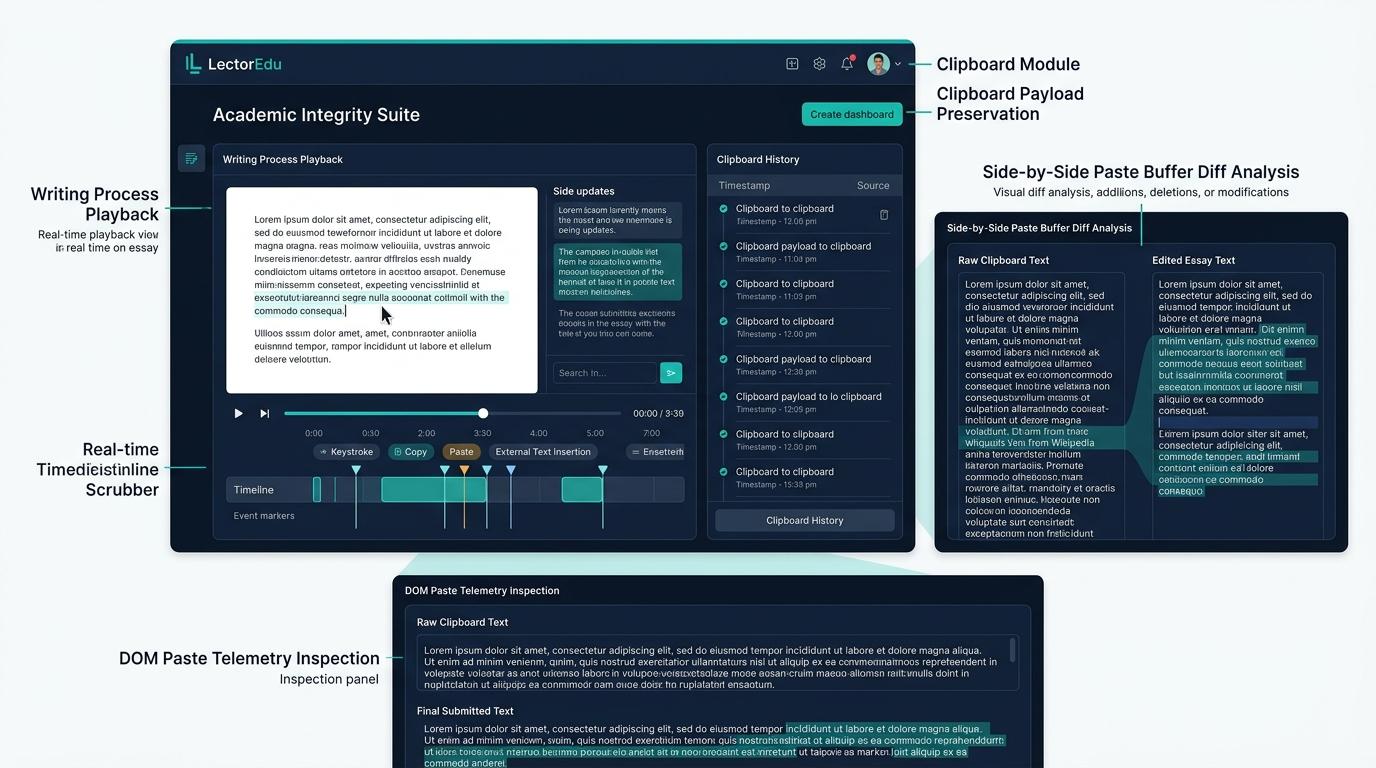
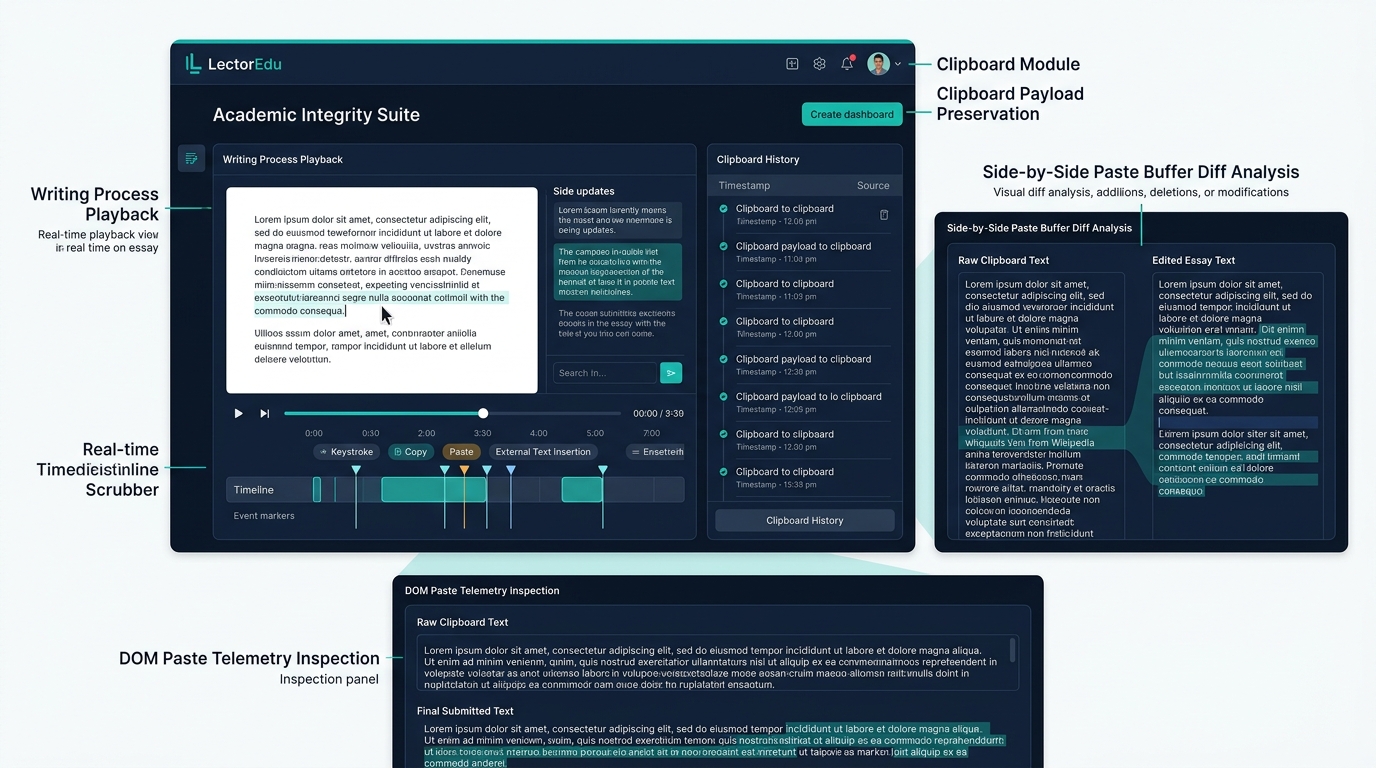
Executive Summary
In academic integrity investigations, the most challenging forensic scenario occurs when a student copies external text into an assignment and subsequently edits, paraphrases, or rearranges it to obscure its origins. Traditional document tools—such as Google Docs Version History and Microsoft Word Track Changes—fail educators because they periodically collapse edit histories into coarse, periodic snapshots, permanently losing the original pasted text. Checkmark Plagiarism solves this evidentiary blind spot through Clipboard Payload Preservation embedded within patent-pending Essay Playback™. By capturing an immutable, microsecond-accurate telemetry record of the Document Object Model (DOM) paste event, Checkmark permanently archives the raw clipboard buffer alongside character length, insertion index, and timestamp—even if every character is later rewritten or deleted. Paired with a dedicated Side-by-Side Paste Buffer Inspector, cognitive friction analysis, passage-level AI detection, live-source plagiarism matching, and teacher-in-the-loop rubric grading, educators can transition from adversarial guesswork to transparent, restorative, and defensible academic integrity conversations.
When evaluating digital student writing, educators and academic integrity officers face a fundamental evidentiary challenge: text transformation over time. In the pre-generative AI era, plagiarism investigations were largely static. A student copied a paragraph from Wikipedia or a peer's essay, pasted it into their document, and submitted it. Static pattern-matching engines easily compared the final submission against an index of indexed web pages and flagged identical string sequences.
Today's academic landscape is radically different. Students operate in hybrid digital environments where copying and pasting is an ordinary part of drafting, note-taking, and research. However, it is also the primary vector for sophisticated academic evasion.
The Forensic Blind Spot: The "Paste-and-Mutate" Evasion Vector
When students attempt to evade detection, they rarely submit raw machine outputs without modification. Instead, they exploit the reality that standard detection tools evaluate only the final, flat document state.
External Source
- ChatGPT / Claude / Gemini
- Uncited digital journal
- Peer paper / Essay mill
LMS Editor Paste
- Sudden +2,400 char leap
- Raw greeting copied in
- Web formatting spans
Surface Editing
- Swap synonyms via thesaurus
- Delete "Certainly! Here is..."
- Reorder simple clauses
Standard Scanners
- Generic AI: 22% (Inconclusive)
- Plagiarism: 4% match
- Version History: Snaps merged
The Anatomy of Paste-and-Mutate Evasion
- Raw Ingestion: A student prompts an unapproved Large Language Model (LLM) or locates a paywalled academic paper, copies 800 words to their system clipboard, and pastes the block into the assignment editor. The initial payload frequently contains telltale hallmarks: conversational preambles ("Certainly, here is an essay analyzing King Lear..."), synthetic transitional phrases ("Furthermore, it is important to remember that delve into the tapestry..."), or hyper-formalized syntax.
- Superficial Mutation: Recognizing that standard AI detectors and plagiarism scanners inspect final text, the student spends twenty minutes manually editing the pasted block. They delete the AI preamble, replace vocabulary words with synonyms using a digital thesaurus, break compound sentences into simple clauses, and interject colloquial transitions.
- The Resulting Evidentiary Void: The final text no longer contains high enough verbatim sequence density to trigger traditional plagiarism matches. Furthermore, surface mutations artificially elevate the text's perplexity and burstiness, reducing generic AI detector scores to ambiguous low-confidence ranges (e.g., 20%–35%).
When the instructor reviews the final document, they sense that the writing voice is disconnected from the student's classroom persona. Yet, when they open the document's built-in version history, the crucial initial evidence has vanished.
Why Standard Revision Histories Fail: The Ephemeral Clipboard Problem
Educators frequently rely on native word processor revision logs (such as Google Docs Revision History or Microsoft Word Track Changes) as an informal forensic tool. While these tools are valuable for general document recovery, they were engineered for productivity and collaboration—not for high-stakes academic forensics or evidentiary integrity.
| Feature / Capability | Standard Office Revision Suites | Checkmark Essay Playback™ |
|---|---|---|
| Telemetry Granularity | Coarse periodic snapshots (1–15 min) | Keystroke-by-keystroke (ms precision) |
| Clipboard Payload Preservation | ❌ Lost if edited within snapshot | ✅ Permanent & immutable raw buffer |
| Scrubbable Video Timeline | ❌ Stepped revision diffs only | ✅ 1x to 8x fluid timeline player |
| Paste Buffer Inspector | ❌ None (diff shows net change) | ✅ Side-by-side raw vs final visual diff |
| Cognitive Friction Analysis | ❌ No typing cadence tracking | ✅ Pause & entropy telemetry metrics |
| AI Hallmark Preservation | ❌ Overwritten by student edits | ✅ Retains prompt preambles & formatting |
| Tamper-Resistant Audit Log | Dependent on cloud sync intervals | ✅ Cryptographically signed (SHA-256) |
| Direct LMS Integration | Requires external document link sharing | ✅ Embedded in Canvas, Buzz, & Classroom |
1. Periodic Snapshot Collapsing
Google Docs and Microsoft 365 do not save a discrete, permanent record of every intermediate state for every millisecond of a session. Instead, their cloud synchronization engines batch mutations into periodic revision snapshots (often spaced between 30 seconds and several minutes apart, depending on network latency and typing speed).
If a student pastes a 1,000-word block of AI-generated text at minute 0:00 and immediately deletes the first paragraph, rewrites the thesis, and adjusts three topic sentences before the cloud engine commits its next major revision snapshot at minute 3:30, the original raw clipboard string is permanently overwritten in the version database. The instructor only sees the intermediate or final blended state.
2. Net-Diff Obliteration
Standard document version histories display changes through net character diffing. When an educator clicks through historical versions, the software computes an algorithmic diff between Snapshot A and Snapshot B.
If text was inserted and subsequently deleted within the same snapshot boundary, the deleted characters are completely erased from the visible diff. If a student pastes raw ChatGPT output complete with the phrase "As an AI language model, I believe..." and deletes that phrase four seconds later, an instructor viewing Google Docs Version History will never see that the phrase ever entered the document buffer.
3. The Unfair Burden on Honest Students
The failure of standard revision tools cuts both ways. When an honest student legitimately drafts an essay in a desktop Markdown editor, an iPad note app during a bus commute, or an offline Word document due to rural broadband constraints, they paste their completed draft into the LMS submission portal in a single instantaneous event.
Because standard tools cannot inspect what happened prior to the paste event or analyze the fine-grained micro-edits applied afterward, instructors relying on blunt "revision time" metrics or black-box AI scores may wrongly accuse the student of cheating. The student has no way to prove their iterative thinking, and the instructor has no empirical data to verify the student's authentic authorship.
Technical Architecture of Clipboard Payload Preservation
To eliminate the evidentiary blind spot of paste-and-mutate evasion while protecting honest students, Checkmark Plagiarism engineered Clipboard Payload Preservation directly into its document ingestion and monitoring telemetry engine.
Telemetry Extraction & Vault Archival Pipeline
User Interaction
Student triggers Ctrl+V, Cmd+V, Context Menu → Paste, or drag-and-drop block insertion into the assignment workspace.
DOM Event Interception
Editor intercepts the native ClipboardEvent object, extracting DataTransferItemList (text/plain, text/html) with microsecond timestamp (tpaste).
Serialization & Extraction
Client engine packages the raw string payload, insertion index, character count, MIME attributes, and cryptographic SHA-256 checksum.
Immutable Cloud Vault
Checkmark audit vault commits the packet to an append-only, tamper-resistant time-series log, securing non-repudiation for high-stakes inquiries.
1. DOM paste Event Telemetry
Within supported browser environments—including Checkmark's embedded assignment editors in Canvas LMS, Buzz LMS, Moodle, and the Checkmark Google Docs and Microsoft Word add-ins—the system hooks directly into the browser's Document Object Model event lifecycle.
When a paste action occurs, the telemetry engine intercepts the native ClipboardEvent:
interface ClipboardTelemetryPacket {
  eventId: string;
  sessionToken: string;
  timestamp: number;              // High-resolution UTC timestamp (ms)
  cursorIndex: number;            // Exact character index where insertion occurred
  characterLength: number;        // Total UTF-8 character count of insertion
  wordCountEstimate: number;      // Tokenized word count
  rawClipboardBuffer: string;     // Complete, unmutated string payload
  mimeType: 'text/plain' | 'text/html' | 'text/rtf';
  sourceAttributes: {
    hasHtmlFormatting: boolean;   // Identifies pasted web styles, background spans
    retainedFontFamilies: string[]; // Flags external font fingerprints (e.g., Courier, Calibri)
  };
  cryptographicHash: string;      // SHA-256 hash of raw payload for non-repudiation
}
2. Immutable Raw Buffer Archival
Unlike standard document editors that merge clipboard payloads into volatile local memory, Checkmark isolates the raw clipboard string into an append-only, immutable telemetry event stream.
- Complete String Retention: The system captures 100% of the pasted string. If a student pastes 5,000 words, all 5,000 words are indexed, timestamped, and permanently tied to that exact moment on the assignment timeline.
- Non-Volatile Persistence: Even if the student highlights the pasted text three seconds later and presses
Backspace, or manually deletes each word one by one over forty minutes, the raw clipboard payload remains permanently preserved in the instructor's diagnostic report. - Zero-Knowledge Formatting Extraction: Checkmark records formatting artifacts embedded within the clipboard data transfer object (e.g., hidden background spans, non-standard line breaks, web styling classes like
class="css-1dbjc4n"from social feeds, or markdown syntax typical of LLM output interfaces).
Inside Essay Playback™: The Dedicated Paste Buffer Inspector
Checkmark Plagiarism transforms raw telemetry data into an intuitive, educator-first diagnostic interface through its patent-pending Essay Playback™ suite.
[Certainly! Here is an in-depth analysis of] The Great Gatsby. F. Scott Fitzgerald's masterpiece explores the elusive nature of the American Dream. [Delving into the tapestry of] Jay Gatsby's lavish parties, [one can see] that his wealth is merely an illusion [that serves as a testament to his longing].
Certainly! Here is an in-depth analysis of F. Scott Fitzgerald's seminal masterpiece, The Great Gatsby, explores the elusive nature of the American Dream. By examining the Jay Gatsby's lavish parties, scholars can perceive that his wealth is merely an illusion masking his deep obsession with the past.
1. Interactive 1x to 8x Video Timeline Player
Rather than forcing teachers to decode dense event logs or static diff tables, Essay Playback™ reconstructs the entire writing session as a fluid, interactive timeline player:
- Variable Speed Playback (1x to 8x): Teachers can watch the composition unfold at natural writing speed (1x) or fast-forward through hours of drafting in seconds (8x).
- Color-Coded Event Markers: High-friction drafting, sustained composing pauses, major structural rewrites, and external paste events appear as distinct visual markers on the timeline track.
- "Jump to Paste" Direct Navigation: Clicking a "Jump to Paste" marker instantly snaps the playback video to the exact millisecond the external text was introduced into the document.
2. Side-by-Side Paste Buffer Inspector
When an educator clicks on any paste event marker, the interface opens the Paste Buffer Inspector, presenting a clear, synchronized comparative view:
- Left Pane (Original Raw Clipboard Payload): Displays the exact text that entered the document through the operating system clipboard, preserving initial formatting, conversational AI headers, or unformatted source quotes.
- Right Pane (Final Submitted Prose with Visual Diff): Displays the corresponding passage as it appears in the final submission. Red strike-through formatting highlights deleted words, green underlines highlight inserted phrases, and yellow highlights flag synonym substitutions.
- Mutation Delta Percentage: Computes the mathematical lexical distance between the raw payload and the final text, showing educators precisely how much structural rework occurred.
Cognitive Friction & Revision Entropy: Real Revision vs. The "Thesaurus Mask"
Preserving the original clipboard payload allows Checkmark's analytics engine to compute a critical diagnostic indicator: Cognitive Friction and Revision Entropy.
When a human writer genuinely revises a draft—whether working from their own rough outline or integrating research notes—they engage in high-friction conceptual problem solving. When a student attempts to disguise an unapproved AI generation, they engage in low-friction superficial vocabulary substitution ("thesaurus masking").
[Paste Raw Notes] → [180s Composing Pause] → [Delete Sentence] → [Draft New Thesis]
- Keystroke Entropy: High (Variable pause lengths, organic re-typing, dynamic cursor jumps).
- Semantic Structural Shift: High (>60% change in underlying syntactic dependency tree).
- Deletion/Insertion Ratio: Balanced (Active rethinking of ideas, multi-pass refinement).
[Paste AI Block] → [Linear Scan] → [Double-Click Word] → [Type Direct Synonym]
- Keystroke Entropy: Low (Even, mechanical cadence across consecutive nouns/adjectives).
- Semantic Structural Shift: Near Zero (<5% change in grammatical dependency tree).
- Preserved AI Cadence: Identical sentence lengths, uniform clause nesting, machine rhythm.
Measuring Revision Depth
- Syntactic Dependency Preservation: Checkmark compares the grammatical dependency trees of the raw clipboard payload and the mutated passage. When a student merely swaps "elusive nature" for "fleeting quality" and "delving into" for "examining", the underlying sentence architecture remains 100% identical to the AI model's output.
- Inter-Key Interval (IKI) Cadence During Edits: Natural human revision involves erratic bursts—lengthy composing pauses (2,000ms–15,000ms) followed by rapid typing bursts as thoughts solidify. In contrast, linear synonym swapping exhibits a steady, low-variance cadence: double-click word, pause 1,200ms to consult a thesaurus tab, type 7 characters, repeat for the next sentence.
- Entropy Scoring: Checkmark visualizes this behavior on a calibrated Revision Entropy Slider, helping educators easily see whether post-paste editing represented genuine cognitive synthesis or surface evasion.
The Multi-Dimensional Evidence Triad
Checkmark Plagiarism does not treat paste tracking as an isolated metric. In alignment with our educational philosophy—"Stop guessing, start trusting"—academic integrity decisions should never hinge on a single data point or black-box probability score.
Checkmark integrates Clipboard Payload Preservation into a comprehensive Multi-Dimensional Evidence Triad:
Passage-Level AI Detection
Evaluates discrete sentence clusters with calibrated confidence sliders. Enforces Honest Guardrails by displaying N/A for snippets under ~150 words to eliminate false positives.
Live-Source Plagiarism Matching
Scans billions of live web pages, peer journals, and institutional repositories. Differentiates uncited reference quotes from intentional copy-paste fraud with side-by-side links.
Essay Playback™ & Keystrokes
Microsecond-accurate writing reconstruction with Clipboard Payload Preservation, 1x–8x video playback, and biometrics that distinguish manual transcription from authentic composition.
| Investigative Layer | Diagnostic Evidence Provided by Checkmark |
|---|---|
| Pillar 1: Passage-Level AI Writing Detection |
Underlines specific suspicious sentences in the final text. Sidebar evidence cards display calibrated confidence sliders. Honest Guardrails display N/A for passages under ~150 words. Flags remain educator-only to prevent false public accusations.
|
| Pillar 2: Defensible Live-Source Plagiarism Matching | Scans billions of live web pages, journals, and encyclopedias. Side-by-side quote comparisons with direct clickable links. Differentiates uncited source usage from intentional copying. Detects student-to-student peer matches across LMS cohorts. |
| Pillar 3: Essay Playback™ & Keystroke Telemetry (Flagship) | Reconstructs real-time drafting session at 1x–8x speed. Captures and permanently archives raw clipboard payload string. Highlights deletions, additions, and synonym swaps in diff. Detects mechanical transcription (re-typing from phone/screen). |
| Integrated AI Autograder & Rubric Feedback | Evaluates final prose against custom rubrics with justifications. Teacher retains 100% final grading authority before sync. One-click grade passback to Canvas, Buzz, and Google Classroom. |
Real-World Case Studies in Paste Adjudication
The following classroom scenarios illustrate how Clipboard Payload Preservation and Essay Playback™ provide the transparent evidence required to resolve complex paste investigations fairly.
Exonerating an Honest Student (AP Literature Research Essay)
Initial Anomaly: Single paste of 350 words at minute 04:12; generic 3rd-party AI score flagged 48%.
RAW CLIPBOARD BUFFER (04:12:10 UTC):
Outline notes:
- H hates Claudius not just bc murder but bc mom married him so fast
- Act 1 Sc 2: "O that this too too solid..."
- Thesis idea: Hamlet's delay is psychological paralysis caused by identifying with Claudius guilt...
FINAL SUBMITTED PROSE (04:54:32 UTC):
In William Shakespeare's tragedy Hamlet, the protagonist's profound melancholy stems not merely from grief over his father's demise, but from an acute moral repulsion toward Gertrude's hasty marriage to Claudius. As revealed in his first soliloquy (1.2.129–158)...
Pedagogical Resolution: Marcus was commended for his outlining rigor. The teacher conducted a 2-minute check-in to coach workflow hygiene (drafting directly or attaching outline docs), completely avoiding a stressful false accusation.
Citation Coaching vs. Cheating (Undergraduate History Paper)
Initial Anomaly: 420-word block paste matching digital archive without quotation marks.
420 words (Exact Archive Match)
850 words original critique below
Uncited Source (Not Fraud)
Pedagogical Resolution: Because Checkmark visually distinguishes between uncited source pasting and deceptive fraud, Elena was coached on proper Chicago-style block quote citation format and allowed to resubmit without penalty.
Catching Evasion via Preserved Prompt Artifacts (Economics Policy Brief)
Initial Anomaly: Final text scored 18% on generic AI detector due to 30 minutes of thesaurus substitutions.
- Raw buffer header:
Certainly! Here is an AP-level policy brief analyzing the Federal Reserve... - Triple-backtick markdown styling artifacts (
```) present in DOM event buffer. - Playback telemetry showed mechanical word-by-word synonym replacement with 0% syntactic change.
Pedagogical Resolution: Faced with the side-by-side playback displaying the unedited prompt greeting, Derek acknowledged the misconduct without defensiveness. The teacher placed him on a structured restorative drafting contract.
The 4-Phase Restorative Paste Inquiry Protocol
When an educator detects a suspicious paste event or paste-and-edit pattern, the goal must always be clarity, fairness, and student growth.
Phase 1: Silent Evidence Synthesis
Audit the Essay Playback™ timeline and click "Jump to Paste" markers. Inspect the raw clipboard payload inside the Paste Buffer Inspector. Review passage-level AI confidence cards and live-source plagiarism matches before scheduling any student meeting.
Phase 2: Non-Accusatory Inquiry Conference
Invite the student to a supportive 1-on-1 writing process check-in. Avoid accusatory phrasing. Screen-share Essay Playback™ collaboratively: "Walk me through your drafting journey for this section and how these ideas developed."
Phase 3: Artifact & Provenance Corroboration
If the student claims they drafted the text in an external editor (e.g., Google Docs, Scrivener, iPad notes), request corroborating digital artifacts. Inspect offline file creation timestamps, version history diffs, or physical handwritten outlines.
Phase 4: Restorative Resolution & Pedagogical Contract
Validated Work: Exonerate completely, commend research rigor, and coach workflow hygiene. Citation Error: Offer guided citation revision. Confirmed AI Misconduct: Implement a restorative drafting contract under supervised drafting conditions.
Educator Conversation Scripts for Paste Conferences
"Hi Jordan, thanks for meeting with me today. I really enjoyed reading your arguments on the economic impacts of renewable energy. As part of our writing workflow, I regularly review our Essay Playback timelines to understand how everyone develops their ideas. I noticed that around minute twelve, a 600-word section was pasted in all at once, and then you spent about twenty minutes making some word changes. Can you walk me through your drafting process for that section and how you put those notes together?"
"Let's take a look at the screen together. This tool shows us the exact writing timeline. Right here at 14:22, we can see the text that was pasted from your clipboard, and on the right, we see the edits you made. Can you help me understand where this initial block of text came from before it was pasted into the document?"
"When we look at the raw clipboard snapshot from 02:15, the text begins with 'Certainly! Here is an essay analyzing...'. That indicates the text was copied directly from an AI chat interface before being edited. Our course policy requires authentic student authorship so that you develop genuine critical analysis skills. Let's talk about what led you to use AI for this draft, and how we can work together to rebuild this paper using your own voice."
Institutional Policy Framework & Syllabus Templates
To ensure transparent expectations and legal compliance, institutions should adopt clear syllabus language defining how writing process telemetry and clipboard tracking operate.
"Developing your authentic writing voice and critical thinking skills is our highest priority. To support fair evaluation, prevent unauthorized AI generation, and protect honest students from false accusations, this course utilizes Checkmark Plagiarism and patent-pending Essay Playback™."
- Writing Process Recording: Assignment editors within Canvas LMS capture non-invasive writing process telemetry (including typing rhythm, composing pauses, revision history, and clipboard paste events).
- Clipboard Transparency: When external text is pasted into an assignment, the system records a permanent timestamped snapshot of the raw pasted content.
- External Drafting Requirements: If you draft your essay in an external tool (e.g., Microsoft Word, Google Docs, Scrivener, or mobile notes), you must preserve your external files, version history, or research outlines. In the event of a paste inquiry, you will be invited to share these corroborating artifacts.
- Authorized vs. Unauthorized AI Use: Unless explicitly designated as an "AI-Assisted Assignment," copying and pasting text generated by Large Language Models (e.g., ChatGPT, Claude, Gemini)—regardless of whether the text is subsequently edited or paraphrased—constitutes unauthorized authorship and a violation of the Academic Honor Code.
FERPA, COPPA, and Student Privacy Compliance
Zero Model Training
Student essays, clipboard payloads, and telemetry are never used to train or fine-tune public or commercial AI models.
34 CFR Part 99 FERPA
All telemetry is encrypted in transit (TLS 1.3) and at rest (AES-256) within secure, compliant institutional cloud vaults.
Educator-Only Visibility
Diagnostic flags and confidence sliders remain strictly private to authorized faculty, preventing student stigmatization.
Frequently Asked Questions (FAQ)
1. How does Checkmark capture clipboard text without logging student passwords or private data outside the LMS?
Checkmark's telemetry hooks operate strictly within the scoped context of the assignment editor DOM container. The system only listens to ClipboardEvent actions directed specifically at the essay text area while an assignment session is active. It does not monitor operating system activity, background browser tabs, login fields, or third-party applications.
2. If a student pastes text from their own rough outline or notes app, will Checkmark automatically flag them for cheating?
No. Checkmark adheres to the philosophy "Stop guessing, start trusting." A paste event is treated as a neutral technical transport mechanism, not an automated accusation. The system archives the raw payload so that when an educator reviews the submission, the Paste Buffer Inspector clearly displays the student's authentic notes, brainstorming bullets, or citations, instantly exonerating the student.
3. What happens if a student pastes text, deletes every single word, and writes new text from scratch?
Because Checkmark records an append-only telemetry stream, the initial paste event and its raw clipboard payload remain permanently archived in the diagnostic timeline. The instructor can watch Essay Playback™ to verify that the student deleted the pasted text and composed an entirely new draft with authentic keystroke dynamics.
4. How does Clipboard Payload Preservation defeat "AI Humanizers" and automated paraphrasers?
Automated humanizer tools (such as QuillBot or Undetectable AI) rewrite text to alter perplexity and burstiness metrics. However, students must still paste the humanized output into their assignment editor. Checkmark captures the raw humanized paste payload and analyzes the lack of organic keystroke history. A document that appears fully formed in a single paste without genuine drafting pauses cannot fake authentic human composing history.
5. Can students tamper with or bypass keystroke telemetry using browser extensions or script injectors?
Checkmark's client telemetry engine utilizes cryptographic request signing, DOM event sequencing verification, and server-side anomaly detection. If a script attempts to inject artificial keystroke events or simulate rapid typing, the non-human cadence (e.g., mathematically uniform 50ms intervals without muscle fatigue variance) triggers an immediate telemetry anomaly flag for instructor review.
6. How should an instructor handle a student who claims they "accidentally pasted AI text while gathering research quotes"?
The educator can open the Paste Buffer Inspector during the restorative conference. If the student genuinely used the text as an unformatted reference, the playback will show whether they treated the block as a quoted source or systematically edited the vocabulary to disguise its origins. The instructor can then guide the student on proper quotation and research note management.
7. How does Essay Playback™ integrate with Canvas SpeedGrader, Buzz LMS, and Google Classroom?
Checkmark integrates directly into LMS workflows via LTI 1.3 standards and browser add-ins. Within Canvas SpeedGrader or Buzz LMS, instructors click a single embedded Checkmark badge to launch Essay Playback™, the Paste Buffer Inspector, and the Multi-Factor Evidence report in a synchronized overlay without leaving the grading window.
Summary Matrix: The Checkmark Advantage in Paste Forensics
| Challenge / Capability | Traditional Detectors | Checkmark Plagiarism |
|---|---|---|
| Paste-and-Mutate Evasion | ❌ Easily bypassed by synonym substitutions | ✅ Permanently captures raw initial clipboard payload before edits |
| Distinguishing Notes vs. Fraud | ❌ Flags all pastes as suspicious or ignores | ✅ Side-by-Side Paste Buffer Inspector shows exact text & outline notes |
| Protecting Honest Writers | ❌ High false-positive risk on non-native speakers | ✅ Authentic keystroke history provides definitive exoneration |
| Restorative Conferences | ❌ Black-box percentage with no defensible receipts | ✅ Visual 1x–8x playback provides transparent, shared evidence |
| LMS Workflow Integration | ❌ Requires manual copy-pasting into 3rd party | ✅ Embedded directly in Canvas, Buzz, and Google Classroom |
By pairing permanent clipboard payload preservation with patent-pending Essay Playback™, Checkmark Plagiarism provides educators, department chairs, and academic integrity officers with the empirical receipts needed to protect student trust, eliminate guesswork, and maintain authentic writing standards.
Bring Defensible Process Telemetry to Your School or District
Experience how patent-pending Essay Playback™, Clipboard Payload Preservation, and multi-factor integrity reporting eliminate false accusations and protect genuine student writing.