
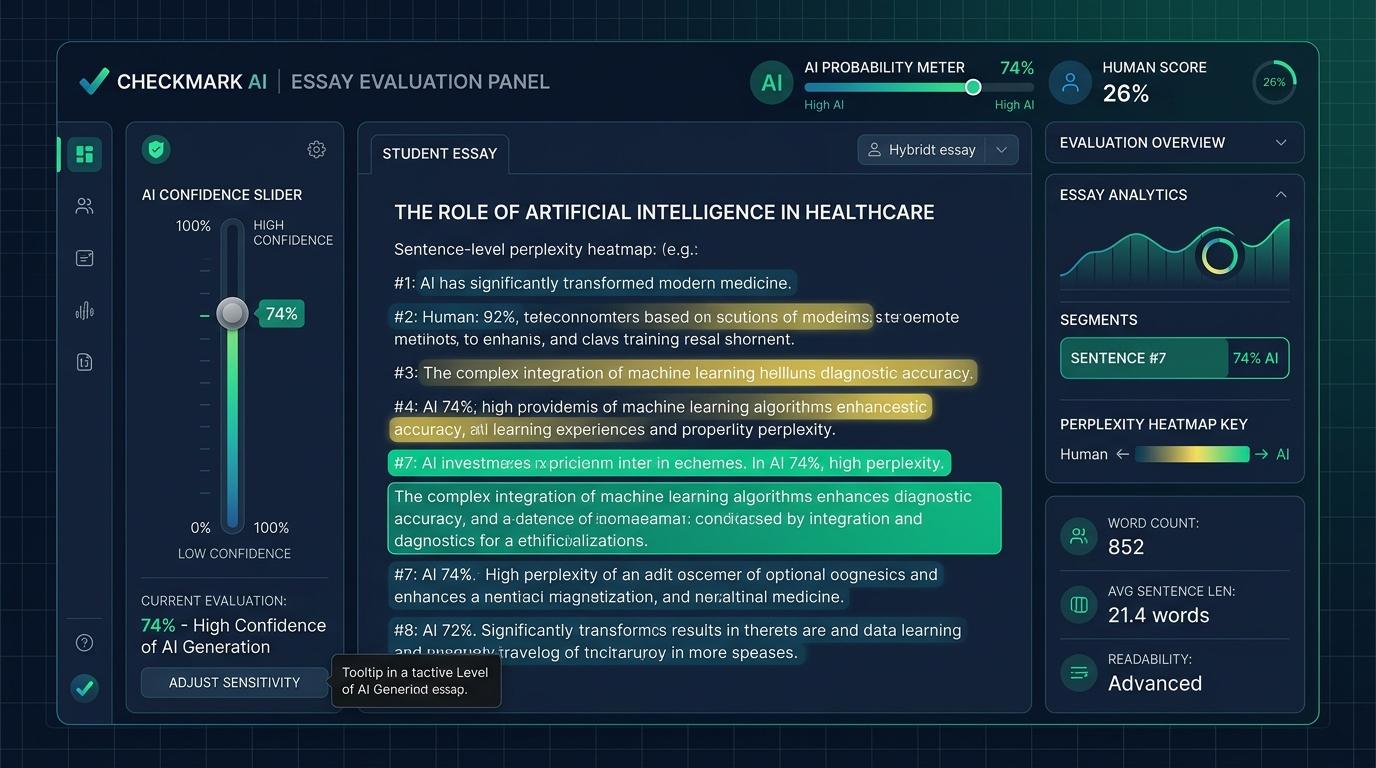
The binary paradigm of student writing—where an essay was either 100% human-crafted or 100% plagiarized—is obsolete. Today’s K-12 and higher education classrooms operate in a hybrid writing reality: students legitimately use artificial intelligence for brainstorming, topic exploration, and grammar refinement, while occasionally inserting unapproved machine-generated paragraphs under time pressure. When legacy academic integrity tools summarize complex multi-page drafts with a single, opaque document percentage (e.g., “42% AI Detected”), they create an untenable administrative crisis. These aggregate scores commit a dangerous dual error: they falsely accuse honest students whose authentic prose is mathematically averaged with standard phrasing, while failing to provide actionable evidence for isolated AI insertions. Checkmark Plagiarism solves this dilemma through Granular Passage-Level AI Detection paired with Calibrated Educator Confidence Sliders. By analyzing linguistic perplexity and burstiness sentence-by-sentence, providing interactive sensitivity controls, and corroborating statistical patterns with patent-pending Essay Playback™ keystroke dynamics, Checkmark replaces punitive guesswork with transparent, defensible process evidence.
Checkmark Plagiarism equips educators to navigate the hybrid drafting era by combining passage-level AI detection with patent-pending Essay Playback™, comprehensive plagiarism checking, quote-anchored rubric autograding, and deep LMS integrations for Canvas LMS, Buzz LMS, and Google Classroom.
The Emergence of the “Hybrid Draft”: The Reality of Modern Classroom Writing
In contemporary secondary and post-secondary humanities courses, writing is no longer an isolated, single-sitting endeavor. Students navigate rich digital ecosystems—researching across web databases, using digital thesauruses, brainstorming with generative assistants, drafting in cloud processors like Google Docs or Microsoft Word, and submitting via Canvas LMS or Buzz LMS.
Within this workflow, student authorship exists along a broad continuum of AI integration:
Organic Composition
- 100% human prose
- Natural typing pauses
- Authentic revisions
AI Outline & Brainstorm
- AI idea exploration
- Student drafts all text
- Full keystroke proof
Sentence Polish
- Student writes draft
- AI polishes cadence
- Mixed linguistic flow
Patchwriting & Pastes
- 80% human composition
- 1–2 unapproved AI pastes
- Time-crunch insertion
Full Generation
- Full prompt dumped
- Zero human authoring
- Instant external paste
Consider the typical experiences of modern educators:
- The Brainstorming Scaffold (Tier 2): An AP English Language student uses an LLM to generate five counterarguments against a prompt on algorithmic bias. The student selects one argument, closes the AI window, and spends three hours organically drafting a four-page essay. The conceptual architecture was AI-assisted, but every sentence, transition, and rhetorical device was penned by the student.
- The Polish and Refinement (Tier 3): An English Language Learner (ELL) writes an authentic draft with rich literary insights but non-standard syntax. The student runs two complex paragraphs through an AI tool with the prompt: “Fix grammatical flow while keeping my ideas.” The resulting passage contains machine-optimized syntax wrapped around organic student thinking.
- The Panic Patch (Tier 4): A college first-year composition student writes 85% of a research paper over three days. At 1:30 AM before the 2:00 AM deadline, fatigued and missing two supporting analysis paragraphs, the student generates two paragraphs in ChatGPT, pastes them into Section III, adjusts two words, and submits.
When an instructor receives these submissions, legacy detection software collapses these vastly different drafting histories into a single, unhelpful number: 38% AI.
What does “38% AI” mean to a teacher? Did the student generate 38% of the sentences? Is the detector 38% confident that the entire paper was written by ChatGPT? Does it mean the student used AI for 38% of their ideas?
Because legacy tools provide no passage-level visibility or interactive sensitivity calibration, teachers are forced to guess. This guesswork erodes trust, triggers adversarial disciplinary hearings, and leaves educators vulnerable to administrative appeals.
The Catastrophic Failure of Binary Whole-Paper AI Scores
Legacy AI detectors evaluate student work through a flawed paradigm borrowed from traditional string-matching plagiarism tools. By attempting to compress a multi-page document into a single aggregate index, whole-paper detectors fail educators in three critical ways.
Arbitrary institutional cutoffs (e.g., >20% triggers referral) penalize honest essays that contain formal academic formulas while letting targeted AI paragraph insertions slide undetected.
Averaging cross-entropy across 2,000 words washes out localized AI injections (PPL ≈ 12) when surrounded by highly idiosyncratic human prose (PPL ≈ 85).
Attempting to score short, isolated phrases produces massive statistical variance and false flags. Checkmark enforces an explicit <150-word N/A guardrail to prevent false accusations.
1. The “All-or-Nothing” Threshold Trap
When school districts adopt whole-paper AI detection tools, administrators frequently establish arbitrary institutional thresholds:
- 0% to 15% AI Score: Deemed “Authentic Human.”
- 16% to 49% AI Score: Labeled “Ambiguous / Inconclusive.”
- 50% to 100% AI Score: Flags an automatic disciplinary referral or zero.
This policy architecture creates an untenable dilemma. An essay containing an authentic, student-authored analysis that happens to use formal academic phrasing, formulaic transitions (“Furthermore, it is crucial to analyze...”), and domain-specific terminology may yield an aggregate score of 28%. Under an arbitrary policy, this honest student faces suspicion, parent notifications, and academic distress.
Conversely, a student who submits an otherwise organic 2,500-word essay containing three completely fabricated, AI-generated research paragraphs might register an overall document score of 14%. Because 14% falls below the 20% institutional threshold, the unapproved AI insertion bypasses teacher scrutiny entirely.
2. Mathematical Aggregation Distortion
Statistical AI detection evaluates linguistic sequences using two primary heuristics: Perplexity (PPL), which measures token predictability, and Burstiness (B), which measures the structural variance of sentence lengths and complexity.
In a whole-paper detector, the algorithm calculates an overall mean cross-entropy across the entire document token sequence:
When an essay is composed of heterogeneous sections—four human paragraphs with high average perplexity (H̄Human = 4.2, corresponding to PPL ≈ 66.7) and one pasted AI paragraph with low perplexity (H̄AI = 1.8, corresponding to PPL ≈ 6.0)—the mathematical average washes out the signal:
This mathematical averaging distorts reality in both directions:
- Signal Dilution: The genuine AI intrusion is softened by the surrounding human prose, lowering the probability score below alert thresholds.
- Guilt by Association: If the composite score does trigger an alert, the teacher cannot determine which section was generated. The student’s four authentic paragraphs are indicted alongside the one generated paragraph.
3. The Short-Text Reliability Breakdown & The <150w Guardrail
The inverse error occurs when educators attempt to isolate suspicious sentences by copying and pasting single 40-word snippets into generic detectors. As established by the Law of Large Numbers, natural language processing requires a sufficient token sample (N ≥ 150 words) to establish stable baseline distributions for perplexity and burstiness.
When evaluating a 50-word excerpt (N ≈ 65 tokens), the standard error explodes. A single formulaic sentence (“The author utilizes juxtaposition to emphasize the stark contrast between societal expectations and individual desires”) will trigger a massive false positive simply because the phrase follows standard academic syntax.
To protect students from statistical noise, Checkmark Plagiarism enforces an explicit guardrail: any isolated passage below ~150 words without surrounding context displays a clear N/A status rather than guessing on an insufficient sample size.
Comparison Matrix: Whole-Paper Detectors vs. Granular Passage-Level Analysis
| Evaluation Dimension | Legacy Whole-Document Detectors | Checkmark Granular Passage-Level Detection |
|---|---|---|
| Output Metric | Single whole-paper percentage (e.g., “64% AI”) | Sentence-by-sentence highlight heatmaps & passage evidence cards |
| Hybrid Draft Handling | Mathematical average distorts localized AI insertions | Pinpoints exact machine-generated sentences while validating human sections |
| Educator Controls | Fixed black-box algorithm with zero teacher adjustment | Interactive Calibrated Confidence Sliders (High / Balanced / Low Sensitivity) |
| Short-Text Protection | Generates unreliable scores on 30-word snippets | Strict <150w N/A Guardrail to eliminate statistical false positives |
| Visibility & Privacy | Scores often broadcast to students/parents before review | Private Educator-Only Flag Statuses (Flagged, Resolved, Not Flagged) |
| Process Corroboration | Text-only analysis; vulnerable to “AI humanizers” | Integrated Essay Playback™ (keystroke dynamics & paste timeline) |
| Pedagogical Action | Punitive all-or-nothing disciplinary referrals | Targeted formative revision of specific hybrid passages |
| LMS Integration | Basic percentage passback to gradebook | Deep rubric-anchored justifications synced to Canvas & Buzz LMS |
Anatomy of Checkmark’s Passage-Level Detection & Calibrated Confidence Sliders
Checkmark Plagiarism replaces black-box scoring with an interactive, transparent diagnostic suite designed specifically for the pedagogical workflow of classroom teachers.
While historical accounts emphasize the economic drivers of the revolution, primary correspondence reveals a deeper ideological rift between regional merchant guilds. [Human: 48 WPM • 12 Revisions]
“The socioeconomic ramifications of the aforementioned policy catalyzed unprecedented paradigm shifts across disparate agrarian demographics, thereby consolidating administrative hegemony.”
Despite these tensions, grassroots agrarian laborers maintained decentralized mutual-aid networks across the northern valleys. [Human: 52 WPM • 18 Revisions]
• External Paste: 184 words in 0.2s at timeline 01:14:02
• Clipboard Source Buffer: Preserved in Paste Inspector
1. Sentence-by-Sentence Perplexity (PPL) and Burstiness (B) Heatmaps
Rather than aggregating token scores across the entire essay, Checkmark calculates localized rolling metrics across shifting n-gram windows:
- Local Perplexity (PPLk): Measures the statistical probability of word sequences within individual clauses and sentences.
- Local Burstiness (Bk): Evaluates the variance of sentence length (Li) and structural complexity across consecutive sentences in paragraph k:
Human writing is inherently bursty: an author writes a long, complex periodic sentence loaded with subordinate clauses, followed by a short, declarative transition (“This failed.”). Large language models, by contrast, exhibit low burstiness—producing sentences with remarkably uniform lengths, balanced syntax, and rhythmic predictability.
Checkmark visually maps these metrics directly onto the student’s text:
- Clean Text: Passages exhibiting normal human perplexity variance and natural burstiness remain unhighlighted.
- Subtle Underlines: Passages exhibiting sustained low perplexity combined with monotonic burstiness are highlighted and linked directly to evidence cards in the sidebar.
2. Interactive Educator Confidence Sliders
Recognizing that no two writing assignments carry identical pedagogical stakes or linguistic constraints, Checkmark provides an Interactive Calibrated Confidence Slider in the educator dashboard.
Requires cross-entropy perplexity below the 1st percentile of human writing and burstiness Bk < 0.15 sustained across at least 150 words.
Target: AP Capstones, collegiate honors finals, formal misconduct hearings.
Standard calibrated multi-factor baseline balancing perplexity distributions against syntactic complexity.
Target: Standard high school & undergraduate essays, DBQs, research papers.
Lowers the perplexity floor to identify subtle stylistic polishing, AI-assisted vocabulary enhancements, and paraphraser tool usage.
Target: Formative first-draft conferences, ESL/ELL writing scaffolding.
3. Private Educator-Only Visibility
A cornerstone of Checkmark’s design philosophy—“Stop guessing, start trusting”—is the protection of student psychological safety.
In legacy systems, raw AI percentages are frequently exposed directly to students upon submission. When an honest student sees an automated “48% AI” badge on their Canvas dashboard, it causes immediate panic, resentment, and a breakdown of the teacher-student relationship.
In Checkmark Plagiarism:
- All AI detections, confidence ratings, and passage highlights are strictly private to the educator.
- Teachers review the granular evidence cards, adjust confidence sliders, and inspect keystroke data before initiating any conversation.
- Flag statuses (Flagged, Resolved, Not Flagged) remain in the teacher’s administrative console, allowing instructors to dismiss false flags silently without subjecting students to unwarranted accusations or peer stigma.
Integrated Multi-Factor Verification: Process Evidence Behind the Sliders
Linguistic detection—no matter how mathematically refined—is probabilistic. To transform probabilistic clues into indisputable, defensible evidence (“receipts”), Checkmark integrates passage-level AI detection with three complementary verification pillars.
Captures complete keystroke dynamics, variable speed playback (1x–8x), composing pauses, and external paste events with full original buffer preservation.
- Variable Speed Timeline: Scrub through the entire writing session like a video.
- Paste Inspector: Preserves raw pasted text even if rewritten later.
- Transcription Detection: Flags unnatural 65+ WPM typing with zero pauses.
Cross-references billions of live web pages and student peer repositories with side-by-side quote viewers and clickable source URLs.
- Side-by-Side Source Views: Two-way linked evidence cards.
- Citation Error Differentiation: Formative vs. punitive distinction.
- Peer Cohort Matching: Class and district assignment cross-checks.
Evaluates student prose against district or LMS rubrics, generating quote-anchored justifications while keeping teachers in full control.
- Quote-Anchored Scores: Every rubric mark cites verbatim student text.
- Teacher Final Authority: Provisional marks approved by teacher.
- One-Click LMS Passback: Direct sync to Canvas and Buzz gradebooks.
Protects student intellectual property under FERPA and COPPA standards without caching student work in public LLM training datasets.
- Zero Model Training: Student writing is never used to train AI.
- Private Flagging: No algorithmic badges exposed to students.
- District SSO: Google Workspace, Clever, and ClassLink integrations.
Real-World Case Studies: How Passage Sliders Resolve Hybrid Scenarios
To see how passage-level confidence sliders and process evidence operate in practice, let us examine three common classroom scenarios:
AP English Language • Authorized Brainstorming vs. Organic Drafting
Student & Task: Maya, 11th Grade • 1,200-word synthesis essay evaluating space exploration funding vs. domestic environmental initiatives.
The Incident: Maya used ChatGPT to brainstorm counterarguments. She chose one point and drafted her essay organically over three evenings in Canvas.
Legacy Detector: Returned 38% AI due to formulaic synthesis sentence stems in the introduction.
Checkmark Investigation:
• Slider Calibration: Setting slider to High Confidence cleared the intro flags, confirming standard rhetorical template phrasing.
• Essay Playback™: Verified 3.2 hours of active drafting, 44 WPM velocity, 420 recursive deletions, and zero paste events.
• Resolution: Full credit awarded with teacher commendation for rigorous revision.
First-Year College Composition • Brainstorm Expansion & Voice Polish
Student & Task: Julian, Undergraduate • 1,500-word rhetorical analysis of a political address.
The Incident: Julian used an LLM outline for section headers and ran two difficult transitions through an AI paraphraser to polish syntax.
Legacy Detector: Returned 54% AI, accusing Julian of full machine generation.
Checkmark Investigation:
• Passage Localization: Highlighted only the outline headers and two 60-word transitional passages; main analytical body was 100% clean.
• Paste Inspector: Revealed Julian typed 2.5 hours organically and pasted the two short transitions at minute 01:45.
• Resolution: Professor clarified syllabus AI policy and permitted Julian to rewrite the two transitions in his authentic voice for full credit.
High School AP US History • Late-Night DBQ Paragraph Injection
Student & Task: Marcus, 12th Grade • 800-word DBQ essay on Progressive Era labor reforms.
The Incident: Wrote Paragraphs 1–3 organically; facing a midnight deadline, Marcus generated Paragraph 4 in ChatGPT on his phone and pasted it at 11:58 PM.
Legacy Detector: Calculated 22% AI overall, passing below the school district’s 25% threshold.
Checkmark Investigation:
• Passage Isolation: Flagged Paragraph 4 with 96% AI confidence ($PPL = 7.2$, $B = 0.08$), persisting even in High Confidence mode.
• Paste Inspector: Logged an instant 210-word external paste at 51:12 on the timeline with exact matching clipboard text.
• Resolution: Restorative conference held; Marcus received credit for authentic sections and rewrote Paragraph 4 in supervised study hall.
The 4-Phase Restorative Hybrid Triage Protocol for Educators
When evaluating hybrid student submissions, educators should avoid immediate punitive measures. Checkmark recommends a four-phase restorative triage workflow:
Open the Checkmark report. Check if highlights are dispersed throughout or localized to specific paragraphs. Check for the <150w N/A guardrail.
Toggle to High Confidence. If flags vanish, dismiss as formulaic academic syntax. If flags persist, proceed to process verification.
Open Essay Playback™. Verify typing speed (30–60 WPM), reflective pauses, and check the Paste Inspector log for clipboard anomalies.
Review playback timeline collaboratively with the student: “Walk me through your drafting process in Section III.” Implement formative revision rather than punitive zeros.
Institutional AI Collaboration Policy Frameworks & Syllabus Language
To prevent hybrid ambiguities before submissions occur, departments and school districts must establish explicit, multi-tier AI collaboration policies.
• Pasting prompts into LLMs to generate essay drafts or thesis statements • Using AI paraphrasers / “humanizers” • Submitting uncredited AI text.
• Using AI for brainstorming counterarguments or outlines • Preliminary source ideas • Mandatory submission of AI prompt transcripts.
• Spell-check & grammar tools • Approved AI rubric feedback prior to submission • Translating non-native primary source documents.
Sample Syllabus Policy Language for High School & Collegiate Courses
1. Authorship Standard: All submitted prose must represent your authentic cognitive work and original sentence construction. Using generative AI to write paragraphs, draft arguments, or synthesize sources on your behalf constitutes authorship fraud.
2. Permitted AI Scaffolding: You are permitted to use AI tools for early-stage brainstorming and conceptual outlining, provided that all final prose is drafted by you from scratch and accompanied by an AI Collaboration Statement.
3. Process Evidence & Essay Playback™: This course utilizes Checkmark Plagiarism integrated within our LMS. Checkmark records drafting telemetry (keystroke dynamics, composing pauses, and revision history). In the event of an integrity inquiry, evaluation will be based on transparent drafting evidence rather than automated percentages. Authentic revision history serves as your complete protection against false accusations.
Frequently Asked Questions (FAQ)
1. How do passage-level sliders protect English Language Learners (ELLs) from false accusations?
Non-native English writers often exhibit lower sentence burstiness and higher syntactic predictability because they rely on structured grammatical formulas taught in language acquisition courses. Whole-paper detectors routinely misclassify these papers as AI-generated. With Checkmark’s passage-level sliders, teachers can set sensitivity to High Confidence (Conservative), which filters out standard grammatical formulas. Furthermore, instructors can verify authentic authorship via Essay Playback™, observing the student’s organic typing pauses, vocabulary lookups, and manual sentence revisions.
2. What happens if a student uses an “AI Humanizer” or paraphraser on an isolated paragraph?
Paraphrasing tools (such as QuillBot or Undetectable AI) swap synonyms and inject deliberate syntactic irregularities to lower perplexity detection scores. However, these tools cannot disguise drafting history. When a student uses a humanizer, Checkmark’s Essay Playback™ detects an instant external paste event, captures the full pasted text in the Paste Inspector, and flags the abrupt absence of natural drafting pauses. The teacher sees both the linguistic anomaly and the exact moment the paraphrased block was inserted.
3. How does an educator confidence slider differ from a simple document percentage cutoff?
An aggregate cutoff (e.g., 20%) is a crude mathematical filter applied to an average score across an entire document. It cannot tell an educator where an issue exists or why the score was generated. Checkmark’s Confidence Slider alters the underlying linguistic sensitivity threshold applied to individual text segments. It adjusts the required cross-entropy and burstiness thresholds dynamically, allowing teachers to distinguish between rigid academic phrasing (which disappears under High Confidence) and true machine generation (which persists even at maximum conservative thresholds).
4. Why does Checkmark display N/A for text segments under 150 words?
Statistical natural language processing requires a sufficient token sample (N ≥ 150 words) to calculate valid probability distributions for perplexity and burstiness. Below 150 words, individual common phrases or prompt quotes cause standard statistical error to skyrocket, making automated scoring mathematically unreliable. Checkmark enforces the <150w N/A guardrail to uphold ethical integrity standards and prevent false accusations on short-answer assessments.
5. Can students view AI confidence sliders and flag statuses in their LMS portal?
No. All AI detection heatmaps, confidence sliders, and flag statuses (Flagged, Resolved, Not Flagged) are strictly private to educators. This design protects students from unwarranted psychological stress and prevents automated algorithms from damaging student-teacher relationships before an educator has conducted an evidence-based review.
6. How does Essay Playback™ prove that an advanced passage was genuinely written by the student?
Essay Playback™ records every keystroke, backspace, pause, and text movement in real time. When an advanced or highly articulate passage is flagged by an AI scanner, the teacher scrubs through the playback timeline. If the recording shows the student typing organically at normal speeds, pausing to reflect, rephrasing clauses, and correcting typographical errors over hours of active composition, the teacher has indisputable, forensic proof that the writing is 100% authentic.
7. How do passage-level findings sync with Canvas LMS SpeedGrader and Buzz LMS?
Checkmark integrates natively with Canvas LMS and Buzz LMS. Within the standard LMS grading interface, educators can view the embedded Checkmark report, inspect passage cards, review Essay Playback™, and approve AI-drafted, quote-anchored rubric justifications. Finalized grades and teacher-approved feedback sync directly back to the LMS gradebook in a single click.
Conclusion: Shifting from Punitive Scores to Restorative Process Evidence
The era of binary, whole-paper AI detection is over. As student drafting workflows become increasingly hybrid, educators cannot rely on opaque percentages that risk innocent students’ academic standing while missing strategic AI insertions.
By combining Granular Passage-Level Detection, Interactive Educator Confidence Sliders, and Patent-Pending Essay Playback™, Checkmark Plagiarism provides schools with the balanced, defensible technology needed for the AI era. Educators can stop guessing, protect honest students, and transform academic integrity investigations into constructive, growth-oriented conversations.
Experience how Checkmark helps educators evaluate hybrid drafts and full-length writing with verifiable process evidence. View a sample report or request a demonstration.