
To tell the difference between legitimate paraphrasing and plagiarism, apply the 4-Point Attribution Test: verify whether the sentence structure was completely dismantled and rebuilt in the student's unique voice (syntactic transformation), whether an explicit in-text citation is attached to the claim (attribution marker), whether any distinctive source phrases are enclosed in quotation marks, and whether the student can explain the concept orally without looking at the text.
The boundary between ethical paraphrasing and academic plagiarism is one of the most common points of confusion in secondary and higher education. Students frequently ask: "If I put someone else's idea in my own words, how is that not plagiarism?" The answer lies in the fundamental distinction between synthesizing an idea with attribution versus concealing an idea without attribution. Checkmark Plagiarism's Semantic Analysis Engine provides side-by-side clause comparisons to help teachers and students evaluate paraphrasing with complete clarity.
Below is a definitive educator guide and diagnostic decision framework for distinguishing paraphrasing from plagiarism.
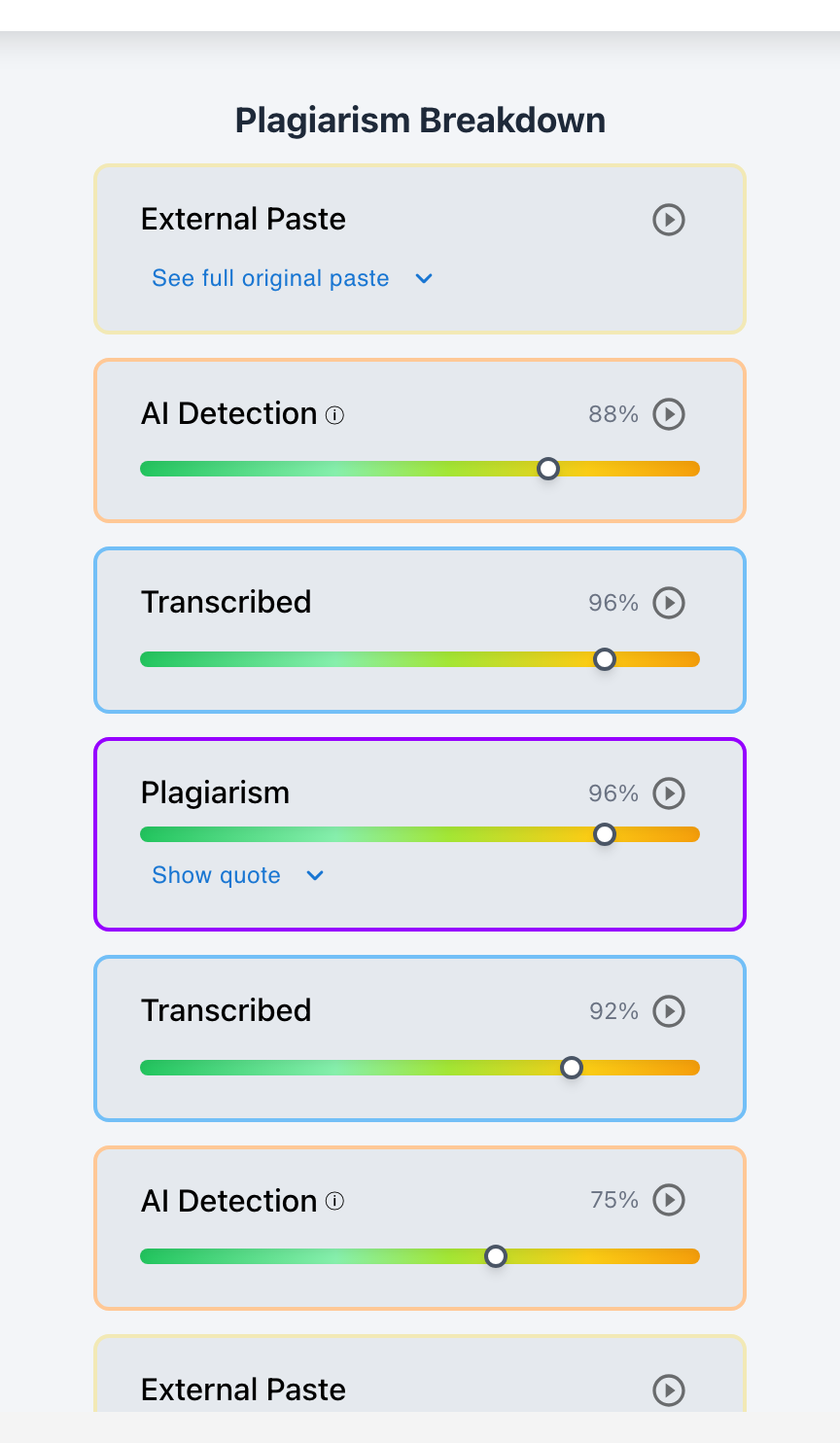
Checkmark Plagiarism evaluates paraphrasing accuracy by pairing plagiarism detection with AI detection, essay writing playback, autograding, and integrations with Canvas and Google Classroom.
The 4-Point Paraphrasing Diagnostic Test
1. The Syntactic Transformation Test
Pass: Sentence structure, clause ordering, and voice are completely new.
Fail: Clause structure mirrors the source with swapped synonyms (Patchwriting).
2. The Attribution Marker Test
Pass: Includes a clear in-text citation (e.g., [Smith, 2024]) or signal phrase.
Fail: Rewritten in new words, but zero author citation provided (Idea Plagiarism).
3. The Distinctive Phrase Test
Pass: Any unique 3+ word source phrasing is enclosed in quotation marks.
Fail: Unique source metaphors or technical terms are borrowed without quotes.
4. The Oral Comprehension Test
Pass: Student comfortably explains the concept in conversation.
Fail: Student cannot define the vocabulary or explain the underlying argument.
The Paraphrasing vs. Plagiarism Decision Tree
Evaluating any piece of borrowed text against scholarly standards:
- Did you change the sentence structure completely? If NO → It is Patchwriting (Plagiarism). If YES → Proceed to Question 2.
- Did you include an in-text citation crediting the author? If NO → It is Idea Plagiarism. If YES → Proceed to Question 3.
- Did you put quotation marks around any exact phrases? If NO → It is Incomplete Quotation (Plagiarism). If YES → It is Legitimate Paraphrasing.
Read more in how Checkmark writing process analysis works.
Comparison Matrix: Original Source, Plagiarism, Patchwriting, and Paraphrase
Original Source Passage
"Artificial intelligence has revolutionized clinical diagnostics, enabling physicians to identify malignancies with unprecedented radiological precision." (Dr. Jane Chen, 2024, p. 18)
Uncited Plagiarism (Unacceptable)
"Artificial intelligence has revolutionized clinical diagnostics, enabling doctors to identify cancers with unprecedented precision."
✗ Near-verbatim + zero citation
Patchwriting (Unacceptable)
"Machine learning has transformed medical testing, allowing doctors to detect tumors with remarkable imaging accuracy (Chen, 2024)."
✗ Has citation, but copied clause structure
Legitimate Paraphrase (Acceptable)
"Modern healthcare has improved tumor detection significantly because machine learning tools help radiologists spot cancerous tissue earlier (Chen, 2024)."
✓ Original syntax + in-text citation
A 5-Step Educator Protocol for Paraphrasing Inquiries
Paraphrasing Evaluation Checklist:
- 1. Open the student's submission in Checkmark Plagiarism inside Canvas SpeedGrader.
- 2. Review the Side-by-Side Source Comparison card: examine syntax alignment and in-text citation tags.
- 3. Apply the 4-Point Diagnostic Test to all highlighted sections.
- 4. If patchwriting or uncited paraphrasing is found, schedule a brief 2-minute coaching conference.
- 5. Guide the student through the "Read, Close, Write" method and require a corrected revision.
How Checkmark Plagiarism Powers Paraphrase Diagnostics
Checkmark Plagiarism combines **AI detection, essay writing playback, static AI detection, plagiarism detection, autograding, and Canvas/Google Classroom integrations** to automatically evaluate sentence transformation depth and ensure that all student paraphrases are properly attributed.
Frequently Asked Questions
What is the golden rule of paraphrasing?
The golden rule is: Original syntax + original vocabulary + in-text citation = legitimate paraphrase. Missing any one of these three elements results in plagiarism.
Can you plagiarize a source even if you change all the words?
Yes. If you borrow an author's unique finding, theory, or argument without providing an in-text citation, you have committed idea plagiarism.
What is the difference between patchwriting and legitimate paraphrasing?
Patchwriting preserves the original sentence structure while swapping synonyms; legitimate paraphrasing completely dismantles the structure and explains the idea in a fresh voice.
How does Checkmark detect paraphrased text?
Checkmark's Semantic Matching Engine evaluates conceptual relationships, argument structures, and factual claim clusters rather than relying strictly on exact string matching.
Do common facts need a paraphrase citation?
No. Common knowledge (e.g., "The Eiffel Tower is located in Paris") does not require a citation, but specialized research claims always do.
How does Checkmark Plagiarism integrate with Canvas LMS?
Checkmark provides certified LTI 1.3 integration, SpeedGrader sidebar embeds, two-way grade passback, and single sign-on (SSO).
What is the 'Read, Close, Write' technique?
It is a proven pedagogical method where students read a source passage, close the document completely, and write a summary from memory to ensure original syntax.
Can students use quotation marks inside a paraphrase?
Yes. If an author uses a memorable or distinctive 2- to 4-word phrase, you can include those exact words inside quotation marks within your paraphrased sentence.
What should a teacher do when patchwriting is identified?
Treat it as a developmental learning opportunity: show the student the side-by-side comparison in SpeedGrader and teach them how to summarize independently.
Why is understanding the difference essential for academic success?
Because mastering authentic paraphrasing enables students to synthesize complex scholarship with confidence, intellectual honesty, and scholarly authority.
Empowering Students with Genuine Scholarly Authority
Paraphrasing is not a game of swapping synonyms—it is the art of translating complex ideas into personal understanding. By applying the 4-Point Attribution Test and leveraging Checkmark Plagiarism's side-by-side diagnostics, educators can empower students to write with confidence, integrity, and authentic scholarly voice.
Checkmark Plagiarism supports this comprehensive approach with AI detection, essay writing playback, static AI detection, plagiarism detection, autograding, and integrations with Canvas and Google Classroom.
See how Checkmark pairs semantic paraphrase analysis with multi-signal detection to evaluate student writing. View a sample report or request a demonstration.