
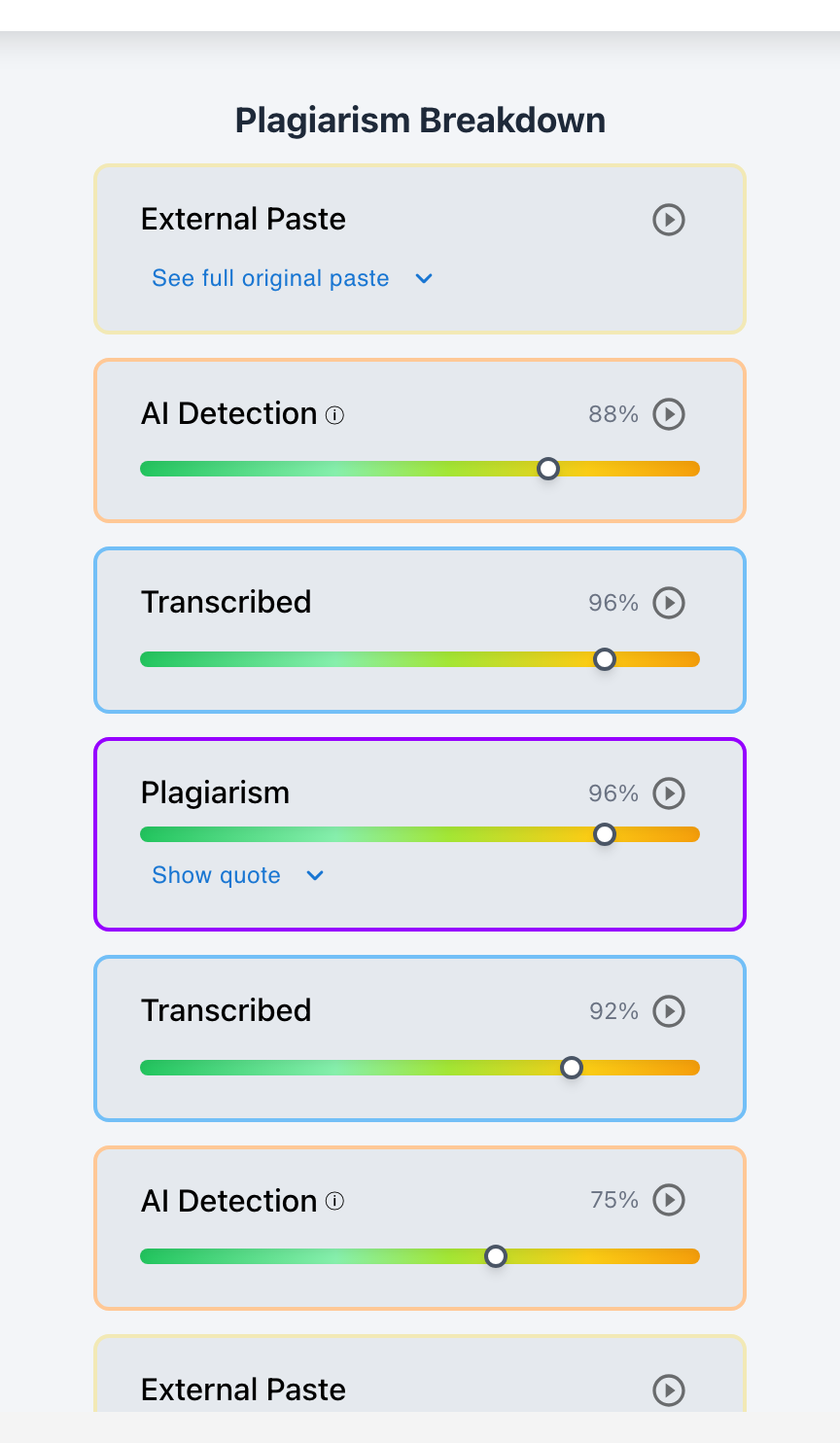
Teachers can find out whether a student actually wrote an assignment by executing Checkmark Plagiarism's 4-Layer Authorship Verification Framework: 1) Process Telemetry (watching a 15-second writing playback video to confirm 2.5+ hours of active typing, natural thinking pauses, and 15–25% backspaces); 2) Stylistic Baseline Matching (comparing vocabulary and sentence length with in-class diagnostic samples); 3) Citation & Source Verification (checking that cited DOIs and quotes exist in real academic databases); and 4) A 2-Minute Diagnostic Oral Check-In.
In a world where generative AI can write an essay in 10 seconds and contract cheating websites offer custom papers on demand, reading the final PDF is no longer enough to confirm authorship. Looking at text alone cannot reveal whether the words originated in the mind of the student or an external language model. Authentic authorship is proven through the process of writing—the keystrokes, hesitation pauses, thesis revisions, and oral reflections that only a human author can produce.
Below is a comprehensive guide for teachers on evaluating and verifying student authorship with total empirical certainty.
Checkmark Plagiarism verifies student authorship by pairing essay writing playback with AI detection, plagiarism detection, autograding, and integrations with Canvas and Google Classroom.
The 4 Layers of the Authorship Verification Framework
Layer 1: Biometric Process Telemetry
Checkmark Playback logs active typing minutes, natural pause-and-burst cadence, organic backspaces (15–25%), and zero 0.05-second clipboard paste payloads.
Layer 2: Stylistic Baseline Correlation
Compares readability metrics, vocabulary sophistication, and syntactic complexity against the student's verified in-class diagnostic writing baseline.
Layer 3: Factual Citation & DOI Verification
Automated database queries verify that cited journal articles, author names, and volume numbers exist in published literature (not AI hallucinations).
Layer 4: Diagnostic Oral Defense
A supportive, 2-minute check-in where the student defines specialized vocabulary, explains their research path, and articulates their central thesis.
How Process Telemetry Proves True Authorship
Understanding why physical drafting evidence provides incontrovertible proof:
- The Physical Labor of Writing: Composing a 1,500-word essay requires thousands of keypresses, continuous cognitive hesitations, and paragraph-level self-editing that cannot be simulated.
- Instant False Positive Protection: When an honest student is flagged by an overzealous statistical detector, their 4 hours of documented typing telemetry immediately clears their name.
- Total Administrative Defensibility: When school leadership presents a compiled Checkmark dossier containing physical keystroke logs and database verification, disputes are resolved instantly.
Read more in how Checkmark writing process analysis works.
Comparison: Reading the Final PDF vs. Inspecting Process Telemetry
Checkmark Process Telemetry (Absolute Certainty)
- Watches 15-second time-lapse replay of drafting.
- Checks active typing duration and backspace ratios.
- Verifies cited academic DOIs against Crossref.
- Proves authentic human labor beyond any doubt.
Reading the Final PDF Alone (Guesswork & Speculation)
- Only sees the final static text on the screen.
- Cannot tell if text was typed, pasted, or ghostwritten.
- Relies on subjective hunches or flawed single scores.
- Leaves teachers vulnerable to disputed integrity cases.
A 5-Step Educator Protocol for Authorship Verification
Authorship Verification Checklist:
- 1. Open the student's submission in Canvas SpeedGrader with Checkmark enabled.
- 2. Watch the 15-Second Writing Playback Video: confirm multi-hour typing and healthy backspaces.
- 3. Check the Baseline Comparison Card: verify consistency with in-class writing samples.
- 4. Inspect the Source Verification Card: confirm that all cited DOIs and quotes are authentic.
- 5. If telemetry is verified, approve the submission; if severe anomalies exist, hold a 2-minute diagnostic check-in.
How Checkmark Plagiarism Powers Authorship Verification
Checkmark Plagiarism combines **AI detection, essay writing playback, static AI detection, plagiarism detection, autograding, and Canvas/Google Classroom integrations** to give teachers complete visibility into the authentic drafting history of every student submission.
Frequently Asked Questions
Can a student fake their writing telemetry?
No. Faking hours of natural burst cadence, 20% backspaces, and messy outline evolution across thousands of words is practically impossible to simulate.
What if a student drafted on paper first?
Ask the student to bring in their handwritten pre-writing notes and outlines; authentic paper drafting will be fully supported by physical notes and oral fluency.
How does Checkmark Plagiarism integrate with Canvas LMS?
Checkmark displays writing playback videos, baseline comparisons, and citation audits directly inside Canvas SpeedGrader with zero tab-switching.
What are the key diagnostic questions to ask during an oral check-in?
Ask: 1) "What was your most interesting finding while researching?", 2) "Can you define this term in paragraph 3?", 3) "How did your thesis evolve while drafting?"
How does citation verification confirm authorship?
Generative AI models hallucinate fake sources; finding verified, authentic academic sources confirms genuine human research effort.
What if a student used speech-to-text assistive technology?
Speech-to-text generates distinct pacing patterns documented in student IEP/504 accommodation profiles, which Checkmark respects during evaluation.
How does Autograder evaluate verified authentic submissions?
Autograder evaluates the text against custom rubric criteria, providing rich, evidence-quoted feedback with complete confidence in authorship authenticity.
Can parents view the authorship verification report?
Yes. Checkmark exports a clean, FERPA-compliant PDF audit dossier that clearly shows typing hours and citation status to parents.
How does establishing an in-class baseline support verification?
Having a verified in-class diagnostic writing sample from the start of the semester provides an objective stylistic anchor for all subsequent assignments.
Why is verifying the writing process better than policing the final text?
Because focusing on the writing process celebrates authentic student effort, teaches critical thinking, and eliminates adversarial policing from the classroom.
Celebrating Authentic Human Learning
True writing is a journey of thought, struggle, and discovery. By utilizing Checkmark Plagiarism's 4-Layer Authorship Verification Framework, educators see and celebrate the authentic human effort behind every student essay, upholding academic excellence with total confidence and care.
Checkmark Plagiarism supports this comprehensive approach with AI detection, essay writing playback, static AI detection, plagiarism detection, autograding, and integrations with Canvas and Google Classroom.
See how Checkmark verifies student authorship with writing playback telemetry in Canvas. View a sample report or request a demonstration.