
An oral defense is the gold standard for verifying student authorship: it transforms writing from a detached digital file into an active, articulate demonstration of knowledge.
While generative AI tools like ChatGPT can generate polished essays in seconds, they cannot stand before an instructor and explain the thesis, defend analytical choices, or define complex vocabulary in real time. Integrating a structured, scalable oral defense component into your major writing assignments not only eliminates the temptation to cheat with AI, but also cultivates essential speaking, rhetoric, and critical reasoning skills.
Below is an educator blueprint on how to design, scale, and evaluate oral defenses for classes of any size without overwhelming your schedule.
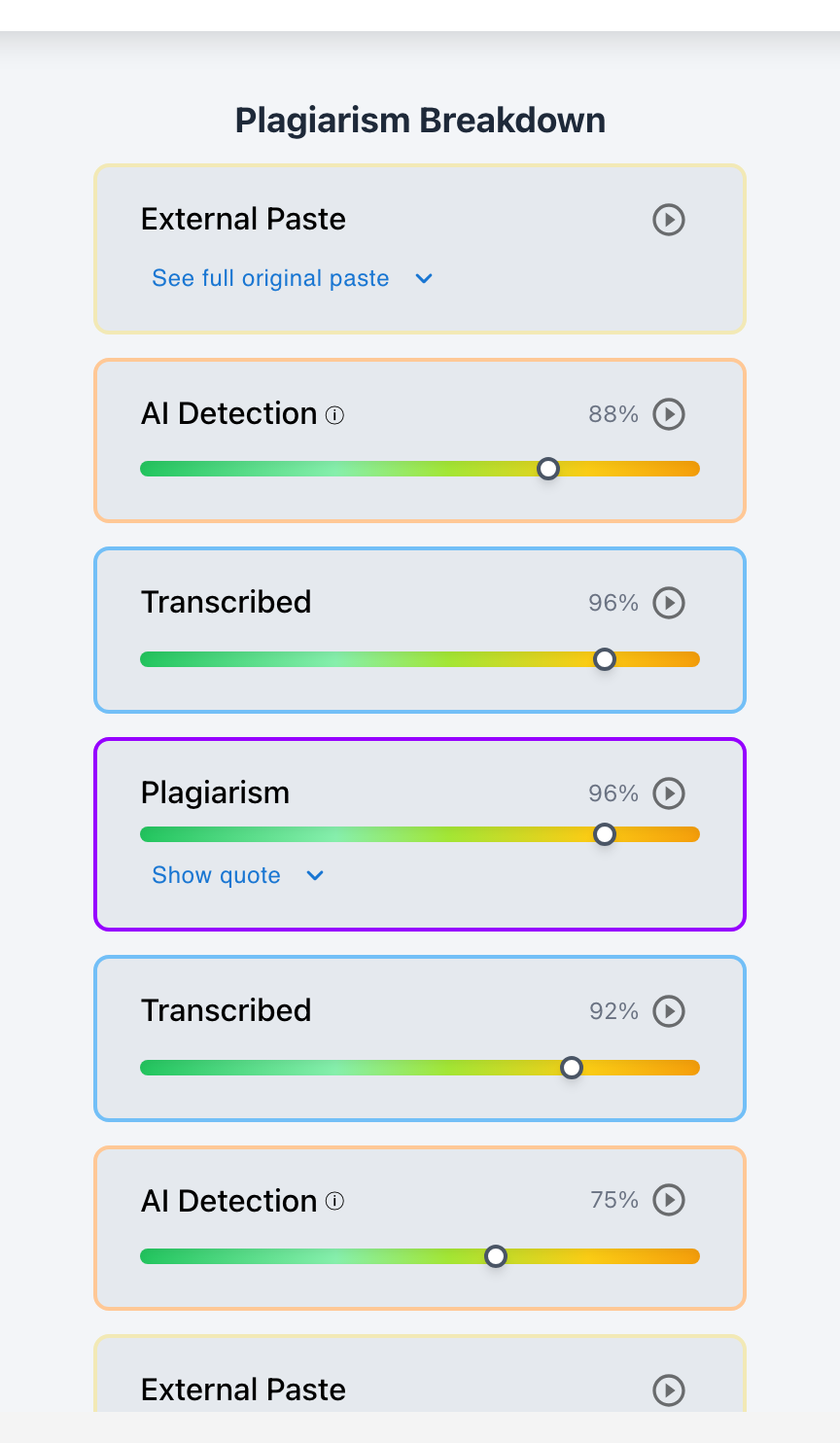
Checkmark Plagiarism supports oral defenses by pairing essay writing playback with AI detection, plagiarism detection, autograding, and integrations with Canvas and Google Classroom.
The 3 Scalable Oral Defense Models
1. The 3-Minute Speed Defense
Conducted 1-on-1 at the teacher's desk during in-class work sessions or scheduled office hours across 2–3 class periods.
2. Peer Defense Roundtables
Students present and defend their papers in small groups of 3–4, questioning each other using a structured teacher rubric while the teacher circulates.
3. Targeted Integrity Defenses
Reserved specifically for submissions flagged with timeline anomalies, wholesale paste events, or unverified citations.
The 4-Part Oral Defense Rubric (20 Points Total)
Structure the oral defense around four clear criteria to ensure consistent, objective evaluation:
Standardized Oral Defense Rubric:
- 1. Thesis & Argument Summary (5 pts): Student articulates the central thesis and main supporting arguments in plain, conversational language without reading verbatim.
- 2. Vocabulary & Phrasing Ownership (5 pts): Student defines 1–2 technical terms or complex sentences selected from their paper by the instructor.
- 3. Source & Evidence Justification (5 pts): Student explains how they located a specific cited study and summarizes the author's primary finding.
- 4. Revision & Process Recall (5 pts): Student describes what changed between their initial outline and final draft, corroborated by writing playback logs.
Integrating Essay Writing Playback into the Defense
To make the oral defense completely objective, pull up Checkmark Plagiarism's essay writing playback during the check-in:
- Review the student's active typing timeline and revision milestones together.
- If an instant paste block appears, ask: "I see this paragraph appeared at 10:15 PM. Can you show me the rough notes where you drafted this argument?"
- If citations were flagged as unverified, ask: "Can you share the PDF or show me where you retrieved this specific study?"
Read more in how Checkmark writing process analysis works.
Sample Syllabus Language: Oral Defense Policy
Recommended Syllabus Policy Clause:
"All major written essays in this course include a mandatory oral defense component (worth 15% of the assignment grade). Students will participate in a brief 3-minute oral defense or peer roundtable to explain their thesis, define key vocabulary, and justify cited research. An inability to explain or defend submitted writing orally will result in a required revision or academic integrity review."
Comparison: Traditional Written-Only vs. Defense-Integrated Assessment
Written-Only Assessment
- Vulnerable to ChatGPT generation and spinning.
- Teacher relies on probabilistic AI detector scores.
- Students experience writing as a transactional output.
Defense-Integrated Assessment
- AI generation becomes completely ineffective as a shortcut.
- Authorship is verified through authentic spoken mastery.
- Builds public speaking, critical reasoning, and confidence.
A 5-Step Implementation Guide for Teachers
Oral Defense Implementation Checklist:
- 1. Publish the defense format, dates, and 4-part rubric alongside the essay prompt.
- 2. Allocate 15–20% of the total essay grade directly to the oral defense.
- 3. Schedule 2–3 class periods for speed check-ins or peer roundtable sessions.
- 4. Open Checkmark essay writing playback summaries to review during the defense.
- 5. Record rubric scores immediately inside your Canvas or Google Classroom gradebook.
How Checkmark Plagiarism Streamlines Oral Defenses
Checkmark Plagiarism combines **AI detection, essay writing playback, static AI detection, plagiarism detection, autograding, and Canvas/Google Classroom integrations** to generate instant student defense dossiers, highlighting key vocabulary, paste timestamps, and citation audits for fast, fair evaluation.
Frequently Asked Questions
How long does an oral defense need to be?
A focused oral defense takes only 2–3 minutes per student to thoroughly evaluate conceptual mastery and verify authentic authorship.
How can I manage oral defenses for 120 students?
Use the Peer Defense Roundtable model during two class periods, or conduct speed defenses while students are working independently on their next project.
What if an authentic student is shy or anxious?
Keep the tone warm, supportive, and conversational. Ask simple questions first, and allow students to refer to their own paper if needed.
Can a student who used ChatGPT pass an oral defense?
No. Students who used AI struggle when asked to explain complex vocabulary, justify specific arguments, or explain how sources were located.
What percentage of the grade should the oral defense be?
Allocating 15–20% of the assignment grade provides strong motivation without penalizing students who are naturally less confident public speakers.
How does writing playback support the oral defense?
Playback provides the objective timeline record—active typing duration, revisions, and paste events—that anchors the conversation in verifiable facts.
What if a student fails the oral defense?
Provide an opportunity for the student to revise or rewrite the assignment in an in-class proctored environment, or refer for academic integrity review if AI use is confirmed.
Do oral defenses help students beyond integrity verification?
Yes. Defending ideas verbally develops articulate communication, critical thinking, and intellectual confidence essential for college and careers.
How does Checkmark Plagiarism integrate with Canvas SpeedGrader?
Checkmark Plagiarism embeds visual writing playback timelines, citation audit logs, and oral defense rubrics directly inside Canvas SpeedGrader.
Should students prepare slides for an oral defense?
No slides are needed for a 3-minute defense. The conversation should be spontaneous and based directly on their submitted text.
Spoken Mastery Proves Authentic Authorship
Designing an oral defense transforms assessment into an authentic, human-centered dialogue. By combining written analysis with spoken articulation and essay writing playback, educators eliminate AI shortcuts and celebrate true intellectual mastery.
Checkmark Plagiarism supports this comprehensive approach with AI detection, essay writing playback, static AI detection, plagiarism detection, autograding, and integrations with Canvas and Google Classroom.
See how Checkmark pairs essay writing playback with multi-signal detection to make oral defenses fast, fair, and scalable in your classroom. View a sample report or request a demonstration.