
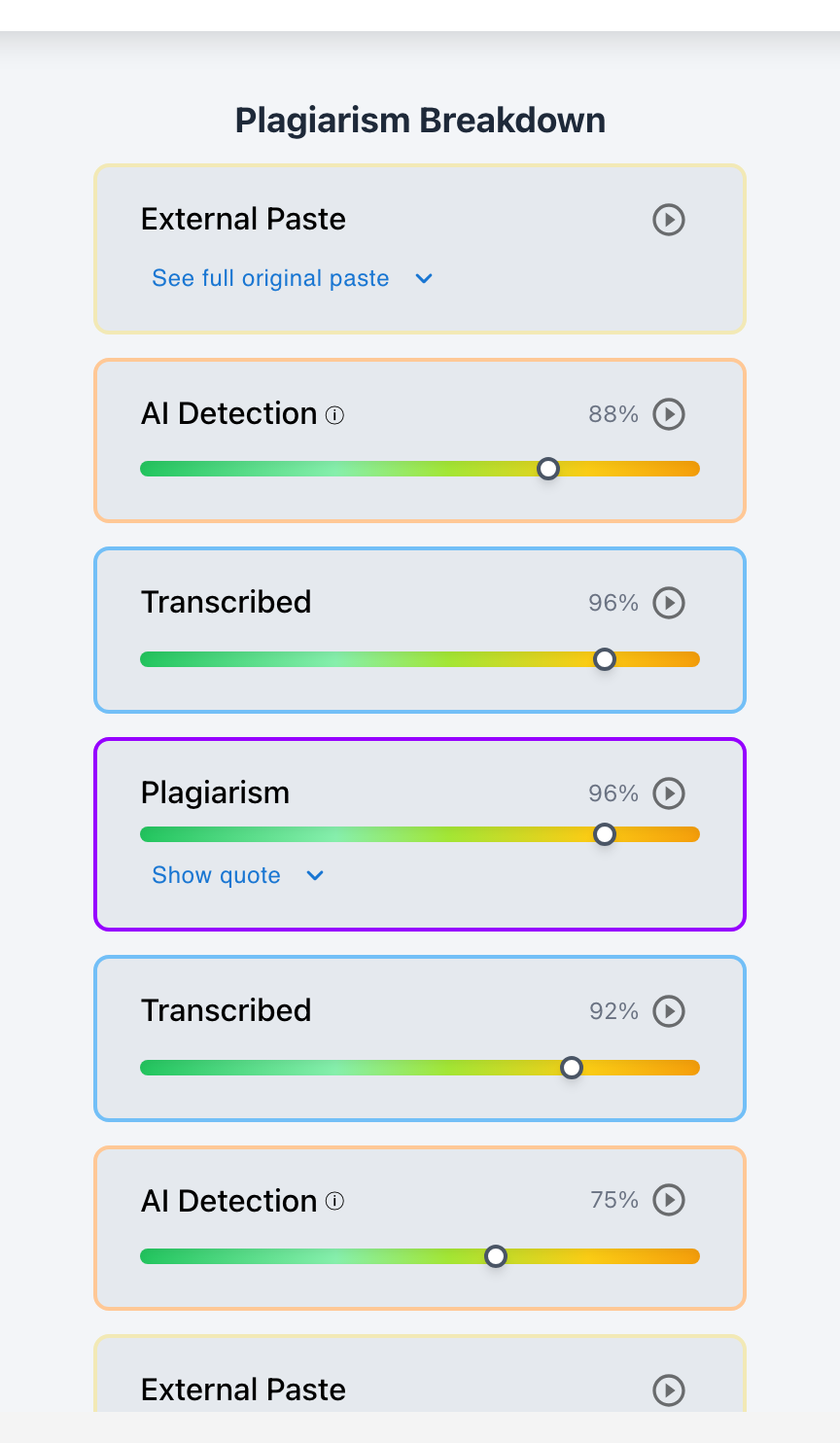
Checking an assignment for both AI generation and traditional plagiarism is no longer optional—it is essential for modern academic integrity.
Because traditional plagiarism checkers search only for exact text matches on published websites, they are completely blind to freshly generated AI prose from tools like ChatGPT. Conversely, an AI detector analyzes statistical language patterns but cannot confirm whether a student copied verbatim paragraphs from a peer's unindexed document. Evaluating student submissions requires a unified, multi-signal approach that checks web similarity, AI probability, and document creation history simultaneously.
Below is a step-by-step educator guide on how to inspect assignments for both threats efficiently and accurately within your standard grading workflow.
Checkmark Plagiarism streamlines this dual verification by uniting plagiarism detection with AI detection, essay writing playback, static AI detection, autograding, and integrations with Canvas and Google Classroom.
The 4 Integrity Quadrants: Interpreting Dual Results
1. High AI / Low Plagiarism
The text was generated by a language model like ChatGPT. It contains novel phrasing that avoids web matches but exhibits AI predictability.
2. High Plagiarism / Low AI
Traditional copy-paste cheating: the student copied directly from Wikipedia, a journal, or a website without using generative AI.
3. High AI / High Plagiarism
AI-assisted patchwriting: the student pasted stolen text into an AI tool, which lightly rephrased it while retaining exact matching fragments.
4. Low AI / Low Plagiarism
Authentic student writing: the paper is free from database matches and exhibits natural human sentence rhythm and burstiness.
The 5-Step Dual-Verification Workflow for Teachers
Step 1: Upload or Sync via Your LMS
Using Checkmark Plagiarism's Canvas or Google Classroom integration, submissions are automatically scanned upon delivery. Instructors do not need to export and re-upload files to separate third-party websites.
Step 2: Review the Plagiarism Similarity Report
Inspect any highlighted text matches against published web pages, academic repositories, or peer submissions. Distinguish between properly quoted citations and unattributed copying.
Step 3: Review the AI Detection Probability Map
Inspect sentence-level perplexity and burstiness heatmaps to identify clusters of formulaic, machine-generated syntax.
Step 4: Inspect Essay Writing Playback Timelines
Confirm the physical reality of how the essay was drafted using Checkmark Plagiarism's essay writing playback:
- Verify that the document was typed across multiple drafting sessions rather than pasted wholesale in one instant event.
- Check total active drafting time against the assignment's word count.
Read more in how Checkmark writing process analysis works.
Step 5: Audit Citations in Academic Databases
Perform a quick 2-minute search on Google Scholar or JSTOR for 2–3 cited articles in the bibliography to ensure sources are real and not hallucinated. Read more in can ChatGPT cite sources that don't exist?
Comparison: Single-Tool Scans vs. Unified Checkmark Platform
Separate Disjointed Tools
- Requires switching between 2–3 different websites.
- Plagiarism scanner gives false confidence with 0% AI scores.
- Zero visibility into document creation playback.
- Time-consuming and disjointed for grading workflows.
Unified Checkmark System
- Simultaneous AI and plagiarism reports in one interface.
- Integrated essay writing playback of keystrokes & pastes.
- Direct integration with Canvas and Google Classroom.
- Instant automated evidence compilation for student conferences.
A 5-Point Educator Checklist for Grading Days
Dual Integrity Checklist for Instructors:
- 1. Enable dual AI and plagiarism scanning on all major writing assignments.
- 2. Check whether flagged text represents legitimate properly cited quotations.
- 3. Inspect writing playback logs for wholesale paste events and active drafting duration.
- 4. Audit 2–3 bibliography citations in academic databases for hallucinations.
- 5. Hold a brief conference if multiple independent signals point to unauthorized assistance.
How Checkmark Plagiarism Automates Dual Scanning
Checkmark Plagiarism combines **AI detection, essay writing playback, static AI detection, plagiarism detection, autograding, and Canvas/Google Classroom integrations** into a single, seamless platform that checks every submission for AI generation, web plagiarism, and process integrity automatically.
Frequently Asked Questions
Can one tool check for both AI and plagiarism at the same time?
Yes. Checkmark Plagiarism runs simultaneous database similarity scans and AI detection algorithms on every submission, displaying both reports side-by-side.
Why do I need to check for both AI and plagiarism?
Because plagiarism checkers miss generative AI writing (which returns 0% similarity), and AI detectors miss direct copy-pasting from unindexed human sources.
What does a high AI score with a 0% plagiarism score mean?
It indicates the essay was generated from scratch by an AI model like ChatGPT without copying directly from existing published web pages.
What does a high plagiarism score with a 0% AI score mean?
It indicates traditional copy-paste plagiarism: the student copied text directly from a website, book, or peer essay without using AI.
How does writing playback enhance dual checking?
Writing playback provides the physical proof of document creation—showing whether text was typed keystroke-by-keystroke or pasted into the document in seconds.
Can students bypass both checks by paraphrasing with AI?
No. AI paraphrasing leaves statistical predictability markers, fake citations, and wholesale paste events in writing playback.
How do I check assignments submitted in Canvas or Google Classroom?
Checkmark Plagiarism integrates directly into Canvas SpeedGrader and Google Classroom, displaying AI scores, plagiarism matches, and writing playback directly inside your grading view.
What should I do if an assignment is flagged for both AI and plagiarism?
Review the writing playback timeline, audit citations, and schedule a supportive conference to discuss the student's research and drafting process.
Can authentic student essays trigger high scores on both checks?
Authentic student essays produce low AI scores, low non-quoted similarity matches, multi-session writing playback logs, and verified citations.
How does Checkmark Plagiarism simplify the grading workflow?
Checkmark Plagiarism delivers combined reports, automated citation checks, visual playback replays, and autograding assistance directly within your LMS.
Comprehensive Verification Protects Academic Standards
Modern academic integrity requires checking both what was written and how it was created. By combining traditional plagiarism detection with AI scanning and essay writing playback, educators save grading time while ensuring absolute fairness and transparency.
Checkmark Plagiarism supports this unified standard with AI detection, essay writing playback, static AI detection, plagiarism detection, autograding, and integrations with Canvas and Google Classroom.
See how Checkmark combines simultaneous AI and plagiarism scanning with essay writing playback inside Canvas and Google Classroom. View a sample report or request a demonstration.