
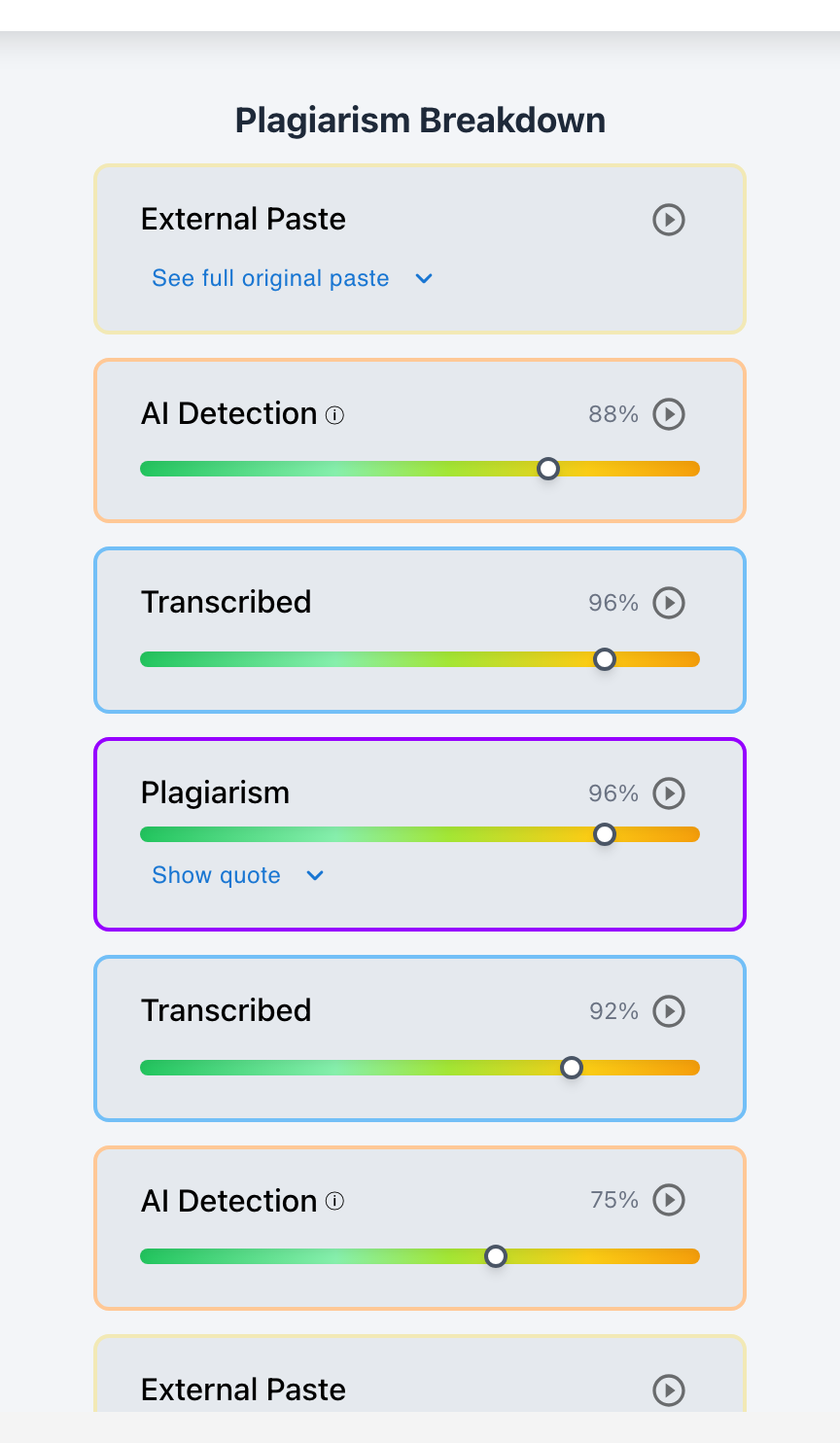
The most effective way to eliminate generative AI cheating is not catching students after the fact—it is establishing upfront process transparency that deters shortcuts before they happen.
When students believe that teachers only evaluate the final submitted PDF, the temptation to copy and paste text from ChatGPT at 11:30 PM is high. However, when students know from Day 1 that their drafting journey—active typing time, keystroke cadence, and paste events—is recorded through essay writing playback, the incentive to cheat vanishes. Knowing the creation timeline is visible transforms writing from a secretive output into an accountable, transparent craft.
Below is an educator guide on how to leverage writing process evidence as a powerful psychological deterrent and positive pedagogical tool.
Checkmark Plagiarism makes process transparency seamless by pairing essay writing playback with AI detection, plagiarism detection, autograding, and integrations with Canvas and Google Classroom.
The Psychology of Deterrence: Why Process Evidence Works
1. Removing the Illusion of Invisibility
Students often believe AI generation is undetectable because it avoids plagiarism matches. Visible playback logs prove that external copy-pasting is immediately recorded.
2. Shifting Value from Product to Process
When rubrics explicitly reward drafting milestones, revision depth, and typing time, students realize that shortcuts forfeit the majority of assignment points.
3. Eliminating Panic-Driven Cheating
Process requirements encourage early, low-stakes drafting, preventing the late-night desperation that causes the vast majority of academic dishonesty.
4. Protecting Student Dignity & Due Process
Process tracking is non-adversarial: honest students have undeniable proof of their labor, shielding them from false detector accusations.
The 4 Pillars of Writing Process Evidence
What constitutes valid writing process evidence? Modern platforms track four key dimensions:
- Active Drafting Time: Verifying that a 1,500-word essay was typed across 3–4 hours of active document engagement rather than 5 minutes of activity.
- Keystroke & Revision Cadence: Recording natural typing patterns, backspaces, deletions, and sentence restructuring.
- Paste Event Auditing: Recording the exact timestamp, location, and character count of any text pasted into the document.
- Multi-Session Continuity: Proving that the essay developed across several distinct sessions over multiple days.
Read more in how Checkmark writing process analysis works.
Sample Syllabus Policy: Process Transparency
Recommended Syllabus Policy Clause:
"Writing in this course is evaluated as both a process and a final product. All major writing assignments must be drafted within our designated LMS document editor with writing playback enabled. Submissions showing zero keystroke history, minimal active drafting duration, or unexplained wholesale text paste events will not receive credit and will require a mandatory oral conference before grading."
Comparison: Final Product Grading vs. Process Accountability
Final Product Only (High Cheating Risk)
- Teacher only evaluates final static PDF.
- Student feels AI text is undetectable.
- High incentive to generate essay in 10 seconds.
- Adversarial disputes relying on probabilistic detector scores.
Process Accountability (Deterrence Model)
- Essay writing playback tracks keystrokes and sessions.
- Student knows wholesale pastes are recorded.
- Incentive shifts to authentic, early drafting.
- Objective timeline logs protect honest students.
A 5-Step Implementation Checklist for Teachers
Educator Process Implementation Checklist:
- 1. Announce writing process expectations and playback tracking on Day 1.
- 2. Require all major essays to be drafted within your integrated LMS document editor.
- 3. Allocate 15–20% of the assignment grade to process milestones and revision depth.
- 4. Show students a sample writing playback replay so they understand what is recorded.
- 5. Use playback logs to provide formative feedback on student revision habits.
How Checkmark Plagiarism Makes Process Tracking Effortless
Checkmark Plagiarism combines **AI detection, essay writing playback, static AI detection, plagiarism detection, autograding, and Canvas/Google Classroom integrations** to automate writing process tracking, giving educators complete transparency without multiplying grading workloads.
Frequently Asked Questions
Why is process evidence a better deterrent than an AI detector?
AI detectors are probabilistic and easy for students to gamble against. Process evidence provides objective physical proof of typing and paste events, eliminating the illusion that AI use can be hidden.
Does tracking writing process invade student privacy?
No. Playback tracks only active keystrokes, typing time, and text changes within the specific assignment document—it does not track webcam, browser history, or personal screen activity.
How does process tracking protect honest students?
If an honest student writes with advanced vocabulary and triggers a false positive on a detector, their multi-session keystroke playback log immediately proves authentic authorship.
What if a student prefers to write in Microsoft Word?
Instruct students to submit their initial Word files with version history or complete major drafting sessions in the LMS editor to maintain continuous process records.
How does writing playback help improve student writing?
Teachers can see where students struggled, how much time they spent revising, and whether they actively reorganized paragraphs, allowing targeted writing coaching.
Can students fake writing process playback?
Faking hours of typing, natural pause cadences, typos, and iterative backspacing takes longer than actually writing the essay, completely defeating the purpose of a shortcut.
What should a teacher do if a student submits a paper with no playback history?
Check for wholesale paste events, review cited sources, and invite the student to discuss their drafting choices in a supportive conference.
How does Checkmark Plagiarism integrate with Canvas LMS?
Checkmark Plagiarism embeds visual writing playback timelines directly inside Canvas SpeedGrader, allowing teachers to review drafting sessions in seconds.
Should process tracking be used on short weekly assignments?
It is best suited for major essays, research papers, and high-stakes projects where the temptation to use generative AI is highest.
How does process tracking change classroom culture?
It shifts the culture from adversarial policing to supportive coaching, encouraging students to take pride in their writing journey and genuine intellectual effort.
Transparency Builds Trust and True Scholarship
When educators illuminate the writing process, academic integrity ceases to be a battle of algorithms and becomes a celebration of human thinking. By establishing clear process accountability, teachers deter shortcuts and inspire authentic student growth.
Checkmark Plagiarism supports this principled standard with AI detection, essay writing playback, static AI detection, plagiarism detection, autograding, and integrations with Canvas and Google Classroom.
See how Checkmark pairs essay writing playback with multi-signal detection to establish transparent process accountability in your classroom. View a sample report or request a demonstration.