
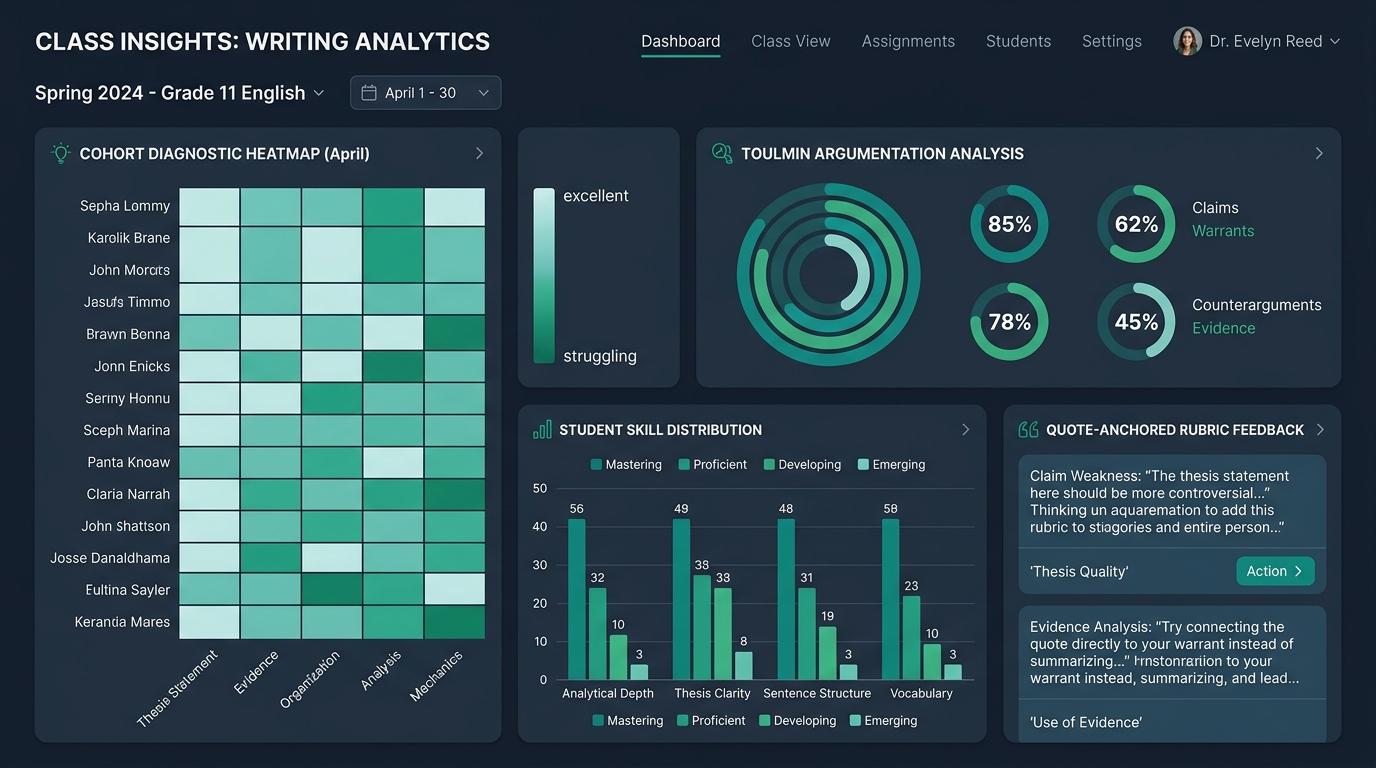
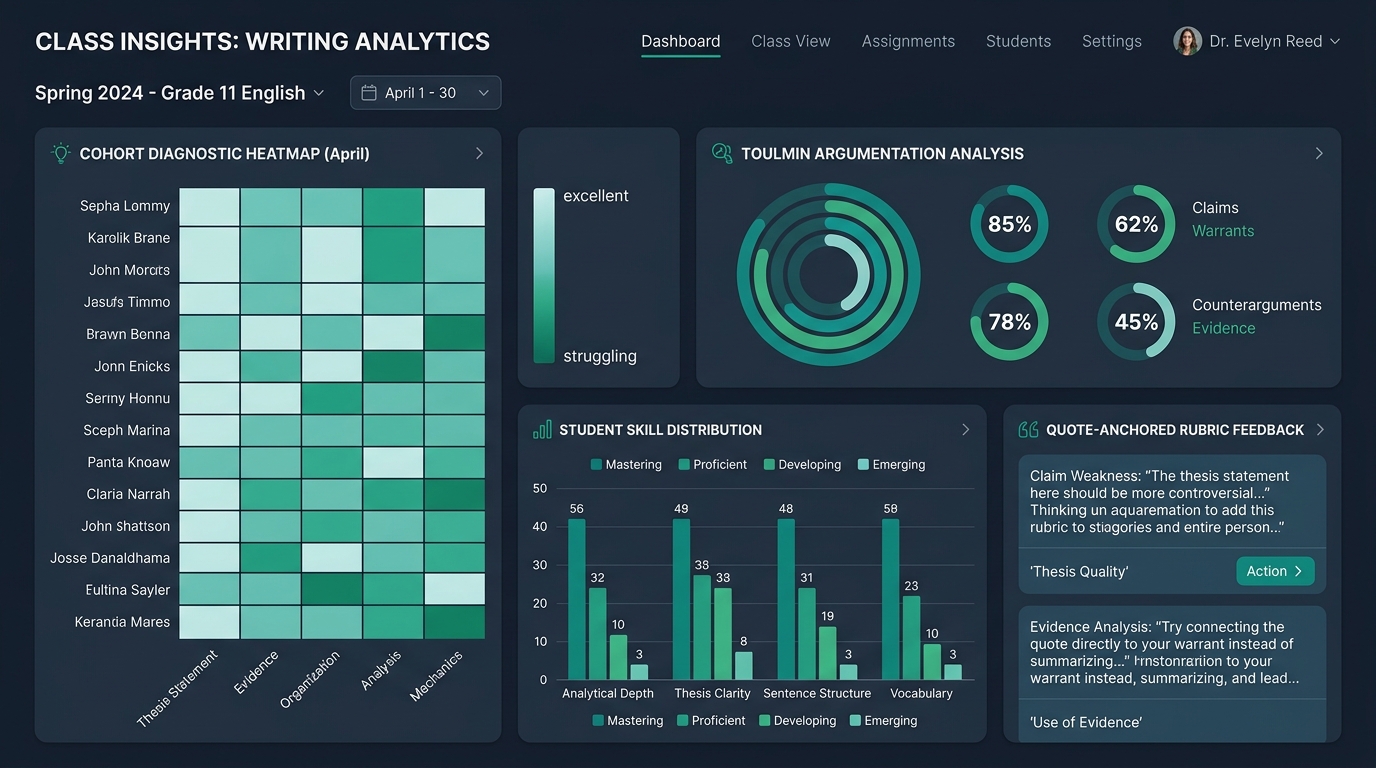
Secondary and postsecondary writing educators face a persistent structural bottleneck known as the Instructional Data Gap. While an English teacher may spend 25–30 hours individually grading 130–150 student essays, that evaluative effort remains locked in isolated summative marginalia. Teachers finish grading exhausted, possessing only an anecdotal, macro-level impression of class performance without actionable cohort metrics. By leveraging Checkmark Plagiarism’s AI Rubric Analytics Engine, educators transform isolated grading into aggregate Formative Learning Analytics. Checkmark uses normalized Abstract Syntax Tree (AST) rubric parsing and verbatim quote-anchored evidence extraction to map student writing against complex frameworks like the Toulmin Argumentation Model (Claims, Grounds, Warrants, Backing, Counterclaims, Rebuttals) and AP/State analytic rubrics. The resulting Classroom & Departmental Diagnostic Heatmaps instantly expose systemic conceptual bottlenecks—such as 68% of a cohort failing to connect warrants to claims or 54% producing superficial “strawman” counterarguments. Paired with patent-pending Essay Playback™ writing process telemetry, passage-level AI detection, and bidirectional LTI 1.3 Advantage (AGS 2.0 / NRPS 2.0) sync with Canvas LMS, Agilix Buzz, and Google Classroom, writing teams can execute high-impact targeted mini-lessons, accelerate student growth, and ground every instructional decision in defensible classroom data.
Checkmark Plagiarism unites AI rubric autograding with writing process replay, AI writing detection, plagiarism detection, and enterprise integrations with Canvas LMS and Agilix Buzz LMS.
1. The Instructional Data Gap in Secondary and Postsecondary Writing
Every secondary English teacher, humanities instructor, and college composition professor is intimately familiar with the grueling ritual of the “essay stack.” Grading 130 to 150 student essays—each running 1,000 to 2,500 words—requires anywhere from 25 to 40 hours of intense cognitive labor. Instructors meticulously highlight dangling modifiers, write margin notes questioning unsupported claims, and check boxes across multi-dimensional analytic rubrics.
Yet, despite this massive investment of educator time, writing instruction remains one of the most data-poor disciplines in modern education:
The Summative Autopsy vs. Formative Cohort Intelligence
In STEM subjects, digital assessments immediately yield detailed item-analysis reports. A math teacher instantly sees that 72% of Period 3 missed Question 14 (quadratic factoring), allowing for an immediate 10-minute reteaching intervention the next morning.
In writing instruction, essay grading has historically functioned as a summative autopsy:
Feedback Arrives Too Late
By the time a teacher finishes grading 140 papers two weeks after submission, the class has already moved on to the next instructional unit.
Data Is Disaggregated
The teacher retains a vague intuition that “the essays felt weak on analysis,” but lacks precise, quantified data detailing which specific argumentative sub-skills collapsed.
Macro-Grades Obscure Deficits
An overall score of 82% (B-) tells a student—and their teacher—virtually nothing about the underlying cognitive mechanism. Did the student lose points on grammar, evidence, or an unstated warrant?
To close this gap, educational researchers and instructional leaders advocate for Data-Driven Writing Instruction (DDWI)—a pedagogical framework that treats student writing drafts not merely as final artifacts to be judged, but as rich streams of diagnostic data that inform immediate, targeted classroom reteaching.
2. Pedagogical Foundations: Data-Driven Writing Instruction (DDWI) & The Toulmin Diagnostic Framework
To extract actionable analytics from student prose, an AI system cannot rely on superficial word counts, readability scores, or generic sentiment analysis. It must evaluate text through rigorous, pedagogically validated argumentation models. The gold standard for teaching and assessing analytical writing across secondary and higher education is the Toulmin Model of Argumentation, developed by philosopher Stephen Toulmin.
Textual quotations, statistical data, historical precedents, and experimental findings extracted from primary sources.
The central debatable assertion or overarching line of reasoning advanced by the writer.
The underlying logical rationale explaining HOW and WHY the specific data point proves the claim. Without an explicit warrant, the essay suffers from the “Warrant Void” where quotes are assumed to speak for themselves.
Secondary validation supporting the universal logic of the warrant, grounding the argument in broader philosophical or empirical paradigms.
Fair representation (“steel-manning”) of opposing perspectives paired with surgical refutation and modal qualifiers.
The Anatomy of Argumentation: Mapping Toulmin Components to Diagnostic Rubrics
When writing teachers grade argumentative synthesis essays (such as AP English Language Question 1, Common Core W.1/W.2, or College First-Year Composition essays), they evaluate how well students execute each Toulmin element:
| Toulmin Element | Function in Student Prose | What Mastery Looks Like | Common Student Failure Mode |
|---|---|---|---|
| 1. Claim / Thesis | Sets the overarching argumentative trajectory and stance. | Defensible, nuanced, qualified claim establishing a clear line of reasoning. | Obvious statement of fact, broad generalization, or vague platitude. |
| 2. Data / Evidence | Grounding evidence extracted from primary texts or research. | Purposefully selected, accurately cited, high-relevance quotations or data. | “Quote bombing” (dropping long block quotes with zero setup). |
| 3. Warrant | The analytical bridge connecting evidence directly to the claim. | Explicit explanation of how the specific quote demonstrates the thesis. | The “Warrant Void”: Assuming the quote speaks for itself. |
| 4. Backing | Deep foundational logic justifying the validity of the warrant. | Contextualizing the argument within broader social or historical paradigms. | Superficial reasoning that collapses under philosophical pressure. |
| 5. Counterclaim | Fair representation of alternate or opposing perspectives. | “Steel-manning” counter-perspectives acknowledging legitimate constraints. | The “Strawman”: Creating an absurd caricature easily dismissed. |
| 6. Rebuttal & Qualifier | Refuting counter-arguments while defining boundary conditions. | Surgical refutation paired with modal qualifiers (often, under specific conditions). | Rigid absolutism (“This proves everyone else is completely wrong”). |
The Four Systemic Argumentation Bottlenecks Diagnosed by Cohort Analytics
When Checkmark Plagiarism runs aggregate rubric analytics across an entire student cohort (e.g., all 145 students in 10th Grade Honors English across five sections), the data consistently isolates four critical breakdowns:
Students provide textual evidence but omit the logical connective tissue linking it back to their thesis statement.
Students introduce an opposing argument but reduce it to an absurd caricature, failing to offer a defensible rebuttal.
Students write with rigid, universal claims (“always,” “never”), lacking the modal qualifiers characteristic of mature academic prose.
Students string together consecutive block quotations without intervening commentary, mistaking volume of citation for rigor of synthesis.
3. The Technology of Checkmark’s AI Rubric Analytics & Teacher-in-the-Loop Engine
Checkmark Plagiarism’s diagnostic capabilities are powered by a multi-layered Natural Language Processing (NLP) architecture designed specifically for educational rubric evaluation. Unlike generic Large Language Models that output hallucinated, unanchored grading summaries, Checkmark operates on a deterministic, grounded framework.
1. Abstract Syntax Tree (AST) Rubric Parsing
Standard school and district rubrics vary wildly in structure—from the 6-point AP English Language & Composition rubric (1 pt Thesis, 4 pts Evidence/Commentary, 1 pt Sophistication), to the 6+1 Trait Writing model, to custom 4-scale state standards.
Checkmark’s AST Rubric Parser ingests any custom rubric (via direct text, PDF upload, or LMS sync) and transforms it into a normalized tree structure:
{
  "rubric_id": "ap_lang_synthesis_q1",
  "framework": "toulmin_analytic_normalized",
  "dimensions": [
    {
      "criterion": "Line of Reasoning & Commentary",
      "max_points": 4,
      "ast_nodes": {
        "mastery_4": "Explicit warrant bridges connecting all secondary grounds to thesis with modal qualification.",
        "developing_2": "Evidence is presented but student assumes self-evidence (Warrant Void observed in 2+ paragraphs).",
        "novice_1": "Description or summary of source materials without argumentative synthesis."
      }
    }
  ]
}
2. Grounded Quote-Anchored Evidence Extraction
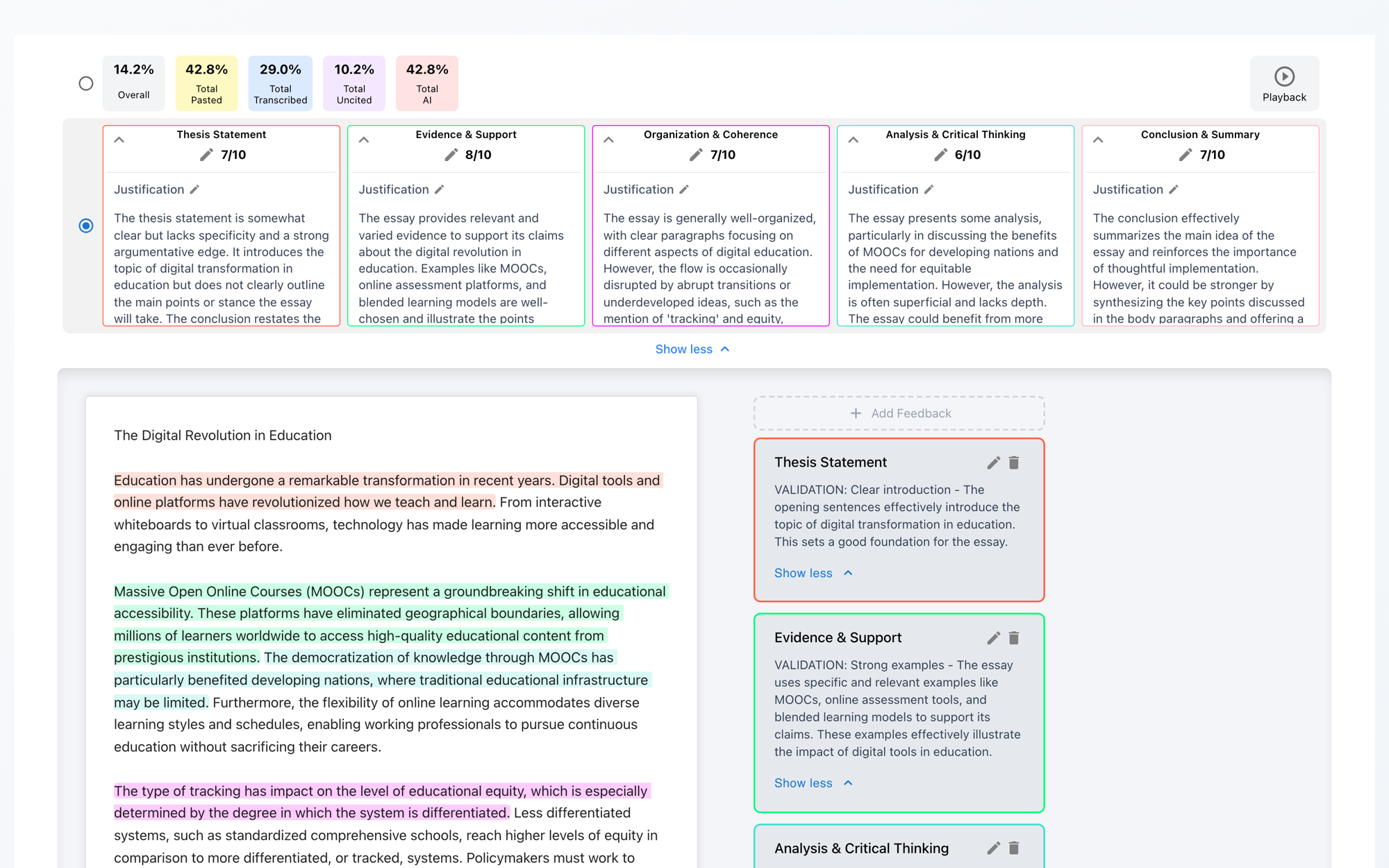
The single greatest danger in AI-assisted evaluation is “hallucinated feedback”—where an AI generates plausible-sounding critique that does not correspond to actual text in the student’s essay. Checkmark eliminates this through strict Grounded Quote-Anchored Evidence Extraction:
Criterion: Evidence & Commentary (Level 2: Developing / 2 of 4 pts)
The student introduces high-value data (Source C temperature drop) and a strong claim (city council failure), but omits the necessary Toulmin Warrant. The essay does not explain the intermediary causal link: how current municipal zoning or funding allocation specifically caused the lack of canopy coverage in low-income districts.
“Bridge the gap between Source C's temperature data and your claim about council failure. What specific municipal policies or budget decisions led to this disparity?”
3. Departmental & Classroom Diagnostic Heatmap Dashboard
When all submissions in an assignment are processed, Checkmark synthesizes the individual quote-anchored analyses into a visual Cohort Diagnostic Heatmap:
| Rubric Dimension | Mastery % | Developing % | Novice % | Primary Cohort Deficit |
|---|---|---|---|---|
| 1. Thesis / Claim | 87.5% | 9.4% | 3.1% | Broad Generalizations |
| 2. Evidence Selection | 78.1% | 15.6% | 6.3% | Excessive Block Quotes |
| 3. Warrant & Analysis | 31.2% | 53.1% | 15.7% | ⚠️ Warrant Void (53%) |
| 4. Counterclaim / Rebuttal | 43.8% | 37.5% | 18.7% | Strawman Arguments |
| 5. Modal Qualification | 25.0% | 50.0% | 25.0% | ⚠️ Absolutist Phrasing |
| 6. Conventions & Flow | 90.6% | 6.3% | 3.1% | Minor Punctuation |
With a single glance, the teacher knows that spending time reteaching thesis statements (87.5% mastery) or basic grammar (90.6% mastery) is unnecessary. Instead, the upcoming 45-minute block must be dedicated to a workshop on Warrant Construction and Modal Qualification.

4. Multi-Dimensional Verification: Unifying Diagnostic Grading with Integrity Telemetry
An argumentation analysis is only as valuable as the authenticity of the student writing it evaluates. In an era where students can prompt generative AI to draft sophisticated arguments or use paraphrasing humanizers to evade legacy detectors, evaluating text in a vacuum is no longer viable.
Checkmark Plagiarism solves this through its Multi-Dimensional Integrity Architecture, combining rubric evaluation with authentic writing process telemetry:
Writing Process Telemetry
- Patent-Pending Essay Playback™ replay
- Pause & revision burst dynamics
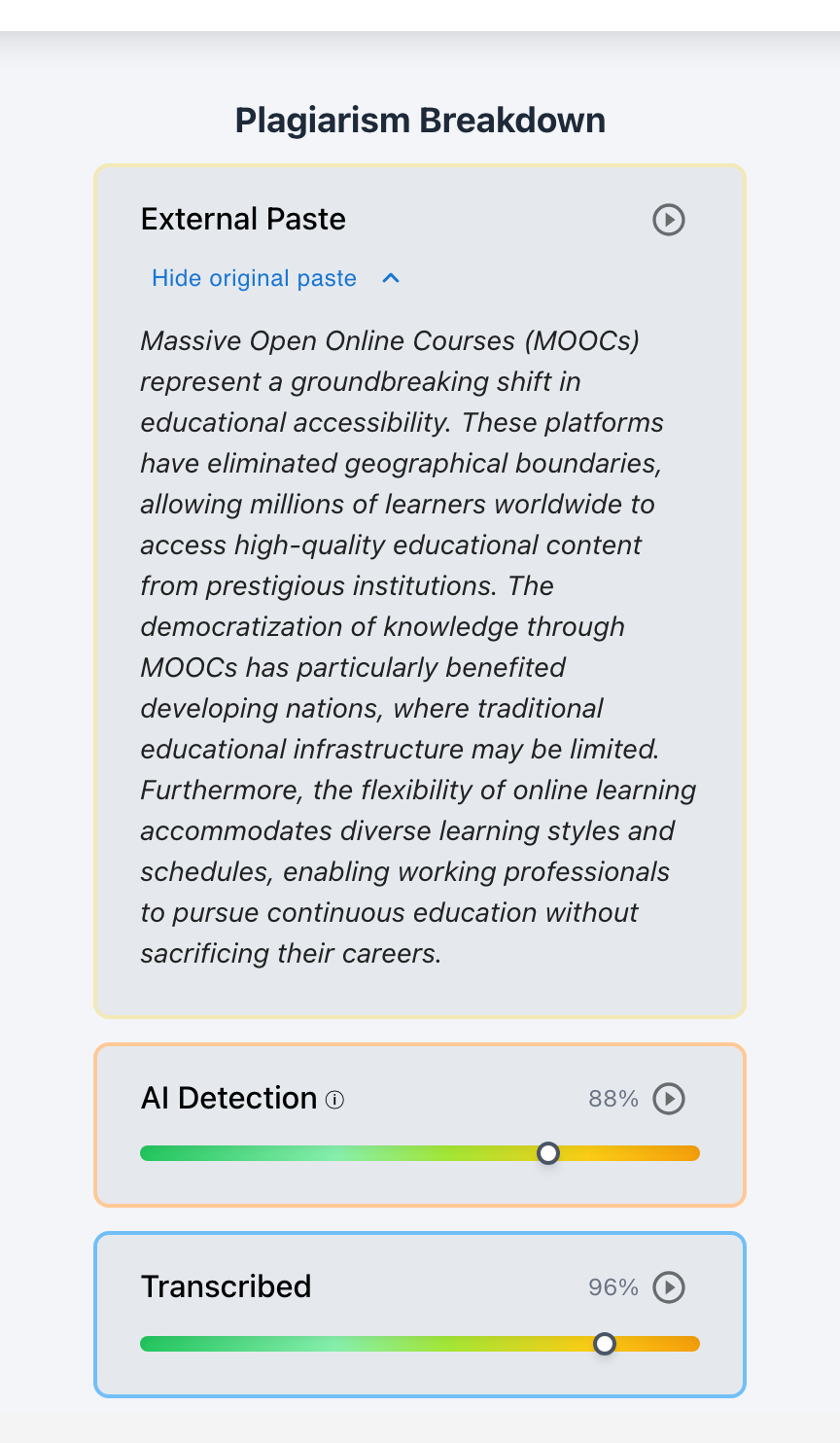
- External paste tracking & buffer capture
- Steady-state mechanical typing flags
Passage-Level AI Detection
- Linguistic perplexity & burstiness metrics
- Calibrated confidence sliders per passage
- Honest <150-word statistical guardrails
- Educator-only flag override controls
Plagiarism & Sources
- Live web matching across billions of pages
- Side-by-side clickable quote comparisons
- Uncited patchwriting vs direct match diff
- Internal student repository checks
SCENARIO: A student submits a complex, highly polished argument on bioethics. A generic AI detector flags the essay as “88% AI-Generated” due to formal vocabulary and sophisticated syntax.
CONCLUSION: The student is indisputably exonerated. Transparent process telemetry replaces speculative black-box suspicion with objective proof.
5. The 4-Phase Diagnostic-to-Intervention Workflow for Writing Teams
To operationalize AI rubric analytics across an entire English department or grade-level team, schools implement Checkmark’s structured 4-Phase DDWI Workflow:
Detailed Phase Execution
Phase 1: Intake & Automated Diagnostic Clustering
Students submit essays through Canvas LMS, Agilix Buzz LMS, or Google Classroom. Checkmark’s background workers parse the essays against attached AST rubrics, match web/peer plagiarism, evaluate passage-level AI patterns, reconstruct keystroke dynamics, and generate draft criterion scores anchored to verbatim quotes.
Phase 2: Teacher Validation & Cohort Heatmap Analysis
Before grading individual papers, the teacher opens the Cohort Analytics Dashboard to review class-wide mastery curves across all rubric criteria. Outliers are automatically highlighted—including skill-deficit clusters (e.g., 18 students lacking warrants) and telemetry flags requiring quick verification.
Phase 3: Targeted Grouping & Data-Driven Mini-Lessons
Rather than delivering a generic whole-class lecture, the teacher uses Checkmark’s auto-generated student clusters:
- Cluster A (Mastery): Advanced Counterclaim & Stylistic Sophistication workshop.
- Cluster B (Developing): The “Because-Therefore-Which Means” Warrant Bridge Reteaching Protocol.
- Cluster C (Novice): Claim-Data Alignment and Citation Mechanics.
Phase 4: Revision Sprint, Telemetry Audit, & LMS Grade Passback
Students open their individual Checkmark feedback portals, review quote-anchored feedback cards, and execute 20-minute targeted revision sprints. The teacher uses Essay Playback™ to verify authentic revision and syncs final calibrated grades directly to SpeedGrader via LTI 1.3 Advantage (AGS 2.0).
6. Actionable Classroom Case Studies
Case Study 1: AP English Language & Composition (Overcoming the “Warrant Void”)
- Institution: Oakridge High School (140 AP Lang students across 4 sections).
- Assignment: Synthesis Essay Prompt on the ethical implications of municipal surveillance infrastructure.
- The Diagnostic Signal: While 92% of students earned the Thesis point and 84% accurately quoted at least three sources, 68.5% scored in the “Developing” band (2 out of 4) for Evidence & Commentary.
- The Bottleneck: Students were engaging in “quote-bombing”—introducing statistics from Source A and Source E followed immediately by transitional phrases (“This clearly shows...”) without explaining the underlying economic or civil liberty mechanisms.
- The Intervention: The AP Lang team paused the curriculum for one 50-minute block to conduct the “Warrant Bridge Workshop” (Section 7). Students were given anonymized quote-anchored cards from the cohort and tasked with writing two-sentence causal warrants.
- The Outcome: On the revised draft, Evidence & Commentary mastery increased from 31.5% to 79.2%, with average section scores rising by 1.4 rubric points on the national AP 6-point scale.
Case Study 2: 9th Grade ELA Cohort (Remediating the “Strawman Counterclaim”)
- Institution: Westlake Middle-High School (210 Grade 9 students across 6 sections, 3 teachers).
- Assignment: Persuasive Literary Analysis on character culpability in Romeo and Juliet.
- The Diagnostic Signal: Checkmark’s Inter-Section Calibration Dashboard revealed that 54% of students scored “Novice” on Counterclaim & Refutation.
- The Bottleneck: Students consistently wrote caricature counterclaims (“Some people say Tybalt is innocent because he was protecting his family, but he is just evil and killed Mercutio”).
- The Intervention: The 9th-grade PLC utilized Checkmark’s “Steel-Manning Protocol”, requiring students to write counterarguments that their opponents would agree with before formulating a nuanced rebuttal with modal qualifiers.
- The Outcome: Cross-section inter-rater reliability improved from κ = 0.44 to κ = 0.86, while class-wide counterargument mastery climbed from 22% to 81%.
Case Study 3: University First-Year Composition (Eliminating Evidence Stacking)
- Institution: Regional State University (620 FYC students, 18 Graduate Teaching Assistants).
- Assignment: 2,000-word Academic Research Essay on climate resilience policies.
- The Diagnostic Signal: Writing Program Administrators observed that across 28 sections, average similarity scores were artificially high (28%–35%), while analysis scores lagged.
- The Bottleneck: Checkmark’s AST Rubric Engine revealed that students were not plagiarizing maliciously; rather, they were “evidence stacking”—inserting consecutive 40-word block quotes to pad length, crowding out interpretive analysis.
- The Intervention: Instructors enforced Checkmark’s “3:1 Analysis-to-Quote Ratio Rule”. Essay Playback™ was used during 10-minute writing conferences to observe how students integrated evidence in real time.
- The Outcome: Block quote density dropped by 64%, while independent student analysis metrics increased by 42% across the entire 600-student cohort.
7. Plug-and-Play Reteaching Mini-Lessons & Pedagogical Toolkits
When Checkmark’s diagnostic heatmaps identify class-wide argumentation weaknesses, teachers can deploy these three battle-tested, 15-to-20-minute instructional mini-lessons:
The “Because-Therefore-Which Means” Warrant Bridge Workshop
Protocol: Model the error (3 min) → Introduce the 3-step bridge (5 min) → Partner drill (7 min) → Live Checkmark revision sprint (5 min).
The Steel-Manning Counterargument Protocol
“Opponents think school uniforms are good, but they are wrong.” (Fails rubric: dismissive, zero nuance).
“Critics argue uniforms eliminate gang colors and reduce peer clothing pressure.” (Approaching standard).
“While advocates legitimately contend standardized dress reduces friction, this policy fails to address root behavioral causes.” (Mastery).
Protocol: The “Opponent's Shoes” Rule → Subordinating pivot stems → Active Checkmark draft rewrite.
Evidence Synthesis & The “Quote Crucible”
8. Enterprise Security, FERPA/COPPA Compliance, and Ethical AI Governance
When school districts and universities adopt AI-powered rubric analytics and writing telemetry, data privacy and ethical integrity are paramount. Educational leaders cannot risk exposing student intellectual property or violating federal privacy statutes.
Student essays and writing telemetry are NEVER used to train, fine-tune, or develop commercial AI models.
Strict compliance with federal student privacy regulations; zero third-party data broker sharing or behavioral ad profiling.
TLS 1.3 in transit and AES-256 at rest. Seamless SSO integration with Google Workspace, Microsoft Entra ID, ClassLink, and Clever.
“Stop Guessing, Start Trusting”
The core philosophy of Checkmark Plagiarism is that academic integrity and rubric tools should build trust between educators and students, not foster an adversarial surveillance climate.
By pairing transparent, quote-anchored rubric diagnostics with verifiable Essay Playback™ writing process history, teachers no longer need to speculate, make arbitrary accusations based on black-box percentage scores, or spend dozens of uncompensated hours tabulating data. Instead, educators gain defensible receipts that celebrate student effort, protect honest writers, and elevate the standard of writing instruction across the entire institution.
9. Frequently Asked Questions (FAQ)
Q1: How does AI rubric analytics differ from traditional LMS autograding?
Traditional LMS autograding is limited to deterministic multiple-choice quizzes or basic keyword matching that cannot evaluate prose. Checkmark’s AI Rubric Analytics uses normalized Abstract Syntax Tree (AST) rubric parsing and Grounded Quote-Anchored Evidence Extraction. It evaluates complex rhetorical traits—such as Toulmin line of reasoning, warrant strength, and counterclaim refutation—and ties every score directly to verbatim student quotes, providing formative cohort diagnostics rather than superficial score stamps.
Q2: Can Checkmark’s rubric analytics handle custom department rubrics or AP/IB scoring scales?
Yes. Checkmark supports any custom analytic or holistic rubric. Teachers and department chairs can upload existing rubrics via PDF or image, input custom criteria in-app, select from pre-configured national frameworks (AP Language 6-point scale, AP Literature, 6+1 Trait Writing, Common Core ELA), or automatically pull rubrics attached to assignments in Canvas LMS, Agilix Buzz, or Google Classroom.
Q3: How does the system prevent “AI hallucinations” in grading feedback?
Checkmark employs strict quote-anchoring constraints. The AI engine is programmatically prohibited from generating evaluative feedback without identifying, extracting, and anchoring the specific student sentences that substantiate the critique. If the AI identifies an unstated warrant, it highlights the exact claim and evidence sentences where the logical gap occurs, ensuring 100% factual fidelity to student writing.
Q4: What happens if a student uses an “AI humanizer” or paraphrasing tool?
While AI humanizers and paraphrasers alter surface syntax to evade legacy AI text detectors, they cannot fake authentic writing telemetry. Checkmark’s patent-pending Essay Playback™ analyzes keystroke dynamics, typing velocity, natural composing pauses, and external paste buffers. A student who pastes paraphrased text from an external humanizer will be immediately identified through paste buffer tracking and the absence of organic drafting pauses.
Q5: Does Checkmark use student essays to train commercial AI models?
No. Under Checkmark’s strict Zero-Training Policy, student intellectual property is completely protected. Submissions and writing process data are never used to train, retrain, or fine-tune LLMs. Checkmark is fully compliant with FERPA, COPPA, and state-level student digital privacy legislation.
Q6: How does Checkmark pass grades back into Canvas SpeedGrader or Agilix Buzz?
Checkmark utilizes certified LTI 1.3 Advantage protocols—specifically Assignment and Grade Services (AGS 2.0) and Names and Role Provisioning Services (NRPS 2.0). Once a teacher reviews and approves the AI-drafted rubric scores, a single click syncs the overall score, individual rubric criterion ratings, and detailed quote-anchored feedback cards directly into the LMS gradebook and SpeedGrader interface.
Q7: How should teachers introduce AI rubric analytics to students without causing anxiety?
Emphasize a growth-oriented, non-punitive framing. Explain to students that Checkmark is being used as a diagnostic learning coach that provides immediate, sentence-level feedback on their arguments before final grades are recorded. Highlight that Essay Playback™ serves as their personal defense shield—providing indisputable proof of their authentic drafting effort and protecting them from false AI accusations.
10. Conclusion: Elevating Writing Pedagogy with Defensible Cohort Analytics
Diagnosing class-wide argumentation weaknesses no longer requires weeks of manual tabulating, anecdotal guesswork, or exhausting grading marathons. By transforming isolated grading into aggregate cohort intelligence, Checkmark Plagiarism’s AI Rubric Analytics Engine empowers educators to bridge the Toulmin warrant gap, eliminate strawman counterarguments, and deliver surgical, data-driven writing interventions.
Deploy AI Rubric Analytics in Your Classroom
Discover how Checkmark Plagiarism provides class-wide diagnostic heatmaps, quote-anchored feedback, and seamless Canvas and Buzz LMS integrations.