
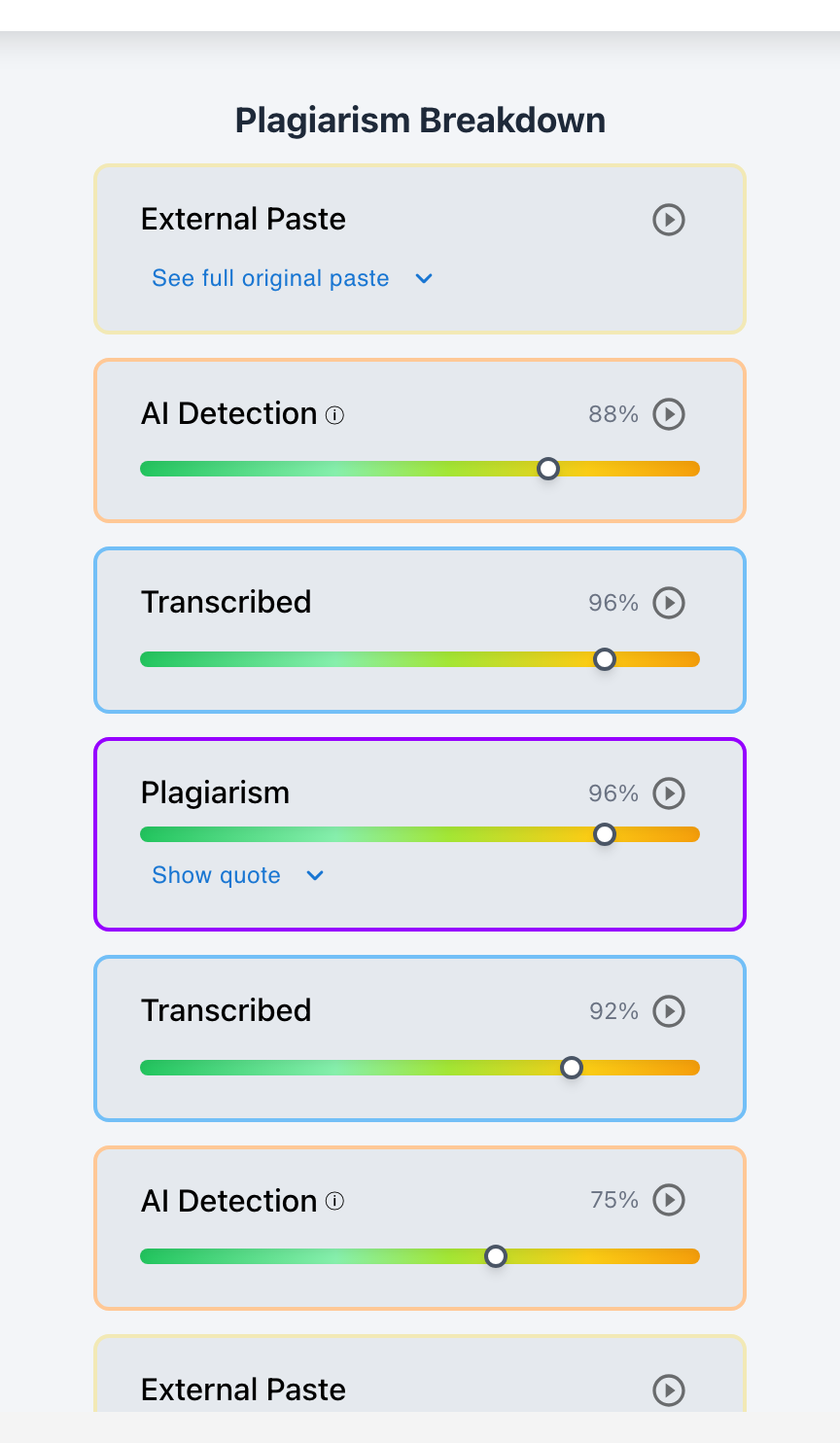
To determine which student copied from which when two essays match, teachers should examine four objective forensic proof points: keystroke process telemetry (the original author has 3+ hours of organic typing with 20%+ backspaces, while the copier has an instant paste or rapid zero-revision typing burst), document creation timestamps, intermediate revision artifacts (such as deleted thesis drafts), and oral comprehension during individual 2-minute conferences.
When a plagiarism checker flags two students with an 85% peer similarity match, both students often point fingers at each other: "I wrote it and let them read it, and they stole it!" vs. "No, I wrote it and they copied me!" Relying on who clicked "Submit" first in Canvas is unreliable, as the copier might have submitted hours ahead of the original author. To establish unassailable origin authorship, educators need physical evidence of the drafting struggle. Checkmark Plagiarism's Peer Origin Engine analyzes keystroke timelines and revision artifacts to prove the true author with certainty.
Below is a comprehensive guide on determining original authorship in peer plagiarism cases.
Checkmark Plagiarism resolves peer plagiarism by pairing plagiarism detection with AI detection, essay writing playback, autograding, and integrations with Canvas and Google Classroom.
The 4 Forensic Proof Points of Original Authorship
1. Keystroke Telemetry & Backspace Depth
The genuine author demonstrates cognitive struggle: 15% to 28% backspaces, false starts, sentence restructuring, and multi-session drafting across multiple days.
2. Copier Insertion Telemetry
The copier's document history shows either a single 0.05-second clipboard paste payload, or a rapid, mechanical transcription session with <2% backspaces.
3. Intermediate Draft Artifacts
The original author's version history contains deleted paragraphs, working outlines, and brainstormed notes that never appeared in the copier's file.
4. Asymmetric Oral Comprehension
In separate conferences, the original author explains the rationale behind specific phrasing effortlessly, while the copier struggles to explain why specific words were chosen.
Why Submission Timestamps Can Be Deceptive
Understanding why the first student to turn in the assignment is not always the author:
- The Early Copier Scenario: Student A finishes drafting their paper on Tuesday night and shares a Google Doc link with Student B for "peer review." Student B immediately copies the text and submits it at 8:00 AM Wednesday, while Student A doesn't submit until the 11:59 PM deadline.
- The Timestamp Trap: Looking solely at LMS submission times would falsely frame Student B as the victim and Student A as the copier.
- Document Creation Ground Truth: Checkmark Playback evaluates when characters were physically typed into the editor, proving Student A generated the text 24 hours earlier.
Read more in how Checkmark writing process analysis works.
Comparison: Original Author Telemetry vs. Copier Telemetry
Original Author (Student A)
- Drafting duration: 4.2 active hours across 3 days.
- 22.4% backspaces; rewrote intro paragraph twice.
- Document creation timestamp: Oct 12, 3:15 PM.
- Explains all sources and arguments effortlessly in person.
Copier (Student B)
- Drafting duration: 6 minutes (single paste event).
- 0.8% backspaces; zero sentence restructuring.
- Document creation timestamp: Oct 14, 11:10 PM.
- Cannot define advanced vocabulary or explain thesis.
A 5-Step Educator Protocol for Peer Plagiarism Inquiries
Peer Origin Attribution Checklist:
- 1. Open the Peer Match report in Checkmark Plagiarism inside Canvas SpeedGrader.
- 2. Review the Side-by-Side Timeline Comparison: note keystroke creation timestamps for both documents.
- 3. Compare Active Typing Duration and Deletion Rates for both students.
- 4. Conduct separate 2-minute oral conferences with each student without revealing the other's responses.
- 5. Present the objective telemetry proof to resolve the case conclusively with school administration.
How Checkmark Plagiarism Powers Peer Origin Attribution
Checkmark Plagiarism combines **AI detection, essay writing playback, static AI detection, plagiarism detection, autograding, and Canvas/Google Classroom integrations** to compare peer submissions side-by-side and automatically identify the true author using keystroke telemetry.
Frequently Asked Questions
How can a teacher prove who wrote an essay when two students submit the same paper?
Checkmark Playback proves origin by comparing active typing hours, backspace ratios, and keystroke creation timestamps between both files.
Does the student who submitted first win the authorship dispute?
No. Copiers frequently submit borrowed work earlier than the original author; document creation history and keystroke telemetry are the true standards of proof.
What if one student retyped the other student's essay by hand?
The retyper will have an unnaturally flat typing speed with <2% backspaces and zero structural revisions, while the author will have hours of revisions and pauses.
What should a teacher do if both students claim the other stole it?
Open Checkmark Playback for both papers side-by-side during a private conference; the video replay will instantly reveal who drafted the text organically.
Is sharing an essay with a classmate considered an integrity violation?
Most institutional honor codes prohibit unauthorized sharing of completed assignments (collusion), though penalties are typically calibrated differently for sharing versus stealing.
How does Checkmark Plagiarism integrate with Canvas LMS?
Checkmark provides certified LTI 1.3 integration, SpeedGrader sidebar embeds, two-way grade passback, and single sign-on (SSO).
What questions should a teacher ask to identify the real author?
Ask: "Why did you choose this specific example in paragraph 3?" and "What was the hardest part of outlining your argument?"
Can students fake drafting history to look like the original author?
Simulating 4+ hours of realistic pauses, typing bursts, false starts, and backspaces requires far more effort than writing an original paper.
How does Checkmark protect innocent students whose work was copied?
By capturing their full multi-hour drafting telemetry, Checkmark provides unassailable proof of their honest labor and original authorship.
Why is keystroke process evidence essential for peer plagiarism cases?
Because it replaces subjective "he-said-she-said" arguments with irrefutable, objective digital video evidence of the writing process.
Defending the Innocent, Proving the Truth
Peer plagiarism disputes should never be decided by guesswork or submission timestamps. By analyzing keystroke telemetry, revision depth, and document creation history with Checkmark Plagiarism, educators can protect honest students and identify copiers with absolute certainty.
Checkmark Plagiarism supports this comprehensive approach with AI detection, essay writing playback, static AI detection, plagiarism detection, autograding, and integrations with Canvas and Google Classroom.
See how Checkmark pairs peer submission matching with writing playback to determine origin authorship. View a sample report or request a demonstration.