
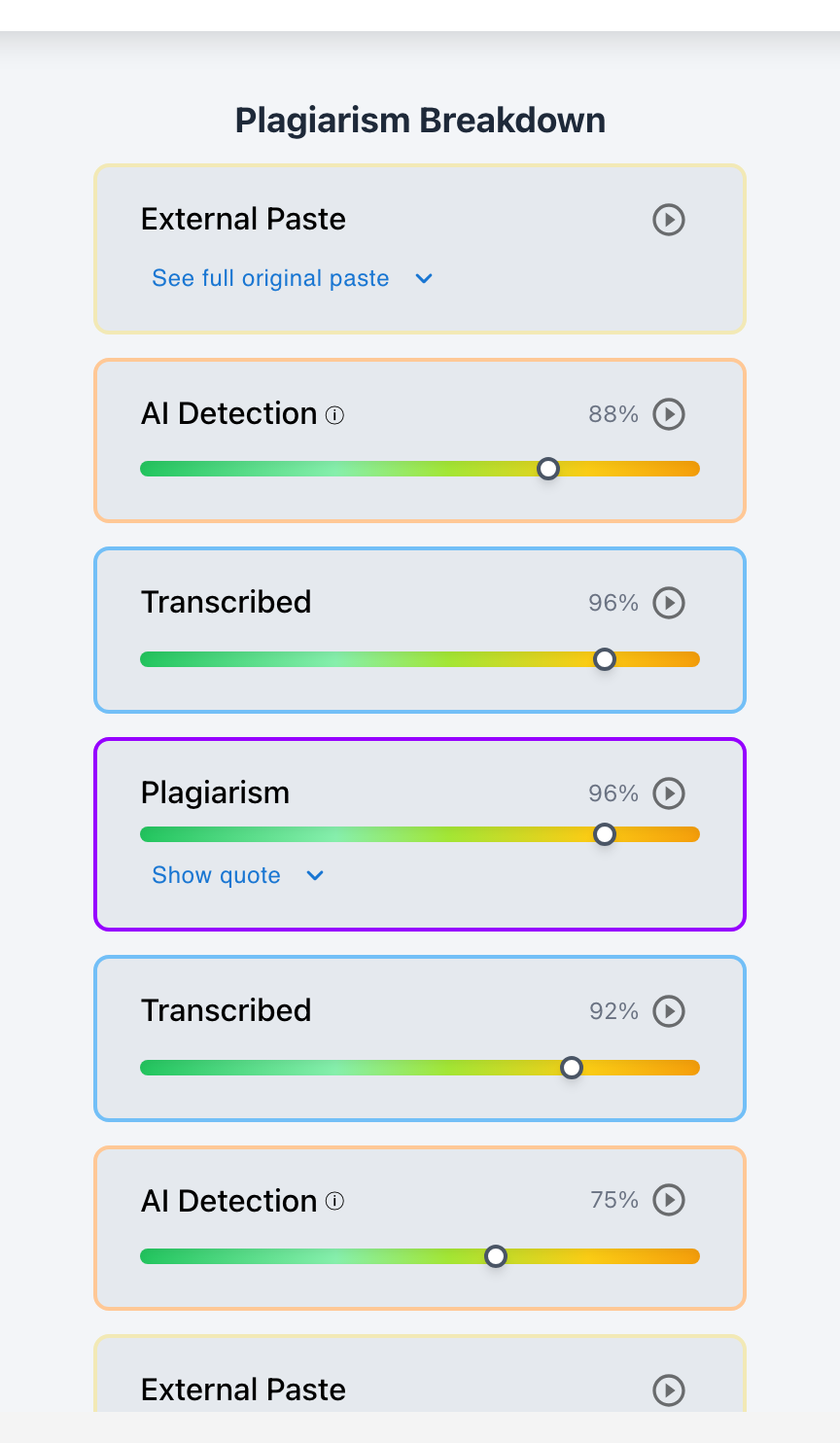
Teachers can review plagiarism matches in seconds without opening external links by using Checkmark Plagiarism's inline side-by-side source diff engine. When an educator clicks on any highlighted text in Canvas SpeedGrader, Checkmark displays an embedded Source Card containing the exact original text snippet, publication title, author, and similarity percentage right beside the student's prose—eliminating the need to open external browser tabs or search engines.
One of the most exhausting aspects of traditional plagiarism grading is the "link-clicking rabbit hole." When a legacy tool flags 15 separate web matches, a teacher is forced to open 15 separate browser tabs, navigate around paywalls, pop-up ads, or dead links, and manually search for the matching paragraph on the external web page. This tedious process adds 10 to 15 minutes of frustration to every graded paper. Inline source snippet rendering brings the original text directly into the grading sidebar, allowing educators to verify matches in under 3 seconds.
Below is a comprehensive guide on evaluating plagiarism matches rapidly using inline source diffs.
Checkmark Plagiarism streamlines source verification by pairing plagiarism detection with AI detection, essay writing playback, autograding, and integrations with Canvas and Google Classroom.
The 4 Features That Eliminate External Link Clicking
1. Inline Side-by-Side Snippet Diffs
Clicking any highlighted sentence instantly pops open the original source text snippet directly in SpeedGrader, highlighting identical words in bold.
2. Primary Source Authority Ranking
Checkmark groups matches by their original scholarly or journalistic source, eliminating duplicates from content aggregators or scraper sites.
3. One-Click Quote Whitelisting
If a flagged passage is a properly attributed quote, clicking "Exclude Source" instantly recalculates the similarity score across the entire document.
4. Intelligent Match Classification
Matches are automatically tagged as "Verbatim Copy," "Paraphrased Text," or "Common Academic Phrase," giving instant context without deep reading.
How Inline Diffs Accelerate Grading
Understanding the operational speed advantage of embedded source comparisons:
- Instant Context: A teacher clicks on a flagged 40-word paragraph and immediately sees the Wikipedia or journal passage side-by-side with identical phrasing highlighted in blue.
- Zero Broken Links: Checkmark caches historical web and academic article snapshots, ensuring you can review matched text even if the original web page was deleted or moved.
- Paywall Bypass: Proprietary academic journal databases (JSTOR, ProQuest, Crossref) are rendered directly inside Checkmark's secure preview window without requiring individual subscription logins.
Read more in how Checkmark writing process analysis works.
Comparison: External Tab Clicking vs. Checkmark Inline Source Diffs
Checkmark Inline Diffs (3 Seconds Per Match)
- Original source snippet rendered inside SpeedGrader.
- Side-by-side word comparison with bold diffs.
- Paywalled academic journals viewable in preview.
- One-click exclusion recalculates score in real time.
External Tab Clicking (3–5 Minutes Per Match)
- Opens separate browser tabs for every match.
- Requires scrolling down long web pages to find text.
- Blocked by paywalls, login prompts, and dead links.
- Clutters teacher screen with dozens of open tabs.
A 5-Step Educator Protocol for Rapid Source Audits
Rapid Source Audit Checklist:
- 1. Open the student's submission in Canvas SpeedGrader with Checkmark enabled.
- 2. Click on the largest highlighted text block in the essay.
- 3. Review the Inline Source Card: compare the student's words against the original snippet side-by-side.
- 4. If the text is a legitimate quote with citation, click "Exclude Match" to update the score.
- 5. If unauthorized verbatim copying is confirmed, export the side-by-side snippet diff into the audit dossier.
How Checkmark Plagiarism Powers Fast Source Verification
Checkmark Plagiarism combines **AI detection, essay writing playback, static AI detection, plagiarism detection, autograding, and Canvas/Google Classroom integrations** to present all source comparisons inline, saving educators dozens of hours every semester.
Frequently Asked Questions
Do I have to open the website where the student copied the text?
No. Checkmark extracts and displays the exact matching paragraph from the source inside the SpeedGrader sidebar, eliminating the need to visit external sites.
Can teachers view matching text from paid academic databases?
Yes. Checkmark indexes millions of scholarly articles and displays the matched text snippet directly in the report without requiring a separate library login.
What if a source link is broken or 404s?
Checkmark maintains cached digital snapshots of indexed web pages, allowing you to view the exact text match even if the live website went offline.
How does Checkmark highlight side-by-side differences?
Identical words are highlighted in bold blue, while substituted synonyms or rearranged words are marked in purple diff formatting.
How does Checkmark Plagiarism integrate with Canvas LMS?
Checkmark embeds inline source diff cards directly inside Canvas SpeedGrader, allowing full verification without ever leaving Canvas.
Can I exclude common phrases or bibliographies in one click?
Yes. Clicking "Exclude Bibliographies" or "Exclude Quotes" automatically recalculates the similarity percentage across the entire submission.
How does inline source verification protect teacher privacy?
Teachers avoid visiting potentially unsafe, ad-heavy, or untrusted external websites by viewing secured text snippets within Checkmark's sandbox.
Can students see the inline source snippets?
When reports are shared with students, they see the same side-by-side comparison to understand exactly how their phrasing mirrored the source.
How does Autograder utilize inline source data?
Checkmark Autograder evaluates whether citations properly credit inline matched sources, incorporating citation mechanics into rubric feedback.
Why is inline diff verification essential for grading speed?
Because eliminating tab switching and manual page searching reduces source verification time from minutes to under 3 seconds per match.
Effortless Source Verification at Your Fingertips
Verifying academic sources should be fast, seamless, and completely reliable. By utilizing Checkmark Plagiarism's inline side-by-side diff engine, educators audit plagiarism matches in seconds without ever opening external browser tabs, maintaining high academic standards with total ease.
Checkmark Plagiarism supports this comprehensive approach with AI detection, essay writing playback, static AI detection, plagiarism detection, autograding, and integrations with Canvas and Google Classroom.
See how Checkmark displays inline side-by-side source diffs directly inside Canvas SpeedGrader. View a sample report or request a demonstration.