
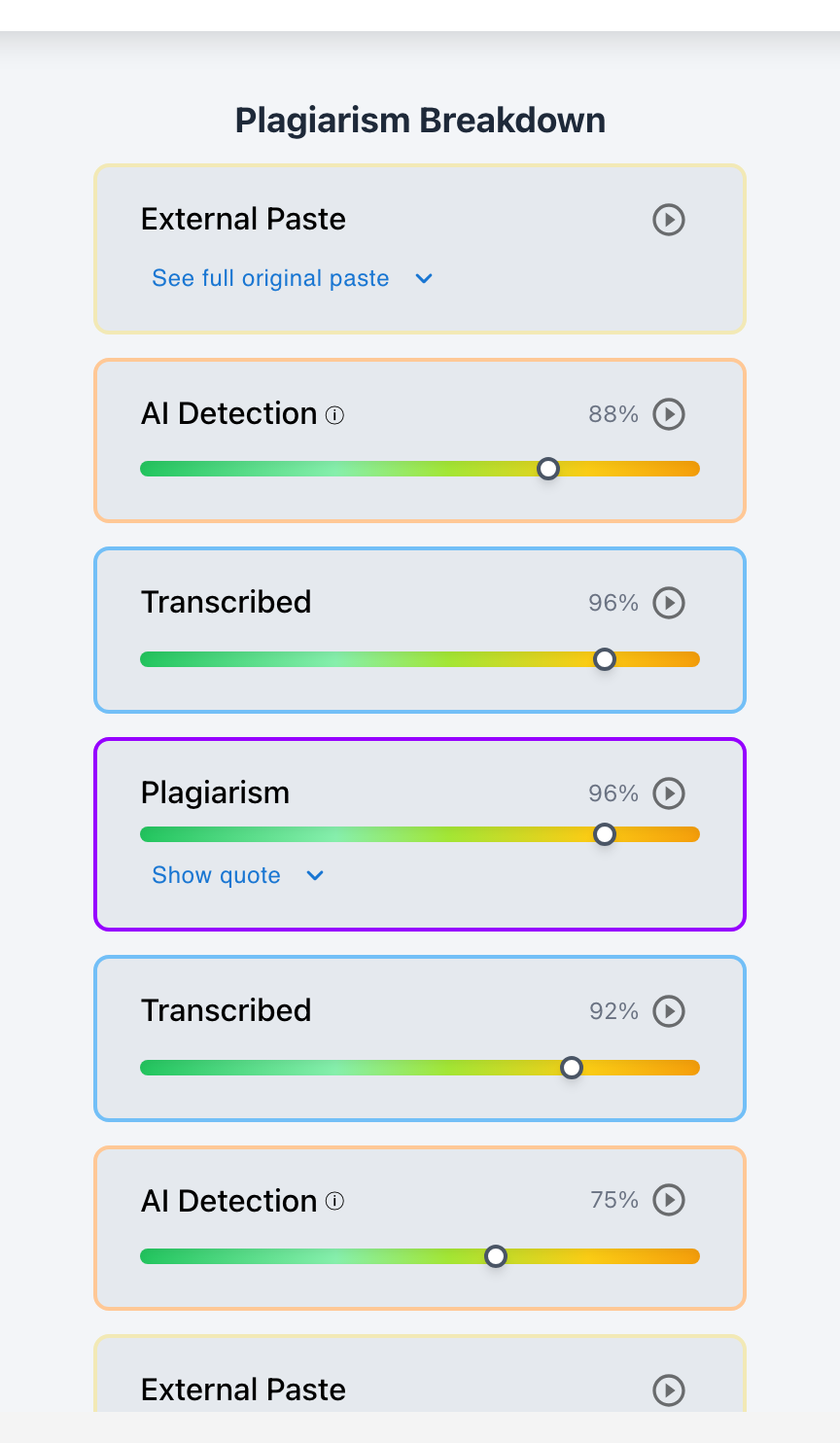
Teachers can review 100 essays for AI use efficiently by implementing a 4-tier triage funnel powered by Checkmark Plagiarism: Tier 1 (Automated Pre-Filtering): the class dashboard sorts submissions into Green (75–85 clean papers), Yellow (10–15 mixed-assistance papers), and Red (3–5 high-risk papers); Tier 2: clear the Green cohort in 10 seconds each by verifying 3+ hours of active typing in Playback; Tier 3: inspect sentence heatmaps on Yellow papers; and Tier 4: execute deep forensic audits (paste logs and DOI checks) exclusively on the 3–5 Red submissions.
Reviewing 100 student essays individually for AI generation, plagiarism, and argumentative quality can easily consume 30 to 50 hours of exhaustive labor. If a teacher treats all 100 submissions as equally suspicious, grading becomes an agonizing marathon of reading line-by-line and second-guessing student voices. Implementing an automated evidence-first triage funnel allows educators to instantly clear 85% of authentic human papers, focus qualitative grading where it matters, and isolate true misconduct in minutes. Checkmark Plagiarism automates this triage workflow directly within Canvas SpeedGrader.
Below is a comprehensive guide on grading 100+ essays efficiently while maintaining rigorous academic integrity.
Checkmark Plagiarism scales essay grading by pairing AI detection with essay writing playback, plagiarism detection, autograding, and integrations with Canvas and Google Classroom.
The 4-Tier Triage Funnel for 100 Essays
Tier 1: Automated Dashboard Sorting (0 mins)
Checkmark automatically analyzes the 100 papers upon submission, grouping them into: 80 Clean (Low AI / 3+ hrs typing), 15 Yellow (Mixed), and 5 Red (High AI / 0 hrs).
Tier 2: Fast-Track Green Cohort (15 mins total)
Glance at the Active Typing Duration badge for the 80 clean papers: confirm 3+ hours and healthy backspaces, then grade directly on rubric criteria.
Tier 3: Surgical Yellow Review (15 mins total)
Open the 15 mixed-assistance papers: review sentence heatmaps to identify if AI was used for grammar or a specific paragraph, applying proportional grading.
Tier 4: Deep Red Forensics (15 mins total)
Perform deep audits on the 5 red papers: watch 15-second Playback videos, inspect 0.05-second paste payloads, check DOIs, and export PDF audit dossiers.
How Autograder Accelerates Rubric Evaluation
Combining integrity triage with automated formative feedback:
- First-Draft Rubric Alignment: Checkmark Autograder evaluates thesis strength, organization, and evidence synthesis across all 100 papers, generating draft scores and actionable comments.
- Teacher-in-the-Loop Review: The educator reviews Autograder's suggestions in SpeedGrader, adjusts scores in seconds, and adds personalized encouragement.
- Total Time Savings: Grading 100 essays drops from 35 hours of manual reading to under 4 hours of focused, high-impact review.
Read more in how Checkmark writing process analysis works.
Comparison: Traditional Linear Grading vs. Checkmark Triage Funnel
Checkmark Triage Funnel (4 Hours Total)
- Automated risk sorting separates clean from high-risk work.
- 80% of papers validated for typing effort in seconds.
- Autograder provides pre-drafted rubric feedback.
- Deep investigations restricted to the 5% true violations.
Traditional Linear Grading (35+ Hours Total)
- Reading all 100 essays sequentially with suspicion.
- Manually checking third-party detector sites one by one.
- Wasting hours investigating false positive alarms.
- Severe educator burnout and delayed student feedback.
A 5-Step Educator Protocol for 100-Essay Grading
100-Essay Triage Checklist:
- 1. Open the Assignment Dashboard in Canvas or Google Classroom with Checkmark.
- 2. Review the class breakdown: note the distribution of Green, Yellow, and Red submissions.
- 3. Grade the Green cohort: verify active drafting hours, approve Autograder feedback, and submit.
- 4. Review Yellow submissions: check sentence heatmaps and adjust rubric criteria proportionally.
- 5. Investigate Red submissions: watch Playback replays, check DOIs, and schedule 2-minute conferences.
How Checkmark Plagiarism Powers High-Volume Grading
Checkmark Plagiarism combines **AI detection, essay writing playback, static AI detection, plagiarism detection, autograding, and Canvas/Google Classroom integrations** to turn overwhelming 100-essay grading stacks into an organized, efficient, and enjoyable workflow.
Frequently Asked Questions
How much time does Checkmark save when grading 100 essays?
Checkmark reduces the total time required to grade and screen 100 essays from 30–40 hours down to approximately 4 to 6 hours.
Does automated triaging miss subtle AI cheating?
No. Checkmark screens every submission at the sentence, paragraph, and keystroke level, ensuring that even single-paragraph AI rewrites are categorized for review.
How fast can a teacher clear an authentic human essay?
With Checkmark's sidebar badge showing 3.5 hours of active typing and 20% backspaces, verifying authenticity takes less than 10 seconds.
What makes an essay get sorted into the 'Yellow' cohort?
Submissions with mixed signals—such as a 25% AI score restricted to one paragraph or an essay with active typing but an isolated paste event.
How does Checkmark Plagiarism integrate with Canvas LMS?
Checkmark integrates directly into Canvas SpeedGrader, allowing teachers to review telemetry and autograded feedback without leaving the LMS.
Can teachers customize the risk thresholds in the dashboard?
Yes. Educators can adjust similarity and AI sensitivity thresholds to match specific course policies and assignment types.
How does Autograder generate feedback without lowering quality?
Autograder quotes specific student sentences and anchors feedback in the teacher's exact rubric criteria, ensuring high-quality, actionable guidance.
Can students see that their essay was screened in bulk?
Students receive standard formative feedback and integrity reports directly inside their LMS portal without seeing internal class-wide dashboards.
How does triaging prevent educator burnout?
By automating repetitive screening and pre-drafting rubric evaluations, teachers spend their mental energy where it matters most: mentoring students.
Why is efficient grading vital for student learning?
Because returning feedback within 48–72 hours reinforces learning while concepts are fresh, dramatically improving student retention and growth.
Scalable Excellence in Writing Assessment
Grading high volumes of student writing should be an empowering educational experience, not an exhausting administrative chore. By utilizing the 4-tier triage funnel with Checkmark Plagiarism, educators grade 100+ essays with unmatched speed, rigorous fairness, and joyful teaching excellence.
Checkmark Plagiarism supports this comprehensive approach with AI detection, essay writing playback, static AI detection, plagiarism detection, autograding, and integrations with Canvas and Google Classroom.
See how Checkmark streamlines grading 100+ essays with triage dashboards and writing playback. View a sample report or request a demonstration.