
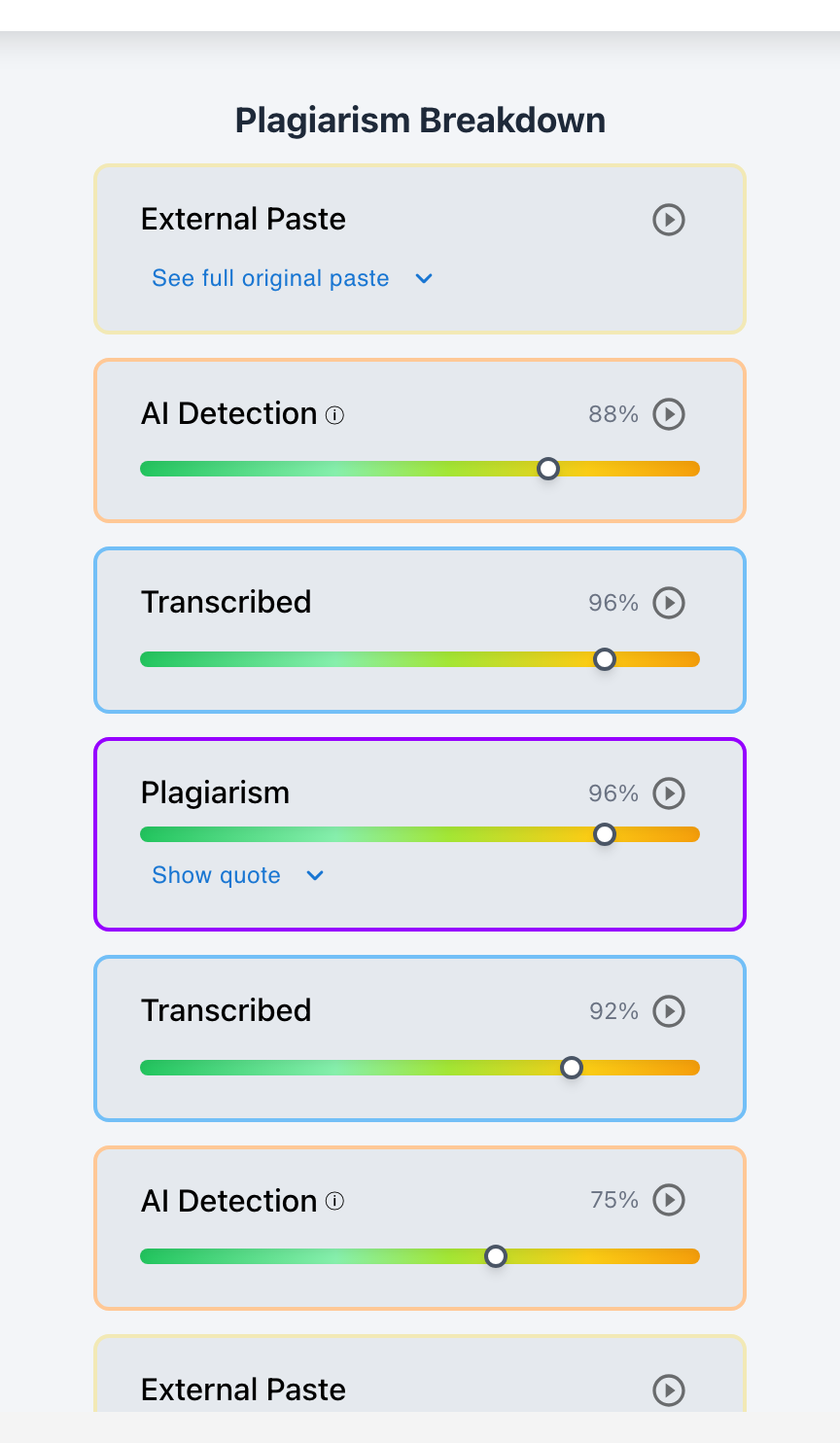
Teachers can prioritize which assignments need manual review by utilizing a 4-tier risk matrix powered by Checkmark Plagiarism: Priority 1 (Immediate Deep Audit): submissions triggering multi-signal red flags (zero typing hours + 0.05s paste payloads + fake DOIs); Priority 2 (Surgical Review): submissions with mixed yellow flags (isolated paragraph AI rewrites or peer matches); Priority 3 (Quick Spot-Check): submissions with high similarity caused by block quotes; and Priority 4 (Fast-Track Grading): verified green submissions with 3+ hours of active human typing.
When grading a batch of 80 to 150 student essays, an educator cannot afford to spend 20 minutes investigating every single paper. Trying to review all submissions with equal intensity leads to decision fatigue, delayed feedback, and overlooked violations. Establishing an evidence-based manual review queue allows teachers to direct 90% of their investigative focus toward the small fraction of papers with true anomalies, while fast-tracking genuine human writing directly to rubric grading. Checkmark Plagiarism automatically organizes grading queues by review priority in Canvas SpeedGrader.
Below is a comprehensive guide on prioritizing manual essay reviews efficiently.
Checkmark Plagiarism streamlines manual review queues by pairing AI detection with essay writing playback, plagiarism detection, autograding, and integrations with Canvas and Google Classroom.
The 4-Tier Manual Review Priority Matrix
Priority 1: Immediate Deep Audit (Top 3–5%)
Trigger: Zero drafting hours + 0.05s clipboard paste + 90%+ AI probability + hallucinated DOIs.
Action: Watch 15-second Playback video, verify citations, and export misconduct dossier.
Priority 2: Surgical Section Review (10–15%)
Trigger: Multi-hour human drafting with an isolated AI paragraph or 25% peer match.
Action: Inspect the sentence heatmap, verify the specific section, and apply calibrated grading.
Priority 3: Quick Spot-Check (5–10%)
Trigger: High similarity score (>25%) caused entirely by extensive block quotations.
Action: Glance at quotation marks, verify proper attribution, and clear within 30 seconds.
Priority 4: Fast-Track Rubric Grading (75–80%)
Trigger: 3+ hours active typing + 15–25% backspaces + valid citations + low AI.
Action: Proceed directly to qualitative grading and approve Autograder feedback.
How Multi-Signal Triaging Saves 80% of Review Time
Understanding the operational impact of prioritized grading queues:
- Elimination of Random Spot-Checking: Teachers no longer need to guess which papers might be AI-generated; the dashboard sorts the highest-risk submissions to the top.
- Instant Exoneration for Authentic Effort: Papers in Priority 4 are validated by physical keystroke telemetry in 5 seconds, eliminating false positive anxiety.
- Targeted Student Interventions: Educators spend their time holding meaningful 2-minute conferences with the few students who actually needed support or took shortcuts.
Read more in how Checkmark writing process analysis works.
Comparison: Unprioritized Manual Grading vs. Checkmark 4-Tier Queue
Checkmark 4-Tier Queue (Focused & Scalable)
- Sorts submissions by multi-signal risk index.
- Investigates only the top 5% of true anomalous papers.
- Fast-tracks 80% of clean papers directly to grading.
- Reduces grading turnaround time by 75%.
Unprioritized Manual Grading (Exhausting & Slow)
- Reviews all 100 papers with identical skepticism.
- Spends hours reading quotes on innocent papers.
- Misses cleverly disguised AI rewrites in the middle.
- Leads to severe grading fatigue and delayed feedback.
A 5-Step Educator Protocol for Prioritizing Reviews
Manual Review Prioritization Checklist:
- 1. Open the Assignment Dashboard in Canvas SpeedGrader with Checkmark enabled.
- 2. Filter the queue by "Review Priority: High to Low".
- 3. Address Priority 1 submissions first: inspect Playback videos and check cited DOIs.
- 4. Address Priority 2 submissions: review sentence heatmaps for partial AI sections.
- 5. Fast-track Priority 3 and 4 submissions directly to qualitative rubric scoring.
How Checkmark Plagiarism Powers Smart Prioritization
Checkmark Plagiarism combines **AI detection, essay writing playback, static AI detection, plagiarism detection, autograding, and Canvas/Google Classroom integrations** to automatically structure grading queues by priority, ensuring educators maximize their time and impact.
Frequently Asked Questions
How does Checkmark determine which papers go into Priority 1?
Priority 1 is reserved for submissions triggering at least two critical anomalies: zero active typing hours, large paste events, fake DOIs, or >90% AI probability.
Can I sort the SpeedGrader queue directly by priority?
Yes. Checkmark adds a smart sorting dropdown to Canvas SpeedGrader, allowing you to grade by risk priority, student name, or submission date.
What if a Priority 4 paper has a high AI detector score?
If a paper has 3+ hours of active typing and healthy backspaces in Playback, Checkmark classifies it as Priority 4 because the telemetry proves the score is a false positive.
How much time does prioritization save per batch of essays?
Educators save an average of 15 to 25 hours per 100-essay assignment by eliminating manual checks on authentic human papers.
How does Checkmark Plagiarism integrate with Google Classroom?
Checkmark provides an integrated assignment dashboard in Google Classroom that highlights priority review papers automatically.
What should a teacher do with Priority 2 papers?
Open the sentence heatmap to identify which specific paragraph was AI-generated, and score the rest of the authentic draft on merit.
Can teachers customize priority thresholds?
Yes. You can adjust the sensitivity of typing duration filters and similarity thresholds in assignment settings.
How does Autograder integrate with prioritized queues?
Autograder pre-scores Priority 4 papers for quick teacher approval, while holding Priority 1 and 2 papers for manual educator inspection.
Does prioritizing reviews compromise academic rigor?
No. Prioritization enhances rigor by ensuring that suspicious papers receive deeper, evidence-backed investigations while honest students receive faster feedback.
Why is workflow prioritization essential for modern teachers?
Because sustainable grading workflows protect teacher well-being and allow educators to invest their energy in meaningful instruction and mentorship.
Maximizing Teaching Impact Through Smart Workflows
Your time as an educator is precious. By implementing the 4-tier manual review priority matrix with Checkmark Plagiarism, you eliminate grading bottlenecks, catch genuine misconduct effortlessly, and dedicate your energy to inspiring authentic student achievement.
Checkmark Plagiarism supports this comprehensive approach with AI detection, essay writing playback, static AI detection, plagiarism detection, autograding, and integrations with Canvas and Google Classroom.
See how Checkmark organizes manual review queues by risk priority in Canvas SpeedGrader. View a sample report or request a demonstration.