
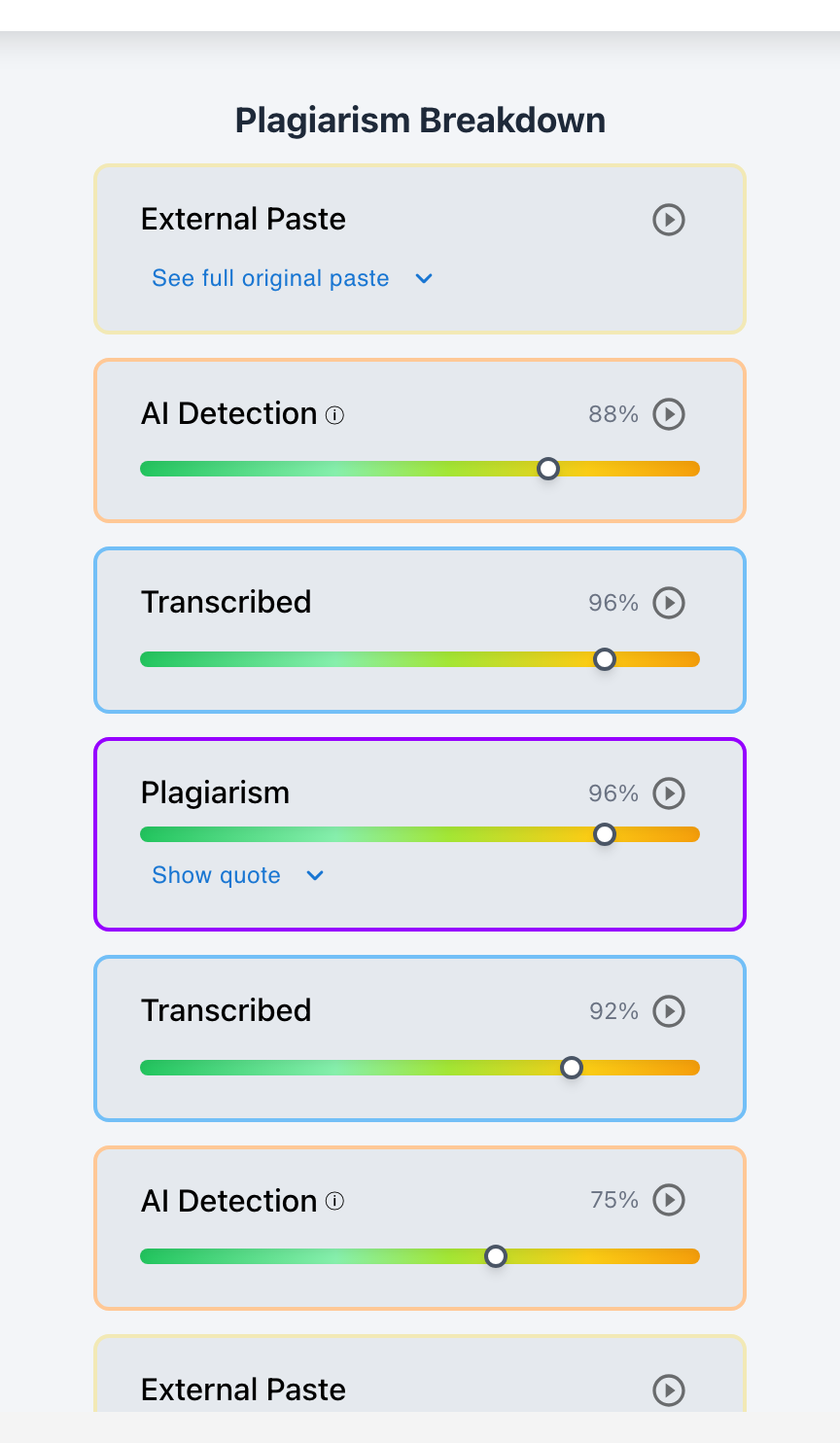
When an entire essay appears in an assignment document all at once in a single millisecond, educators must follow a structured, multi-signal investigative protocol combining paste analysis, essay playback, citation verification, and student dialogue.
An essay that appears all at once indicates a large external paste event. While this can represent unauthorized generative AI use (such as copying an essay from ChatGPT) or web plagiarism, it can also represent a student who drafted legitimately in Microsoft Word or Pages and copied the text into the LMS editor. Reaching a fair, defensible conclusion requires examining the physical evidence before making disciplinary determinations.
Through Checkmark Plagiarism's Paste + Playback Investigation Suite, educators can conduct thorough, objective audits in under two minutes.
Checkmark Plagiarism powers paste investigations by pairing essay writing playback with AI detection, plagiarism detection, autograding, and integrations with Canvas and Google Classroom.
The 4-Step Educator Investigation Workflow
Step 1: Inspect the Raw Paste Payload
Click the flagged paste block in Checkmark Playback to view the raw, unedited text as it was inserted, checking for AI cliches or formatting artifacts.
Step 2: Cross-Scan with Dual Engines
Review both the Plagiarism Match report (billions of web/peer sources) and the AI Detection probability score for that specific pasted text block.
Step 3: Audit Cited Bibliography Sources
Search 2–3 cited journal titles in Google Scholar or JSTOR enclosed in quotes to verify whether the sources exist or were hallucinated by AI.
Step 4: Hold an Evidence-Based Conference
Invite the student to share original offline Word files, review the playback timeline together, and ask 2–3 oral comprehension questions.
What to Ask During the Student Conference
Keep the conference inquiry-driven and supportive, focusing on observable facts:
- "I noticed this essay appeared in our document editor in a single paste at 11:30 PM. Can you share the original file or rough notes where you drafted this?"
- "In paragraph 3, you used the phrase [insert technical term]. Can you define that in your own words?"
- "How did you locate this specific cited journal article, and what was the author's primary finding?"
Read more in how Checkmark writing process analysis works.
Comparison: Legitimate Offline Draft vs. Unauthorized AI Paste
Legitimate Offline Draft (Word/Pages)
- Student provides original .docx file with creation metadata.
- Subsequent active editing in LMS shows revisions.
- All cited sources verified in academic databases.
- Student fluently explains thesis and arguments orally.
Unauthorized AI Paste (ChatGPT Shortcut)
- Student has no prior drafts, notes, or external files.
- 0 minutes active typing; submitted immediately.
- Citations contain hallucinated authors or dead DOIs.
- Student struggles to define vocabulary or summarize claims.
A 5-Step Educator Checklist for Investigating Pastes
Educator Investigation Checklist:
- 1. Open the Checkmark Playback visual replay to evaluate the paste timestamp.
- 2. Click the paste block to examine the Original Preserved Paste payload.
- 3. Cross-reference the payload with dual AI and plagiarism detection scores.
- 4. Audit 2 cited sources in Google Scholar to check for hallucinations.
- 5. Review the timeline with the student during an objective, non-accusatory conference.
How Checkmark Plagiarism Powers Paste Investigations
Checkmark Plagiarism combines **AI detection, essay writing playback, static AI detection, plagiarism detection, autograding, and Canvas/Google Classroom integrations** to give teachers automated, indisputable forensic dossiers for investigating all-at-once essay submissions.
Frequently Asked Questions
Does an essay appearing all at once mean the student cheated?
Not necessarily. It proves the text was composed externally, which could be an authentic offline draft in Microsoft Word or a paste from ChatGPT. Verification is required.
How can a student prove an external paste was authentic?
Provide the original external file (Word, Pages) showing creation date metadata, save history, and rough notes, and explain the paper fluently in an oral check-in.
How does writing playback help investigate large pastes?
Playback logs the exact timestamp, character count, and raw text payload of the paste, showing whether any active editing occurred afterward.
Can teachers see what text was pasted if the student edited it?
Yes. Checkmark's Original Paste Preservation captures the unedited text at the moment of paste, showing diff overlays of subsequent edits.
What if a student claims they wrote the essay by hand and typed it in?
Typing a handwritten essay generates steady human keystrokes (30–60 WPM) over hours, which playback easily confirms. A paste event inserts text in a millisecond.
How do hallucinated citations confirm AI use in a pasted essay?
ChatGPT frequently invents fake journal titles and DOIs. If cited sources fail database verification, it provides physical proof of AI generation.
How does Checkmark Plagiarism integrate with Canvas LMS?
Checkmark Plagiarism displays visual writing playback timelines, paste volume alerts, and dual AI/plagiarism reports directly inside Canvas SpeedGrader.
What should a teacher do if a student admits they pasted from AI?
Acknowledge their honesty, explain why AI generation violates course authorship rules, and allow a supervised rewrite for revised credit.
Does paste investigation protect honest students?
Yes. It ensures students who drafted offline in Word are given due process and the opportunity to present their authentic files before any penalty is applied.
Why is combining paste detection with student conferences essential?
Because software provides objective forensic data, while human conversation evaluates understanding, intent, and authentic learning.
Objective Evidence and Due Process Protect Integrity
Investigating an essay that appeared all at once requires a balanced approach rooted in forensic evidence and student dialogue. By combining paste analysis with essay playback and citation audits, Checkmark Plagiarism gives educators the tools to uphold academic standards with justice and precision.
Checkmark Plagiarism supports this comprehensive approach with AI detection, essay writing playback, static AI detection, plagiarism detection, autograding, and integrations with Canvas and Google Classroom.
See how Checkmark pairs essay writing playback with multi-signal detection to investigate large paste events inside your LMS. View a sample report or request a demonstration.