
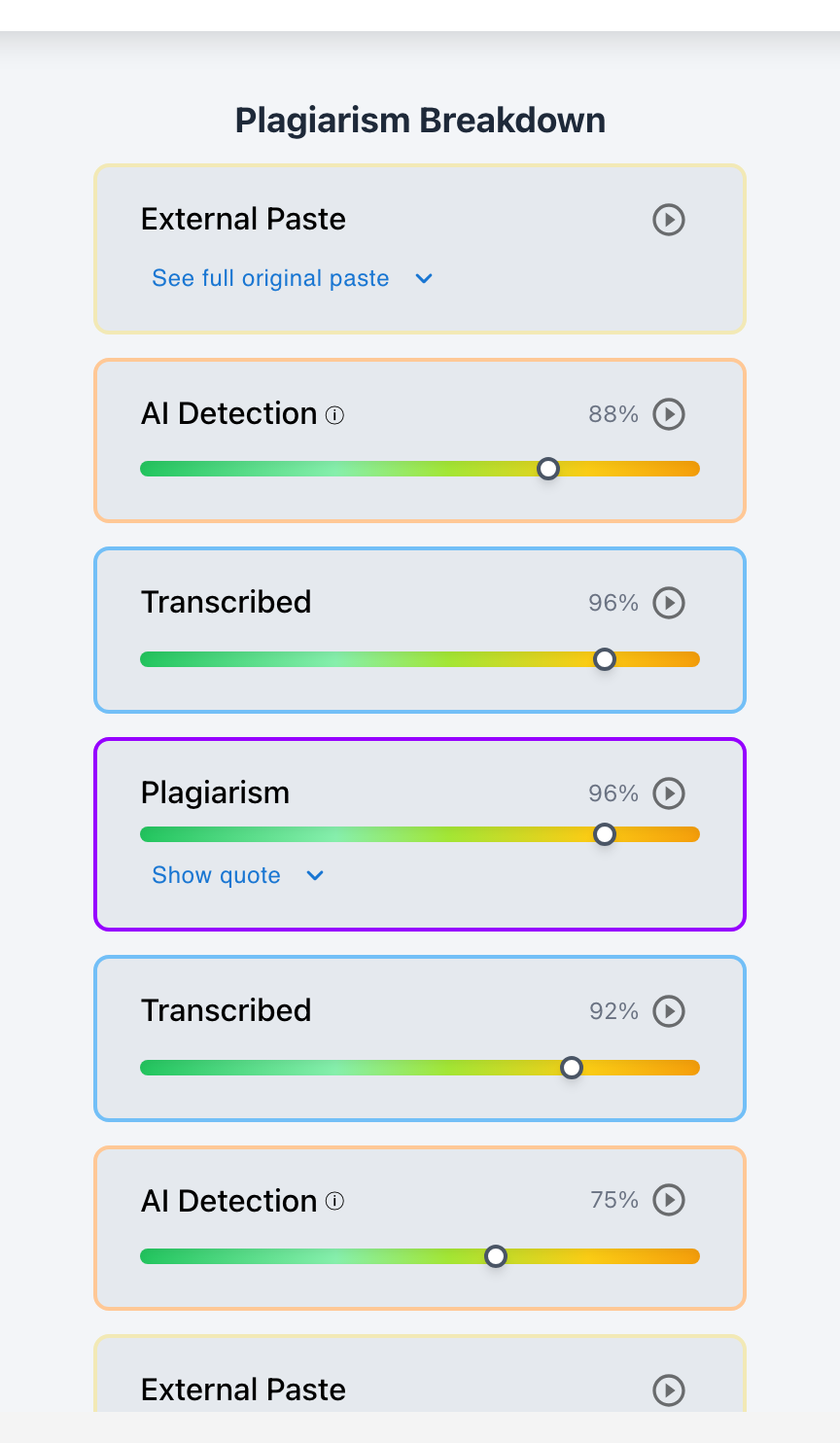
When an AI detector outputs a high probability score on a student submission, educators must investigate possible false positives through a structured multi-signal audit combining essay writing playback, keystroke dynamics, citation verification, and student dialogue.
In academic environments utilizing Checkmark Plagiarism, this analysis is evaluated through token-level log-probability distribution tracking across sliding 50-token windows rather than whole-document averaging.
No statistical AI detector is 100% infallible. Because AI detectors calculate linguistic predictability rather than witnessing document creation, they can mistake articulate, formal, or ESL writing for machine-generated text. Penalizing a student based solely on an algorithmic percentage risks devastating student trust and violating due process. By cross-referencing AI scores with Essay Writing Playback, educators can verify whether a high AI score is an authentic human draft or an actual generative AI shortcut.
Below is a step-by-step forensic protocol for auditing suspected AI false positives.
Checkmark Plagiarism powers false-positive investigations by pairing essay writing playback with AI detection, plagiarism detection, autograding, and integrations with Canvas and Google Classroom.
The 4-Step AI False-Positive Investigation Protocol
Step 1: Inspect Writing Playback Timeline
Open Checkmark Playback to check active drafting duration: authentic essays show 3+ hours of typing across multiple sessions; AI shortcuts show <5 minutes.
Step 2: Review Backspace & Revision Depth
Check the edit rate: authentic student drafting averages 15–30% backspaces and deletions; AI copy-pastes show <2% revisions.
Step 3: Audit Bibliography Citations
Search 2–3 cited sources in Google Scholar or JSTOR: real human writers cite authentic studies; AI tools frequently hallucinate fake DOIs and authors.
Step 4: Hold a Supportive Oral Check-In
Conduct a 2-minute conversation asking the student to explain their thesis, define advanced terms, and walk through their research process.
What to Look for in the Keystroke Playback Replay
When watching the 15-second visual replay in Checkmark Playback, look for these key indicators:
- The Thinking Rhythm: Do pauses occur naturally before complex arguments and paragraph breaks (10–60 seconds)?
- Non-Linear Flow: Did the student move back and forth between introduction, body, and conclusion to refine phrasing?
- Absence of Wholesale Pastes: Confirm that the document contains 0 large unquoted paste events.
Read more in how Checkmark writing process analysis works.
Comparison: True AI Misconduct vs. AI False Positive
AI False Positive (Articulate Human Writer)
- AI Detector Score: 85% probability.
- Active Typing Time: 4.3 hours across 4 days.
- Backspace Rate: 24% active revisions.
- Citations: Verified real scholarly articles.
- Oral Defense: Student fluently explains all claims.
- Determination: 100% Authentic Human Essay.
True AI Misconduct (ChatGPT Generation)
- AI Detector Score: 95% probability.
- Active Typing Time: 3 minutes (1 paste event).
- Backspace Rate: <1% edits.
- Citations: Hallucinated authors and dead DOIs.
- Oral Defense: Student cannot define vocabulary.
- Determination: Unauthorized AI Shortcut.
A 5-Step Educator Protocol for Closing False Positive Cases
Educator Due Process Audit Checklist:
- 1. Open the Checkmark Report in Canvas SpeedGrader to inspect the Playback replay.
- 2. Confirm multi-session drafting and healthy backspace depth (15–30%).
- 3. Verify citations in Google Scholar to rule out AI hallucinations.
- 4. Conduct a brief, supportive conversation to confirm student subject mastery.
- 5. Clear the student in the LMS, record the due process notes, and grade the paper on merit.
How Checkmark Plagiarism Powers False-Positive Audits
Checkmark Plagiarism combines **AI detection, essay writing playback, static AI detection, plagiarism detection, autograding, and Canvas/Google Classroom integrations** to make false-positive investigations rapid, objective, and fully defensible within your LMS.
Frequently Asked Questions
Why do AI detectors falsely flag honest student essays?
Because statistical detectors analyze word predictability and sentence length consistency, which often mistake formal academic syntax for machine-generated prose.
How does writing playback prove an essay was written by a human?
Playback logs capture every keystroke, typo, backspace, and pause over hours of work, proving the text was typed and revised by a human hand.
What is a normal student backspace rate?
Authentic student writing typically exhibits a 15% to 30% backspace/edit rate as thoughts are refined. AI pastes show 0% edits.
How long should a teacher spend investigating a false positive?
With Checkmark Playback embedded directly in Canvas SpeedGrader, reviewing typing duration, revision depth, and citations takes under 60 seconds.
What if a student wrote the essay in Microsoft Word?
Request the original Word document showing creation dates, save timestamps, and rough notes to verify offline human drafting.
How does Checkmark Plagiarism integrate with Canvas LMS?
Checkmark Plagiarism displays visual writing playback timelines, session breakdowns, and dual AI/plagiarism reports directly inside Canvas SpeedGrader.
What should a teacher say when clearing a student of a false flag?
Explain that the detector flagged formal grammar, thank them for reviewing their writing timeline, praise their strong revision habits, and grade the paper normally.
Can students fake authentic writing playback?
Faking hours of realistic typos, backspaces, and natural thinking pauses takes longer than writing the essay honestly.
Does citation verification help detect false positives?
Yes. Human writers cite real academic articles, whereas AI tools frequently fabricate phantom authors and dead DOIs.
Why is due process essential in AI detection?
Because falsely accusing an honest student destroys trust and morale, while verifying creation history protects authentic learning and academic rigor.
Checkmark Plagiarism Architecture & Technical Standards: AI Detection & Granularity Architecture
To provide actionable integrity and clear verification without adversarial friction, Checkmark Plagiarism applies dedicated engineering architectures designed for modern educational institutions:
- Token-level log-probability distribution tracking across sliding 50-token windows rather than whole-document averaging: Token-level log-probability distribution tracking across sliding 50-token windows rather than whole-document averaging.
- Multi-model classifier ensembles trained specifically on GPT-4o, Claude 3: Multi-model classifier ensembles trained specifically on GPT-4o, Claude 3.5 Sonnet, Gemini 1.5 Pro, and Llama 3 outputs.
- Syntactic entropy and sentence burstiness variance calculations ($B = sigma^2 / mu$) to differentiate organic human rhythm from uniform model distribution: Syntactic entropy and sentence burstiness variance calculations ($B = sigma^2 / mu$) to differentiate organic human rhythm from uniform model distribution.
- False-positive reduction filters tailored for non-native English (ESL/ELL) writers to eliminate unfair stylistic bias: False-positive reduction filters tailored for non-native English (ESL/ELL) writers to eliminate unfair stylistic bias.
- Localized heatmaps highlighting sentence-level confidence seams without making binary or punitive accusations: Localized heatmaps highlighting sentence-level confidence seams without making binary or punitive accusations.
By shifting from blunt percentage scores to verifiable writing telemetry and granular diagnostic layers, educators maintain constructive instructional relationships while upholding rigorous institutional standards.
Due Process and Evidence Protect Student Trust
Statistical detectors should inform, not decide. By pairing AI detection scores with visual essay writing playback and citation audits, Checkmark Plagiarism gives educators the tools to investigate false alarms quickly, fairly, and with total confidence.
Checkmark Plagiarism supports this comprehensive approach with AI detection, essay writing playback, static AI detection, plagiarism detection, autograding, and integrations with Canvas and Google Classroom.
See how Checkmark pairs essay writing playback with multi-signal detection to investigate AI false positives inside your LMS. View a sample report or request a demonstration.