
Teachers can establish an unassailable student writing baseline by administering a proctored, 45-minute in-class analytical writing task during the first two weeks of school, indexing four core stylometric and telemetry metrics (lexical diversity, mean sentence length, backspace rate, and typing velocity), and storing the profile in Checkmark Plagiarism to automatically evaluate future assignments.
With generative AI accessible on every smartphone, establishing an authentic baseline of student writing ability is no longer optional—it is the cornerstone of fair, evidence-based assessment. An authentic writing baseline provides a verified snapshot of a student's unassisted voice, vocabulary range, and drafting habits. When future essays are submitted, teachers can compare new work against this empirical anchor rather than relying solely on abstract detector percentages. Checkmark Plagiarism automates baseline profiling seamlessly inside Canvas and Google Classroom.
Below is a step-by-step practical guide for establishing and calibrating student writing baselines.
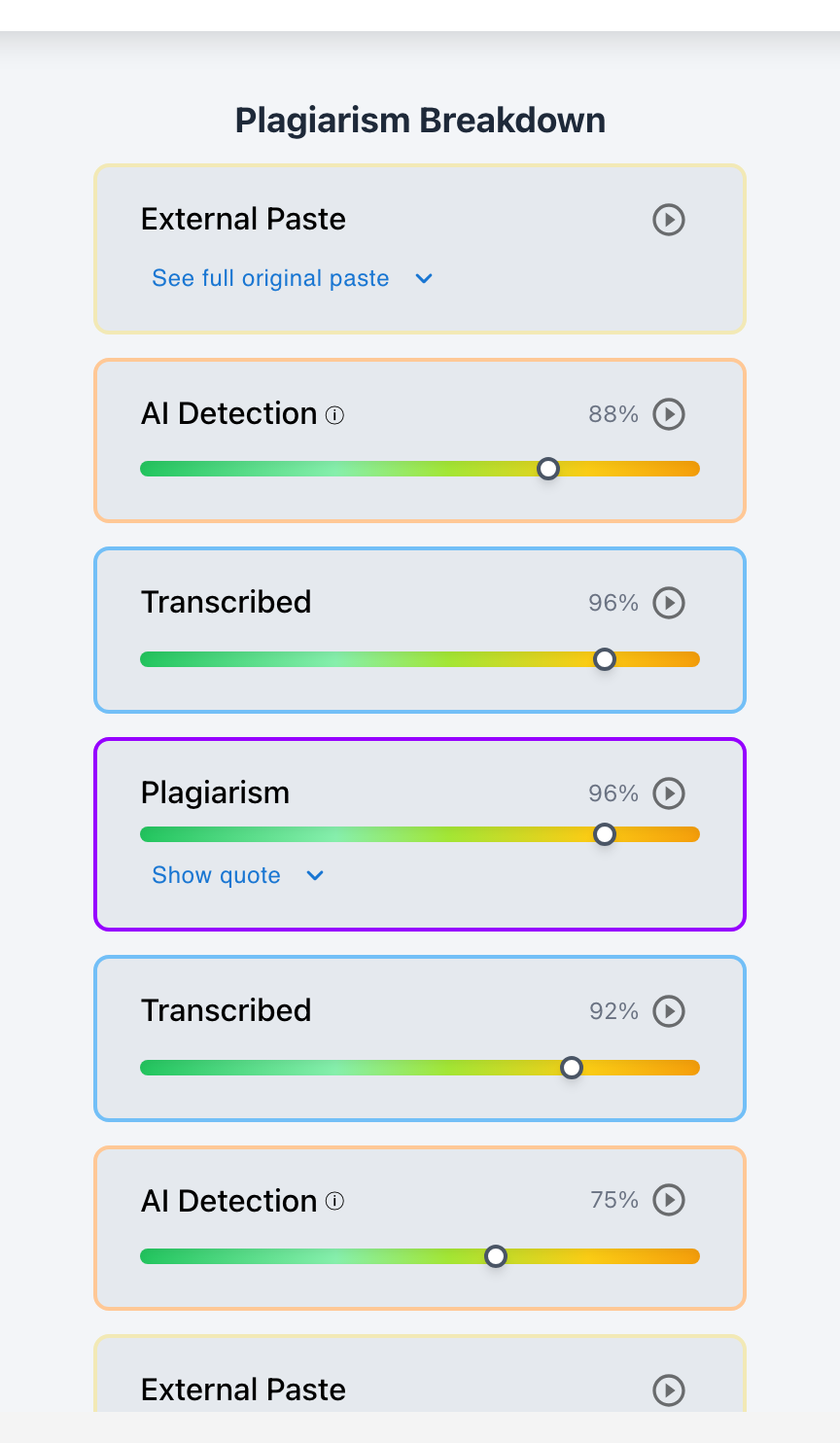
Checkmark Plagiarism establishes writing baselines by pairing AI detection with essay writing playback, plagiarism detection, autograding, and integrations with Canvas and Google Classroom.
The 4-Step Baseline Establishment Framework
Step 1: The Week 1 In-Class Cold Write
Administer a 40- to 50-minute analytical response prompt in class under direct teacher supervision with no internet access or external writing aids.
Step 2: Platform & Playback Tagging
Have students type their response directly into Canvas or Google Docs with Checkmark enabled, capturing keystroke timestamps and deletion rates.
Step 3: Stylometric & Telemetry Indexing
Checkmark automatically extracts the student's unique lexical tier ratio, mean sentence length, backspace percentage, and baseline typing velocity.
Step 4: Continuous Longitudinal Calibration
As students complete subsequent multi-draft assignments, Checkmark refines the baseline to accommodate authentic, scaffolded skill progression.
The 4 Key Metrics Captured in a Baseline Profile
An effective baseline captures both text characteristics and writing behaviors:
- Lexical Tier Ratio: The proportion of everyday conversational words (Tier 1) versus academic and specialized terminology (Tiers 2 & 3).
- Syntactic Subordination: The frequency of complex, compound, and periodic sentence structures.
- Typing Speed Baseline: The student's natural composition velocity (typically 35–55 net WPM).
- Revision Depth Ratio: The student's natural deletion and backspace rate (averaging 15% to 30% for human writers).
Read more in how Checkmark writing process analysis works.
Comparison: Proctored Diagnostic vs. Unverified Home Submissions
Proctored In-Class Diagnostic (True Baseline)
- Completed under direct teacher supervision.
- Zero access to ChatGPT, QuillBot, or external tutors.
- Captures authentic vocabulary and natural error habits.
- Serves as an undeniable reference point all year.
Unverified Take-Home Assignment (Unreliable)
- Completed outside school without supervision.
- High potential for parent editing, tutoring, or AI aid.
- Cannot serve as a clean baseline for future integrity.
- Creates ambiguity if subsequent writing changes.
A 5-Step Educator Protocol for Designing Baseline Prompts
Baseline Prompt Design Checklist:
- 1. Choose an analytical reading passage (1–2 pages) with 2 clear central arguments.
- 2. Ask a specific synthesis question: "Which author makes the stronger case regarding [topic]? Use evidence from the text to justify your position."
- 3. Provide 45 minutes total: 10 minutes reading/outlining, 35 minutes writing in Canvas.
- 4. Frame the task positively: "This is a low-stakes diagnostic to help me understand your unique writing strengths."
- 5. In Checkmark Plagiarism, click "Index as Baseline" to activate automatic comparative profiling for the semester.
How Checkmark Plagiarism Powers Automated Baseline Profiling
Checkmark Plagiarism combines **AI detection, essay writing playback, static AI detection, plagiarism detection, autograding, and Canvas/Google Classroom integrations** to automatically calculate baseline profiles and flag anomalous deviations in SpeedGrader.
Frequently Asked Questions
When is the best time to establish a student writing baseline?
During the first two weeks of the semester, before major out-of-class essay assignments are assigned.
What type of prompt works best for establishing a writing baseline?
A short analytical response based on a provided in-class article works best, as it evaluates both reading comprehension and academic vocabulary synthesis.
Can a baseline be established with handwritten essays?
Yes. Teachers can keep handwritten diagnostic samples on file or scan them into Checkmark for OCR and stylometric indexing.
How does writing playback record a baseline session?
Playback logs keystroke speed, thinking pauses, and backspaces during the in-class diagnostic to establish the student's behavioral drafting baseline.
What if an English language learner improves significantly over the term?
Checkmark dynamically updates baselines as students complete scaffolded drafts, recognizing genuine learning growth accompanied by active typing hours.
How does Checkmark Plagiarism integrate with Canvas LMS?
Checkmark provides certified LTI 1.3 integration, SpeedGrader sidebar embeds, two-way grade passback, and single sign-on (SSO).
How does a baseline protect students from false AI flags?
If a gifted student triggers an AI detector, comparing the submission against their equally eloquent in-class baseline instantly clears the flag.
How long does it take Checkmark to index a baseline?
Checkmark indexes stylometric profiles instantly upon assignment submission in Canvas or Google Classroom.
Should students know that their writing baseline is being established?
Yes. Transparency encourages students to do their best and understand that their unique voice is valued and protected throughout the year.
Why is an in-class baseline better than taking home diagnostic work?
Because an in-class setting guarantees that the work was completed without unauthorized AI tools, tutors, or family members.
A Strong Foundation for Integrity and Growth
Establishing an authentic student writing baseline grounds evaluation in reality. By using Checkmark Plagiarism to index diagnostic writing samples in Week 1, educators create a fair, transparent environment where authentic student effort is celebrated and protected all year long.
Checkmark Plagiarism supports this comprehensive approach with AI detection, essay writing playback, static AI detection, plagiarism detection, autograding, and integrations with Canvas and Google Classroom.
See how Checkmark pairs automated baseline indexing with multi-signal detection to evaluate student writing. View a sample report or request a demonstration.