
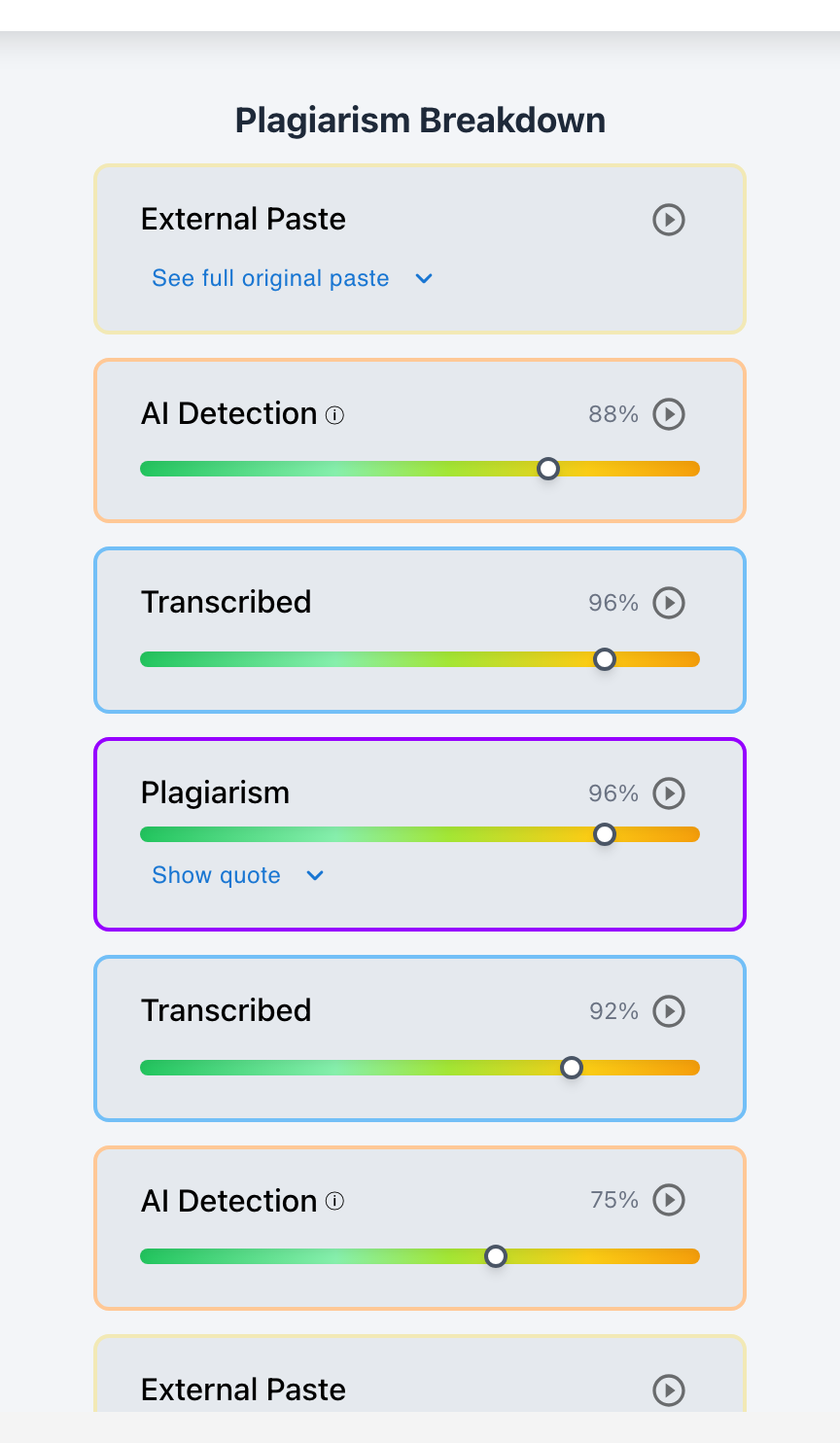
Teachers can detect AI writing without copy-and-paste evidence by leveraging a 4-pillar multi-signal approach: analyzing neural linguistic patterns (perplexity and burstiness), evaluating keystroke transcription cadence (flat velocity with near-zero backspaces), comparing syntax against in-class writing baselines, and conducting targeted oral source verifications.
As students learn that learning management systems flag clipboard paste events, many attempt alternate input methods: retyping AI text manually, using speech-to-text dictation, or employing browser extensions. When a document exhibits zero paste events, some educators assume that AI use cannot be proven. In reality, paste tracking is only one of many forensic signals. Checkmark Plagiarism combines deep linguistic analysis with typing telemetry and baseline benchmarking to prove AI use even when zero pasting occurred.
Below is a comprehensive guide on detecting AI writing in the absence of copy-paste evidence.
Checkmark Plagiarism detects non-paste AI use by pairing AI detection with essay writing playback, plagiarism detection, autograding, and integrations with Canvas and Google Classroom.
The 4 Non-Paste AI Detection Pillars
1. Neural Linguistic Classifiers
Scans text for low perplexity, uniform burstiness, and formulaic AI rhetorical patterns (e.g., "multifaceted tapestry," "delve into") regardless of input method.
2. Transcription Keystroke Telemetry
Writing Playback records unnatural mechanical typing rhythms: steady 75 WPM speed with <2% backspaces and zero cognitive thinking pauses.
3. In-Class Baseline Comparison
Compares the submitted paper's vocabulary and sentence complexity against proctored, in-class diagnostic writing samples from earlier in the term.
4. Citation & Hallucination Audits
Checks cited sources and quotes: AI models frequently fabricate convincing-looking academic citations with fake DOIs or non-existent page numbers.
Why Multiple Non-Paste Signals Create Unassailable Proof
Corroborating multiple independent evidence streams eliminates doubt:
- Linguistic + Keystroke Telemetry: An essay scoring 90% AI probability paired with an unedited 20-minute typing timeline proves manual transcription with mathematical precision.
- Citation Audits Expose AI Fabrications: Asking a student to produce the cited book or article immediately uncovers AI hallucinations that the student typed without verifying.
- Oral Verification Confirms Authorship: In a brief 2-minute conversation, students who typed AI text cannot define the advanced vocabulary words they typed.
Read more in how Checkmark writing process analysis works.
Comparison: Single Paste Check vs. Checkmark Multi-Signal Detection
Single Paste Check (Easily Evaded)
- Checks only for clipboard copy-paste events.
- Blind to manual retyping and phone transcription.
- No linguistic perplexity or burstiness analysis.
- Leaves teachers powerless when paste logs are clean.
Checkmark Multi-Signal Detection (Evasion-Proof)
- Neural AI probability scores and paragraph heatmaps.
- Keystroke cadence velocity and backspace analysis.
- Automated citation and source hallucination checks.
- In-class diagnostic writing baseline benchmarking.
A 5-Step Educator Protocol for Non-Paste AI Audits
Non-Paste AI Audit Checklist:
- 1. Open the student's submission in Checkmark Playback inside Canvas SpeedGrader.
- 2. Review the AI Probability Score: flag submissions scoring above 50% AI probability.
- 3. Inspect the Deletion Rate: check if backspaces are below 3% across 1,000+ words.
- 4. Check the Cited Sources: verify if journal titles, authors, and quotes actually exist.
- 5. Hold a 2-minute oral check-in: ask the student to explain their thesis and define 2 key terms.
How Checkmark Plagiarism Powers Multi-Signal Detection
Checkmark Plagiarism combines **AI detection, essay writing playback, static AI detection, plagiarism detection, autograding, and Canvas/Google Classroom integrations** to give teachers definitive proof of AI use regardless of the input method.
Frequently Asked Questions
Can AI writing be detected if a student didn't copy and paste?
Yes. Neural linguistic classifiers evaluate the mathematical probability of vocabulary arrangements, while keystroke telemetry reveals transcription typing.
What does AI transcription look like without paste logs?
It shows continuous linear typing at 70+ WPM with zero thinking pauses between complex paragraphs and a sub-2% backspace rate.
What is an AI citation hallucination?
It occurs when ChatGPT invents plausible-sounding academic journal articles, author names, or page numbers that do not exist in reality.
How do baseline comparisons help detect AI use?
Comparing an out-of-class essay against a proctored in-class diagnostic sample highlights sudden, uncharacteristic leaps in vocabulary and syntax.
What if a student used speech-to-text dictation?
Dictation creates unique audio-transcription formatting artifacts and rapid text influxes that Checkmark Playback distinguishes from manual drafting.
How does Checkmark Plagiarism integrate with Canvas LMS?
Checkmark provides certified LTI 1.3 integration, SpeedGrader sidebar embeds, two-way grade passback, and single sign-on (SSO).
Why do students have low backspaces when retyping AI text?
Because they are copying finalized sentences from another screen, eliminating the natural self-editing and cognitive struggle of original drafting.
Can a student beat detection by using QuillBot after retyping?
Paraphrasing tools introduce distinct lexical distortion patterns that modern multi-signal platforms detect with high precision.
What questions should a teacher ask during an oral defense?
Ask: "What does this word mean?", "How did you find this source?", and "Can you summarize your main argument in your own words?"
Why is multi-signal evidence more reliable than single detectors?
Because combining linguistic AI scores with keystroke cadence and citation verification creates an airtight, defensible evaluation.
Beyond Copy-Paste: Comprehensive Academic Integrity
Evaluating student authorship requires looking at the complete writing reality. By combining neural AI detection, keystroke telemetry, and citation verification with Checkmark Plagiarism, teachers can uphold academic standards across all input methods with total fairness and accuracy.
Checkmark Plagiarism supports this comprehensive approach with AI detection, essay writing playback, static AI detection, plagiarism detection, autograding, and integrations with Canvas and Google Classroom.
See how Checkmark pairs linguistic AI detection with keystroke forensics to detect AI writing without paste evidence. View a sample report or request a demonstration.