
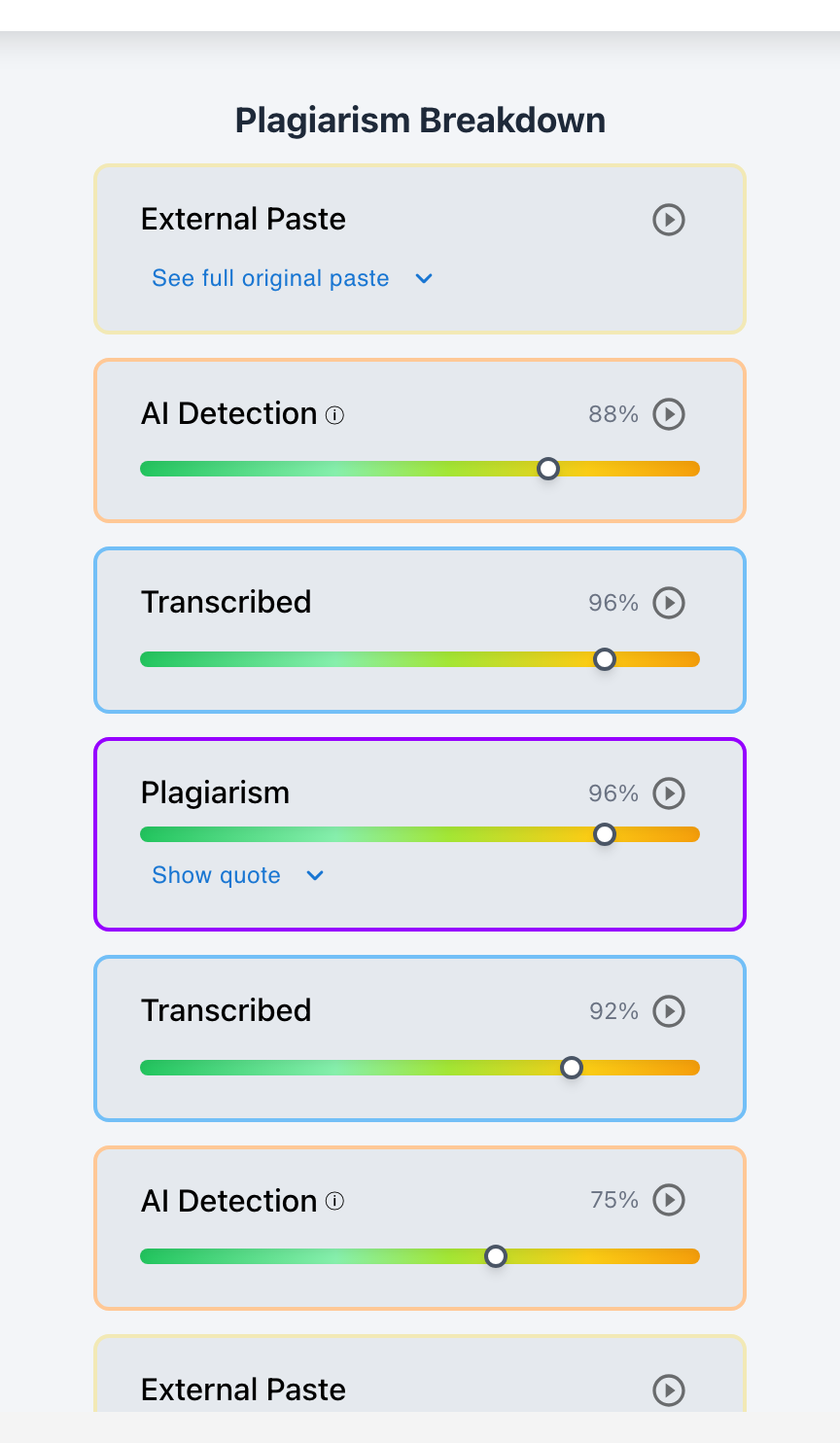
Detecting AI-assisted plagiarism requires educators to look beyond simple text matching and evaluate the entire lifecycle of document creation.
AI-assisted plagiarism occurs when students use generative tools like ChatGPT, Claude, or QuillBot to rewrite stolen web sources, generate fictitious research bibliographies, or stitch together patchwork essays. Because the AI rephrases sentences into novel syntactical structures, traditional plagiarism checkers often report a misleading 0% similarity score.
To identify AI-assisted plagiarism accurately and defensibly, teachers must combine essay writing playback timelines with citation database audits, historical baseline comparisons, and supportive student conferences.
Checkmark Plagiarism streamlines this verification by uniting plagiarism detection with AI detection, essay writing playback, static AI detection, autograding, and integrations with Canvas and Google Classroom.
What Is AI-Assisted Plagiarism?
1. AI Rewriting & Spinning
Pasting an existing copyrighted article or peer essay into an AI tool and prompting it to rewrite the text to evade plagiarism filters.
2. Phantom Research Creation
Prompting AI to generate an essay with fabricated academic citations and fake DOIs to simulate scholarly research.
3. Mosaic AI Patchwork
Blending short original student paragraphs with large, uncredited AI-generated analysis sections.
The 4 Pillars for Detecting AI-Assisted Plagiarism
1. Essay Writing Playback Timelines (Physical Proof)
The single most powerful tool against AI-assisted plagiarism is Checkmark Plagiarism's essay writing playback. Rather than guessing from static text, teachers can watch the document's assembly:
- Wholesale Paste Events: The entire spun text appears in the document in one instant paste timestamp.
- Active Drafting Time: Playback records only 8 minutes of total active document time for a 1,500-word essay.
- Lack of Revisions: Zero natural keystrokes, backspacing, or sentence restructuring.
Read more in how Checkmark writing process analysis works.
2. Citation Authentication Audits
Auditing the bibliography in academic databases (JSTOR, Google Scholar, WorldCat) exposes non-existent journal titles, fake author pairings, and dead DOIs invented by generative AI. Read more in can ChatGPT cite sources that don't exist?
3. Linguistic & Structural Cliches
AI-assisted text exhibits distinct markers: overused transitions ("delve," "tapestry," "crucial"), rigid paragraph symmetry, and abstract commentary that avoids specific classroom discussions.
4. The Student Conference (Oral Comprehension)
Asking the student to summarize their core thesis, explain cited sources, and define advanced vocabulary in plain words quickly reveals whether they genuinely authored the text.
Comparison: Traditional Plagiarism vs. AI-Assisted Plagiarism
Traditional Plagiarism
- Copied directly from websites or peer essays.
- Caught easily by standard text-matching scanners.
- Produces side-by-side matching URL reports.
AI-Assisted Plagiarism
- Rewritten or generated by AI models.
- Passes legacy plagiarism scanners with 0% match.
- Exposed by writing playback, fake citations, & oral checks.
A 6-Step Protocol for Teachers to Investigate AI Plagiarism
Educator Protocol to Investigate AI-Assisted Submissions:
- 1. Review essay writing playback to inspect active drafting duration and wholesale paste timestamps.
- 2. Run simultaneous AI probability scans and database plagiarism checks.
- 3. Audit cited sources in academic databases (Google Scholar, JSTOR) for phantom citations.
- 4. Compare the submission against 2–3 verified historical baseline writing samples.
- 5. Conduct a supportive, open-ended conference to test oral conceptual understanding.
- 6. Base academic integrity decisions on the cohesive multi-signal evidentiary package.
How Checkmark Plagiarism Detects AI-Assisted Plagiarism
Checkmark Plagiarism combines **AI detection, essay writing playback, static AI detection, plagiarism detection, autograding, and Canvas/Google Classroom integrations** to give educators complete, unassailable visibility into writing authenticity.
Frequently Asked Questions
What is the difference between traditional plagiarism and AI-assisted plagiarism?
Traditional plagiarism involves copying text directly from a website. AI-assisted plagiarism involves using AI to generate or rewrite text, disguising the original source from basic scanners.
Can traditional plagiarism checkers detect AI-assisted plagiarism?
Usually no. Because AI rewrites sentences into novel phrasing, traditional string-matching checkers report a 0% similarity score.
How does essay writing playback expose AI-assisted plagiarism?
Playback captures the exact moment the rewritten text was pasted wholesale into the document and reveals the lack of active keystroke drafting time.
Why do fake citations expose AI-assisted research papers?
AI tools frequently invent non-existent journal titles, authors, and DOIs. Auditing citations in academic databases confirms generative AI use.
What is 'patchwriting' with AI?
When a student pastes source material into an AI tool, prompts it to rephrase the text lightly, and submits it without attribution.
Can a student be disciplined for AI plagiarism if the similarity score is 0%?
Yes, if multi-signal evidence (writing playback paste logs, hallucinated citations, and oral comprehension failure) proves unauthorized AI generation.
How can teachers check if cited sources exist?
Search Google Scholar or JSTOR for the exact title enclosed in quotation marks. If zero records appear, the citation is non-existent.
What questions should I ask a student suspected of AI-assisted plagiarism?
Ask open-ended questions: "Can you walk me through your research process? Where did you locate this journal article? What does this term mean?"
How does comparing previous writing help detect AI plagiarism?
It reveals whether the submission represents natural growth in the student's recognizable voice or an uncharacteristic leap in syntax and vocabulary.
How does Checkmark Plagiarism assist educators?
Checkmark Plagiarism provides visual playback timelines, citation validation logs, dual AI/plagiarism scans, and seamless LMS integrations.
Multi-Signal Visibility Protects Authentic Scholarship
AI-assisted plagiarism may bypass legacy copy-paste scanners, but it cannot evade comprehensive multi-signal verification. By combining essay writing playback with citation audits and student dialogue, educators defend genuine academic achievement.
Checkmark Plagiarism supports this principled standard with AI detection, essay writing playback, static AI detection, plagiarism detection, autograding, and integrations with Canvas and Google Classroom.
See how Checkmark pairs essay writing playback with multi-signal detection to uncover AI-assisted plagiarism with objective timeline proof. View a sample report or request a demonstration.