
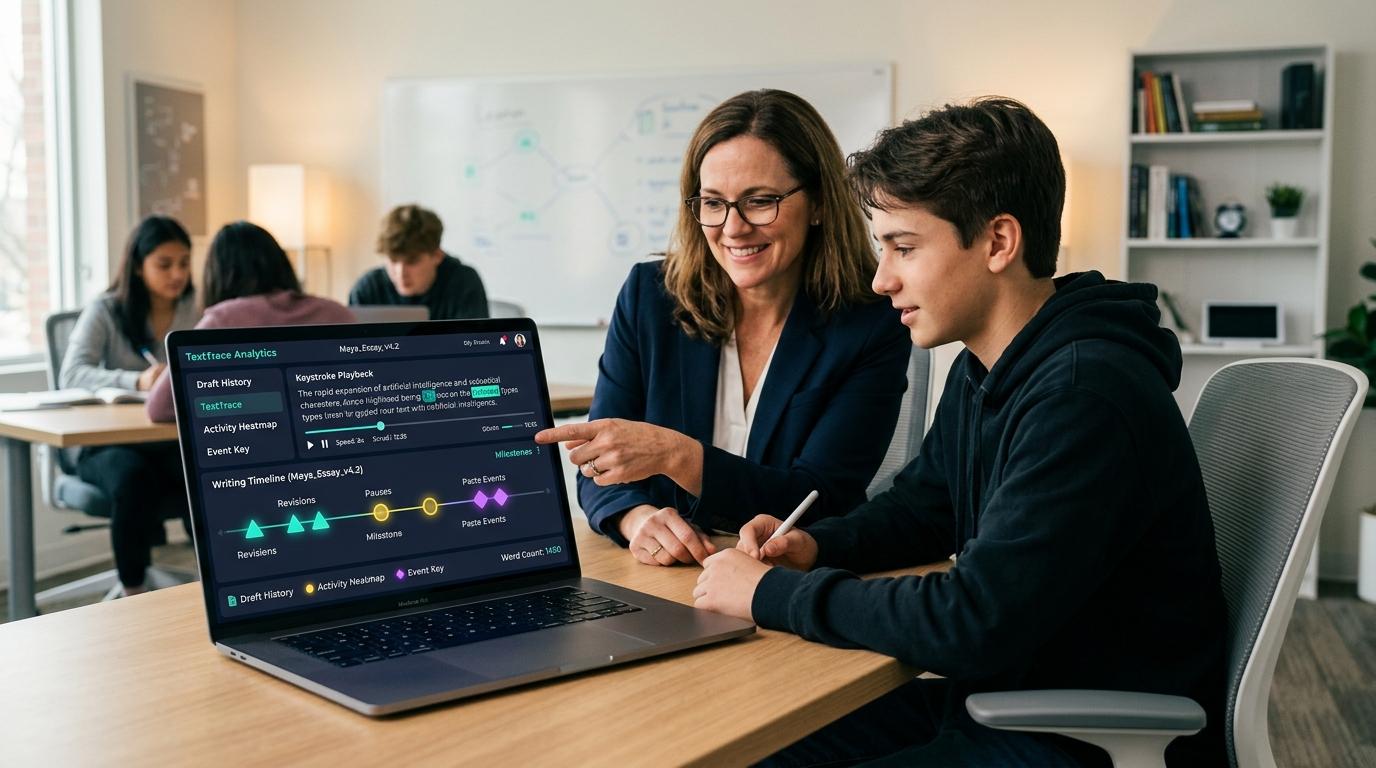
For decades, academic integrity investigations have followed an adversarial, criminal-justice model: an opaque detector generates a suspicion score, a teacher confronts an anxious student across a desk, the student enters a defensive crouch, and the educational relationship collapses into mutual distrust. In the age of generative AI and black-box probability scores, this punitive paradigm is broken—inflicting false accusations on honest students while failing to address the root causes of unauthorized AI use. Restorative academic integrity conferences powered by keystroke playback fundamentally invert this dynamic. Guided by the core philosophy of “Stop guessing, start trusting,” educators can sit side-by-side with students to examine patent-pending Essay Playback™ telemetry—including 1x–8x chronological replay, time-stamped revision heatmaps, external paste tracking with full text preservation, and transcription cadence analysis. By substituting transparent physical “receipts” for arbitrary percentages, teachers transform high-stakes confrontations into collaborative, metacognitive coaching dialogues that uphold standards while fostering authentic student growth.
Checkmark Plagiarism provides the pedagogical and technical foundation for restorative writing governance by integrating patent-pending Essay Playback™ with passage-level AI detection, comprehensive plagiarism checking, rubric autograding, and native LMS integrations for Canvas LMS, Google Classroom, and Buzz LMS.
The Crisis of the Adversarial Plagiarism Interrogation
Every educator recognizes the emotional dread of suspecting academic dishonesty. Whether triggered by an abrupt shift in rhetorical maturity, an unformatted block of text, or a generic AI detector displaying an ominous “87% AI-Generated” badge, the standard institutional response has long been confrontational:
Static detector outputs a generic score (“85% AI”) with zero physical evidence or verifiable drafting context.
Teacher summons student across a formal barrier desk, demanding an admission of guilt based solely on algorithmic suspicion.
Student panics, denies, or feels alienated. Trust permanently breaks down, leading to parent escalations or administrative appeals.
This legacy interrogation model suffers from three fatal structural flaws in modern digital classrooms:
1. The Evidentiary Vacuum of Black-Box Probabilities
Generic statistical AI detectors analyze static text for predictability (perplexity) and structural variety (burstiness). They output a single, whole-paper percentage with zero corroborating evidence.
When a student asks, “Why did it flag me? What proof do you have?”, the educator is left defenseless. Teachers cannot point to a specific sentence and explain why an algorithm marked it, nor can they disprove a student's claim of innocence. This lack of due process leads to prolonged email disputes with parents, administrative appeals, and severe teacher burnout.
2. The Devastating Harm of False Positives
Statistical text classifiers systematically disadvantage students who write with structured, formulaic, or highly regular syntax. Studies and classroom experience confirm that English Language Learners (ELLs), neurodivergent writers, and students adhering strictly to rigid academic templates are disproportionately misclassified as AI.
Falsely accusing a student who spent twelve hours laboring over an assignment destroys their academic confidence and creates lasting psychological trauma around writing.
3. The Missed Instructional Opportunity
When a student does misuse generative AI or copy external text, punitive interrogation treats the violation as a moral failing rather than an instructional signal.
Students rarely plagiarize out of malice; they do so out of deadline panic, cognitive overload, imposter syndrome, or confusion over research synthesis. Giving a student an automatic zero without examining the breakdown in their writing process guarantees they will seek more sophisticated evasion tools (such as paraphrasers or second-screen retyping) on their next assignment.
The Restorative Paradigm: “Stop Guessing, Start Trusting”
Restorative academic integrity reframes integrity violations not as offenses against school rules to be punished, but as fractures in the learning process and classroom trust to be repaired.
The core philosophy of Checkmark Plagiarism is simple: educators should never have to guess, and students should never have to defend themselves against unsubstantiated algorithms.
| Evaluation Dimension | Adversarial Interrogation (Punitive) | Restorative Process Conference (Growth-Oriented) |
|---|---|---|
| Core Presumption | Presumption of guilt (“Accuser vs. Suspect”) | Presumption of goodwill, learning potential & growth |
| Primary Focus | Extracting a confession / administering a penalty | Understanding the writing, research, and revision journey |
| Evidentiary Basis | Opaque whole-paper percentage (“84% AI”) | Patent-pending Essay Playback™ writing telemetry |
| Physical Dynamic | Oppositional: Across a barrier desk with hidden screen | Collaborative: Side-by-side at a shared monitor |
| Investigation Trigger | Algorithmic black-box suspicion score | Observable drafting patterns, pauses, and milestones |
| Immediate Outcome | Punitive zero, formal disciplinary referral | Metacognitive reflection, supervised revision, coaching |
| Long-Term Impact | Teaches evasion tactics & fosters resentment | Builds writing stamina, self-regulation, & authentic voice |
When an educator approaches an integrity conversation with transparent, time-stamped writing telemetry, the nature of the interaction transforms completely. The teacher does not say, “Explain why this software thinks you cheated.” Instead, the teacher says, “Let’s pull up your drafting timeline together so you can walk me through how your ideas evolved from your initial brainstorm to your final draft.”
Technical Foundations: Patent-Pending Essay Playback™ & Writing Telemetry
To conduct an effective restorative conference, educators need objective, multi-dimensional evidence (“receipts”) rather than speculative probabilities. Checkmark Plagiarism provides this foundation through its integrated suite of writing process analytics:
- 00:14:22 [P-Burst] 142 words composed (4 pauses > 6,000ms)
- 00:38:10 [R-Burst] 18 backspaces, 2 sentence restructurings
- 01:12:05 [External Paste] 412 words inserted (Original text preserved)
- 01:45:30 [Cadence] Steady 74 WPM monotonic; 0 backspaces
Clicking any highlighted phrase jumps directly to its chronological replay milestone. Original external paste text is permanently archived even if later rewritten.
1. 1x–8x Scrubbable Chronological Replay
Patent-pending Essay Playback™ reconstructs the complete writing session keystroke-by-keystroke. Educators can scrub through the timeline like a video at variable speeds (1x, 2x, 4x, 8x) to observe:
- How the opening paragraph was drafted and revised.
- Where the student paused for cognitive planning versus where text flowed effortlessly.
- Structural reorganizations (such as cutting a paragraph from the conclusion and moving it to the body).
- Cursor navigation patterns indicating organic self-monitoring.
2. Time-Stamped Revision Heatmaps & Typing Telemetry
Authentic human composition is physically messy, non-linear, and recursive. Checkmark captures and visualizes key biomechanical telemetry:
- Inter-Key Intervals (IKI): The millisecond latency between consecutive keystrokes.
- Production Bursts (P-Bursts): The clusters of characters typed between cognitive planning pauses.
- Revision Bursts (R-Bursts): The frequency of deletions, backspacing, cursor hops, and text replacements. A normal human drafting session typically exhibits a 10% to 25% revision/backspace ratio.
- Cognitive Pause Distributions: Natural 3,000ms to 15,000ms hesitations at syntactic boundaries (commas, periods, paragraph breaks) where writers deliberate over word choice and logic.
3. External Paste Detection with Full Text Preservation
When text is pasted from an external application, Checkmark immediately creates a permanent, time-stamped milestone. Crucially, Checkmark stores and preserves the exact original pasted text permanently—even if the student subsequently rewrites, paraphrases, or deletes every single word across subsequent hours.
With a single click on the “Jump to Playback” button, the teacher can view the exact moment of insertion and compare the pasted passage against side-by-side web and academic database matches.
4. Optical Transcription & Retype Detection
When students attempt to evade paste loggers by propping a smartphone next to their screen and manually typing out AI-generated or copied text, they produce a distinctive mechanical signature:
- Flat, Unbroken Cadence: Constant typing speed (e.g., 65–80 WPM) across simple prepositions and multisyllabic academic jargon alike.
- Absence of Evaluative Pauses: Zero hesitations at complex structural junctures.
- Near-Zero Revision Ratio (< 1.5% backspaces): Typing finalized text requires virtually no self-correction.
Checkmark flags this transcription pattern with dedicated telemetry, giving teachers clear visual evidence of secondary-screen retyping.
5. Multi-Factor Passage-Level AI & Plagiarism Integration
Rather than assigning an arbitrary whole-paper score, Checkmark underlines specific suspect passages directly within the essay text. Each passage is linked two-way to an evidence card in the sidebar showing:
- Calibrated confidence sliders (Human Writing Characteristics vs. Typical AI Linguistic Patterns).
- Direct side-by-side quotes and clickable URLs for web sources.
- Dedicated visual styling for uncredited source usage to distinguish improper citation formatting from deliberate authorship fraud.
- Private Educator-Only Flag Statuses (Flagged, Resolved, Not Flagged) ensuring that unverified suspicions are never displayed to students or recorded prematurely on official transcripts.
The Anatomy of a Restorative Academic Integrity Conference
A restorative conference is not an ad-hoc conversation; it is a structured, three-phase pedagogical intervention designed to uphold high academic standards while preserving trust and student agency.
- Review Checkmark Telemetry Dashboard
- Audit 4 key telemetry indicators:
- Paste preserved original text
- Pause & burst latencies
- Revision & backspace ratio
- Passage-level source matches
- Formulate open-ended dialogic prompts
- Collaborative side-by-side seating
- Establish psychological safety
- Screen-share Essay Playback™
- Student narrates thought process
- Inquire into specific pauses, pastes, or transcription blocks
- Listen actively to identify root cause
- Metacognitive reflection log
- Differentiated learning action plan:
- Supervised 48h re-drafting
- Citation & synthesis coaching
- Time-management scaffolding
- Update Checkmark status to “Resolved”
Phase 1: Pre-Conference Preparation & Telemetry Audit
Before inviting the student to meet, the educator conducts a systematic 3-to-5 minute review of the submission telemetry in Checkmark Plagiarism. This prevents premature assumptions and ensures the conference is grounded in concrete facts.
| Telemetry Indicator | What the Educator Audits |
|---|---|
| 1. External Paste Events | Were external blocks inserted? What was the exact preserved original text? Was it personal research notes, an outline, or finalized AI prose? |
| 2. Revision & Backspace Dynamics | Is the backspace ratio > 8% (typical human drafting) or < 1.5% (transcription / mechanical copy)? Are there internal word and phrase substitutions? |
| 3. Cognitive Pause Distribution | Are there multi-second pauses before complex claims? Does the pause graph match organic idea generation at clause boundaries? |
| 4. Passage-Level Source Breakdown | Are highlighted sections matched to web or peer sources? Is it an uncited direct quote vs. structural copy? |
Establishing the Meeting Objective
The teacher defines a clear pedagogical objective for the meeting:
- If the telemetry shows authentic drafting that triggered a false AI flag: The goal is to validate the student's authentic hard work, explore their rhetorical choices, and clear the flag immediately.
- If the telemetry shows a sudden 500-word midnight paste: The goal is to uncover the underlying pressure (time constraints, comprehension breakdown) and guide the student to construct those paragraphs organically.
- If the telemetry shows mechanical second-screen transcription: The goal is to evaluate whether the student understands the underlying concepts and re-anchor their writing in genuine research.
Phase 2: The Side-by-Side Conference Dialogue
The physical and interpersonal setting of the conference sets the tone for the entire interaction.
- Teacher and student sit directly across a large desk.
- Laptop screen is tilted toward the teacher, hiding evidence.
- Dynamic feels like an interrogation room or courtroom.
- Triggers defensive fight-or-flight shutdown in students.
- Sit side-by-side at a shared table or round desk.
- Shared monitor with Essay Playback™ clearly visible to both.
- Trackpad or mouse placed where student can navigate replay.
- Dynamic feels like a supportive writing workshop coaching session.
The Non-Accusatory Opening
Begin the conference with neutral, supportive framing that validates the student's presence and establishes growth as the sole agenda:
“Thanks for taking the time to sit down with me today, Jordan. I always like to hold writing conferences where we look behind the scenes at how a draft came together. Writing is a complex process, and looking at the actual drafting journey helps us identify your biggest strengths and find areas where you might need more support. Let's pull up your Checkmark timeline and walk through it together.”
Navigating Essay Playback™ Together
Launch the playback timeline at 2x or 4x speed. Invite the student to narrate their own thought process:
- At the introduction: “I see you spent about 15 minutes drafting this first paragraph, and you rewrote the thesis sentence three times here. Walk me through what you were trying to accomplish with that shift.”
- At a significant cognitive pause: “Right here around minute 28, you paused for about four minutes before starting the third body paragraph. What were you thinking about or looking up during that pause?”
- At an external paste event: “Let's pause the playback right here at the 42-minute mark. I see a block of text was pasted in. Let's click 'Inspect Pasted Text' together. Can you tell me where this material came from and how it fit into your drafting plan?”
| Telemetry Event Observed | Recommended Dialogic Prompt |
|---|---|
| High Revision / Multiple Rewrites | “I love seeing how much you experimented with this sentence. What made you decide on this final phrasing?” |
| 5-Minute Mid-Essay Pause | “You took a productive thinking break here. Were you checking a source, reviewing your outline, or wrestling with an idea?” |
| Large External Paste Event | “We have a paste milestone recorded here. Walk me through your research notes—did you copy this from an outline or source?” |
| Monotonic Transcription Cadence | “Looking at this section, the typing was very steady without our usual drafting pauses. Were you typing from notes nearby?” |
| Uncited Direct Source Match | “Checkmark highlighted this match to the Smithsonian article. Let's look at how to frame this as an in-text quote together.” |
Phase 3: The Resolution & Metacognitive Repair Phase
Once the drafting process has been reviewed transparently, the educator guides the student toward a constructive resolution. The conference concludes not with an arbitrary punishment, but with an individualized Restorative Action Plan.
Student resorted to AI paste due to deadline overload or personal stress.
- Supported 48h drafting extension
- Time management coaching plan
- Supervised redrafting of body paragraphs
Student struggled with source integration, patchwriting, or synthesis.
- 10-minute citation coaching clinic
- Side-by-side quote framing workshop
- Resubmit with proper parenthetical citations
Authentic human drafting misclassified by legacy statistical detector.
- Validate student voice and effort
- Toggle flag to “Resolved” in Checkmark
- Add private note praising revision stamina
1. Metacognitive Reflection Log
The student completes a brief, structured reflection (100–200 words) addressing:
- What challenges arose during this assignment.
- What strategies or shortcuts were attempted, and why they undermined learning.
- What specific steps the student will take on the next assignment to manage time, track sources, or seek teacher help earlier.
2. Differentiated Learning Pathways
- For Citation/Source Misunderstandings: The student completes a 10-minute citation coaching exercise using Checkmark's side-by-side quote tool, replaces uncredited text with proper parenthetical citations, and resubmits.
- For External Paste / Panic Drafting: The student is granted a structured 48-hour extension to rewrite the flagged sections under authentic drafting conditions, using the teacher's feedback on their initial outline.
- For Exonerated False Positives: The teacher praises the student's rigorous drafting history, resolves the flag in Checkmark with one click, and notes the student's authentic revision stamina in their private educator log.
3. Updating Flag Status in Checkmark
Within the Checkmark Plagiarism interface, the educator updates the document flag:
- Toggle status from
FlaggedtoResolved. - Add a private educator note: “Met with student on 10/24. Reviewed Playback together. Student explained external paste was an unformatted personal brainstorming doc. Student completed citation revision successfully.”
- Because Checkmark flags are educator-facing, the student’s permanent record remains clean, protecting their academic standing.
Three Concrete Classroom Case Studies & Dialogic Scripts
To see how restorative keystroke conferences operate in diverse classroom scenarios, consider the following three case studies drawn from high school and collegiate humanities settings.
The Midnight Panic Paste
Student: Alex (11th Grade)
Assignment: 1,200-word rhetorical analysis of Frederick Douglass
Context: Two AP exams & track finals on the essay due date
Telemetry Signature:
• 00:00–00:25: 350 words drafted organically (18% backspaces)
• 01:42 AM: External paste of 480 words in 0.3s (Preserved AI output)
• 01:45 AM: 4 mins spent swapping 5 adjectives
Teacher: “Hey Alex, thanks for coming in. I was reviewing your rhetorical analysis draft on Frederick Douglass. Your introductory paragraph is really compelling—I loved how you framed his use of antithesis. Let’s open up your Essay Playback timeline together so we can look at how you built the middle section.”
Alex: (Appears tense, arms crossed) “Okay. Is there something wrong with it?”
Teacher: (Pulls up Checkmark, sits side-by-side, clicks Playback) “Nothing is 'wrong'; we’re just looking at how the writing unfolded. Notice how here in the first 25 minutes, we can watch you building your thesis—you paused here, tried two different topic sentences, and backspaced several times. That’s great authentic drafting. But look at what happens right here at 1:42 AM. See this blue milestone? A block of 480 words appeared in less than a second. Let's click 'Inspect Pasted Text' right here.”
Alex: (Looks down, sighs) “Yeah... I knew you'd see that.”
Teacher: (Tone remains calm, warm, and supportive) “Walk me through what happened at 1:42 AM, Alex. You had track finals yesterday and two AP tests, right?”
Alex: “I completely panicked. It was almost 2:00 in the morning, I was exhausted, and I still had two body paragraphs left. I opened ChatGPT on my phone, asked it to give me an analysis of Douglass's second paragraph, and pasted it in. I tried to change a few words so it sounded more like me, but I knew it was wrong. I'm sorry.”
Teacher: “Thank you for being completely honest with me right now, Alex. That honesty matters tremendously. Here’s what this telemetry tells me: you understand how to write—your first paragraph proves that. What broke down wasn’t your intelligence; it was your time management and stress threshold under extreme pressure. Giving you a punitive zero right now doesn’t teach you how to write those body paragraphs. Here is what we’re going to do.”
Alex: “You’re not giving me a zero?”
Teacher: “We are going to hit 'pause' on this grade. You’re going to sit at that table during study hall today, or take until tomorrow afternoon, and draft those two body paragraphs in your own words using Douglass's text directly. Then we’ll look at the updated playback, grade the essay fairly, and set up a check-in system before your next big deadline so you don't find yourself in a 2:00 AM corner again. How does that sound?”
Alex: (Visibly relieved) “That sounds fair. Thank you so much, Mrs. Davis. I'll get it done today.”
Exonerating an Honest Multilingual Student (ELL)
Student: Meiling (10th Grade ELL)
Assignment: 1,000-word persuasive essay on renewable energy
Trigger: Generic AI detector flagged paper as “88% AI-Generated”
Checkmark Telemetry Signature:
• 5 hours 42 mins drafting across 4 distinct sessions
• 1,840 backspaces, 94 cursor hops, 16% revision ratio
• Extended 8,000–14,000ms pauses for bilingual glossary lookup
Teacher: “Come on in, Meiling. Have a seat right next to me. I know you were anxious about that notification from our old testing tool showing an AI score. I called you in today so we could put that completely to rest.”
Meiling: (Tearful, holding printed notes) “Teacher, I swear I did not use ChatGPT! I worked every single night after school. I have all my handwritten notes right here. I don't know why the computer said I cheated.”
Teacher: “Meiling, take a deep breath. Look at my screen right now. This is Checkmark Plagiarism, and we are not looking at a dumb probability score. We are looking at your actual Essay Playback telemetry. Look at this.”
Teacher: (Presses Play at 4x speed on Session 2) “Look at this replay from Tuesday evening. I can see you spending nearly two hours working on just these two paragraphs. Look at all these green backspace markers—over 1,800 revisions across your essay. Look at these twelve-second pauses where you were carefully thinking through your vocabulary. A computer algorithm might get confused because your sentences are very neat and orderly, but this playback shows me your authentic human mind at work.”
Meiling: (Wiping away tears, watching the replay) “You can see all of that?”
Teacher: “Every single keystroke. This playback proves beyond a shadow of a doubt that this is 100% your original writing. You wrestled with every single sentence. I am marking this flag as 'Resolved' in Checkmark right now, and I’m writing a note in your file praising your incredible drafting discipline.”
Meiling: “Thank you so much. I was so scared no one would believe me.”
Teacher: “In this classroom, we don't guess—we look at the real evidence. You did extraordinary work, Meiling. Never doubt your own voice.”
The Secondary-Screen Transcription Loophole
Student: Marcus (12th Grade)
Assignment: 1,500-word research paper on CRISPR genetic engineering
Tactic: Generated essay on iPad via Claude, retyped character-by-character
Telemetry Signature:
• 38 continuous minutes typing at monotonic 72 WPM
• 0.3% backspace ratio (6 typos corrected in 1,500 words)
• 0 cognitive planning pauses (>1,500ms) across multisyllabic jargon
Teacher: “Marcus, thanks for meeting with me today. Let’s pull up your research paper on CRISPR technology. You chose a fascinating topic. Let’s sit together and look at your drafting telemetry in Checkmark.”
Marcus: (Casual, confident) “Sure thing. I typed the whole thing out in Canvas like you asked. No copy-pasting.”
Teacher: “I see that you didn’t use the clipboard paste function, Marcus. But let’s look at what the keystroke playback reveals. Let’s hit play at 2x speed.”
Teacher: (Watches screen as text streams across the page in a continuous, unbroken rhythm) “Marcus, notice how the text is appearing. You typed 1,500 words in 38 straight minutes at an unbroken 72 words per minute. Look at the backspace counter: you made only 6 typographical corrections in the entire paper. When you reached this phrase—'CRISPR-Cas9 endonuclease precision and its associated epigenetic ramifications'—you typed it without a single pause, at the exact same rhythm as typing the word 'the'.”
Marcus: (Shifts uncomfortably in chair, stops smiling) “I'm just a really fast typer when I get in the zone.”
Teacher: (Speaking warmly without hostility) “Marcus, I’ve taught writing for fifteen years. Even professional geneticists pause for a few seconds to organize their syntax when explaining endonuclease mechanics. Authentic composition requires stopping to think, rewording sentences, and changing your mind. What we're seeing here is a classic transcription cadence—typing text that is already fully composed on another screen or phone. Can you explain the difference between endonuclease precision and epigenetic ramifications for me right now in your own words?”
Marcus: (Struggles, looks at screen, pauses for several seconds) “I... I know it has to do with gene editing, but I don't really know all the details. I had Claude generate the essay on my iPad and I typed it in because I didn't understand the science articles we were reading.”
Teacher: “Thank you for being real with me, Marcus. That gets to the heart of the issue: you felt overwhelmed by the technical research, so you used Claude as a shield. But the goal of this assignment is for you to master these concepts, not to test how quickly your fingers can copy words off an iPad screen. Do you see why this didn't fulfill the learning goal?”
Marcus: “Yeah. I do. I just got completely lost in the library databases.”
Teacher: “That is a research scaffolding problem, and we can solve that right now. Let’s take 15 minutes today during tutorial to break down two accessible scientific sources together. Then, you’re going to outline three core claims in your own words and draft this paper here in the writing lab. We'll watch your authentic playback come together. Deal?”
Marcus: “Deal. Thank you for helping me understand the research instead of just kicking me out of the class.”
Comparative Matrix: Adversarial Interrogation vs. Restorative Keystroke Conference
To provide academic leaders and department chairs with a clear evaluation framework, the table below contrasts every stage of the traditional disciplinary model against Checkmark's restorative approach:
| Evaluation Dimension | Traditional Adversarial Interrogation | Restorative Keystroke Playback Conference |
|---|---|---|
| 1. Evidentiary Basis | Opaque, static percentage (e.g., “78% AI”) | Time-stamped keystrokes, preserved pastes, pause maps |
| 2. Teacher-Student Stance | Oppositional (“Accuser vs. Defendant”) | Collaborative (“Writing Coach & Developing Writer”) |
| 3. Physical Dynamic | Across an executive desk; screen hidden | Side-by-side at shared monitor; co-navigated playback |
| 4. Investigation Trigger | Algorithmic suspicion score | Observable writing milestones, pauses, and revisions |
| 5. Vulnerability to Bias | High (Disproportionately flags ELL/Neurodiverse) | Zero (Evaluates physical writing behavior, not style) |
| 6. Student Response | Panic, denial, defensiveness, resentment | Openness, self-reflection, relief at transparent proof |
| 7. Time Investment | Hours of back-and-forth email disputes | Single 8-to-12 minute focused conference |
| 8. Administrative Record | Permanent punitive infraction / referral | Private “Resolved” status with teacher coaching notes |
| 9. Pedagogical Outcome | Student learns better digital evasion | Student builds metacognition, stamina, and research ethics |
| 10. Legal Defensibility | Unreliable (Easily challenged by parents) | Indisputable (Auditable physical keystroke record) |
Equity, Neurodiversity, and Student Privacy Considerations
Implementing restorative academic integrity conferences requires careful attention to equity, diverse cognitive styles, and strict student data privacy standards.
- Frequent bilingual lookup pauses at clause boundaries.
- Higher backspace-to-word ratios while adjusting grammar.
- Telemetry exonerates structured syntax from false AI flags.
- Validates translation effort and drafting perseverance.
- Accommodates hyperfocus drafting sprints.
- Supports non-linear paragraph hopping.
- Reflects extended thinking breaks between bursts.
- Telemetry validates unique executive functioning workflows.
- Zero AI model training on student essays or keystroke logs.
- End-to-end encryption in transit and at rest.
- Native LMS integration without third-party account creation.
- Strict district-isolated data tenancy.
1. Protecting Multilingual & ELL Learners
Multilingual students frequently construct sentences using deliberate, highly structured syntactic templates acquired during language acquisition. Traditional statistical detectors flag these patterns as “predictable” or “AI-like.”
Keystroke dynamics protects ELL writers by revealing their authentic lexical translation effort:
- Extended inter-word pauses while consulting bilingual resources.
- Frequent backspacing to correct verb conjugations and preposition choices.
- Natural P-burst lengths that reflect second-language processing.
When educators examine Essay Playback™, they see tangible proof of a multilingual student's hard work, instantly dismantling biased algorithmic false positives.
2. Supporting Neurodivergent Writers (ADHD, Dysgraphia, Executive Functioning)
Neurodivergent students rarely write in a smooth, linear progression from sentence one to sentence fifty. Their composing telemetry often displays:
- Hyperfocus Sprints: Rapid production bursts of 300–400 words followed by lengthy organizational pauses.
- Non-Linear Construction: Jumping between the introduction, conclusion, and body paragraphs out of sequence.
- Elevated Deletion Rates: Purging and restructuring entire sections as thoughts coalesce.
Restorative conferencing allows educators to interpret these patterns through a neurodiversity-affirming lens. Rather than treating irregular telemetry as an anomaly, the teacher uses Essay Playback™ to help the student reflect on how their drafting environment impacts their focus and stamina.
3. FERPA, COPPA, and Zero-Training Privacy Architecture
A core ethical requirement of any academic integrity software is the absolute protection of student intellectual property and privacy:
- Zero Model Training: Checkmark Plagiarism never uses student submissions or keystroke telemetry to train general AI models.
- FERPA & COPPA Compliance: All writing telemetry, session logs, and rubric assessments are encrypted in transit and at rest, remaining the exclusive property of the educational institution.
- Native LMS Integration: Checkmark operates natively within Canvas LMS, Buzz LMS, Google Classroom, and Google Docs, eliminating the need for students to create third-party accounts or share data with unregulated external websites.
Institutional Policy Template: Restorative Writing Verification Protocols
For department chairs, academic deans, and district curriculum directors seeking to codify restorative academic integrity practices, the following policy language can be integrated directly into faculty handbooks, course syllabi, and district honor codes:
1. Pedagogical Philosophy
Our institution views writing as an essential cognitive and communicative discipline. Academic integrity policies are designed to support student growth, foster honest inquiry, and protect the authentic voice of every writer. In accordance with a restorative pedagogical framework, writing evaluations prioritize transparent dialogue, skill development, and due process over punitive measures.
2. Multi-Dimensional Evidence Standards
No disciplinary action, grade reduction, or academic integrity referral may be initiated solely on the basis of a single, uncorroborated statistical AI probability score or similarity percentage. All inquiries into authorship authenticity must be substantiated by multi-dimensional evidence, including:
- Chronological writing process telemetry (keystroke dynamics, revision history, and pause distributions).
- Verification of external paste events and examination of preserved source text.
- Side-by-side source comparison for uncited or improperly attributed material.
3. Mandatory Restorative Conference Protocol
Prior to recording any grade deduction or academic integrity flag on an official record, the instructor of record must conduct a Restorative Writing Conference with the student:
- Collaborative Format: The conference shall be conducted side-by-side, sharing a visual display of the drafting process via Essay Playback™.
- Student Narration: The student shall be invited to walk through their writing timeline, explain their research process, and clarify specific drafting milestones.
- Differentiated Resolution: If an unauthorized paste, mechanical transcription, or uncredited source match is verified, the instructor and student shall establish a Restorative Learning Plan (e.g., supervised revision, citation workshop, or structured deadline extension).
- Exoneration of Authentic Effort: If the writing telemetry confirms authentic composition and revision history, any automated software flags shall be marked “Resolved” immediately, with no negative impact on the student's academic standing.
4. Student Privacy & Data Protections
All writing process telemetry captured through institutional learning management systems (Canvas LMS, Buzz LMS, Google Classroom) shall remain strictly confidential, compliant with FERPA and COPPA standards, and shall never be transmitted to third-party entities for commercial artificial intelligence training.
Frequently Asked Questions (FAQ)
How does Essay Playback™ capture writing telemetry if a student works offline or on personal devices?
Checkmark captures writing telemetry directly through native ecosystem extensions and LMS integrations (including Google Docs, Canvas LMS embedded editors, Buzz LMS, and Microsoft Word). When a student writes inside these supported environments, keystroke intervals, pauses, revisions, and pastes are logged locally in real time and securely synchronized to the cloud repository once internet connectivity is restored. If a student drafts in an unsupported offline text editor and pastes their work into the submission portal in a single event, Checkmark flags the paste milestone and preserves the original text, allowing the educator to ask the student for their offline drafting notes during the conference.
Does reviewing Essay Playback™ add excessive time to an educator's grading workload?
No. Educators do not watch entire writing sessions in real time. Checkmark’s automated telemetry dashboard surfaces high-level diagnostic indicators—such as paste flags, revision ratios, and pause heatmaps—at a glance within 5 to 10 seconds. For the 90%+ of essays showing normal human drafting dynamics, no replay review is necessary. When an essay requires a restorative conference, the teacher scrubs through the timeline at 4x or 8x speed directly to specific flagged milestones, allowing a comprehensive conference preparation in under three minutes.
What if a student uses authorized speech-to-text (dictation) software?
Speech-to-text tools input sentences in rapid, distinct chunked bursts that look different from standard keyboard typing. Checkmark’s telemetry recognizes assistive speech-to-text input profiles and distinguishes them from mechanical second-screen transcription. In a restorative conference, the teacher simply clarifies whether assistive technology was utilized, and the student's authentic dictation history is verified and preserved without penalty.
How does keystroke playback help defend grading decisions during parent or administrative appeals?
Traditional grade appeals break down because neither the parent nor the teacher has objective proof of how the essay was produced. When a parent challenges an integrity flag, the educator does not present an ambiguous statistical AI score; instead, the school presents an objective, auditable screen recording and keystroke ledger of the writing session. When parents see the exact moment a 500-word block was pasted or observe a 38-minute transcription cadence with zero revisions, adversarial arguments dissolve into productive collaboration on the student's learning needs.
Can students bypass keystroke playback by using automated typing scripts (auto-typers)?
No. Automated typing scripts insert characters at rigid, perfectly uniform millisecond intervals (e.g., exactly 25ms between every character) with zero biomechanical deviation. Authentic human typing exhibits natural micro-variations in rhythm based on finger reach, digraph familiarity, and cognitive planning. Checkmark’s keystroke dynamics engine detects the unnatural mathematical regularity of automated typing scripts and flags them immediately as synthetic input anomalies.
Why does Checkmark preserve the full text of external pastes even if the student deletes or edits it later?
Many students who paste external AI content or source material spend the subsequent 20 minutes manually tweaking synonyms or deleting sentences to evade simple clipboard checkers. By preserving the complete, unedited original pasted text at the exact timestamp of entry, Checkmark provides educators with the full context of what was originally introduced into the document, making restorative discussions completely transparent and factual.
Summary: Building a Culture of Trust in the AI Era
Generative AI has permanently changed the landscape of writing instruction. Attempting to police student writing with opaque, punitive black-box detectors is a losing strategy that erodes teacher-student rapport, punishes vulnerable students, and fails to teach critical thinking.
By adopting restorative academic integrity conferences powered by Checkmark Plagiarism's patent-pending Essay Playback™, schools replace fear and guesswork with transparency and trust:
- Defensible Evidence: Replace speculative percentage scores with auditable, time-stamped writing telemetry.
- Collaborative Coaching: Transform stressful accusations into side-by-side metacognitive writing reviews.
- Protection for Honest Writers: Provide honest students with the definitive proof they need to write with confidence.
- Restorative Growth: Diagnose the root causes of academic panic and equip students with the skills, stamina, and ethics to succeed in an AI-assisted world.
Stop guessing, start trusting. Discover how Checkmark Plagiarism's Essay Playback™, passage-level AI detection, and rubric autograding empower educators to foster authentic writing communities.