
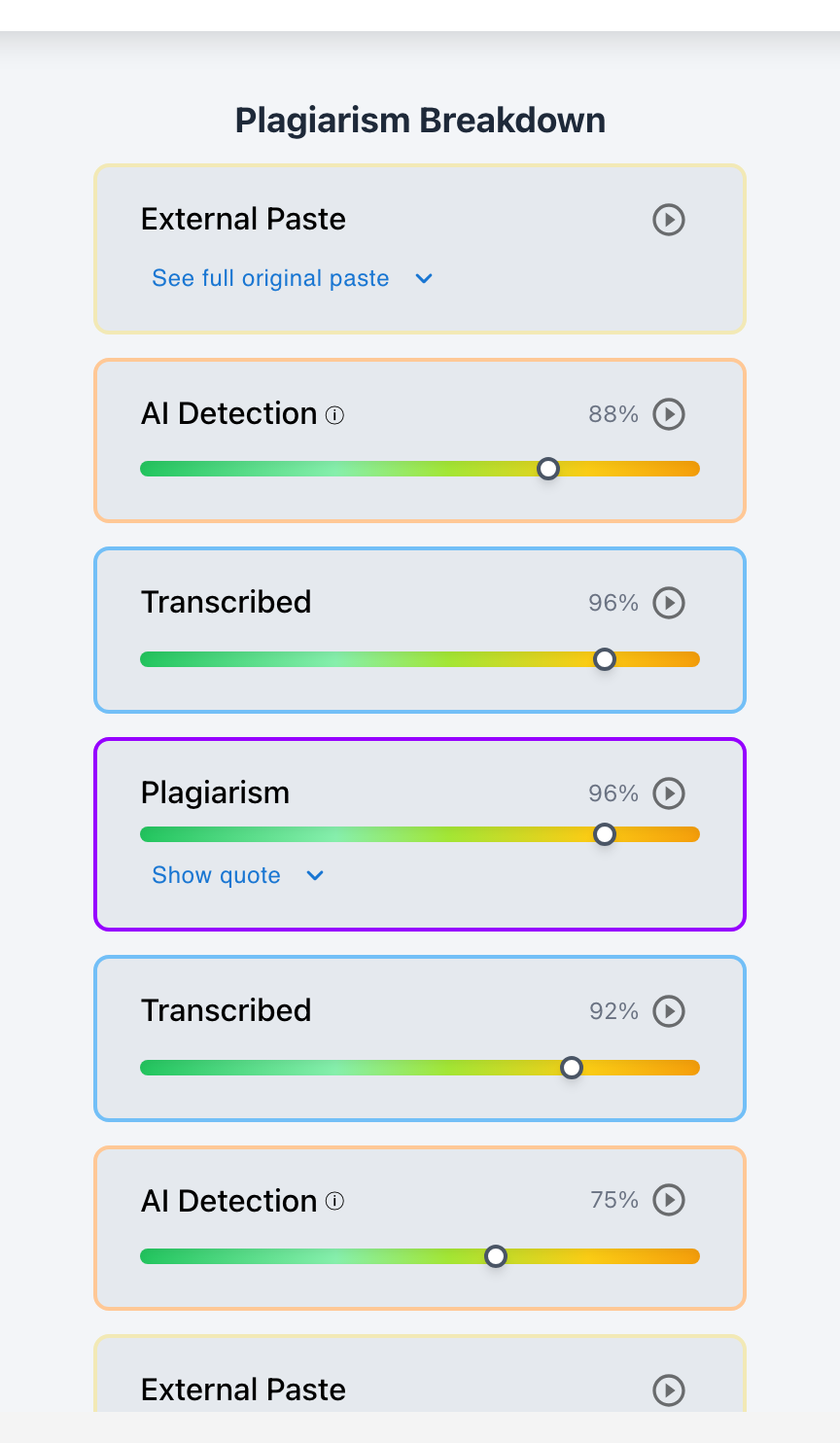
When an educator identifies clear academic dishonesty involving generative AI, submitting an informal accusation or an isolated detector score is never enough.
To sustain an academic integrity referral before department chairs, honor councils, student conduct boards, or parent conferences, an instructor must construct an evidence-based case dossier. A successful case file does not rely on subjective impressions or automated algorithms; instead, it synthesizes objective timeline logs, document writing playback, citation audits, baseline comparisons, and student conference records into a clear, cohesive narrative.
Building an evidence-based case is not about prosecuting a student; it is about establishing a transparent, defensible, and objective factual record that protects institutional integrity while respecting student due process.
Checkmark Plagiarism streamlines case compilation by combining AI detection with essay writing playback, static AI detection, plagiarism detection, autograding, and integrations with Canvas and Google Classroom.
The 4 Pillars of an Evidence-Based AI Misconduct Dossier
1. Published Policy Mapping
Every case begins by linking the observed writing behavior directly to specific, unambiguous syllabus clauses and assignment instructions.
2. Forensic Timeline Integrity
Objective physical records: active typing duration, keystroke cadences, wholesale paste timestamps, and post-paste edit ratios.
3. Objective Physical Verification
Verification audits proving that cited academic sources, author names, and volume numbers are non-existent hallucinations.
4. Documented Due Process
Complete records of student conference questions, oral conceptual mastery evaluations, and review of any external drafts submitted.
The 7-Exhibit Structure of an Airtight Case Dossier
Organizing evidence into standardized exhibits ensures that review panels can quickly evaluate the merits of the referral:
Exhibit A: Policy Baseline & Assignment Parameters
Establish the rules and constraints governing the submission:
- The complete assignment prompt, rubric, required sources, and submission deadlines.
- The published syllabus policy explicitly defining permissible vs. prohibited AI use.
Exhibit B: The Submitted Essay with Annotated Anomalies
Preserve the original submission and annotate specific factual discrepancies:
- Paragraphs displaying sudden stylistic and syntactic divergence.
- Generic filler phrasing that fails to reference assigned course readings or class discussions.
Exhibit C: Essay Writing Playback Logs & Timeline Analysis
Physical proof of document creation. Utilizing Checkmark Plagiarism's essay writing playback, attach:
- Total active typing duration vs. idle document time (e.g., 14 minutes total active drafting for a 1,500-word essay).
- Exact timestamps and character counts of wholesale paste events.
- Revision ratios proving that large pasted blocks received zero substantive editing prior to submission.
Read more in how Checkmark writing process analysis works.
Exhibit D: Citation & Source Authentication Audit
A structured log of database searches (JSTOR, Google Scholar, WorldCat) demonstrating whether cited sources exist:
- List of non-existent book titles, fake journal articles, or fabricated volume numbers.
- Direct quotations that do not exist within the cited publications.
Exhibit E: Historical Student Writing Baseline Portfolio
Attach 2–3 verified prior writing samples (e.g., proctored in-class essays, previous papers) to establish an authentic baseline for comparison:
- Syntactic comparison showing uncharacteristic shifts in sentence complexity.
- Vocabulary divergence and the disappearance of recurring grammatical patterns.
Read our guide on how can I compare a student's assignment to their previous writing?
Exhibit F: Student Conference Summary & Due Process Record
Document the exploratory student conference:
- Specific open-ended questions asked regarding the thesis, sources, and revision choices.
- Verbatim notes of student explanations regarding where the essay was drafted.
- Evaluation of oral conceptual comprehension (e.g., whether the student could explain core arguments in plain language).
- Status of external drafts requested and evaluated.
Exhibit G: Instructor Synthesis & Academic Integrity Report
A concise executive summary explaining how the independent pieces of evidence corroborate one another, concluding with a policy-aligned disciplinary recommendation.
Weak vs. Strong Cases: A Comparative Matrix
Weak Case (Easily Dismissed on Appeal)
- Relying solely on an isolated 88% AI detector score.
- Subjective notes: "The essay does not sound like the student."
- No document creation history or playback timeline logs.
- Citations were not audited in academic databases.
- No private student conference was conducted.
Strong Case (Defensible & Unassailable)
- Playback confirms 1,200 words pasted in one second with no edits.
- Audit confirms 3 cited journal articles do not exist in JSTOR.
- Student was unable to explain core arguments during conference.
- Student explanation contradicts observable document timestamps.
- Multi-signal alignment across playback, citations, and baselines.
A 6-Step Checklist for Building Your Case File
Educator Case Building Checklist:
- 1. Confirm the observed behavior violates the published syllabus AI policy.
- 2. Export essay writing playback timeline logs and paste event timestamps.
- 3. Audit all cited sources in academic databases to identify non-existent citations.
- 4. Retrieve 2–3 verified historical baseline writing samples for comparison.
- 5. Conduct a private, supportive student conference and evaluate oral comprehension.
- 6. Compile Exhibits A–G into a standardized Academic Integrity Report for submission.
How Checkmark Plagiarism Automates Case Dossier Compilation
Checkmark Plagiarism combines **AI detection, essay writing playback, static AI detection, plagiarism detection, autograding, and Canvas/Google Classroom integrations** to compile complete, multi-signal evidence dossiers automatically, empowering educators to uphold academic integrity with transparency, speed, and fairness.
Frequently Asked Questions
What is the single most important exhibit in an AI misconduct case?
Essay writing playback logs (documenting wholesale paste events and typing duration) combined with citation authentication audits (proving non-existent sources).
Can an AI detector score alone serve as the basis for a case?
No. AI detector scores are probabilistic estimates and must be corroborated by timeline logs, baseline comparisons, citation checks, and student conferences.
How do I handle a student who claims they wrote the paper in Microsoft Word?
Provide a 24–48 hour window for the student to submit the original Word document with version metadata and include their explanation in Exhibit F.
Why are hallucinated citations considered ironclad evidence?
Because non-existent journal titles, fake DOIs, and invented author pairings cannot be attributed to student writing mistakes, providing concrete physical proof of generative AI involvement.
How should oral conceptual comprehension be evaluated in the case file?
Document whether the student could summarize their thesis, explain key arguments, and define advanced terms in plain, everyday language during the conference.
What tone should be used throughout the misconduct dossier?
Maintain an objective, neutral, professional, and clinical tone that describes verifiable facts and timeline data without emotional or accusatory language.
How does comparing historical baselines strengthen the case?
Baseline samples demonstrate whether the submission represents natural academic development or an unexplained, abrupt departure from the student's authentic voice.
What happens if the evidence is mixed or inconclusive?
Do not refer the case for disciplinary sanctions. Resolve the matter educationally, reinforce expectations, and require process tracking on future assignments.
How does Checkmark Plagiarism simplify case preparation?
Checkmark Plagiarism automatically captures writing playback timelines, verifies citations, runs dual AI/plagiarism scans, and generates exportable evidence packets directly inside your LMS.
Rigorous Evidence Upholds True Academic Integrity
Constructing an evidence-based AI misconduct case ensures that academic standards are defended with objectivity, fairness, and absolute transparency. By grounding cases in multi-signal physical proof—writing playback, citation audits, baseline comparisons, and student interviews—educators ensure that academic integrity decisions are equitable and unassailable.
Checkmark Plagiarism supports this rigorous standard with AI detection, essay writing playback, static AI detection, plagiarism detection, autograding, and integrations with Canvas and Google Classroom.
See how Checkmark pairs essay writing playback with multi-signal detection to compile comprehensive, defensible evidence dossiers for every assignment. View a sample report or request a demonstration.