
When middle and high school students transition from basic informative writing to complex secondary research, they frequently encounter dense academic texts that exceed their working vocabularies. Faced with high cognitive load, emerging writers overwhelmingly resort to patchwriting—the practice of swapping select words with dictionary synonyms while preserving the original author’s grammatical clause structure. For decades, legacy plagiarism scanners have misdiagnosed this developmental stepping stone as deliberate academic dishonesty by calculating blunt, single-percentage similarity indexes (e.g., 42% Similarity). This guide details how secondary English, social studies, and science educators can replace punitive accusations with actionable, formative instruction using Checkmark Plagiarism’s Synchronized Side-by-Side Source Verification Workbench. By coupling synchronized dual-pane source mapping, a 4-badge citation taxonomy, patent-pending Essay Playback™ keystroke dynamics, and passage-level AI detection, teachers can visually demystify the mechanics of authentic synthesis, protect developing writers, and foster lasting academic integrity.
Checkmark Plagiarism empowers educators with comprehensive authorship verification, uniting side-by-side source comparison with keystroke process playback, passage-level AI writing detection, quote-anchored rubric autograding, and direct LTI 1.3 integrations for Canvas LMS and Agilix Buzz LMS.
1. The Secondary Research Dilemma: The Synonym Trap vs. Authentic Synthesis
Every secondary educator recognizes the pattern. A 9th-grade World History student is assigned a five-page research paper on the socioeconomic ramifications of the Industrial Revolution. Finding an authoritative scholarly chapter or primary document, the student attempts to incorporate the historian’s argument into their draft:
When this passage is submitted through a traditional plagiarism checker, the algorithm highlights the entire sentence in bright red and flags the submission with an alarming similarity score.
How monolithic similarity percentages convert a developmental writing milestone into disciplinary confrontation
- “The student intentionally committed plagiarism.”
- “They attempted to steal scholarship without reading.”
- “The student lacks academic integrity.”
- Automatic zero grade on research project
- Disciplinary referral to grade-level dean
- Parent escalation and student alienation from writing
The teacher is placed in an adversarial posture: Did the student intentionally commit intellectual fraud, or did they simply struggle to express an intricate historical concept in their own voice?
The Mechanics of “Patchwriting”
In composition studies, this phenomenon is recognized as patchwriting—a term coined by composition scholar Rebecca Moore Howard (1992, 1993):
“Patchwriting is copying from a source text which may be acknowledged or unacknowledged, deleting some words, altering grammatical structures, or substituting select synonyms while retaining the original syntactic architecture and semantic cadence.”
In middle school and high school classrooms, patchwriting is rarely an act of calculated deceit. Instead, it is the predictable byproduct of two intersecting pressures:
- Cognitive Overload in Unfamiliar Discourse: Secondary students reading advanced disciplinary articles (scientific abstracts, primary historical treaties, literary criticism) lack the domain-specific vocabulary required to re-frame the material organically.
- Algorithmic & Instructional Misdirection: Students are frequently given the vague instruction to “put it in your own words” without being taught how syntactic restructuring works. Consequently, they deploy a word-by-word “thesaurus swap” (often using right-click synonym tools or basic paraphrasing extensions), believing in good faith that changing every third word satisfies the requirement of original authorship.
Word-by-word substitution preserves 100% of the original grammatical skeleton without authentic cognitive synthesis
When schools treat patchwriting as a disciplinary violation rather than a diagnostic teaching opportunity, they alienate emerging researchers, heighten writing anxiety, and incentivize students to rely on generative AI tools to mask their stylistic shortcomings.
2. The Pedagogy of Source Integration and Paraphrasing
To teach research writing effectively, secondary educators must ground their instructional models in established writing research, separating novice linguistic struggle from bad faith.
A developmental hierarchy for scaffolding secondary research and argumentative synthesis
- Mechanics: Exact words extracted; enclosed in quotation marks; parenthetical citation or signal phrase.
- Pedagogical Role: Preserves historical voice, exact legal definitions, or unique literary eloquence.
- Mechanics: Word-for-word thesaurus swap; original sentence clause structure and cadence preserved.
- Pedagogical Role: Scaffolding stage; signals vocabulary gaps, working memory load, or comprehension struggles.
- Mechanics: Core historical mechanism extracted; sentence completely reconstructed to advance the student’s thesis.
- Pedagogical Role: Independent disciplinary scholarship, authentic voice, and conceptual mastery.
Rebecca Moore Howard and the Citation Project
The empirical foundation for understanding patchwriting comes from The Citation Project (Howard, Serviss, & Rodrigue, 2010; Jamieson & Howard, 2011), a landmark multi-institution study that analyzed source use across hundreds of student research papers:
| Citation Project Finding | Statistical Prevalence | Pedagogical Implication for Teachers |
|---|---|---|
| Direct Copying or Patchwriting | 52% of all analyzed citations | Over half of all citations in student writing involve sentence-level mimicry rather than original synthesis. |
| Summary of Entire Argument | < 6% of all analyzed citations | Fewer than 6% of students summarize an author’s overarching thesis; the vast majority focus only on isolated sentences. |
| Engagement Beyond Page 2 | < 23% of cited sources | Students rarely read entire sources, extracting quotes or patchwriting from the opening pages. |
| Missing Quotation Marks | 16% of all citations | Students frequently name the author in their text or bibliography but omit quotation punctuation. |
The Citation Project proved that patchwriting is not an ethical anomaly—it is the standard developmental default for students entering unfamiliar academic domains.
Cognitive Load Theory and the 3 Dimensions of Academic Discourse
Drawing on John Sweller’s Cognitive Load Theory, writing researchers understand that secondary students attempting to write research papers must juggle three cognitive dimensions simultaneously:
Decoding dense, specialized vocabulary, historical terminology, and scientific jargon.
Reconstructing complex subordinate clauses, academic qualifications, and compound arguments.
Managing MLA/APA parenthetical citations, signal phrase integration, and punctuation rules.
3. Why Legacy “Similarity Percentages” Fail Secondary Teachers
For more than two decades, secondary schools have relied on legacy plagiarism engines that output a single, blunt metric: a whole-document Similarity Score (e.g., 38% Match).
This aggregate approach creates profound pedagogical and administrative failures:
REALITY: Only 9% of the text requires formative coaching; the remaining 29% is completely legitimate research formatting!
The Four Fatal Flaws of Whole-Document Similarity Scores
A student who diligently incorporates three perfectly formatted, cited direct quotes will see their similarity percentage skyrocket. Automated school policies mandating zero-tolerance penalties actively punish students for engaging with scholarship.
A student who forgets quotation marks around a cited sentence receives the exact same visual warning as a student who copied an uncited paragraph from Wikipedia or bought an essay from a paper mill.
When a teacher sees a high similarity score, the instinctive response is investigative and punitive. Writing conferences become adversarial interrogations rather than workshops, destroying trust.
Telling a 10th grader “your paper is 35% plagiarized, fix it” provides zero instructional guidance. The student cannot see which clauses represent authentic synthesis vs. patchwriting.
4. Checkmark’s Synchronized Side-by-Side Source Verification Workbench
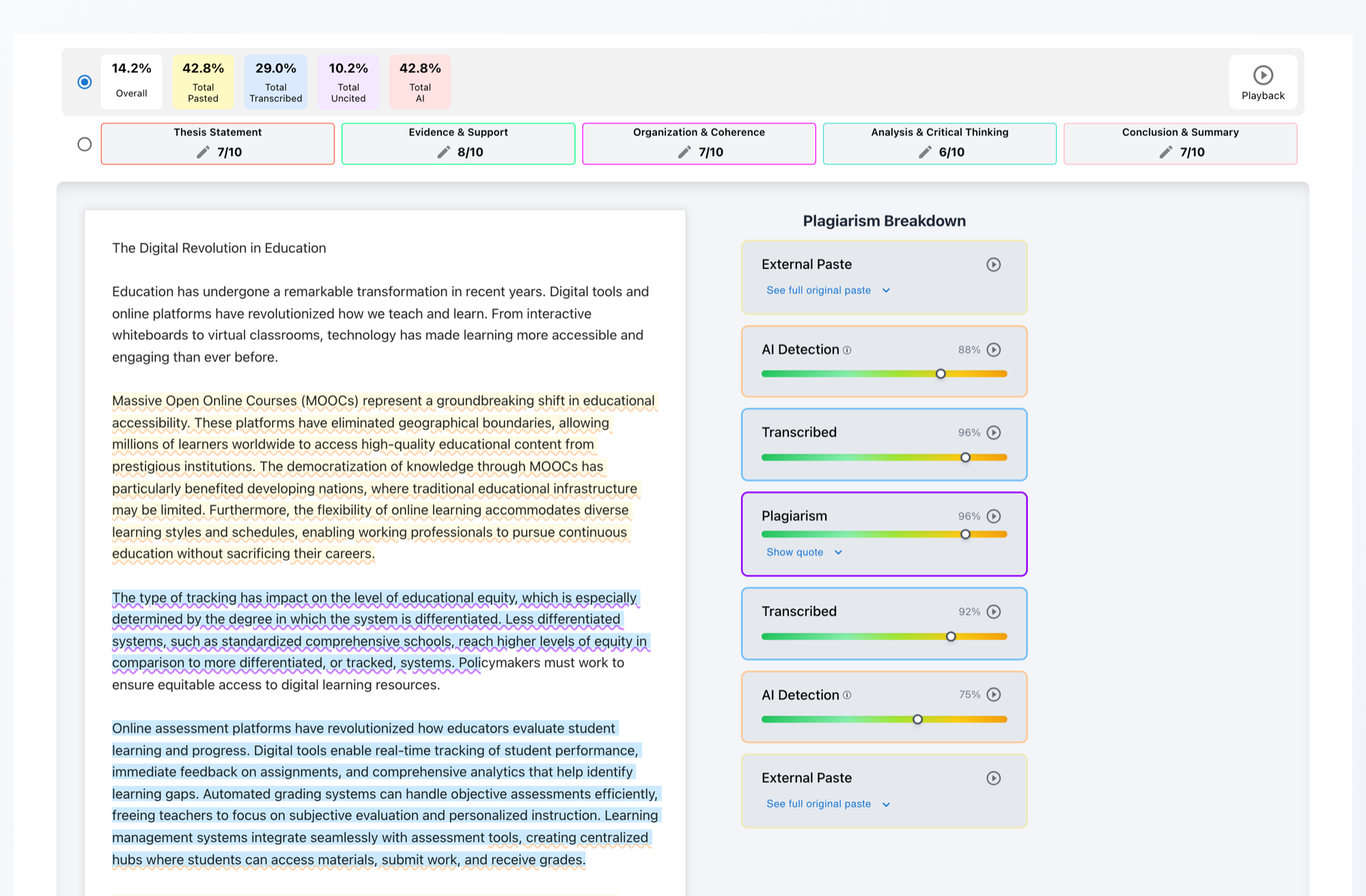
To solve this dilemma, Checkmark Plagiarism provides a purpose-built Synchronized Side-by-Side Source Verification Workbench. Instead of presenting a single threatening percentage, Checkmark transforms the integrity report into an interactive, formative teaching interface.
Arnold Toynbee argued that the Industrial Revolution brought massive economic shifts. The main point of the Industrial Revolution is the replacement of competition for the middle-age rules that had formerly managed the creation and sharing of riches (Toynbee, 1884).
1. Synchronized Dual-Pane Source Mapping
- Bi-Directional Scrolling: Clicking any highlighted sentence in the student’s draft automatically scrolls the right-hand source pane to the exact paragraph, line, and character index of the original published text.
- Live URL and DOI Resolution: Checkmark does not simply display cached snippets; it resolves live web pages, academic DOIs, digital encyclopedias, and open-access journals, allowing teachers and students to view the surrounding context of the original scholarship.
- Granular Substring Highlighting: Within the dual-pane view, Checkmark uses distinct typographic styling to differentiate between verbatim substrings (exact matches), transposed clauses (re-ordered phrases), and synonym shifts (thesaurus substitutions).
2. The 4-Badge Source Taxonomy
Checkmark eliminates aggregate score confusion by categorizing every matched passage under an educator-first 4-Badge Taxonomy:
Text is enclosed in valid quotation marks with parenthetical citation. Exclude from plagiarism concerns; review for stylistic integration.
Text closely mimics source syntax with an attribution. Requires non-punitive intervention: launch side-by-side comparison to teach Level 3 synthesis.
Verbatim or close match from web/academic index with zero citation. Require student to identify source, add citations, or rewrite.
Matches text from a peer submission in the school repository. Examine both drafts side-by-side using Essay Playback™ to see who authored the text.
| Badge Color & Type | Technical Detection Criteria | Pedagogical Diagnosis | Immediate Classroom Action |
|---|---|---|---|
| 🟢 Quoted & Cited | Verbatim text enclosed in standard quotes (“...”) with proximate citation or signal phrase. |
Proper Attribution: Student correctly attributes and punctuates source material. | Exclude from plagiarism concerns; review for stylistic quote integration. |
| 🟡 Cited but Unquoted | Near-verbatim or patchwritten text with high syntactic alignment accompanied by in-text citation, but lacking quotation marks. | Developmental Patchwriting: Student attempted honest attribution but fell into the synonym trap. | Non-punitive intervention: Launch side-by-side comparison to teach Level 3 synthesis. |
| 🔴 Uncited External Match | High substring similarity against live web, book, or journal indexes with zero parenthetical citation or author attribution. | Missing Attribution / Cut-and-Paste: Student copied external prose without crediting the creator. | Require student to identify original source, add citations, or rewrite. |
| 🟣 Peer Cohort Match | High textual overlap matching another student draft within local classroom, school, or district repository. | Unauthorized Collaboration / Peer Copying: Shared drafting or unpermitted peer assistance. | Examine both drafts using Essay Playback™ to see who authored the text. |
3. Formative Paraphrasing Coaching Overlays
When an educator clicks on a 🟡 Cited but Unquoted (Amber) badge, Checkmark provides an interactive Coaching Overlay that can be displayed during a student conference or assigned directly to the student for revision:
DIAGNOSIS: SYNTACTIC SCAFFOLDING (THE SYNONYM TRAP)
Original Core Claim: Free market competition replaced medieval guild rules in wealth production and distribution.
Original Structure: [The essence is X] for [Y which previously did Z].
Target Structure: Begin with the historical context or economic outcome rather than copying the definition formula.
“As nineteenth-century industry expanded, open competition replaced traditional medieval regulations, reshaping the economy (Toynbee, 1884).”
This transforms what used to be a confrontational accusation into a structured, visual writing conference where the student can see why their sentence remains tethered to the source and how to unhook it.
5. Multi-Factor Evidence Suite: Beyond Surface Matching
Surface plagiarism checks represent only one dimension of modern writing integrity. Today’s secondary teachers must evaluate submissions across a complex landscape of copy-pasting, paraphrasing extensions, generative AI, and second-screen transcription.
Checkmark solves this by uniting four proprietary, teacher-centered technologies into a single defensible ecosystem:
Side-by-Side Engine
Synchronized dual-pane alignment, 4 citation badges, live URLs, and substring matching.
Essay Playback™
Keystroke replay, 1x–8x scrubber, 100% paste buffer preservation, and typing telemetry.
Passage-Level AI
Sentence-level confidence sliders, perplexity scans, <150w N/A guardrails, and private educator flags.
Rubric Autograder
Quote-anchored justifications, custom district rubrics, teacher authority, and LMS passback.
1. Patent-Pending Essay Playback™ & Keystroke Telemetry
- Full Process Reconstruction: Checkmark records the authentic, chronological drafting session. Educators can scrub through the entire writing session like a video at 1x, 2x, 4x, or 8x speed, observing pauses, deletions, structural reorganizations, and real-time edits.
- 100% External Paste Buffer Preservation: When text is pasted into the document from an external source, Checkmark captures the exact timestamp and the complete original clipboard text. Even if the student subsequently edits, rewords, or deletes every word of the pasted text over a two-hour session, the teacher can click “Jump to Playback” to view the raw pasted snippet and watch how it was modified.
- Transcription Detection: Identifies mechanical typing rhythms (steady, robotic character-by-character entry without natural composing pauses or backspacing) characteristic of students retyping text from a mobile phone, tablet, or secondary monitor.
- Exonerating Honest Students: For students falsely accused by generic AI detectors, Essay Playback™ provides unassailable proof of human authorship, documenting organic drafting struggles, typos, vocabulary searches, and sentence-level revisions.
Outline Created
Drafting Intro
External Paste
Active Revision
Final Attributions
2. Passage-Level AI Writing Detection with Calibrated Confidence
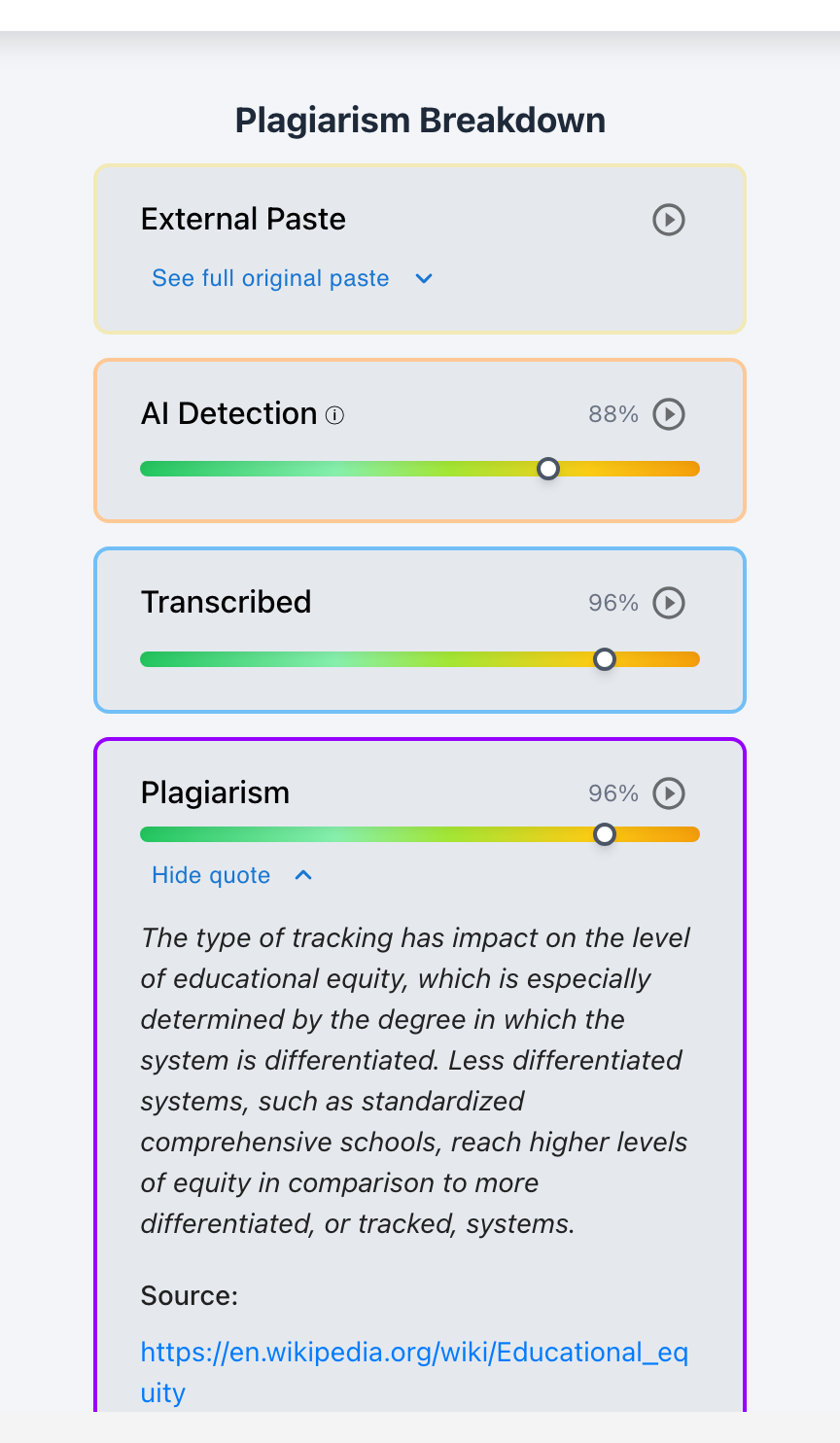
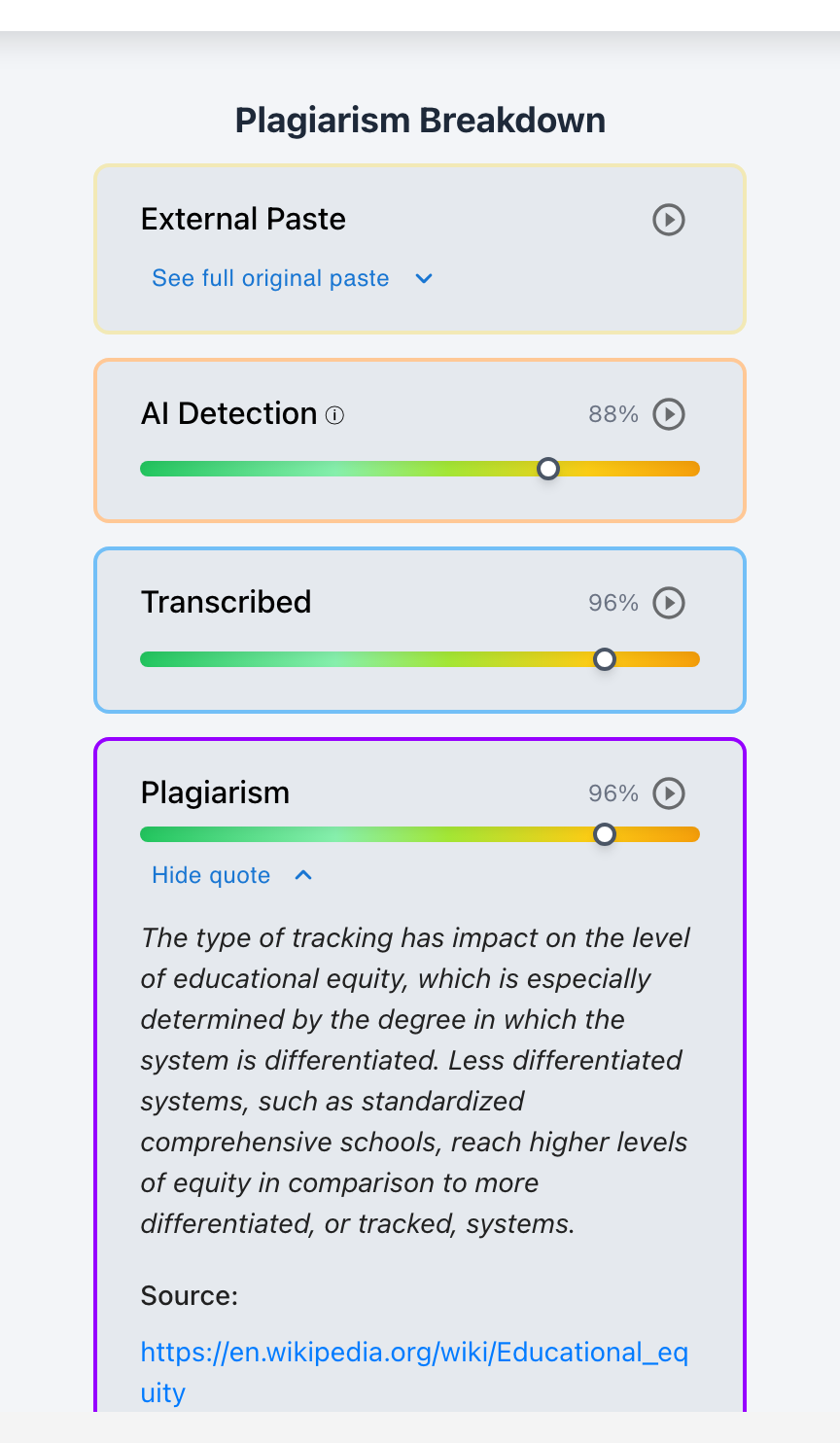
- In-Situ Highlighting: Rather than assigning a single, arbitrary whole-document percentage (e.g., “67% AI”), Checkmark underlines specific sentences and paragraphs directly within the essay.
- Granular Confidence Sliders: Every flagged passage links to a sidebar evidence card featuring a calibrated slider contrasting typical human stylistic variability against robotic AI patterns.
- Linguistic Metric Analysis: Leverages multi-dimensional evaluation of perplexity (word choice predictability) and burstiness (variation in sentence length and syntactic complexity).
- Honest Guardrails on Short Passages: For submissions or independent text fragments under 150 words, Checkmark explicitly displays
N/A, preventing false-positive flags on short writing prompts or exit tickets. - Immunity to “AI Humanizers” and Paraphrasers: Tools like QuillBot or Undetectable AI alter lexical perplexity to fool traditional AI scanners. However, because they require students to paste modified blocks of text into their drafts, Checkmark’s Essay Playback™ instantly reveals the external paste event, exposing the evasion attempt.
- Private Educator Flags: AI flag statuses (Flagged, Resolved, Not Flagged) remain private to the teacher, ensuring students are never subjected to automated accusations.
3. AI Autograder with Quote-Anchored Rubric Justifications
- Teacher-in-the-Loop Workflow: Checkmark autogrades first drafts against custom district or teacher-created rubrics, generating tentative point allocations and written rationales. All grades remain preliminary until approved by the teacher.
- Quote-Anchored Evidence Cards: Feedback justifications are directly anchored to specific student sentences, illustrating exactly where the student met, approached, or fell short of rubric expectations (e.g., Source Synthesis, Thesis Clarity, Evidence Integration).
- Direct LMS Gradebook Synchronization: Seamless, one-click passback pushes finalized rubric scores and quote-anchored feedback directly into Canvas LMS SpeedGrader, Buzz LMS, and Google Classroom.
4. Zero-Data Retention & Enterprise Ethics
- FERPA & COPPA Compliant: Student writing is never sold, shared, or utilized to train commercial large language models (LLMs).
- Encrypted Security: Enterprise-grade encryption in transit and at rest ensures all student telemetry and essay drafts remain secure within school-authorized boundaries.
6. Real-World Secondary Case Studies
To illustrate how synchronized side-by-side verification and multi-factor evidence function in practice, consider three authentic secondary classroom scenarios.
| Case Study | Raw Legacy Score | Checkmark Multi-Factor Findings | Final Pedagogical Outcome |
|---|---|---|---|
| 1. 9th-Grade World History | 45% Similarity (Triggered Auto-Zero) | 12 Green Quoted Badges + 4 Amber Badges; 45m continuous typing in Playback. | 5-minute paraphrasing conference; student rewrote to Level 3 synthesis for full credit. |
| 2. 11th-Grade AP Capstone Seminar | 12% Low Similarity (Passed Undetected) | Passage AI detection flag + 400-word single keystroke paste captured from QuillBot. | Restorative conference; guided reverse-outline exercise and authentic rewrite. |
| 3. 8th-Grade Science CER Report | 40% Similarity (Suspected Copying) | 25% NOAA quoted definitions + 15% Amber linguistic scaffolding by ELL student. | Teacher validated comprehension; coached scientific reasoning integration. |
Context: A 9th-grade student submitted a research paper on child labor during the British Industrial Revolution. A legacy scanner flagged the document with a 45% Similarity Score, prompting the department chair to consider academic dishonesty penalties.
Checkmark Workbench Analysis:
- The teacher opened the Checkmark report. Instead of a monolithic red block, the essay displayed twelve 🟢 Quoted & Cited (Green) badges (properly formatted testimonies from parliamentary hearings) and four 🟡 Cited but Unquoted (Amber) badges.
- The synchronized right pane displayed the 1833 Sadler Committee Report. The student had cited the report but wrote: “Children were beaten with straps to keep them diligent during the prolonged fifteen-hour shifts.” (Original: “The children were beaten with straps to keep them working during the long fifteen-hour workday.”)
- Essay Playback™ Verification: Playback showed the student spending 45 minutes typing the section, pausing frequently, consulting notes, and looking up synonyms. There were zero external paste events.
Context: An 11th-grade AP Seminar student submitted a 1,200-word literature review evaluating algorithmic bias in medical diagnostic software. The paper received a 12% Similarity Score on a legacy scanner, well below the school’s alert threshold.
Checkmark Workbench Analysis:
- Despite the low similarity score, Checkmark flagged two central paragraphs with 🔴 Passage-Level AI Highlighting (High Confidence).
- The teacher inspected the Essay Playback™ timeline: at minute 14:02, the student pasted a 400-word block of text in a single keystroke (
Ctrl+V). Checkmark’s clipboard capture revealed that the pasted text was generated by an online paraphraser (QuillBot) fed by a peer-reviewed abstract from The Lancet Digital Health. - The student had used the tool to disguise the copied text, lowering lexical similarity while preserving AI-style sentence cadence.
Context: An 8th-grade English Language Learner (ELL) submitted a Claim-Evidence-Reasoning (CER) report on ocean acidification. The submission registered a 40% Similarity Index on a legacy tool.
Checkmark Workbench Analysis:
- Checkmark’s Side-by-Side view revealed that 25% of the match consisted of standard chemical equations and NOAA definitions (🟢 Quoted & Cited).
- The remaining 15% was flagged with 🟡 Cited but Unquoted (Amber) on the reasoning section. The student wrote: “Because seawater absorbs more carbon dioxide, the water becomes more acidic and marine organisms cannot produce shells easily.” (Original NOAA text: “As seawater absorbs increased carbon dioxide, ocean acidity rises, impairing the capacity of marine calcifiers to build shell structures.”)
- Essay Playback™ confirmed steady, deliberate typing over a 35-minute period with multiple dictionary lookups for terms like “calcifiers” and “acidity.”
7. The 4-Phase Paraphrasing Mastery Instructional Unit
To systematically transition secondary students from Level 2 patchwriting to Level 3 synthesis, schools should implement this structured, four-phase instructional unit during the launch of any major research project.
- Read and annotate source paragraph twice (max 3 keywords)
- Physically close or minimize the source tab
- Verbalize core claim to a peer in 30 seconds
- Draft explanation from memory before re-checking facts
- Project sample exemplar draft in Checkmark dual-pane view
- Guide class through 4 badges (Green, Amber, Red, Purple)
- Collaborative live board rewrite of Amber patchwritten sentences
- Demystify integrity reports into visual writing feedback
- Create 2-source matrix comparing differing author perspectives
- Extract core mechanisms rather than isolated sentences
- Practice sentence combining, subordination, and thesis anchoring
- Produce unified Level 3 argumentative claims
- Submit rough draft through student revision portal
- Complete pre-submission integrity checklist
- Resolve all Amber and Red badges prior to final grading
- Verify continuous keystroke drafting in Essay Playback™
Multi-Source Synthesis Matrix Template
Secondary students move from single-sentence paraphrasing to multi-source synthesis by using a comparative matrix:
| RESEARCH QUESTION | SOURCE A (Author / Finding) | SOURCE B (Author / Finding) |
|---|---|---|
| What caused the fall of the Western Roman Empire? | Gibbon (1776): Internal moral decay and political division. | Ward-Perkins (2005): External violent invasions and trade collapse. |
“While classical historians like Gibbon attribute Rome’s decline to internal political fragmentation, modern archaeological evidence highlighted by Ward-Perkins demonstrates that sudden economic disruption from external invasions dealt the fatal blow.”
8. Classroom Mini-Lesson Plans (15-Minute Modules)
These modular 15-minute lessons can be inserted directly into secondary writing workshops.
- Top Bread: Signal Phrase (Sociologist Jane Addams observed that...)
- Meat: The precise quoted or synthesized evidence.
- Bottom Bread: Student analysis explaining why this evidence matters to their thesis.
9. Restorative Conferencing Dialogue Scripts
When Checkmark flags a submission with extensive 🟡 Cited but Unquoted (Amber) or 🔴 Uncited External (Red) badges, secondary teachers should utilize restorative, growth-oriented conferencing protocols.
Scenario A: Conferencing on Developmental Patchwriting (🟡 Amber Badge)
Teacher: “Thanks for sitting down with me, Maya. I was reading your draft on the American civil rights movement, and you found an outstanding historical analysis by Dr. King. Let’s pull up the draft on Checkmark’s Side-by-Side Workbench together.”
Student: (Noticing the yellow highlighting) “Am I in trouble? Did I get flagged for plagiarism?”
Teacher: “Not at all. Look at the badge color—it’s amber, which means ‘Cited but Unquoted.’ You did the right thing by putting King’s name and page number at the end of the sentence. That tells me you were being honest about where you got the idea.”
Student: “Yeah, I tried to change the words so it wouldn’t be copied.”
Teacher: “Exactly, and that’s a very normal first step when you’re reading complex history. But look at the right pane: when we compare your sentence next to Dr. King’s original text, see how both sentences follow the exact same grammatical rhythm? You swapped ‘injustice’ for ‘unfairness’ and ‘inescapable network’ for ‘unavoidable web.’ That’s called patchwriting.”
Student: “I didn’t know how else to say it without messing up his meaning.”
Teacher: “That makes complete sense—his vocabulary is elevated. Let’s do this: close your eyes or look away from the screen. In your own normal conversational words, what was Dr. King trying to tell the clergymen about why he came to Birmingham?”
Student: “He was saying that whenever someone’s rights are violated in one city, it hurts everybody across the entire country because communities are connected.”
Teacher: “That was brilliant! That is 100% your own voice, and it captures his philosophical thesis even better than the sentence you patchwrote. Let’s type that exact sentence into your draft right now and add your citation. See how that transforms it into a Level 3 synthesis?”
Scenario B: Conferencing on an Uncited External Paste (🔴 Red Badge + Essay Playback™)
Teacher: “Hello, Jason. I wanted to review your environmental science literature review. Let’s open your Checkmark report and look at the drafting telemetry together.”
Student: “Okay.”
Teacher: “Let’s look at paragraph three. Checkmark identified a Red Badge here, matching a paragraph from a National Geographic article on microplastics. When we open Essay Playback™, look at the timeline at minute 18:30: a 250-word block was pasted in all at once, without a citation or quotation marks.”
Student: “I was doing research and pasted it into my doc so I wouldn’t lose it, but then I forgot to rewrite it before submitting.”
Teacher: “I appreciate you explaining that. Keeping research notes directly in your draft document is a common organizational pitfall that leads to accidental uncredited text. To fix this, we need to separate your note-taking space from your writing space. Let’s pull up the original National Geographic source in the right pane right now. What is the single data point from this article that supports your argument?”
Student: “The statistic about how many metric tons of microplastics enter the ocean annually.”
Teacher: “Great. So we don’t need the author’s whole paragraph. We only need that specific data point. Let’s delete the pasted block, write a clean sentence introducing the statistic, and cite National Geographic. Then, let’s look at how you can set up a split-screen research journal for your next project so pasted notes never get mixed into your final prose.”
10. Frequently Asked Questions (FAQ)
1. How does developmental patchwriting differ from intentional plagiarism?
Developmental patchwriting occurs when a student attempts in good faith to engage with an authoritative source but lacks the vocabulary or syntactic confidence to reconstruct the author’s argument. It is almost always accompanied by author mentions, attempted citations, or organic drafting keystrokes. Intentional plagiarism involves deliberate attempts to deceive—such as copying entire uncited essays, buying papers, or using generative AI and paraphrasing obfuscators to mask unauthorized sources without conducting actual research.
2. Why does Checkmark use a 4-Badge taxonomy instead of a single similarity percentage?
Single similarity percentages are fundamentally misleading because they lump legitimate research citations, bibliography entries, and common disciplinary idioms together with uncited copying. Checkmark’s 4-Badge Taxonomy (🟢 Quoted & Cited, 🟡 Cited but Unquoted, 🔴 Uncited External, 🟣 Peer Cohort Match) isolates the precise pedagogical nature of each match, allowing teachers to instantly separate citation formatting errors from intentional academic misconduct.
3. How does Essay Playback™ help teachers verify authentic writing?
Essay Playback™ records the full chronological typing session, allowing educators to replay the creation of the essay keystroke-by-keystroke at up to 8x speed. Teachers can observe natural composing pauses, revisions, deletions, and structural reorganizations. Crucially, Checkmark captures 100% of external clipboard paste events, preserving the exact original pasted text even if the student spent hours editing it afterwards.
4. Can students use AI paraphrasers like QuillBot to bypass Checkmark?
No. While automated paraphrasing tools modify surface vocabulary to evade legacy keyword-matching algorithms, they cannot fabricate an authentic human drafting timeline. Checkmark detects the sudden external paste event in Essay Playback™, flags the mechanical pacing of the insertion, and applies passage-level AI detection to identify the low-burstiness syntactic patterns characteristic of AI-altered prose.
5. Why does Checkmark enforce a 150-word minimum guardrail for AI detection?
Statistical linguistic analysis (evaluating perplexity and burstiness) requires a sufficient sample size to produce reliable, defensible results. On passages under 150 words (such as short-answer responses, exit tickets, or poetry), statistical variance is too high, leading generic detectors to produce catastrophic false positives. Checkmark displays N/A on sub-150-word samples to protect students from unscientific accusations.
6. How does Checkmark integrate with Canvas SpeedGrader and Buzz LMS?
Checkmark features seamless LTI 1.3 / Enterprise API integration with Canvas LMS, Buzz LMS, and Google Classroom. Teachers can launch the Synchronized Side-by-Side Workbench directly inside Canvas SpeedGrader, review quote-anchored rubric justifications, edit point allocations, and pass finalized grades and comments straight back into the district gradebook with a single click.
7. Does Checkmark store or train AI models on student essays?
Never. Checkmark maintains strict compliance with FERPA, COPPA, and state student data privacy laws. Student drafts and writing telemetry are encrypted in transit and at rest and are never sold, shared, or utilized to train commercial machine learning or large language models.
11. Conclusion: Transforming Academic Integrity from Surveillance into Pedagogy
Teaching secondary students how to conduct research and synthesize authoritative scholarship is among the most vital responsibilities of secondary education. When schools rely on blunt, punitive plagiarism tools that reduce student writing to an arbitrary similarity number, they discourage deep inquiry, heighten writing anxiety, and criminalize the natural developmental process of learning academic discourse.
- Black-box aggregate percentages (e.g., “35% Plagiarized”)
- Zero-tolerance discipline without diagnostic investigation
- Adversarial teacher-student dynamic; incentivizes AI cheating evasion
- Synchronized Side-by-Side Workbench with live source resolution
- 4-Badge Citation Taxonomy separating patchwriting from theft
- Patent-Pending Essay Playback™ preserving authentic drafting receipts
- Teacher-in-the-loop autograding with quote-anchored rubric justifications
By adopting Checkmark Plagiarism’s Synchronized Side-by-Side Source Verification Workbench, secondary educators gain the transparent evidence needed to uphold rigorous standards while nurturing student growth. With granular dual-pane source mapping, patent-pending keystroke dynamics, and formative paraphrasing overlays, teachers can confidently stop guessing and start trusting—empowering the next generation of secondary scholars to discover, articulate, and defend their authentic voices.
Stop Guessing. Start Trusting.
Equip your secondary faculty with patent-pending Essay Playback™, synchronized side-by-side source verification, and teacher-in-the-loop rubric autograding designed for Canvas LMS, Buzz LMS, and Google Classroom.