
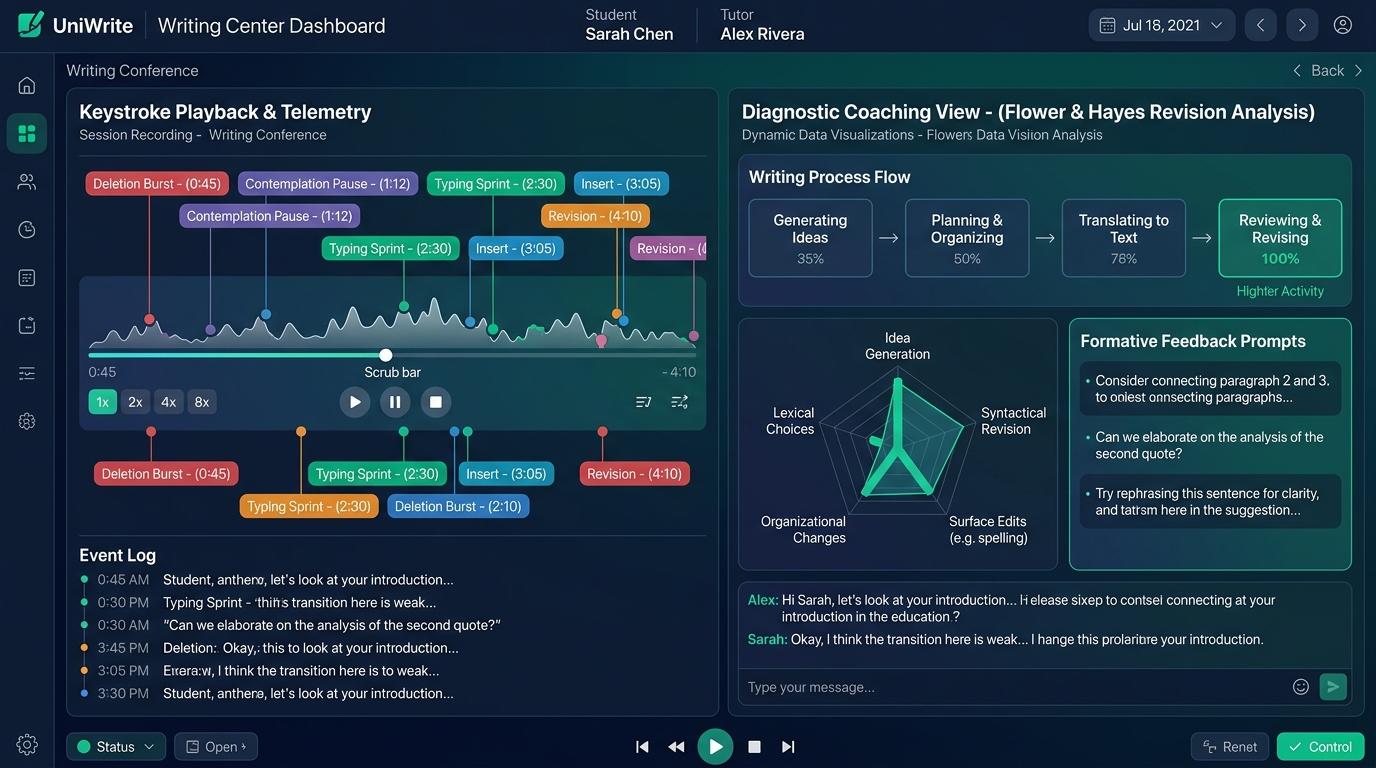
For decades, university writing centers, high school peer tutoring labs, and faculty writing fellows have operated under a profound pedagogical constraint: they can only evaluate the static artifact of a student's final draft—or the paralyzing emptiness of a blank document. Tutors are forced to guess what cognitive friction occurred during drafting, while anxious and reluctant writers struggle to articulate why they hit a wall. Traditional integrity tools have compounded this anxiety by weaponizing writing telemetry for punitive surveillance and black-box AI accusations. Grounded in Checkmark Plagiarism’s core philosophy of “Stop guessing, start trusting,” this comprehensive guide explores the paradigm shift toward formative writing process diagnostics. By leveraging patent-pending Essay Playback™, 1x–8x scrubbable keystroke timelines, telemetry event markers ([DELETION_BURST], [LONG_CONTEMPLATION_PAUSE], [EXTERNAL_NOTES_PASTE]), and cognitive psycholinguistic modeling (Flower & Hayes; Scardamalia & Bereiter), peer tutors can sit shoulder-to-shoulder with writers to diagnose the “backspace spiral,” unlock premature editing traps, validate authentic external scratchpad brainstorming, and transform writing paralysis into self-regulated mastery.
Checkmark Plagiarism empowers writing centers and peer coaching labs by uniting patent-pending Essay Playback™ with passage-level AI confidence sliders, side-by-side plagiarism source verification, quote-anchored rubric autograding, and enterprise LTI 1.3 integrations for Canvas SpeedGrader, Google Classroom, and Agilix Buzz.
1. The Writing Center Dilemma: The “Black Box” of the Final Draft vs. The Hidden Composing Journey
In higher education writing centers and secondary peer tutoring labs, the central challenge of writing pedagogy is rarely a lack of student ideas. Rather, it is the invisibility of the composing process.
When a student sits down with a peer tutor, the consultation almost universally begins with a finished paper, an incomplete fragment, or a completely blank screen. The tutor asks: “Where did you get stuck?” or “What was your thought process when writing this paragraph?”
For reluctant writers, second-language learners, and students grappling with writing anxiety, answering these metacognitive questions on demand is intimidating. They may remember feeling overwhelmed, frustrated, or uncertain, but they cannot reconstruct the exact cognitive micro-decisions that led to a stalled draft.
Tutor Diagnoses Only Surface Symptoms:
- Weak thesis or missing claim?
- Abrupt transitions between paragraphs?
- Surface grammatical and spelling errors?
❓ Tutor: “Why did you choose this phrasing?”
🗣️ Student: “I don't know... I just got confused.”
Tutor Diagnoses Real Cognitive Friction:
- 45-min pause identified before Paragraph 2
- 14 backspace cycles detected on opening claim
- External notes paste verified and preserved
💡 Tutor: “Let's watch this 5-minute pause together. What two ideas were you wrestling with?”
🗣️ Student: “I had a quote, but couldn't link it to my main point!”
The Invisible Cognitive Stalls of Reluctant Writers
Before a stalled draft ever reaches a tutoring desk, the student has typically engaged in hours of silent, exhausting cognitive labor that leaves zero trace on the static page:
A student types three brilliant, tentative sentences exploring an argument, feels a surge of self-doubt about phrasing or vocabulary, hits backspace until the page is blank again, and repeats this cycle twelve times over 45 minutes.
A writer spends forty minutes obsessively tweaking individual adjectives in an introductory sentence with an online dictionary instead of organizing their core claims, seeking the safety of low-stakes surface edits.
A student drafts three disjointed body paragraphs across external note apps, attempts to paste them into the main LMS editor, panics because they lack logical connective tissue, and shuts their laptop in despair.
When evaluating only the static final document, even experienced tutors often misdiagnose these deep cognitive blockages as mere “laziness,” “poor time management,” or simple “grammar weakness.”
By contrast, when peer tutors have access to dynamic writing telemetry, writing centers gain an empathetic, objective mirror that externalizes the writing process. Writing telemetry transforms an adversarial or awkward interrogation into a collaborative coaching partnership.
2. Cognitive Psycholinguistics of Writing & Revision Stalls
To effectively utilize writing process replays in peer tutoring, tutors and writing center directors must understand the cognitive architecture of composition. Writing is not a linear act of transcription; it is an intensely demanding, non-linear problem-solving process that taxes working memory.
Visualizing how executive working memory overload triggers revision freezes
- Generating ideas & concepts
- Organizing argument hierarchy
- Setting rhetorical goals
- Syntactic clause formulation
- Lexical retrieval & typing
- Converting thoughts to text
- Evaluating intent vs. output
- Macro structural reorganizations
- Local editing and proofreading
When the executive Monitor triggers Reviewing prematurely while the writer is still in the middle of Translating, working memory is overwhelmed. The student experiences cognitive paralysis and triggers the Backspace Spiral.
1. The Flower & Hayes Model and Executive Overload
In their seminal cognitive framework (Flower & Hayes, 1981), composition is divided into three recursive cognitive subprocesses governed by an executive Monitor:
- Planning: Generating abstract concepts, retrieving background knowledge, setting rhetorical objectives, and organizing argument hierarchies.
- Translating: The physical and linguistic act of converting non-verbal semantic thoughts into linear, syntactically correct text on the page.
- Reviewing: Reading, evaluating, diagnosing mismatches between intent and output, and editing prose.
The Cognitive Overload Bottleneck
Expert writers manage these three processes concurrently through cognitive chunking and automated low-level mechanics (spelling, typing, syntactic flow). Novice and reluctant writers, however, possess limited working memory capacity. When the executive Monitor triggers the Reviewing subprocess prematurely—evaluating a sentence while the student is still in the vulnerable middle of Translating an idea—the cognitive load spikes uncontrollably. The student experiences working memory exhaustion, and the composing pipeline collapses.
2. Scardamalia & Bereiter: Knowledge Telling vs. Knowledge Transforming
Scardamalia and Bereiter (1987) established the crucial distinction between novice and mature composing strategies:
Knowledge Telling vs. Knowledge Transforming Modalities
| Composing Modality | Cognitive Mechanics | Student Mindset | Keystroke Replay Signature |
|---|---|---|---|
|
Knowledge Telling (Novice Default) |
Direct linear retrieval: the writer retrieves an idea from memory and immediately writes it down sentence-by-sentence with minimal planning or macro-revision. | “I just write down everything I know about the topic until I reach the page limit.” | Fast, linear typing with minimal long pauses; revisions are strictly local spelling or word-swapping edits. Zero structural reorganizations. |
|
Knowledge Transforming (Mature Goal) |
Complex problem-solving: the writer continuously interacts between the content space (what do I know?) and the rhetorical space (how does this affect my argument/audience?). | “How does this new evidence change my thesis? I need to restructure my second argument.” | Long contemplation pauses, large-scale paragraph reordering, structural deletion bursts, and iterative synthesis from external notes. |
Reluctant writers frequently stall when an assignment forces them to move from comfortable Knowledge Telling into complex Knowledge Transforming. Without structured scaffolding, the cognitive leap causes them to freeze. Keystroke telemetry makes this invisible cognitive transition visible and coachable.
3. The Anatomy of Three Classic Revision Traps
When students hit cognitive friction points, their struggle manifests in distinct, measurable typing behaviors:
Cognitive Diagnosis: The student's internal evaluator operates at 1:1 speed with their ideation engine. Because first drafts are inherently imperfect, the student rejects every emergent formulation before it can be scaffolded by subsequent sentences.
Cognitive Diagnosis: High cognitive anxiety. Tackling macro-level structural flaws requires immense working memory and emotional vulnerability. Polishing spelling and punctuation offers immediate psychological gratification without deep revision pain.
Cognitive Diagnosis: In psycholinguistics, time elapsed between keystrokes (IKI) reveals cognitive processing. Fluency pauses (<2.0s) indicate motor execution; macro pauses (>30s to 10m+) indicate global rhetorical problem-solving or context boundary disorientation.
3. Checkmark Plagiarism’s Essay Playback™ Suite for Writing Centers
Checkmark Plagiarism transforms writing telemetry from an opaque, punitive mechanism into an open, student-centered coaching laboratory.
Unlike legacy AI checkers that output an arbitrary, whole-paper percentage (e.g., “68% AI Detected”) that alienates students and invites confrontation, Checkmark provides a comprehensive, multi-dimensional evidence architecture designed for formative instruction.
Granular sentence-by-sentence confidence cards evaluating perplexity and burstiness. Features Honest Guardrails displaying N/A below ~150 words to eliminate reckless short-text guessing.
Deep web and scholarly repository comparisons highlighting matching text side-by-side with Uncited Source Differentiation to turn citation mistakes into constructive coaching moments.
Generates formative first-draft rubric scores, criterion breakdowns, and specific prose-anchored suggestions. Remains in draft status until tutor/teacher review with 1-click LMS Grade Passback.
Core Innovations for Peer Tutoring & Writing Labs
1. 1x–8x Scrubbable Keystroke Timeline Player
The cornerstone of the suite is the patent-pending Essay Playback™ engine. Rather than reconstructing crude 10-minute snapshot diffs, Essay Playback™ captures the precise sequence of every keystroke, backspace, cursor movement, text selection, pause, and paste.
Tutors and tutees can scrub through the timeline smoothly at variable speeds (1x, 2x, 4x, 8x), watching the draft assemble dynamically. This allows a 60-minute composing session to be reviewed collaboratively in 3 to 5 minutes, immediately exposing where the student typed with effortless rhetorical flow and where they hit cognitive friction.
2. Automatic Telemetry Event Markers
Essay Playback™ automatically annotates the scrubber timeline with color-coded, interactive event markers:
[DELETION_BURST]: Identifies rapid, large-scale text erasures (>50 characters erased within seconds), highlighting acute self-doubt or frustration.[LONG_CONTEMPLATION_PAUSE]: Flags pauses exceeding user-defined thresholds (e.g., 3 minutes, 5 minutes, 10 minutes), marking conceptual bottlenecks.[STRUCTURAL_REORGANIZATION]: Detects when an existing paragraph or block of text is cut and relocated to a new structural position in the document, signaling authentic Knowledge Transforming.[EXTERNAL_NOTES_PASTE]: Identifies text inserted from the external clipboard, hyperlinking directly to the paste buffer inspector.
3. External Paste Buffer Tracking with 100% Text Preservation
One of the greatest sources of false accusations in modern education occurs when students draft outlines, bullet points, or paragraphs in external tools (Notion, Apple Notes, Google Keep, Discord) and paste them into their assignment. Traditional AI detectors flag these large, abrupt insertions as probable LLM generation.
Checkmark Plagiarism solves this definitively by preserving 100% of the raw pasted text in a dedicated side-panel inspector. Tutors and instructors can click [EXTERNAL_NOTES_PASTE] to inspect the exact historical clipboard content—even if the student later edited or rewrote every single word. Authentic cognitive labor is permanently vindicated.
4. The Multi-Factor Verification Triad
Multi-Factor Integrity & Diagnostics Triad
| Triad Component | Technical Architecture | Writing Center Application |
|---|---|---|
| Passage-Level AI Detection | Sentence-by-sentence linguistic analysis (perplexity, burstiness, syntax diversity) with calibrated confidence sliders. Includes Honest Guardrails (N/A displayed below ~150 words). |
Eliminates whole-paper percentage paranoia. Tutors address isolated passages of over-formalized prose without assuming malicious misconduct. |
| Side-by-Side Plagiarism Matching | Deep web and scholarly scanning matching billions of live pages and peer archives with direct side-by-side quote comparisons and Uncited Source Differentiation. | Tutors use side-by-side comparisons to teach proper quotation integration and APA/MLA citation mechanics, treating citation flaws as coaching moments. |
| Quote-Anchored Rubric Autograder | Generates formative first-draft rubric scores, criterion breakdowns, and specific prose-anchored suggestions. Remains in draft status until tutor review, with 1-click LMS Grade Passback. | Provides writing center tutors with instant diagnostic scaffolding aligned to the instructor's official rubric, streamlining conference focus. |
4. The 4-Phase Peer Tutoring Replay Protocol
To ensure writing process telemetry is utilized formatively and empathetically, Writing Center Directors and Peer Tutoring Coordinators should train tutors on the 4-Phase Process Replay Consultation Protocol.
- Physical Positioning: Tutor and tutee sit side-by-side. Crucially, the student holds the mouse or controls the trackpad.
- The “Game Film” Metaphor: Tutor establishes psychological safety: “Think of Checkmark's Essay Playback like game film for athletes. We aren't here to judge you; we're watching to see where the drafting felt easy and where you got tackled, so we can build a better play together.”
- Quick Telemetry Scan: Check total drafting duration vs. active typing time, pause count, and paste markers.
- Fast-Forward Fluency: Scrub at 4x or 8x through passages where typing was steady and fluent.
- Decelerate at Markers: Slow to 1x speed whenever approaching
[DELETION_BURST]or[LONG_CONTEMPLATION_PAUSE]event markers. - Inspect External Notes: Click
[EXTERNAL_NOTES_PASTE]to verify original outline fragments and phone notes in the raw buffer inspector.
- Retrospective Think-Aloud: Student narrates their thought process while watching their past drafting actions on screen.
- Socratic Inquiries: Tutor asks open-ended questions: “I notice the replay paused for 6 minutes after this transition. What two directions was your mind pulling you in?”
- Diagnose Root Causes: Separate structural thesis confusion from premature sentence-level self-criticism.
- Zero-Backspace Sprints: For Backspace Spirals, conduct a 5-minute freewrite where the student is forbidden from hitting backspace.
- Reverse Outlining: For Macro-Micro Fixation, summarize paragraph functions on paper to check global argument logic.
- Scaffold Action Plan: Document 3 clear revision goals in the shared writing center portfolio linked to the assignment rubric.
5. Comprehensive Comparison Matrices
Table 1: Traditional Static Draft Consultation vs. Keystroke Telemetry Replay Consultation
| Dimension | Traditional Static Draft Consultation | Keystroke Telemetry Replay Consultation (Essay Playback™) |
|---|---|---|
| Primary Artifact Evaluated | Static text on paper or finished Word/Docs snapshot. | Dynamic, scrubbable keystroke video timeline with interactive event markers. |
| Diagnostic Focus | Product-focused: Identifies surface grammar, syntax errors, and missing rhetorical components. | Process-focused: Identifies cognitive friction, working memory overload, and revision bottlenecks. |
| Student Agency & Posture | Passive/Defensive: Student listens to tutor critique or struggles to justify phrasing choices. | Active/Metacognitive: Student holds the scrubber, navigates their own history, and explains their thought process. |
| Detection of Writer's Block | Invisible: Blank page is attributed to procrastination, lack of preparation, or disinterest. | Visible: Reveals 2,000+ keystrokes of deleted attempts, proving intense effort and diagnosing the backspace spiral. |
| Validation of External Notes | Suspect: Pasted paragraphs risk false-positive AI or plagiarism flags from generic detectors. | Defensible: 100% text preservation of paste buffer proves authentic student outline and notes origin. |
| Remediation Strategy | Prescriptive editing: Tutor suggests better words or rewrites problematic sentences. | Strategic coaching: Tutor teaches self-regulation, pause management, and separated drafting/editing phases. |
Table 2: Writing Behavior, Telemetry Signature, Underlying Cognitive Barrier, and Targeted Coaching Intervention
| Writing Behavior | Keystroke Telemetry Signature | Underlying Cognitive Barrier | Targeted Peer Coaching Intervention |
|---|---|---|---|
| The Backspace Spiral | Rapid bursts of 10–30 chars followed immediately by backspacing; [DELETION_BURST] clusters. |
Premature Evaluation: Internal editor chokes ideation before complete thoughts can form. | Zero-Backspace Sprint: Challenge student to write 5 mins with no backspacing. Use placeholder brackets [need better word]. |
| Context Boundary Stall | Cursor idles for 8–20 mins following a topic sentence. [LONG_CONTEMPLATION_PAUSE]. |
Rhetorical Disorientation: Cannot decide which supporting evidence best advances the thesis. | Socratic Elevator Pitch: Ask student to turn away from screen and explain point aloud in two conversational sentences. |
| Surface Fixation | Cursor jumps between finished sentences altering adjectives, commas, or font settings. | Structural Avoidance: Subconscious anxiety over unconvincing arguments retreats to low-level mechanics. | Reverse Outlining: Hide text. Have student summarize what Paragraph 1 accomplishes, Paragraph 2 accomplishes, etc. |
| Source Integration Paralysis | External text pasted, followed by extended cursor hovering and fragmented edits around quote. | Synthesis Breakdown: Understands source in isolation but cannot bridge it to authorial voice. | Evidence Unpacking Template: Guide student through: What does it say? Why does it matter? What is the counterargument? |
| Mechanical Retyping | Uniform speed with zero contemplation pauses or structural edits over 500+ words. | Second-Screen Copying: Copying directly from uncredited source, phone, or unauthorized AI output. | Restorative Inquiry: Compare telemetry with side-by-side viewer; prompt student to explain core concepts in their own words. |
Table 3: Checkmark Multi-Factor Suite vs. Legacy Integrity Scanners in Writing Center Settings
| Feature / Metric | Legacy Black-Box AI Detectors | Default Revision History (GDocs) | Checkmark Plagiarism & Essay Playback™ |
|---|---|---|---|
| Primary Output | Single opaque score (e.g., “84% AI”) | Periodic snapshot diffs (every 5–15 mins) | Continuous scrubbable keystroke video + multi-factor evidence cards |
| External Paste Handling | Flags pasted text as probable AI or plagiarism | Shows massive text block appearing instantly | 100% Text Preservation Buffer: Captures raw clipboard text with 1-click jump |
| Short-Text Protection | High false-positive rate on passages <150w | No short-text differentiation | Honest Guardrails: Displays N/A under ~150w to prevent unreliable guessing |
| AI Detection Granularity | Global percentage score with no local context | None | Passage-Level Sliders: Visual confidence sliders for specific sentences |
| Formative Grading Support | None (purely disciplinary) | None | Draft Rubric Autograder: Quote-anchored feedback with Canvas/Buzz LMS passback |
| FERPA & Privacy Guarantee | May store student essays to train AI models | Cloud vendor storage | Zero Model Training: Submissions never train public LLMs; fully FERPA/COPPA compliant |
6. Real-World Case Studies & Field Transcripts
Case Study 1: The University Writing Center — Overcoming the 60-Minute “Thesis Statement Block”
Marcus brought a draft with only two introductory sentences to a 45-minute writing center consultation. His instructor had flagged his initial submission for missing the deadline, noting that Marcus “seemed disengaged and unprepared.”
Peer Tutor (Elena): “Hey Marcus, thanks for coming in. Looking at your Checkmark Playback replay, you didn't just stare at a blank screen—you typed over 1,200 keystrokes and drafted four completely different versions of your thesis! Look right here at minute 05:30: 'This is because algorithms create echo chambers...' and then at minute 08:45 you brought in 'algorithmic polarization.' Let's watch this 18-minute pause together. What was happening in your head right here?”
Marcus (Relieved): “Honestly? Every time I tried to explain what the algorithms do, it sounded like a middle school essay. I knew what I wanted to say—that social media actively radicalizes people by hiding opposing views—but every time I typed it out, I hated how it looked on screen, so I just kept hitting backspace.”
Elena (Tutor): “Your brain was trying to do two massive jobs at the exact same second: invent the idea AND polish phrasing like a published article. Look at how clear your verbal explanation was! Let's do a 5-minute sprint right now. We'll put that exact sentence on screen with zero backspacing allowed.”
Case Study 2: The High School Peer Tutoring Lab — The 10th Grade “Macro-Micro Fixation” in AP Literature
Sophia scheduled an appointment before submitting a 1,200-word paper on The Great Gatsby. Her mid-draft feedback indicated a disjointed thesis, but Sophia believed she only needed help “fixing a few awkward sentences.”
Peer Tutor (Jordan): “Sophia, your vocabulary choices are fantastic. But looking at your Essay Playback timeline, from minute 45 to 90 you stayed entirely inside Paragraphs 1 and 2 swapping words like 'demonstrates' and 'exemplifies' six times. Meanwhile, Paragraph 4 stopped right in the middle. Why do you think your attention kept pulling backward to the intro?”
Sophia: “Because every time I started Paragraph 4, I realized my analysis of Daisy didn't match what I said in my thesis. But I had already worked so hard making Paragraph 1 sound pretty that rewriting it made me want to cry. So I just kept tweaking words hoping it would magically fix the connection.”
Jordan (Tutor): “That is the 'sunk cost' of beautiful sentences. Let's use Checkmark's split-screen view. What if we change your thesis to match what you actually discovered while writing Paragraph 4?”
Case Study 3: The Reluctant / ELL Writer — Overcoming Blank-Page Paralysis via External Scratchpads
Peer Tutor (Aaliyah): “When we open Checkmark's Paste Buffer Inspector, it captured your original bullet notes from your phone: 'cost is lower now... pollution make asthma in city kids.' And then we watch you spend 43 minutes looking up academic terms and transforming those rough notes into full sentences.”
Devon (Emotional): “I was so scared I was going to get expelled. I write notes in Spanish and rough English on my phone on the bus because staring at the Canvas box gives me anxiety. Then I paste them in and use my dictionary. The other AI detector said I cheated, but I worked on this for five days!”
Aaliyah (Tutor): “You did the exact work of an authentic researcher. Checkmark's replay proves 100% of your cognitive labor. Let's export this Process Dossier and send it to Professor Davis right now.”
7. Tutor Training Guide, Restorative Dialogue Scripts & Pedagogical Scaffolding
Writing Center Directors and Peer Lab Coordinators must train undergraduate tutors and peer fellows to ensure writing telemetry is applied supportively. Tutors must never adopt the posture of an interrogator or compliance auditor.
Destroys trust, increases defensive shutdown:
- “Why did you paste 300 words all at once at minute 4?”
- “The AI detector flagged this paragraph at 75%. Did you use ChatGPT?”
- “You didn't do anything for 25 minutes here. Were you on your phone?”
Builds psychological safety and metacognition:
- “I see an external paste marker here. Let's check your paste buffer together—did you bring these notes in from your phone or outline doc?”
- “Checkmark highlighted this paragraph for formal sentence patterns. Let's read it aloud—does this sound like your speaking voice, or were you trying to sound fancy?”
- “Let's watch this 25-minute pause together. What was the toughest question you were trying to solve before writing the next sentence?”
Restorative Dialogue Scripts for Common Telemetry Scenarios
[LONG_CONTEMPLATION_PAUSE])
Tutor: “Let's look at minute 22. The replay shows you stopped typing right after introducing this statistic, and the cursor stayed here for 12 minutes. Take me back to that moment: what questions were running through your mind?”
Tutee: “I realized the statistic contradicted what I said in my intro, and I didn't know whether to delete the intro or the stat.”
Tutor: “That is a brilliant realization! That is what real academic research feels like. Let's turn that contradiction into a strong counterargument paragraph.”
[DELETION_BURST])
Tutor: “I noticed three big red deletion markers right when you were working on body paragraph 2. You drafted 150 words and deleted the whole block. Do you remember what made you hit reset?”
Tutee: “I felt like I was repeating myself and rambling.”
Tutor: “Let's recover that core idea from the playback history. Look at this sentence before you deleted it: 'The main problem is that nobody takes responsibility.' That wasn't rambling—that was your central claim! Let's build on that.”
Tutor: “Checkmark highlighted these two sentences because the phrasing is very uniform and predictable. Were you using an automated rephraser, or trying to copy the style of the medical journal you were reading?”
Tutee: “I was reading a medical study and trying to make my paper sound just as smart, so I used some of their phrasing.”
Tutor: “That's called 'patchwriting,' and it's a completely normal stage of learning complex topics. Let's practice translating those medical concepts into your own voice.”
8. Institutional Implementation & LMS Workflow (Canvas, Buzz, Google Classroom)
To implement Checkmark Plagiarism and Essay Playback™ across an institution's writing support infrastructure, writing center directors and IT administrators should follow an integrated six-step technical workflow:
Instructor configures Checkmark LTI 1.3 in Canvas, Buzz, or Google Classroom with assignment rubric attached.
Student books writing center appointment; telemetry dossier auto-links directly to the tutor dashboard.
Tutor & student launch Essay Playback™ directly from the appointment portal with 1-click student-controlled scrubber.
Tutor & student log post-conference revision goals and draft rubric notes inside the student portfolio.
Instructor reviews Checkmark verification report accompanied by formative writing center conference notes.
Final approved grades and rubric feedback sync straight into Canvas / Buzz Gradebook with 1-click passback.
Technical Setup Specifications:
- LTI 1.3 Deep Linking: Checkmark integrates seamlessly into Canvas LMS, Agilix Buzz, and Google Classroom via standard LTI 1.3 protocols. Instructors enable Checkmark on writing assignments with a single checkbox.
- Native Extension & Editor Capture: Writing telemetry is captured transparently whether students compose directly within the LMS rich text editor, embedded Google Docs, or Microsoft Word via Checkmark’s native writing environment.
- FERPA & Privacy Guardrails: All writing telemetry and keystroke logs are encrypted end-to-end (AES-256 in transit and at rest). Student data is strictly isolated within the institution's tenant and is never shared with third parties or used to train commercial AI/LLM models.
- Draft-Only Rubric Autograding: Checkmark's AI-assisted rubric recommendations remain strictly in “Draft” status. Tutors and instructors retain 100% final grading authority, with one-click direct gradebook passback once scores are approved.
9. Frequently Asked Questions (FAQ)
A: When implemented through Checkmark's formative writing center framework, keystroke telemetry is explicitly repositioned from surveillance to student empowerment. Keystroke telemetry operates identically to an athletic team reviewing “game film” or a music instructor analyzing a rehearsal recording. Crucially, Checkmark ensures that telemetry logs are strictly private to the student and their authorized instructors, submissions are never cached in public databases or used to train AI models, and the student controls the playback scrubber during consultations to advocate for their own authentic effort.
A: Multilingual writers are disproportionately harmed by generic AI detectors, which regularly flag their standard, grammatically formal prose as “machine-generated.” Essay Playback™ provides absolute protection by recording their authentic composing journey: pausing to select vocabulary, consulting bilingual reference dictionaries, and revising syntax. This proves the essay was constructed through painstaking human cognitive effort and dispels false accusations immediately.
A: In writing psycholinguistics, cognitive pauses are contextualized by the keystrokes immediately surrounding them. In an authentic cognitive pause, a student pauses for 6 minutes after a complex claim and resumes with a relevant supporting sentence. In an off-task interruption, the student pauses mid-word and returns to backspace and re-orient. In peer tutoring, tutors do not police off-task time; they use pause clusters to ask: “What question were you trying to answer right here?”
A: Checkmark's External Paste Buffer Inspector preserves 100% of the raw pasted text. The tutor can inspect the paste buffer to verify that the pasted material matches the student's authentic notes or outline. If the student subsequently edits or polishes that text inside the editor, Essay Playback™ records the ongoing revision history.
A: Generic detectors return a single, opaque score (e.g., “85% AI”), which provides zero actionable feedback and encourages confrontational accusations. Checkmark uses Passage-Level Confidence Sliders with specific linguistic evidence cards explaining perplexity and burstiness. Passages under ~150 words display an honest N/A guardrail rather than guessing recklessly on inadequate samples.
A: Yes. Checkmark features native, bidirectional integration with Canvas LMS, Agilix Buzz, and Google Classroom. Tutors and instructors can import existing institutional rubrics with a single click. Checkmark's AI Autograder generates draft criterion scores and quote-anchored feedback aligned directly with the teacher's rubric.
A: Most peer tutoring centers complete tutor onboarding in a single 60-minute training workshop covering: navigating the 1x–8x scrubber and event markers, adopting restorative inquiry scripts, and conducting the 4-Phase Process Replay Consultation within standard appointment timeframes.
10. Summary & Implementation Checklist for Writing Center Directors
- ☑ Update Writing Center mission to reflect process transparency.
- ☑ Frame Essay Playback™ as “athletic game film” for writers.
- ☑ Establish student data ownership: tutee controls the scrubber.
- ☑ Deploy Checkmark LTI 1.3 across Canvas, Buzz, or Classroom.
- ☑ Enable native Google Docs & rich-text telemetry capture.
- ☑ Verify FERPA/COPPA zero-data-retention compliance guarantees.
- ☑ Conduct 60-min workshop on 4-Phase Process Replay Protocol.
- ☑ Practice Socratic dialogue scripts for Backspace Spirals.
- ☑ Train tutors on inspecting External Paste Buffers.
- ☑ Integrate Checkmark process replays into pre-intake forms.
- ☑ Align post-conference action plans with instructor rubrics.
- ☑ Utilize direct LMS passback for verified formative milestones.
Empower Your Writing Center with Process-First Telemetry
Transition your tutoring lab from static draft autopsies to dynamic, empathetic composing replays. Build self-regulated, confident writers with Checkmark Plagiarism.