
If you suspect that a student used ChatGPT or another AI tool, it can be difficult to know how to investigate without making the student feel that a decision has already been made. The best approach is to focus on verification, not accusation.
Instead of saying, "I know you used AI," gather evidence, review the student's writing process, compare the assignment with previous work, check sources, and ask the student to explain how the work was created.
This gives the student a meaningful opportunity to provide context while helping the teacher determine whether the available evidence is consistent with unauthorized AI use.
Checkmark Plagiarism supports this process with AI detection, essay writing playback, static AI detection, plagiarism detection, autograding, and integrations with Canvas and Google Classroom.
Start With Questions, Not Conclusions
A teacher may notice several warning signs: a sudden style change, an AI detector flag, unusually advanced vocabulary, unfindable citations, or a large text paste in document history. These signs justify a closer review, but they do not prove misconduct.
The first step should never be: "You used ChatGPT."
A much stronger starting point is: "I have a few questions about how you completed this assignment. Can you walk me through your process?"
Why Avoid an Immediate Accusation?
There are many legitimate explanations for unusual student submissions: extensive tutoring, revision with a writing center, drafting in an external application, or permitted grammar assistance. An accusation made too early turns a fact-finding conversation into an adversarial argument.
1. Identify Exactly What Raised Your Concern
Avoid relying on vague impressions like "it sounds like AI." Identify observable, concrete issues:
- Vocabulary or syntax dramatically divergent from past work
- Specific paragraphs that appear far more sophisticated than surrounding sections
- Omission of required classroom-specific instructions
- Nonexistent or hallucinated citations
- Unusual paste events in writing history
- AI detection flags concentrated in specific passages
2. Compare the Assignment With Previous Student Work
Compare the submission with earlier work across vocabulary, sentence structure, grammar, tone, and depth of analysis. An improved paper should not be treated as suspicious simply because it is better than past drafts—the question is whether the difference is significant enough to justify asking how the work was produced.
3. Review the Assignment Before Looking at the AI Score
Read the essay yourself first: Does it answer the prompt? Does it engage with assigned readings? Are arguments supported by specific evidence? Are there strange factual errors? Independent reading prevents score bias from clouding your evaluation.
4. Use AI Detection as a Signal
Treat detection results as: "This gives me another reason to ask questions," not "This proves the student cheated." Read more about detector interpretation in our guide on what does an AI detection percentage actually mean?
5. Review How the Assignment Was Written
Two essays may appear equally polished, but one shows multi-session gradual drafting while the other appears all at once. Process evidence creates concrete, non-accusatory questions: "Can you explain where this section was drafted?"
How Checkmark Plagiarism's Essay Writing Playback Helps
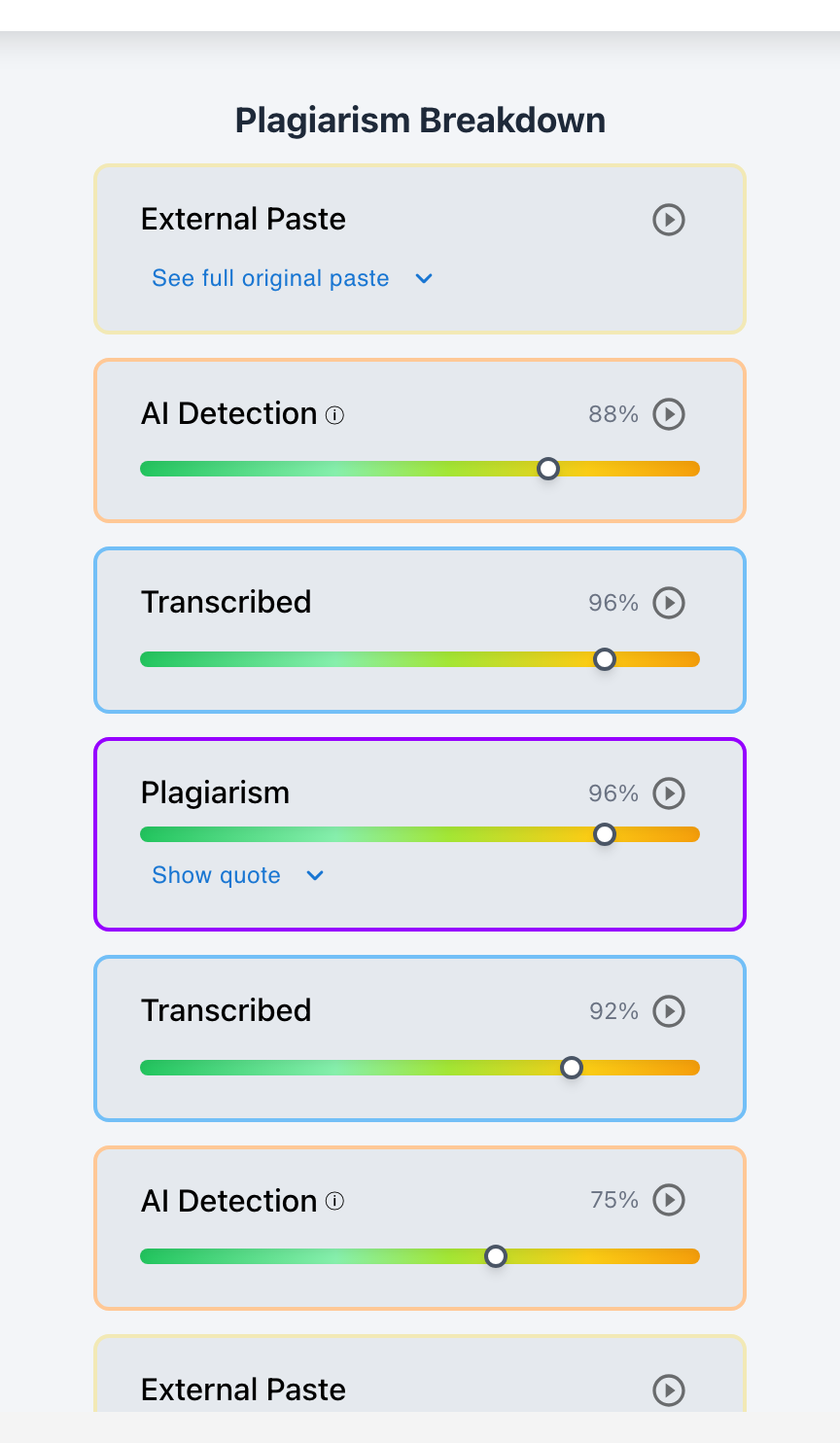
Checkmark Plagiarism's essay writing playback allows teachers to examine drafting, large additions, revisions, and editing activity over time. Instead of saying "This paper looks AI-generated," a teacher can say: "I noticed that these paragraphs appeared at the same time. Can you tell me how you created that section?" Read more in how Checkmark writing process analysis works.
6. Remember That a Large Paste Does Not Prove AI Use
A large paste indicates inserted text, but the source could be an earlier draft, research notes, quotations, or external word processors. Always ask: "Where did this text come from?" and allow the student to provide earlier versions.
7. Verify Sources and Citations
Verify whether cited articles, authors, and quotes exist. If a citation cannot be located, ask neutrally: "Can you show me where you found this source?" This addresses evidence directly without accusing the student of fabricating sources with AI.
8. Ask the Student to Explain the Assignment
Ask neutral comprehension questions:
- What is your central thesis?
- Why did you choose this specific example?
- What does this paragraph mean in your own words?
- What does this specialized term mean here?
- Which section was most difficult to write?
Look at the overall pattern of familiarity rather than expecting flawless recall from a nervous student.
9. Ask the Student to Walk Through Their Writing Process
Ask: "Can you walk me through how you completed this assignment from beginning to end?" Inquire about where they began, how they drafted, what tools were used, and what revisions took place.
10. Ask About AI Directly, but Neutrally
When appropriate, ask directly: "Did you use ChatGPT or another AI tool while completing this assignment?" If they answer yes, follow up with: "How did you use it?"
11. Do Not Treat Any AI Use as Automatic Misconduct
Brainstorming, outlining, grammar checking, sentence rewriting, and full essay generation are fundamentally different uses. Academic misconduct depends on whether the student's specific actions violated course policy.
12. Give the Student a Chance to Provide Evidence
Allow the student to share earlier drafts, research notes, version histories, or outlines. A fair review must be capable of concluding that an initial suspicion was unjustified.
13. Look for Consistency Across the Evidence
Evidence Supports the Student
- Writing matches past student style
- History shows gradual multi-day drafting
- Student produces research notes & drafts
- Citations are fully verified
- Student fluently explains all arguments
Multiple Concerns Remain
- Style is dramatically different from past work
- Writing playback shows instant wholesale paste
- Several citations do not exist in databases
- Student cannot explain key concepts
- Explanation conflicts with document history
14. Keep the Conversation Focused on the Assignment
Avoid personal or accusatory statements such as "This is too good for you." Focus strictly on observable evidence: "This writing style is different from your earlier work. Can you tell me about your revision process?"
15. Explain Why You Are Asking
Reassure the student by saying: "I'm trying to understand how the assignment was created before making any decisions." This establishes transparency and encourages honest dialogue.
16. Compare What Happened With the Assignment Policy
Determine: 1) What AI assistance occurred? 2) Was it allowed? 3) Was disclosure required? 4) Did the student comply? Academic integrity is tied to published expectations.
17. Document the Review
If an academic integrity review is necessary, document the assignment prompt, detection results, writing playback logs, verified sources, and conversation notes.
What If the Student Denies Using AI?
Evaluate the denial against the full body of evidence: previous work, citation validity, writing playback progression, and conceptual comprehension.
What If There Is No Writing History?
When students submit PDFs or Word files, Checkmark Plagiarism's static AI detection provides an objective analysis of the text to accompany citation verification and student conversations.
AI Detection Is Not the Same as Plagiarism Detection
Plagiarism detection matches text against existing sources, whereas AI detection identifies statistical language patterns without direct external source matches. Read our full comparison in AI detection vs. plagiarism detection.
A Practical Verification Process
A Practical 13-Step Verification Sequence:
- 1. Identify the specific observable concern (not just "sounds like AI").
- 2. Read the assignment independently before fixating on detector scores.
- 3. Compare it with previous student work baselines.
- 4. Review AI detection as one signal among many.
- 5. Examine writing playback when available to check drafting progression.
- 6. Verify sources, author names, and direct quotes.
- 7. Ask the student to explain the thesis and key concepts.
- 8. Ask the student to describe the writing process step-by-step.
- 9. Ask neutrally about AI and other digital tools used.
- 10. Allow the student to provide drafts, notes, or version histories.
- 11. Look for consistency across all collected evidence.
- 12. Compare any AI use with the specific assignment policy.
- 13. Document the review and follow established school procedures.
How Checkmark Plagiarism Supports Verification Without Immediate Accusation
Checkmark Plagiarism combines **AI detection, essay writing playback, static AI detection, plagiarism detection, autograding, and Canvas/Google Classroom integrations** so educators have the tools required to conduct fair, process-oriented verification.
Frequently Asked Questions
How do I ask a student about AI without accusing them?
Ask neutral questions about their writing process: "Can you walk me through how you completed this assignment?" Then ask about specific passages, sources, and drafting tools.
Should I tell a student that an AI detector flagged their work?
You can discuss the result, but present it as one reason for reviewing the assignment rather than proof of cheating.
Can I ask directly whether a student used ChatGPT?
Yes. A neutral question such as "Did you use ChatGPT or another AI tool while completing this assignment?" is appropriate, followed by asking how the tool was used.
What if a student says they only used AI for brainstorming?
Compare that use with the assignment policy. If brainstorming was permitted, no violation occurred.
What if writing history shows a large paste?
Ask the student where the text came from. A large addition may come from an earlier draft or research notes.
What if the student says they wrote the essay in another document?
Give them an opportunity to provide the earlier draft or version history, which may resolve the concern.
Can a student be falsely flagged by an AI detector?
Yes. False positives are possible, which is why detection results should be considered alongside other evidence.
What if the student cannot explain their own essay?
Difficulty explaining major arguments or terminology should be evaluated alongside other evidence rather than treated as automatic proof.
How does Checkmark Plagiarism help verify AI use?
Checkmark Plagiarism combines AI detection, essay writing playback, static AI detection, plagiarism detection, autograding, and Canvas and Google Classroom integrations.
Verify the Process Before Reaching the Conclusion
Teachers do not have to choose between ignoring suspicious work and making premature accusations. By gathering evidence, reviewing writing playback, verifying sources, and asking neutral process questions, educators can maintain high academic standards fairly.
Checkmark Plagiarism helps support this verification-first approach with AI detection, essay writing playback, static AI detection, plagiarism detection, autograding, and integrations with Canvas and Google Classroom.
See how Checkmark supports evidence-based verification with complete essay writing playback. View a sample report or request a demonstration.