
A student who usually struggles with grammar, sentence structure, or analysis suddenly submits one of the strongest essays in the class. Did the student genuinely improve, or did they use ChatGPT?
There is no single feature of an essay that reliably answers that question: improvement and AI-assisted writing can look very similar in the final document. The better approach is to examine the evidence around the assignment: compare baselines, review document drafting history, ask what the student did differently, verify sources, and use AI detection as one signal.
The key question is not: "Is this paper better than the student usually writes?" It is: "Can the student's writing process, understanding, and explanation reasonably account for the improvement?"
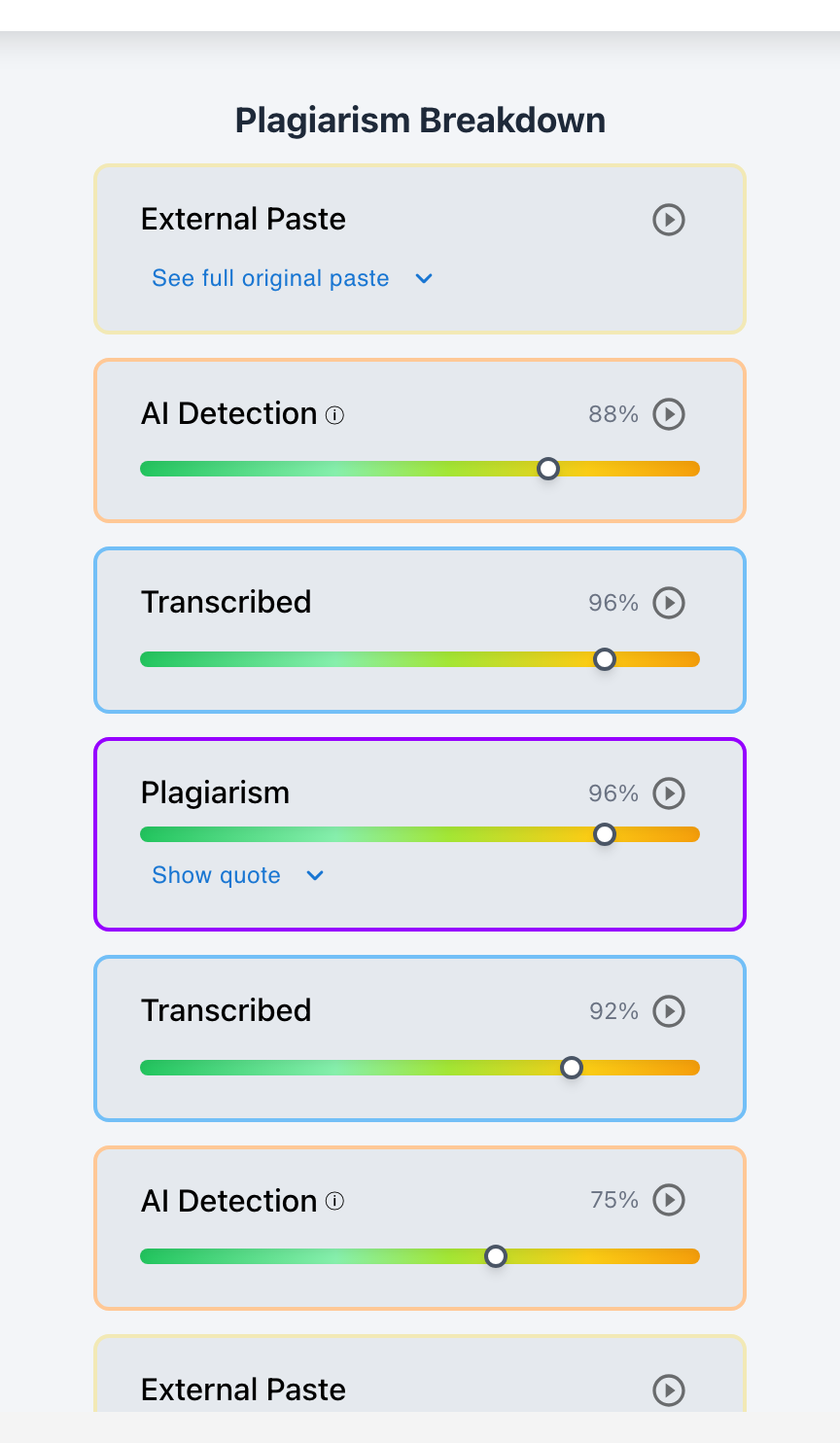
Checkmark Plagiarism helps teachers examine that broader picture through AI detection, essay writing playback, static AI detection, plagiarism detection, autograding, and integrations with Canvas and Google Classroom.
Students Are Supposed to Improve
Improvement is the primary objective of education. Students improve when they apply instructor feedback, spend more time revising, work with a writing center tutor, use permitted grammar tools, or experience an intellectual breakthrough. Better writing should prompt curiosity and dialogue rather than an automatic presumption of misconduct.
Look for Development, Not Just Better Quality
Student A (Genuine Development)
- Outline and rough paragraphs in playback
- Multiple revision cycles across days
- Vocabulary reflects taught classroom units
- Fluently explains arguments and citations orally
- Points to specific tutor/teacher feedback applied
Student B (Unexplained Sudden Jump)
- Empty document receives 1,200 words instantly
- Zero subsequent edits or revisions
- Writing voice completely disconnected from baseline
- Multiple citations do not exist in databases
- Cannot explain key arguments or vocabulary orally
What Does Genuine Improvement Often Look Like?
Genuine improvement typically maintains continuity with a student's core voice: they use stronger vocabulary while retaining familiar argument structures, reduce recurring grammar mistakes after direct feedback, and can fluently discuss the evolution of their ideas. Read more in what should I look for when a student's writing suddenly improves?
Ask What the Student Did Differently
Ask neutrally: "This paper is much stronger than your previous work. What did you do differently during your writing process?" A student who improved through effort can describe concrete steps: visiting the writing center, rewriting the thesis, outlining paragraphs, or applying rubric guidelines.
How Essay Writing Playback Clarifies Improvement
Checkmark Plagiarism's essay writing playback allows teachers to examine how an assignment developed: multi-session drafting, revisions, and editing activity over time. Seeing a student work through rough paragraphs, rephrase sentences, and rearrange arguments provides direct evidence of genuine growth. Read more in how Checkmark writing process analysis works.
Improvement Usually Includes Conceptual Understanding
A student whose writing has matured can explain the thesis, define advanced terminology, and discuss source evidence in plain, everyday language. Spoken answers do not need to sound formal—they simply need to demonstrate authentic familiarity with the ideas.
Verify Cited Sources
Check whether cited academic articles, book titles, author names, and direct quotes exist in academic indices. Hallucinated or unverifiable citations provide concrete, objective evidence of generative AI involvement.
What If the Student Used Grammarly or AI Tools?
Ask what the tool did: basic grammar/spelling correction vs. generative sentence rephrasing and paragraph creation. Read more in can AI detectors detect Grammarly or AI writing assistants?
A Practical Process for Distinguishing AI from Improvement
A Practical 14-Step Process for Distinguishing AI from Genuine Improvement:
- 1. Start with the presumption that writing improvement can be genuine.
- 2. Identify exactly what specific stylistic and structural elements changed.
- 3. Compare multiple previous writing samples across similar assignment types.
- 4. Look for continuity in student voice, reasoning style, and argument themes.
- 5. Review document drafting history and essay writing playback.
- 6. Ask the student neutrally: "What did you do differently on this paper?"
- 7. Ask the student to explain the thesis, key paragraphs, and terminology orally.
- 8. Verify cited sources, author names, and direct quotes in academic databases.
- 9. Review AI detection reports as one corroborating signal among several.
- 10. Check plagiarism detection results for traditional web/database source matches.
- 11. Inquire about writing tools, grammar assistants, and writing center visits.
- 12. Ask specifically and neutrally how AI was used if it was involved.
- 13. Compare the student's explanation with observable document history and drafts.
- 14. Determine whether any technological assistance conformed to course policy.
How Checkmark Plagiarism Helps Teachers Evaluate Growth
Checkmark Plagiarism combines **essay writing playback, AI detection, static AI detection, plagiarism detection, autograding, and Canvas/Google Classroom integrations** to give teachers complete visibility into student drafting and writing progress.
Frequently Asked Questions
How can I tell if a student's writing genuinely improved?
Look for evidence of development: drafting, revision, oral conceptual understanding, valid sources, application of feedback, and continuity with earlier writing.
Is sudden improvement a sign of ChatGPT use?
Not by itself. Students can improve rapidly due to tutoring, writing center visits, increased effort, or clearer understanding of the prompt.
What changes may justify a closer look?
Simultaneous dramatic changes in vocabulary, grammar, tone, analysis, and citations, particularly when combined with instant text additions in document history.
Can a student explain AI-generated writing well?
Oral comprehension is strong evidence, but should be synthesized with writing playback, source verification, and previous baselines.
Does gradual drafting prove the student did not use AI?
No. AI could still have been used during brainstorming, feedback, outlining, or sentence-level assistance.
Does a large paste prove the student used AI?
No. The student may have drafted the work in Microsoft Word, another Google Doc, or a notes application.
What should I ask when a student's writing suddenly improves?
Ask: "This paper is much stronger than your previous work. What did you do differently?" Then discuss drafting, revision, sources, and writing tools.
What if the student says they used Grammarly?
Ask what the tool did: basic grammar correction vs. generative rewriting represent different levels of assistance under course policies.
Should an AI detector decide whether the improvement is genuine?
No. AI detection should be treated as one signal alongside previous work, writing history, student understanding, sources, and drafts.
How does Checkmark Plagiarism help distinguish improvement from AI writing?
Checkmark Plagiarism combines essay writing playback, AI detection, static AI detection, plagiarism detection, autograding, and Canvas and Google Classroom integrations.
Better Writing Should Prompt Curiosity, Not Automatic Suspicion
Distinguishing authentic growth from unauthorized AI generation requires evaluating the process behind the paper. By analyzing drafting history, verifying conceptual mastery, and engaging students in dialogue, educators can celebrate genuine growth while safeguarding academic integrity.
Checkmark Plagiarism supports this broader approach with essay writing playback, AI detection, static AI detection, plagiarism detection, autograding, and integrations with Canvas and Google Classroom.
See how Checkmark pairs essay writing playback with multi-signal detection to celebrate genuine writing growth while protecting academic standards. View a sample report or request a demonstration.