
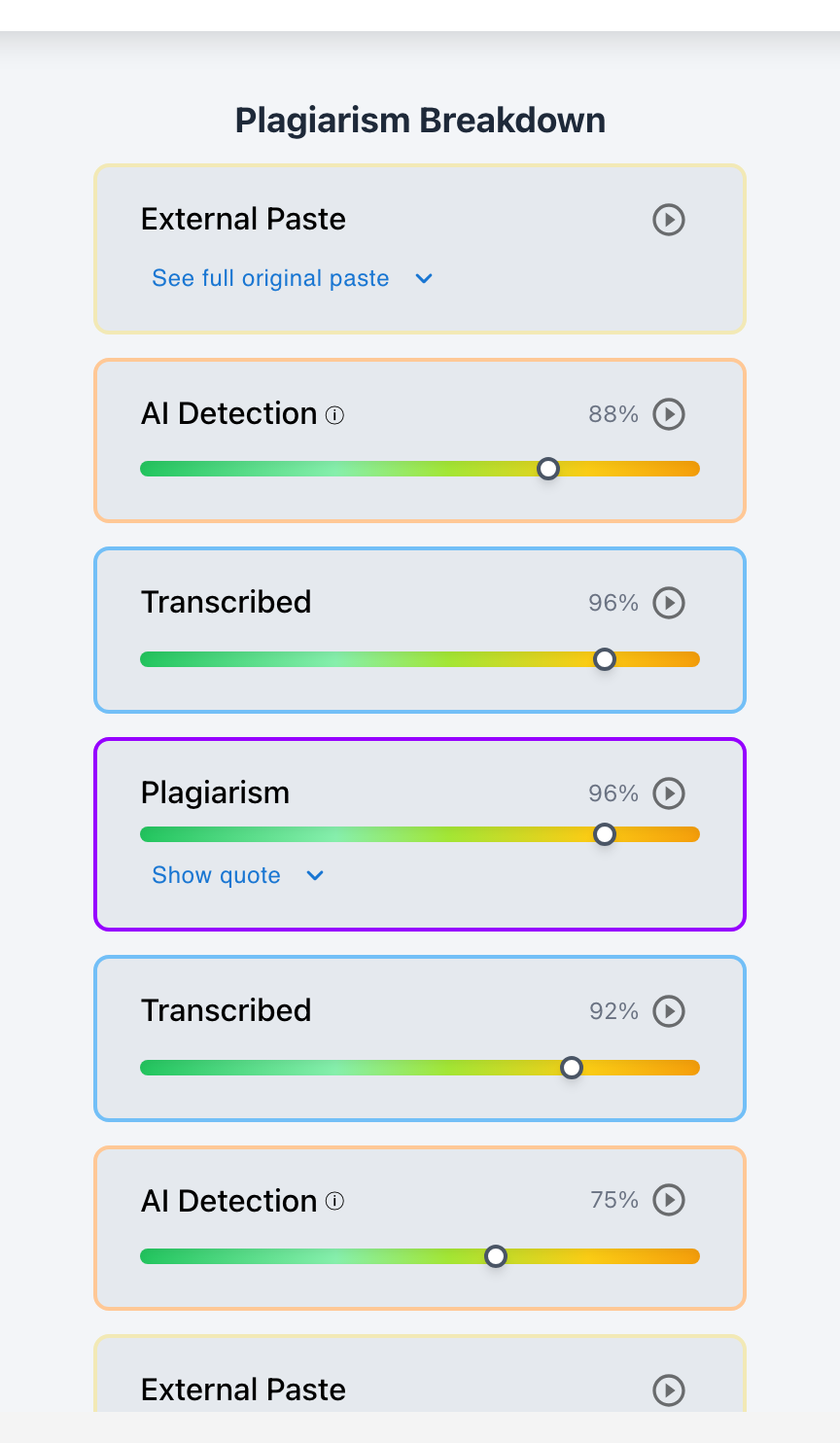
To tell if AI edited an essay versus wrote it from scratch, teachers should analyze two forensic layers: the sentence-level revision diff (AI editing shows an underlying human draft where individual words or commas were corrected, while AI generation shows zero prior human text) and writing playback telemetry in Checkmark (AI editing exhibits multi-hour human drafting followed by targeted replacement bursts, whereas AI writing appears as an instant wholesale paste).
With tools like Grammarly, QuillBot, and ChatGPT widely used by students for proofreading, distinguishing between "AI as a digital copyeditor" and "AI as the author" is one of the most critical challenges in contemporary education. A student who spent four hours writing an original draft and ran it through ChatGPT to fix punctuation has preserved their intellectual authorship. Conversely, a student who prompted AI to generate the entire paper from a single bullet point has surrendered authorship completely. Checkmark Plagiarism's Writing Playback and Diff Engine visually separates human drafting from AI revision overlays.
Below is a comprehensive guide on distinguishing AI editing from AI authorship.
Checkmark Plagiarism analyzes AI editing versus generation by pairing AI detection with essay writing playback, plagiarism detection, autograding, and integrations with Canvas and Google Classroom.
The 4 Forensic Distinctions Between AI Editing and AI Writing
1. Underlying Human Drafting Telemetry
AI Edited: Playback shows 3+ hours of organic keyboard typing, false starts, and backspaces prior to any AI editing polish.
AI Written: Document begins with an instant 0.05s paste or flat transcription.
2. Granularity of Text Changes (Diffs)
AI Edited: Diff history shows surgical word substitutions (e.g., fixing tenses or typos).
AI Written: Entire paragraphs and arguments appear pre-formed without prior human foundation.
3. Conceptual Ownership & Oral Defense
AI Edited: Student explains the core thesis, examples, and logic effortlessly in person.
AI Written: Student cannot explain why specific arguments or synthetic phrases were used.
4. Stylometric Signature Retention
AI Edited: The paper retains the student's personal voice, topic examples, and core perspective.
AI Written: Monotonous AI cliches, triadic lists, and detached academic hedging dominate.
The Spectrum of AI Assistance in Student Writing
Understanding the four distinct levels of AI involvement:
- Level 1: Rule-Based Grammar Check (Acceptable): Standard spellcheck and basic punctuation correction (e.g., standard Google Docs suggestions).
- Level 2: AI-Assisted Style Polish (Acceptable with Disclosure): Using tools to rephrase awkward human sentences while preserving the student's original ideas.
- Level 3: AI Co-Writing / Heavy Rewriting (Restricted): Prompting AI to generate counterarguments or expand a 200-word outline into 1,000 words.
- Level 4: Full AI Generation (Academic Misconduct): AI produces the entire essay from scratch with zero original student drafting.
Read more in how Checkmark writing process analysis works.
Comparison: AI-Edited Student Draft vs. AI-Generated Submission
AI-Edited Student Draft (Authentic Core)
- Playback shows 3.5 hours of initial human drafting.
- AI editing applies to grammar and word polish only.
- Ideas, evidence, and unique perspective belong to student.
- Student speaks fluently about all arguments during conference.
AI-Generated Submission (Surrendered Authorship)
- Playback shows <10 minutes total document time.
- Entire paragraphs generated from AI prompts.
- Formulaic triadic syntax and hallucinated references.
- Student has no personal connection or recall of text.
A 5-Step Educator Protocol for AI Editing Audits
AI Editing Audit Checklist:
- 1. Open the student's submission in Checkmark Plagiarism inside Canvas SpeedGrader.
- 2. Review the Writing Playback timeline: look for an extensive human drafting phase (2+ hours).
- 3. Inspect the Revision Diff tab: verify whether edits were surgical word replacements or wholesale paragraph pastes.
- 4. Check the AI Probability Breakdown: note if high AI scores are restricted to stylistic polish rather than ideas.
- 5. Hold a 2-minute oral check-in: confirm the student's conceptual mastery and applaud their original drafting effort.
How Checkmark Plagiarism Powers AI Editing Forensics
Checkmark Plagiarism combines **AI detection, essay writing playback, static AI detection, plagiarism detection, autograding, and Canvas/Google Classroom integrations** to visually separate original human drafts from AI editing layers directly in SpeedGrader.
Frequently Asked Questions
Is using Grammarly considered AI generation?
Basic Grammarly spelling and comma suggestions are considered automated editing, not AI generation; however, Grammarly's full-paragraph generative rewriting features fall into AI co-writing.
How does writing playback prove an essay was edited by AI rather than generated?
Playback displays the hours of human typing, deletions, and structural planning that existed *before* the AI editing polish was applied.
What if a student writes a rough draft and asks ChatGPT to rewrite the whole thing?
If ChatGPT rewrites all sentences into synthetic syntax, the student has surrendered stylistic authorship; Playback will show a large replacement paste over the rough draft.
Can AI detection scores distinguish between editing and writing?
Static AI detectors often flag heavily edited text as 100% AI; Checkmark resolves this false alarm by pairing AI scores with keystroke drafting playback.
How does Checkmark Plagiarism integrate with Canvas LMS?
Checkmark provides certified LTI 1.3 integration, SpeedGrader sidebar embeds, two-way grade passback, and single sign-on (SSO).
What should a course policy say about AI editing?
Policies should clearly distinguish between permissible proofreading (spelling/grammar checks) and impermissible content generation (AI drafting paragraphs).
How can students disclose AI editing responsibly?
Students can include an AI Acknowledgement Statement specifying: "I drafted this essay independently and used ChatGPT only to check grammar and comma placement in Section 2."
What if an English Language Learner uses AI to improve fluency?
Playback protects ELL students by proving that their ideas, structure, and arguments were authored through hours of genuine human typing.
How does Autograder evaluate AI-edited essays?
Checkmark Autograder evaluates the depth of human argumentation and original synthesis, rewarding authentic critical thinking over surface-level polish.
Why is writing process telemetry essential for AI editing cases?
Because process telemetry provides the only empirical proof that an original human draft existed prior to AI proofreading.
Evaluating the Human Mind Behind the Polish
Technology should empower human expression, not replace it. By using Checkmark Plagiarism to analyze drafting telemetry alongside AI probability, educators can embrace modern editing tools while ensuring that core intellectual authorship remains firmly in the hands of students.
Checkmark Plagiarism supports this comprehensive approach with AI detection, essay writing playback, static AI detection, plagiarism detection, autograding, and integrations with Canvas and Google Classroom.
See how Checkmark pairs writing playback with revision diffs to distinguish AI editing from AI writing. View a sample report or request a demonstration.