
To tell if a student actually read the sources they cited, teachers should examine four core forensic and pedagogical indicators: whether cited quotes exist on the actual page numbers referenced, whether the student synthesizes the broader context of the source rather than just quoting an isolated search snippet, whether cited literature exhibits AI hallucination artifacts (such as fake DOIs or invented author pairings), and whether the student can summarize the source's central thesis during a 2-minute oral check-in.
In the age of generative AI and instant Google searches, "ornamental citation" has become a pervasive issue in student research papers. Students often ask ChatGPT to generate an essay with citations, or skim a Google search result for a single quote without ever reading the underlying journal article or book. When grading research essays, verifying true intellectual engagement with sources is essential for distinguishing authentic scholarship from surface-level citation padding. Checkmark Plagiarism's Citation Verification Engine automates source-matching and hallucination detection to help teachers verify source authenticity in seconds.
Below is a comprehensive guide on verifying whether students genuinely read and understood their cited sources.
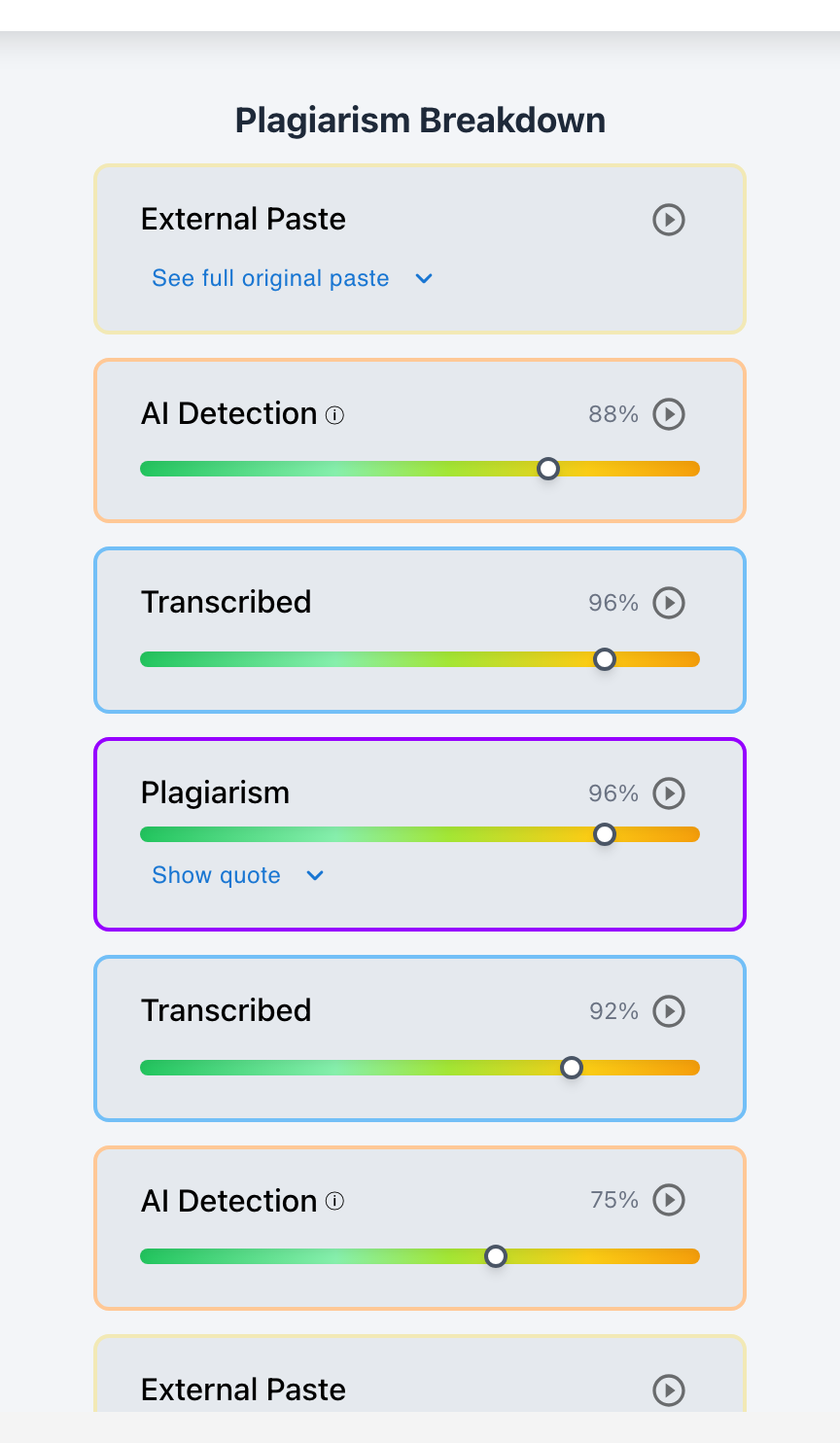
Checkmark Plagiarism verifies source authenticity by pairing plagiarism detection with AI detection, essay writing playback, autograding, and integrations with Canvas and Google Classroom.
The 4 Diagnostic Signs That a Student Did Not Read Their Sources
1. "Hit-and-Run" Quote Dropping
Quotes appear as standalone sentences without analytical framing, synthesis, or explanation of how the quote supports the student's central thesis argument.
2. AI Citation Hallucinations
The bibliography lists plausible-sounding academic papers with real author names, but the cited titles, volume numbers, or DOIs do not exist in real academic databases.
3. Contextual Misrepresentation
The student cites a quote that actually contradicts the original author's main conclusion—revealing the quote was pulled from a decontextualized search snippet.
4. Total Failure in Oral Summary
When asked in person to describe the cited study's methodology or main findings, the student is unable to provide any basic conceptual details.
How Authentic Source Integration Looks in Document History
Analyzing how students interact with sources during active drafting:
- Legitimate Source Pastes: In Checkmark Playback, an authentic researcher pastes a 30- to 60-word quote, puts quotation marks around it, and immediately types 2 to 3 sentences of original analytical synthesis around it.
- Ornamental Citation Influx: AI-generated papers insert pre-formatted citations within continuous 1,500-word blocks with zero evidence of source consultation pauses.
- Research Pauses: Authentic student timelines exhibit 15- to 45-minute thinking pauses where the student was reading the source article before resuming typing.
Read more in how Checkmark writing process analysis works.
Comparison: Genuine Source Engagement vs. Ornamental AI Citation
Genuine Source Engagement (Authentic Research)
- Quotes are analyzed and connected to thesis.
- Citations match real journal articles and pages.
- Playback shows research reading pauses and edits.
- Student can explain the author's argument orally.
Ornamental AI Citation (Superficial / Fake)
- Quotes dropped with zero contextual analysis.
- Citations contain fake DOIs or non-existent titles.
- Playback shows instant wholesale text insertion.
- Student cannot describe the cited author or study.
A 5-Step Educator Protocol for Source Verification
Source Verification Protocol Checklist:
- 1. Open the student's submission in Checkmark Plagiarism inside Canvas SpeedGrader.
- 2. Review the Automated Source Verification Card: check if DOIs, ISBNs, and titles resolve to real databases.
- 3. Inspect the Writing Playback timeline: verify whether quote insertions coincide with natural research pauses.
- 4. Spot-check 1 primary source quote: verify that the quote supports the student's claim in context.
- 5. Hold a 2-minute oral check-in: "What was the most surprising conclusion in the [Author Name] study you cited?"
How Checkmark Plagiarism Powers Source Forensics
Checkmark Plagiarism combines **AI detection, essay writing playback, static AI detection, plagiarism detection, autograding, and Canvas/Google Classroom integrations** to automatically verify cited academic sources, detect fake DOIs, and evaluate quote integration depth.
Frequently Asked Questions
How can a teacher quickly check if a student read their sources?
Ask a single open-ended question during class: "What was the main argument of the second article in your bibliography?" Authentic readers answer instantly.
What is an AI citation hallucination?
It occurs when ChatGPT invents a convincing-looking academic citation with real author names but a fabricated title, date, or journal volume.
Why do students include sources they never read?
Students often fulfill rubric citation minimums by copying references from search engine abstracts, Wikipedia bibliographies, or AI generators.
How does Checkmark verify whether a source actually exists?
Checkmark cross-references bibliography entries against Crossref, PubMed, Google Scholar, and open web repositories to verify DOIs and metadata.
What is 'hit-and-run' quoting?
It is the practice of dropping a direct quote into a paragraph without introducing the author, explaining the context, or linking it to the thesis.
How does Checkmark Plagiarism integrate with Canvas LMS?
Checkmark provides certified LTI 1.3 integration, SpeedGrader sidebar embeds, two-way grade passback, and single sign-on (SSO).
What does authentic quote integration look like in Playback?
Playback shows a short paste event for the quote text, followed by 10 to 20 minutes of active typing where the student analyzes the quotation.
Can students fake oral source comprehension?
No. Students who did not read the underlying article cannot spontaneously summarize its core arguments, methodology, or nuances.
What should a teacher do if a fake AI citation is discovered?
Use the Checkmark citation report to show the student that the DOI is non-existent, framing the conference around academic honesty and research verification.
Why is source verification essential for academic integrity?
Because authentic research requires engaging with real human knowledge, and verifying sources ensures that grades reflect genuine scholarly labor.
Grounding Research in Genuine Scholarly Engagement
True research is a conversation with existing scholarship. By verifying source existence, quote integration depth, and drafting telemetry with Checkmark Plagiarism, educators ensure that student research papers reflect authentic inquiry, critical reading, and genuine learning.
Checkmark Plagiarism supports this comprehensive approach with AI detection, essay writing playback, static AI detection, plagiarism detection, autograding, and integrations with Canvas and Google Classroom.
See how Checkmark pairs automated citation verification with multi-signal detection to verify student research sources. View a sample report or request a demonstration.