
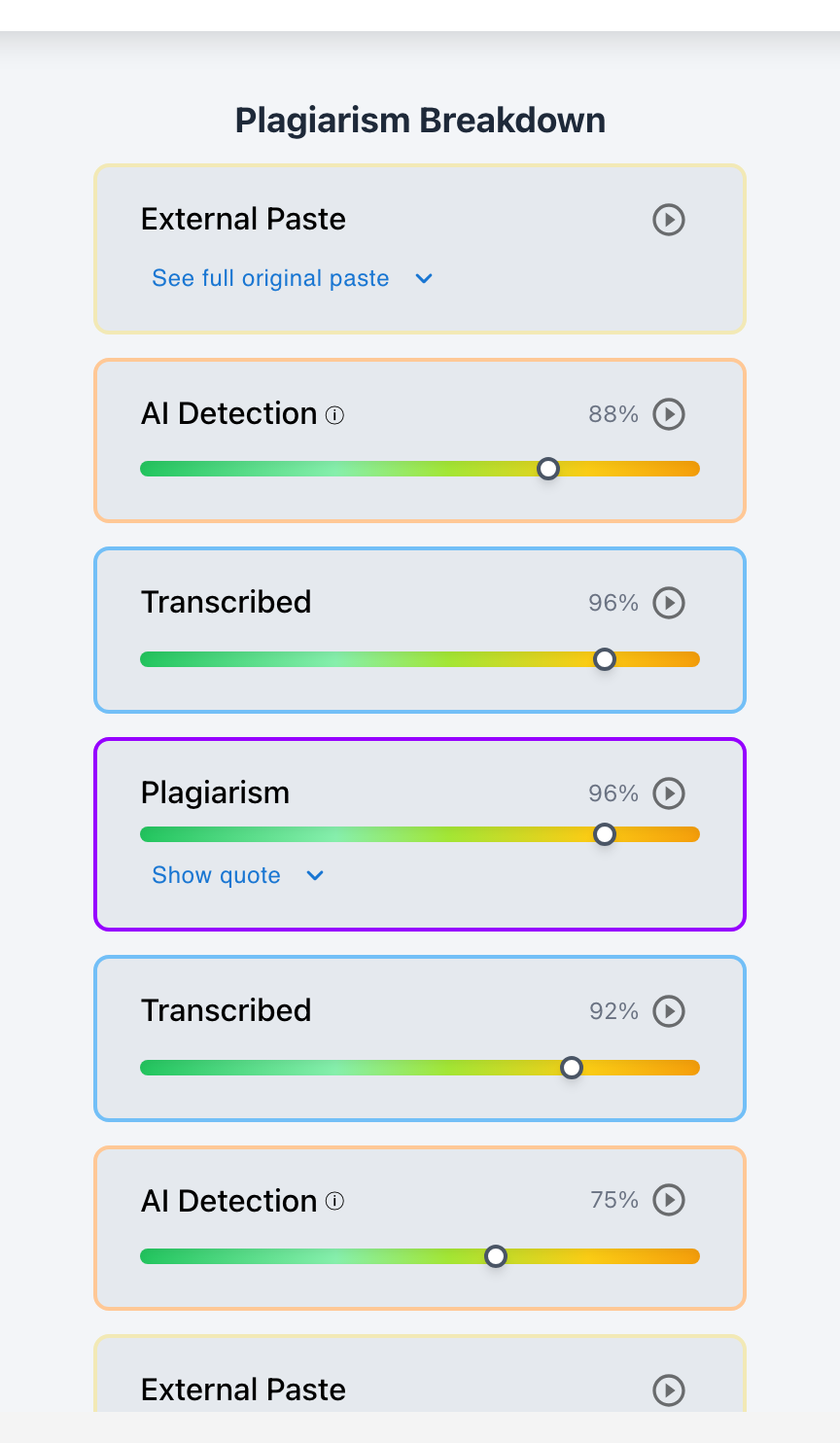
Finding the exact source a student copied from requires combining automated web source matching, academic database cross-referencing, and targeted exact-phrase search operators.
When an essay contains sophisticated syntax, unusual jargon, or sudden shifts in tone, teachers often suspect plagiarism but lack the specific URL or publication to prove it. A vague accusation of "this sounds copied" is vulnerable to dispute. However, by leveraging automated Web Source Matching and Source Evidence Cards, educators can uncover the exact website, journal article, online study guide, or peer paper with side-by-side textual proof.
Below is a comprehensive guide on how educators can trace copied passages back to their original online roots with speed and precision.
Checkmark Plagiarism powers web source matching by pairing plagiarism detection with essay writing playback, AI detection, autograding, and integrations with Canvas and Google Classroom.
The 4 Methods to Trace an Original Copied Source
1. Automated Web Source Matching
Checkmark scans billions of live web pages, archived sites, blogs, and news articles, highlighting identical passages with clickable destination URLs.
2. Academic & Journal Repository Indexing
Cross-references paywalled journals, JSTOR publications, ProQuest dissertations, and Google Scholar to locate scholarly sources.
3. Institutional Student Paper Repositories
Matches text against millions of previously submitted student papers across high schools and universities to catch peer-to-peer sharing.
4. Manual Exact-Phrase Search Operators
Taking a distinct 8-to-12 word phrase from the essay and querying Google enclosed in quotation marks: "exact matching phrase here".
What Checkmark Source Evidence Cards Reveal
In Checkmark Plagiarism, every flagged match is presented as an interactive Source Evidence Card:
- Side-by-Side Comparison: Shows the student's submitted text on the left and the original crawled web text on the right with matched words highlighted.
- Source Metadata: Displays the source domain, original publish date, author name, and direct clickable URL link.
- Similarity Match Percentage: Calculates the exact percentage of overlapping vocabulary and sentence structure.
Read more in how Checkmark writing process analysis works.
Comparison: Automated Source Matching vs. Manual Google Searching
Automated Checkmark Source Matching
- Scans entire essay against billions of sources in 5 seconds.
- Searches paywalled academic journals and peer repositories.
- Generates side-by-side highlighted comparison cards.
- Tracks fuzzy/paraphrased matches automatically.
Manual Search Engine Queries (Google)
- Requires manually copying 10+ separate sentences into search.
- Cannot search restricted student paper archives or journals.
- Easily defeated if the student swapped 2–3 words.
- Time-consuming for teachers with 100+ essays.
A 5-Step Educator Source Tracing Protocol
Educator Source Tracing Checklist:
- 1. Open the Checkmark Plagiarism report in Canvas SpeedGrader or Google Classroom.
- 2. Review the list of Source Evidence Cards sorted by match percentage.
- 3. Click destination URLs to inspect the original web context and publication dates.
- 4. Verify whether the matching text was enclosed in quotation marks or cited properly.
- 5. Present the side-by-side evidence card to the student during a constructive conference.
How Checkmark Plagiarism Powers Web Source Matching
Checkmark Plagiarism combines **AI detection, essay writing playback, static AI detection, plagiarism detection, autograding, and Canvas/Google Classroom integrations** to pinpoint copied web sources instantly, providing educators with unassailable physical proof.
Frequently Asked Questions
How do plagiarism checkers find the website a student copied from?
They crawl and index billions of web pages, comparing sequences of words (n-grams) to identify exact and near-exact matches with direct URL links.
Can plagiarism checkers find sources behind paywalls?
Yes. Checkmark indexes subscription academic journals, library databases, and scholarly repositories, detecting matches from paywalled sources.
What if a student copied text from Wikipedia and changed a few words?
Checkmark's fuzzy matching and semantic algorithms identify the underlying sentence structure and link directly to the matching Wikipedia article.
What is a Source Evidence Card?
An interactive report element that displays the student's text side-by-side with the crawled source, highlighting matching words and providing the URL.
Can teachers find sources if the text came from a classmate?
Yes. Checkmark's institutional repository cross-checks submissions across all course sections and previous semesters to catch student-to-student copying.
What if Google doesn't return any search results for a suspicious sentence?
The text may have been generated by ChatGPT (which produces novel text) or copied from a private student repository not indexed on Google.
How does writing playback support source matching?
Playback logs capture the exact timestamp when the copied text was pasted into the document, proving it was inserted externally.
How does Checkmark Plagiarism integrate with Canvas LMS?
Checkmark Plagiarism displays visual writing playback timelines, source evidence cards, and dual AI/plagiarism reports directly inside Canvas SpeedGrader.
Does source matching protect honest students?
Yes. It confirms when matching text is a properly formatted direct quotation or common phrase, clearing honest students of false plagiarism claims.
Why is showing the source better than giving a percentage score?
A percentage score is abstract and debatable; showing the exact matching URL and original text provides undeniable proof of plagiarism.
Evidence-Based Truth Protects Scholarship
Academic integrity investigations require verifiable facts. By connecting automated web source matching with interactive evidence cards and essay playback, Checkmark Plagiarism gives educators the clarity and confidence needed to uphold academic rigor.
Checkmark Plagiarism supports this comprehensive approach with AI detection, essay writing playback, static AI detection, plagiarism detection, autograding, and integrations with Canvas and Google Classroom.
See how Checkmark pairs essay writing playback with multi-signal detection to trace original web sources inside your LMS. View a sample report or request a demonstration.