
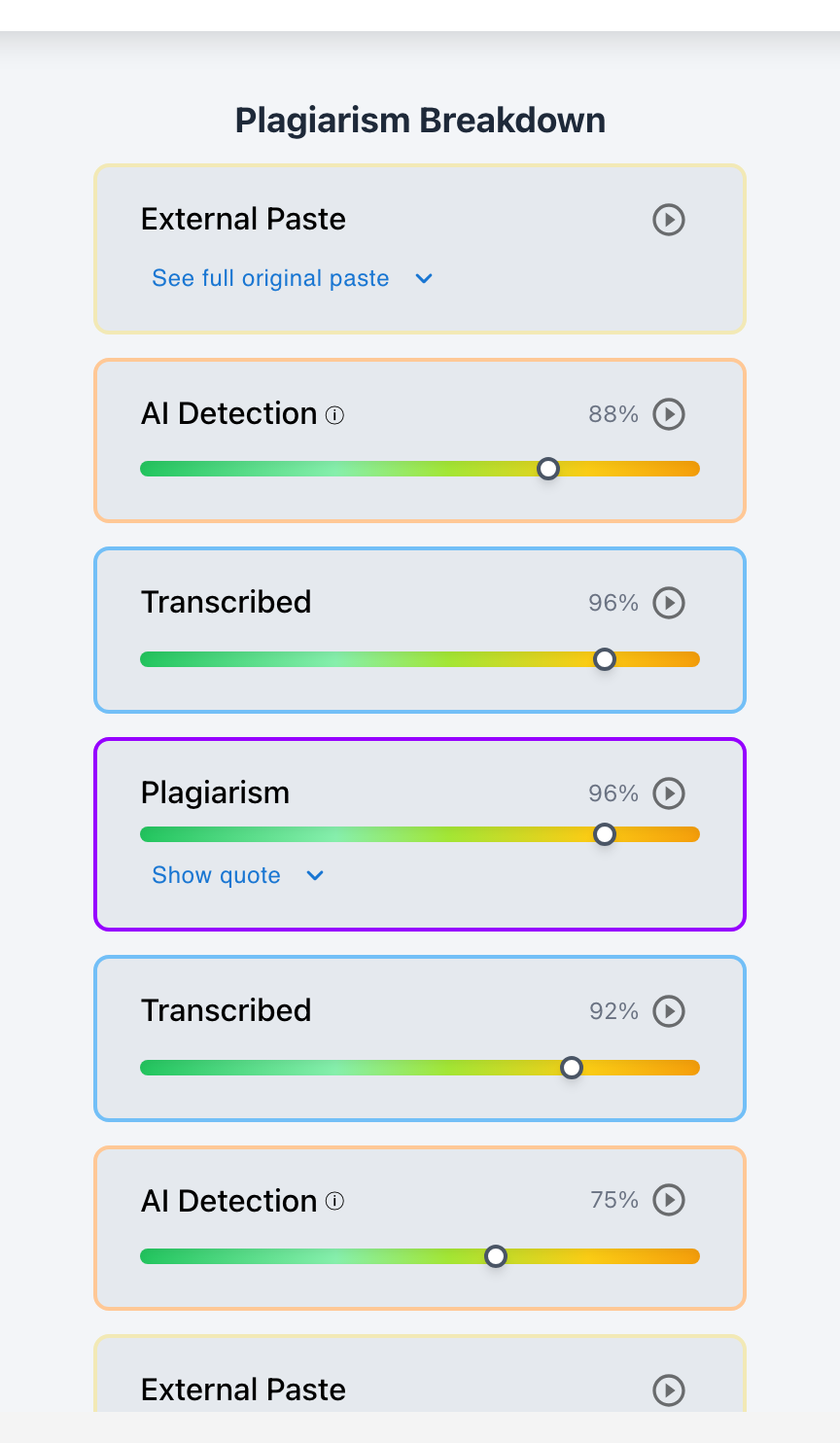
To compare a suspicious essay with a student's earlier assignments effectively, teachers should use a structured 4-point stylometric and telemetry audit: evaluate vocabulary tier shifts, compare average sentence length and syntactic subordination, cross-examine mechanical error patterns (punctuation and spelling habits), and compare writing playback telemetry (typing speed, backspace rates, and active drafting hours).
When an essay feels uncharacteristically advanced or sudden in its rhetorical sophistication, an educator's first instinct is to pull previous submissions from earlier in the semester. However, subjective "gut feeling" comparisons often fail under scrutiny. A scientific, evidence-first comparison relies on empirical stylometric markers and writing process forensics to prove whether an essay represents natural student growth or an external AI/ghostwriting anomaly. Checkmark Plagiarism automates longitudinal baseline comparisons to provide teachers with objective clarity.
Below is a comprehensive guide on comparing suspicious essays against prior student work.
Checkmark Plagiarism powers authorship verification by pairing AI detection with essay writing playback, plagiarism detection, autograding, and integrations with Canvas and Google Classroom.
The 4 Diagnostic Dimensions of Stylometric Comparison
1. Lexical Tier & Vocabulary Density
Compare the ratio of Tier 1 (conversational), Tier 2 (academic), and Tier 3 (specialized) words. A sudden jump from 8% to 45% Tier 3 vocabulary indicates external text.
2. Syntactic Complexity & Clause Structures
Examine mean sentence length and clause embedding. If a student consistently wrote 14-word simple sentences and suddenly submits 32-word periodic clauses, investigate.
3. Error Fingerprints & Idiosyncrasies
Every human writer has habitual mechanical quirks (comma splices, specific misspelled homophones). The complete disappearance of habitual quirks suggests AI assistance.
4. Process Telemetry & Revision Depth
Compare typing velocity and backspace rates: if earlier authentic essays showed 22% backspaces and 3.5 hours of drafting, a 15-minute unedited paper is a clear anomaly.
How Natural Student Growth Differs from AI Disruption
Understanding how legitimate improvement develops across a semester:
- Gradual Scaffolding: Authentic student improvement happens incrementally across drafts and assignments as feedback is incorporated.
- Voice Consistency: Even as vocabulary expands, a student's core rhetorical voice, humor, and sentence cadences remain recognizable.
- Oral Comprehension: A student who improved through study can explain their newly acquired vocabulary fluently in conversation.
Read more in how Checkmark writing process analysis works.
Comparison: Natural Student Growth vs. AI/Ghostwriting Disruption
Natural Student Growth (Authentic Learning)
- Vocabulary expands gradually around taught terms.
- Sentence structures show practice with assigned grammar.
- Drafting time: 3+ hours with healthy 15–25% backspaces.
- Student speaks confidently about essay concepts.
AI / Ghostwriting Disruption (External Anomaly)
- Sudden leap to collegiate prose with zero transition.
- Total disappearance of personal voice and habits.
- Drafting time: under 20 minutes (or paste payload).
- Student cannot define vocabulary during conference.
A 5-Step Educator Protocol for Baseline Essay Comparison
Essay Comparison Protocol Checklist:
- 1. Open the student's longitudinal portfolio in Checkmark Plagiarism to view all semester submissions.
- 2. Compare the Lexical Diversity Index and Mean Sentence Length across Assignment 1, 2, and the current paper.
- 3. Inspect the Writing Playback telemetry: compare active typing hours and backspace percentages.
- 4. Cross-reference with the AI Probability Score and Paragraph Heatmap.
- 5. Hold a 2-minute non-adversarial conference: ask the student to define key terms and discuss their writing process.
How Checkmark Plagiarism Powers Longitudinal Profiling
Checkmark Plagiarism combines **AI detection, essay writing playback, static AI detection, plagiarism detection, autograding, and Canvas/Google Classroom integrations** to automatically track student writing profiles across entire academic terms.
Frequently Asked Questions
How do I compare a suspicious essay with earlier student writing?
Compare vocabulary tier ratios, average sentence length, habitual punctuation habits, and active drafting telemetry in Checkmark Playback.
Can a student's writing improve dramatically overnight?
While students can improve, a sudden leap from basic remedial prose to published academic syntax with zero revisions is a near-certain indicator of external AI or ghostwriting.
What is a lexical diversity index?
It measures the variety and sophistication of unique words used in a text relative to total word count.
How does writing playback help in baseline comparisons?
Playback compares typing speeds, active hours, and deletion rates across assignments, proving whether drafting effort matched historical patterns.
What if a student had a private tutor help them edit?
A tutor-edited essay will still show iterative drafting and backspaces in Playback, whereas AI generation shows instant unedited text.
How does Checkmark Plagiarism integrate with Canvas LMS?
Checkmark provides certified LTI 1.3 integration, SpeedGrader sidebar embeds, two-way grade passback, and single sign-on (SSO).
What are 'habitual error fingerprints'?
They are individual mechanical habits—such as specific comma splices, sentence fragments, or spelling tendencies—unique to each writer.
How many prior essays are needed for an accurate baseline?
Two to three diagnostic writing samples (including one proctored in-class writing task) provide a reliable baseline.
What questions should I ask during a baseline conference?
Ask: "What does this word mean?", "Why did you choose this transition?", and "Can you explain the main argument of paragraph three in your own words?"
Why is multi-signal comparison essential for fair grading?
Because combining stylometric linguistic analysis with keystroke process telemetry provides objective, unshakeable proof for academic integrity reviews.
Grounding Authorship in Empirical Longitudinal Evidence
Evaluating student authorship is most accurate when viewed as an evolving journey. By comparing stylometric benchmarks and writing process telemetry with Checkmark Plagiarism, educators can celebrate genuine student growth while addressing anomalies with absolute fairness and precision.
Checkmark Plagiarism supports this comprehensive approach with AI detection, essay writing playback, static AI detection, plagiarism detection, autograding, and integrations with Canvas and Google Classroom.
See how Checkmark pairs longitudinal writing profiling with multi-signal detection to compare suspicious essays. View a sample report or request a demonstration.