
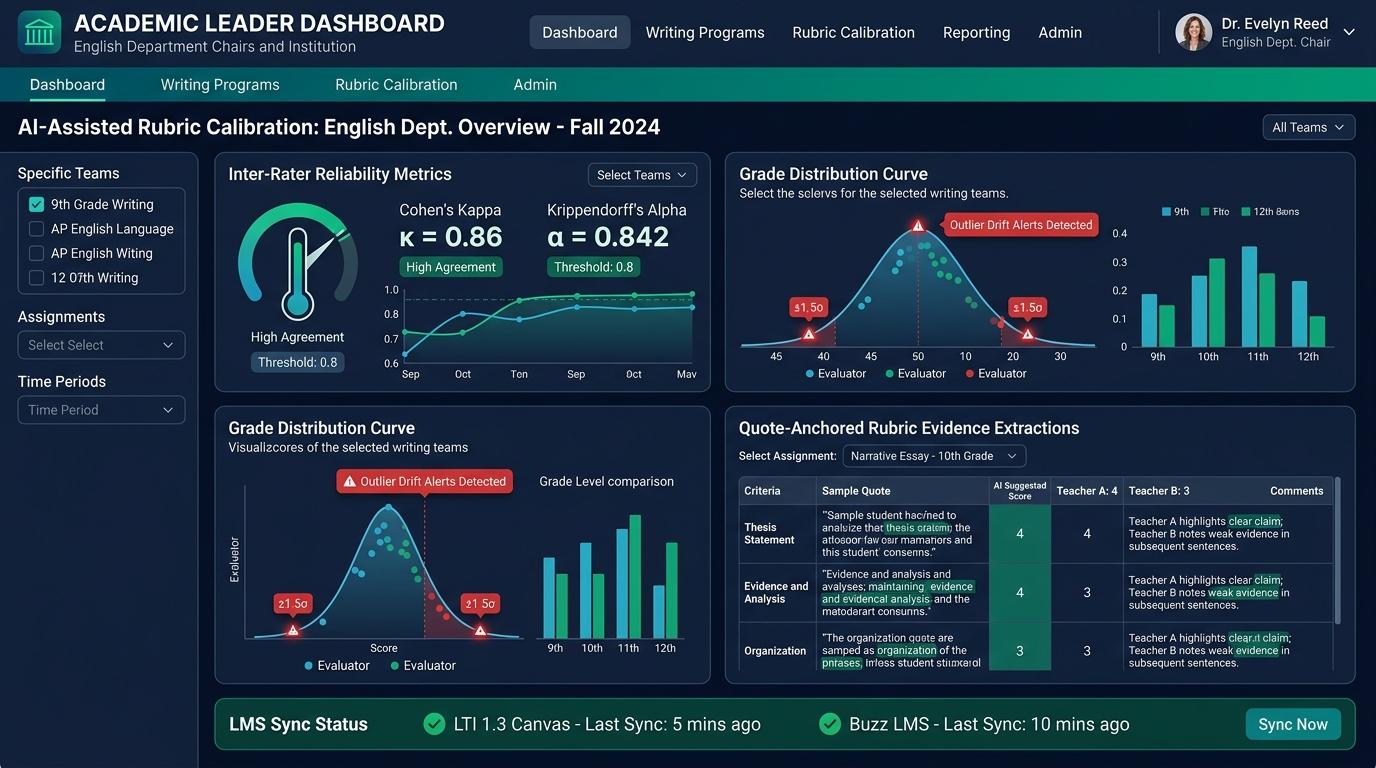
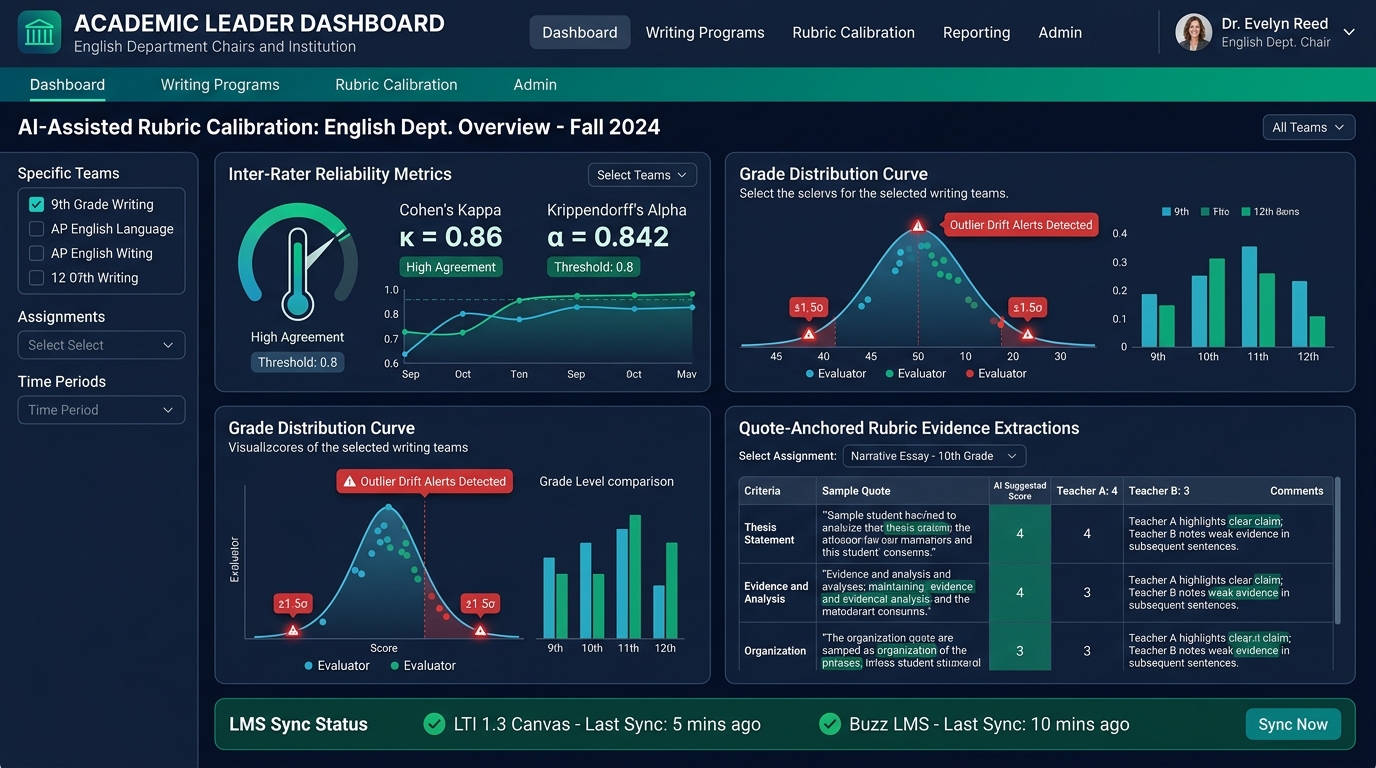
In secondary school districts, multi-section college courses, and Professional Learning Communities (PLCs), academic leaders face a persistent and damaging structural crisis: inter-rater grading variance. Identical student writing routinely receives an “A-” in one classroom and a “C+” in an adjacent room due to differing teacher stringency, subjective rubric interpretation, and severe cognitive fatigue across grading sessions. Traditional once-a-semester department norming meetings fail because human calibration quickly decays under the weight of 150-essay grading marathons. By implementing Checkmark Plagiarism’s AI-Assisted Rubric Calibration Framework, department chairs transform subjective grading into an equitable, unified, and mathematically grounded discipline. Checkmark parses standardized department rubrics into normalized Abstract Syntax Tree (AST) schemas, generates verbatim quote-anchored evidence extractions for every criterion, facilitates pre-moderation blind team calibration, and monitors real-time cohort distribution curves (±1.5σ drift alerts). Paired with patent-pending Essay Playback™ typing dynamics and passage-level integrity telemetry, writing teams achieve high inter-rater concordance (κ > 0.80, α > 0.80), preserve teacher final authority, and seamlessly sync calibrated marks to Canvas LMS SpeedGrader and Agilix Buzz LMS via LTI 1.3 Advantage (AGS 2.0).
Checkmark Plagiarism streamlines departmental calibration by uniting AI rubric autograding with writing process replay, AI writing detection, plagiarism detection, and enterprise integrations with Canvas LMS and Agilix Buzz LMS.
1. The Departmental Grading Dilemma: Variance, Subjectivity Drift, and the Equity Crisis
For English department chairs, humanities curriculum coordinators, and postsecondary Writing Program Administrators (WPAs), few leadership challenges are as pervasive, contentious, or corrosive to student trust as grading inconsistency across grade-level writing teams.
When a high school 9th-grade team of four educators or a university First-Year Composition (FYC) program of twenty instructors assigns a shared argumentative essay, all sections operate under the same course catalog, state standards, and analytic rubric. Yet every semester, department chairs confront the reality of the “Grading Lottery”:
When a student’s grade is determined more by their teacher assignment than by the objective quality of their prose, academic integrity and institutional equity collapse.
The Four Systemic Drivers of Departmental Grading Variance
Grading divergence is rarely caused by teacher negligence. Rather, it is the predictable outcome of four intersecting cognitive and institutional pressures:
Evaluator Archetypes & Baselines
Unconscious ideological baselines (Harsh vs. Lenient vs. Central Tendency Hedgers) shift baseline grading thresholds across classrooms.
Cognitive Fatigue & Temporal Drift
Grading fatigue across 120+ essays causes individual teachers to drift from rigorous early reviews to hurried mid-tier marks near the deadline.
Semantic Rubric Ambiguity
Qualitative adjectives (“nuanced,” “adequate,” “sophisticated”) invite divergent subjective interpretations without grounded textual anchors.
The “Norming Decay Curve”
Calibration achieved during August PD meetings decays within 2 to 3 weeks once educators grade hundreds of submissions in classroom isolation.
1. Evaluator Archetypes and Ideological Baselines
Every teacher brings an internalized evaluative philosophy to the stack of papers:
- The Severe Gatekeeper: Believes top marks should be extraordinarily rare. A single grammatical lapse or informal transition drops an essay from “Exemplary” to “Approaching Standards.” Section averages linger in the low 70s.
- The Leniency Maximizer: Awards top-tier scores generously to encourage student morale, protect course evaluations, or avoid parent confrontations. Section averages exceed 90%, masking foundational literacy deficits.
- The Central Tendency Hedger: Avoids giving extreme high or low marks. Regardless of quality, nearly every student receives a score between 80% and 86%, compressing the distribution and failing to differentiate exceptional scholarship from superficial summary.
- The “Halo & Horns” Grader: Allows early impressions of a student’s verbal engagement, formatting aesthetics, or behavioral compliance to disproportionately dictate scores on critical thinking and textual evidence.
2. Cognitive Fatigue and Intra-Rater Temporal Drift
Even within a single teacher’s grading workflow, evaluative standards are unstable. An instructor grading Essay #1 on Saturday morning spends 18 minutes writing thorough marginalia and enforcing strict rubric standards. By Sunday night at Essay #110, cognitive depletion sets in; the teacher skims body paragraphs in 4 minutes, assigns middle-bracket rubric scores, and leaves vague feedback (“Good thoughts, clarify thesis”). The same teacher grades with different standards at hour 1 versus hour 20.
3. Semantic Ambiguity in Qualitative Rubric Descriptors
Standard rubrics rely heavily on subjective adjectives. Descriptors like “demonstrates a sophisticated line of reasoning,” “provides adequate textual evidence,” or “organizes ideas with clear transitions” mean radically different things to a 25-year veteran AP reader versus a first-year emergency-certified teacher. Without grounded textual anchors, each teacher maps these words to an arbitrary internal baseline.
4. The “Norming Decay Curve”
Most school districts and academic departments attempt to solve grading variance through traditional norming sessions during beginning-of-year Professional Development (PD) days. Teachers sit together, review two sample anchor papers, debate scores for two hours, and reach consensus.
However, empirical research in educational psychometrics demonstrates that human norming decays exponentially within two to three weeks. Once teachers return to their isolated classrooms and face hundreds of submissions alone, their scoring habits rapidly revert to their personal baseline archetypes.
Teachers debate anchor papers in person. High consensus and shared alignment on core criteria.
Independent grading begins. Evaluators begin re-asserting personal severity and leniency baselines.
Cognitive fatigue sets in. Gatekeepers average 72% while Leniency Maximizers average 91%.
Without real-time calibration telemetry, grading variance reaches peak disparity across sections.
2. Statistical Foundations of Inter-Rater Reliability (IRR) in Writing Assessment
To lead an effective calibration initiative, department chairs must ground their work in the formal mathematics of Inter-Rater Reliability (IRR). Moving beyond vague impressions (“Teacher A seems a bit tough”) requires objective statistical metrics.
| Reliability Metric | Mathematical Model | Ideal Writing Assessment Application |
|---|---|---|
| Cohen’s Kappa (κ) | κ = (p_o - p_e) / (1 - p_e) | Binary mastery decisions & master/novice dual-scoring comparisons |
| Weighted Kappa (κ_w) | w_ij = 1 - (i - j)² / (k - 1)² | Multi-tiered analytic rubrics (penalizes extreme score discrepancies) |
| Krippendorff’s Alpha (α) | α = 1 - (D_o / D_e) | Department-wide grading across multiple raters & non-overlapping rosters |
| Standard Deviation (σ) Bands | z_sec = (μ_sec - μ_coh) / (σ_coh / √N) | Real-time detection of grading severity, leniency, and central tendency drift |
1. Cohen’s Kappa (κ) for Categorical Agreement
When two raters evaluate whether a student has achieved mastery on a specific rubric benchmark (e.g., Defensible Thesis: Present vs. Deficient), simple percentage agreement is misleading because raters can agree by sheer chance. Cohen’s Kappa (κ) isolates true agreement by subtracting the probability of chance agreement:
| Kappa Coefficient (κ) | Strength of Agreement | Departmental Health & Action Required |
|---|---|---|
| < 0.20 | Poor / Severe Divergence | Urgent calibration needed; grades reflect random grader assignment. |
| 0.21 – 0.40 | Fair / Substantial Drift | Noticeable grading disparity; student appeals and grievances common. |
| 0.41 – 0.60 | Moderate Baseline | Typical uncalibrated department baseline; requires structured PLC norming. |
| 0.61 – 0.80 | Substantial Agreement | Healthy Professional Learning Community; consistent rubric application. |
| 0.81 – 1.00 | Almost Perfect Concordance | Exemplary calibrated department; legally and academically defensible scores. |
2. Weighted Kappa (κw) for Multi-Tiered Analytic Rubrics
For rubrics with ordinal scoring bands (e.g., a 4-point scale: 1 = Beginning, 2 = Developing, 3 = Proficient, 4 = Advanced), treating all disagreements equally is flawed. If Rater A awards a 3 and Rater B awards a 4, that is a minor discrepancy. If Rater A awards a 1 and Rater B awards a 4, that represents complete evaluative failure.
Weighted Kappa (κw) introduces a quadratic disagreement penalty matrix:
3. Krippendorff’s Alpha (α) for Multi-Rater Departmental Teams
In large school districts or university departments, it is mathematically impossible for every teacher to grade every student paper. Multiple instructors evaluate non-overlapping subsets of the student body, resulting in sparse data matrices with missing values.
Krippendorff’s Alpha (α) is the gold standard for departmental writing programs because it:
- Supports any number of raters (from 3 to 50+ faculty members).
- Seamlessly handles missing data and incomplete pairwise comparisons.
- Operates across nominal, ordinal, interval, and ratio rubric scales.
4. Standard Deviation (σ) Bands and Distribution Analytics
To monitor grading in real time without requiring double-blind reading of every essay, department chairs analyze the dispersion of section grade distributions:
3. Checkmark Plagiarism’s AI-Assisted Rubric Calibration Framework
To bridge the gap between statistical theory and classroom practice, Checkmark Plagiarism provides a purpose-built, educator-first calibration architecture. Rather than replacing teacher professional judgment with automated black-box scoring, Checkmark establishes a transparent, evidence-grounded baseline that standardizes evaluative criteria across the entire department.
Pillar 1: Departmental Rubric AST Schema Normalization
Traditional LMS rubrics are stored as flat text blocks, making systematic machine interpretation impossible. Checkmark’s engine parses any uploaded rubric—whether created in-app, uploaded via PDF/image, or synced from Canvas/Buzz LMS—into an Abstract Syntax Tree (AST) Schema.
The AST decomposes rubrics into distinct hierarchical nodes:
- Dimension Identifiers: (e.g., Thesis Defensibility, Textual Integration, Rhetorical Analysis, Syntax & Mechanics).
- Performance Bands & Weighting: Specific point allocations, mastery percentages, and threshold requirements.
- Pedagogical Criteria Descriptors: The exact textual conditions required to achieve each performance tier.
{
  "rubric_id": "eng_10_argument_q2",
  "version": "2.4.0",
  "schema_type": "analytic_multitier",
  "total_points": 100,
  "criteria": [
    {
      "id": "crit_01_thesis",
      "name": "Thesis & Line of Reasoning",
      "weight_pct": 20,
      "levels": [
        {
          "score": 20,
          "label": "Exemplary",
          "ast_rule": "MUST contain a defensible claim AND establish a multi-pronged line of reasoning addressing counter-perspectives."
        },
        {
          "score": 14,
          "label": "Proficient",
          "ast_rule": "Contains a defensible claim but line of reasoning is linear or lacks counter-perspective synthesis."
        },
        {
          "score": 8,
          "label": "Emerging",
          "ast_rule": "States a broad topic or non-defensible truism without clear analytical progression."
        }
      ]
    }
  ]
}
This normalization ensures that regardless of whether a school uses the AP English 6-Point Analytical Rubric (0-1-4-1), the 6+1 Trait Writing Model, or a custom state standards matrix, the evaluation logic is structured, repeatable, and mathematically auditable.
Pillar 2: Grounded Quote-Anchored Evidence Extraction
The fatal flaw of generic generative AI tools (such as asking ChatGPT to “grade this essay”) is evaluative hallucination. Generic models invent praise or criticism detached from what the student actually wrote, providing generic feedback that cannot be defended to a skeptical parent or department chair.
Checkmark Plagiarism eliminates hallucination through quote-anchored evidence extraction:
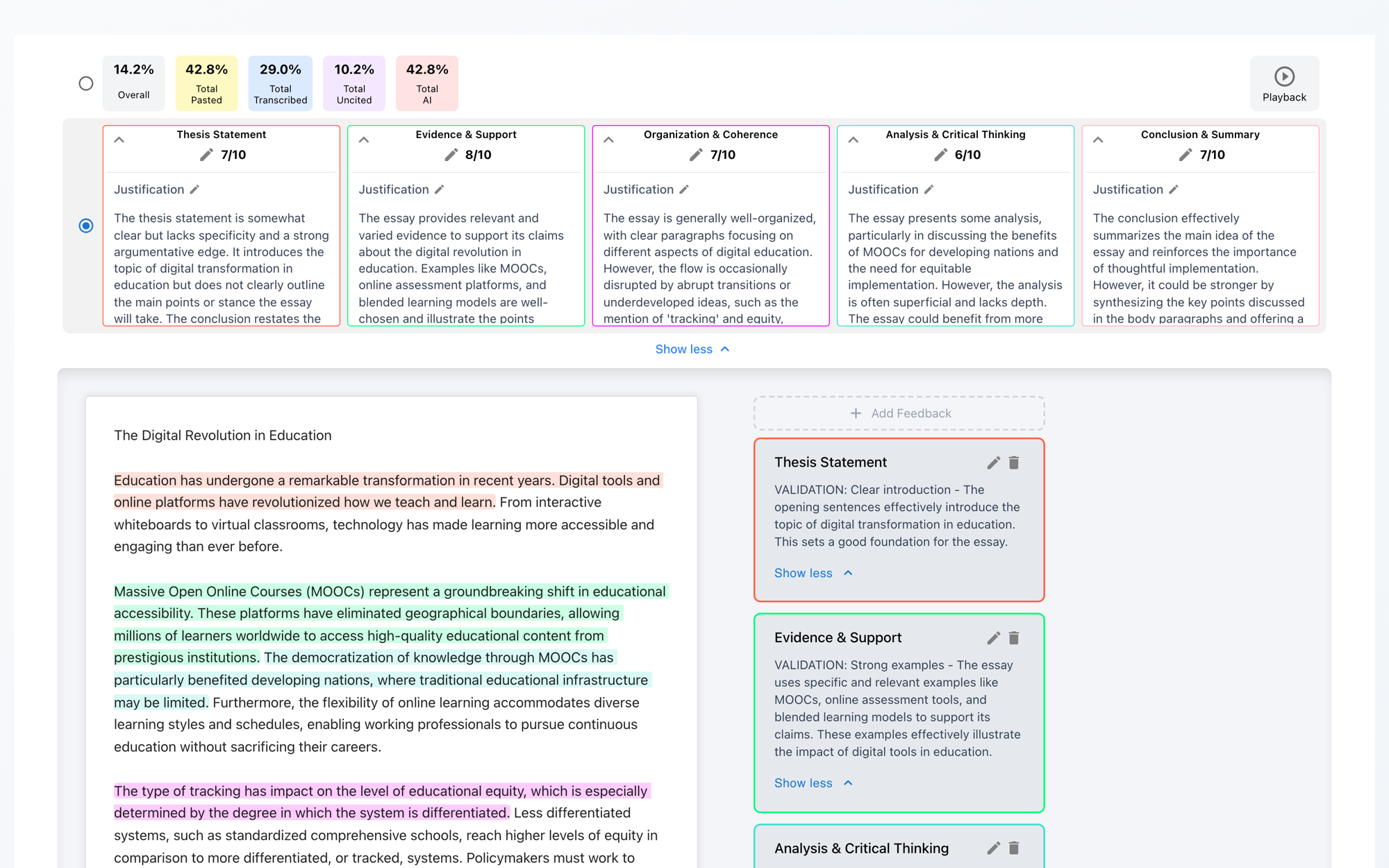
- Every rubric score generated by Checkmark is strictly bound to verbatim text quotations extracted from the student’s submission.
- In the grading interface, clicking any rubric criterion instantly highlights the exact supporting and contradicting passages in the essay body.
- The system provides an explicit pedagogical justification explaining why the student’s prose satisfies or falls short of the AST descriptor.
Criterion: Textual Evidence & Synthesis
The student provides two strong direct citations addressing economic and ecological trade-offs. However, the connection between Thorne’s capital expenditure data and the central claim of long-term economic viability is asserted rather than analyzed. Rubric AST rule requires ‘sustained explanatory commentary connecting evidence to claim.’ Score calibrated at Proficient (16/20) rather than Exemplary (20/20).
This transparent evidence trail equips teachers with objective, unassailable documentation during student conferences or parent inquiries.

Pillar 3: Pre-Moderation Blind Calibration Workflows for PLCs
Before a department begins grading a major assignment cohort, Checkmark enables Pre-Moderation Blind Calibration Workflows:
Department chair uploads 3 anonymous student papers representing Low, Mid, and High performance benchmarks.
All team members and Checkmark AI independently score anchor papers. No rater sees peer marks prior to completion.
Checkmark calculates team κ, Krippendorff’s α, criterion deltas, and identifies outlier scoring patterns.
Team meets strictly to resolve criteria with high variance. Normalized baseline is locked for the entire cohort.
By focusing departmental discussions strictly on criteria with high statistical variance, PLCs replace contentious 2-hour meetings with highly targeted, 20-minute calibration sessions.
Pillar 4: Real-Time Department Chair Distribution Analytics & Drift Alerts
During active grading cycles, department chairs access the Checkmark Calibration Dashboard. The dashboard tracks live grading velocity, class averages, score distributions, and standard deviations across all course sections:
| Instructor | Section | Submissions | Mean Score | Std Dev (σ) | Drift Status |
|---|---|---|---|---|---|
| Morrison, K. | ENG 101-01 | 28 / 28 | 81.4% | 6.8 | ✅ Calibrated |
| Vance, D. | ENG 101-04 | 30 / 30 | 82.1% | 7.2 | ✅ Calibrated |
| Sterling, J. | ENG 101-07 | 29 / 29 | 70.8% | 12.4 | ⚠️ Strict Drift (-1.8σ) |
| Chen, L. | ENG 101-12 | 27 / 27 | 93.4% | 3.8 | ⚠️ Lenient Drift (+1.9σ) |
| Rivera, M. | ENG 101-18 | 31 / 31 | 84.0% | 2.1 | ⚠️ Compressed (σ<3.0) |
Cohort Aggregate Benchmark: μ = 82.3% | σ = 7.1 | Reliability: Krippendorff’s α = 0.842
Pillar 5: Teacher-in-the-Loop Final Authority & Native LTI 1.3 Advantage Grade Passback
Checkmark adheres strictly to a teacher-in-the-loop philosophy. AI-generated scores and quote-anchored feedback are provided as pre-drafted recommendations, never as automated final verdicts.
- Educator Review: Teachers open the submission in the Checkmark calibration workspace, where pre-scored rubric rows, anchored quotes, and draft comments are pre-populated.
- Pedagogical Adjustment: The teacher accepts, edits, overrides, or adds custom personalized commentary in 60 to 90 seconds per essay.
- One-Click LTI 1.3 Advantage Passback: Once approved, grades and detailed rubric criterion breakdowns sync instantly to Canvas LMS SpeedGrader, Agilix Buzz LMS, or Google Classroom via 1EdTech LTI 1.3 Assignment and Grade Services (AGS 2.0) and Names and Role Provisioning Services (NRPS 2.0).
4. Integrated Integrity Verification: Merging Writing Authenticity with Rubric Evaluation
A critical vulnerability of rubric calibration is the assumption that the submitted text represents authentic student authorship. In the era of widespread generative AI, a student can submit a syntactically flawless essay generated by ChatGPT, Claude, or a humanizer bypass tool. If a department standardizes its rubric scoring but ignores authorship verification, it calibrates the evaluation of machine-generated text.
Checkmark Plagiarism uniquely integrates writing process verification directly alongside rubric calibration.
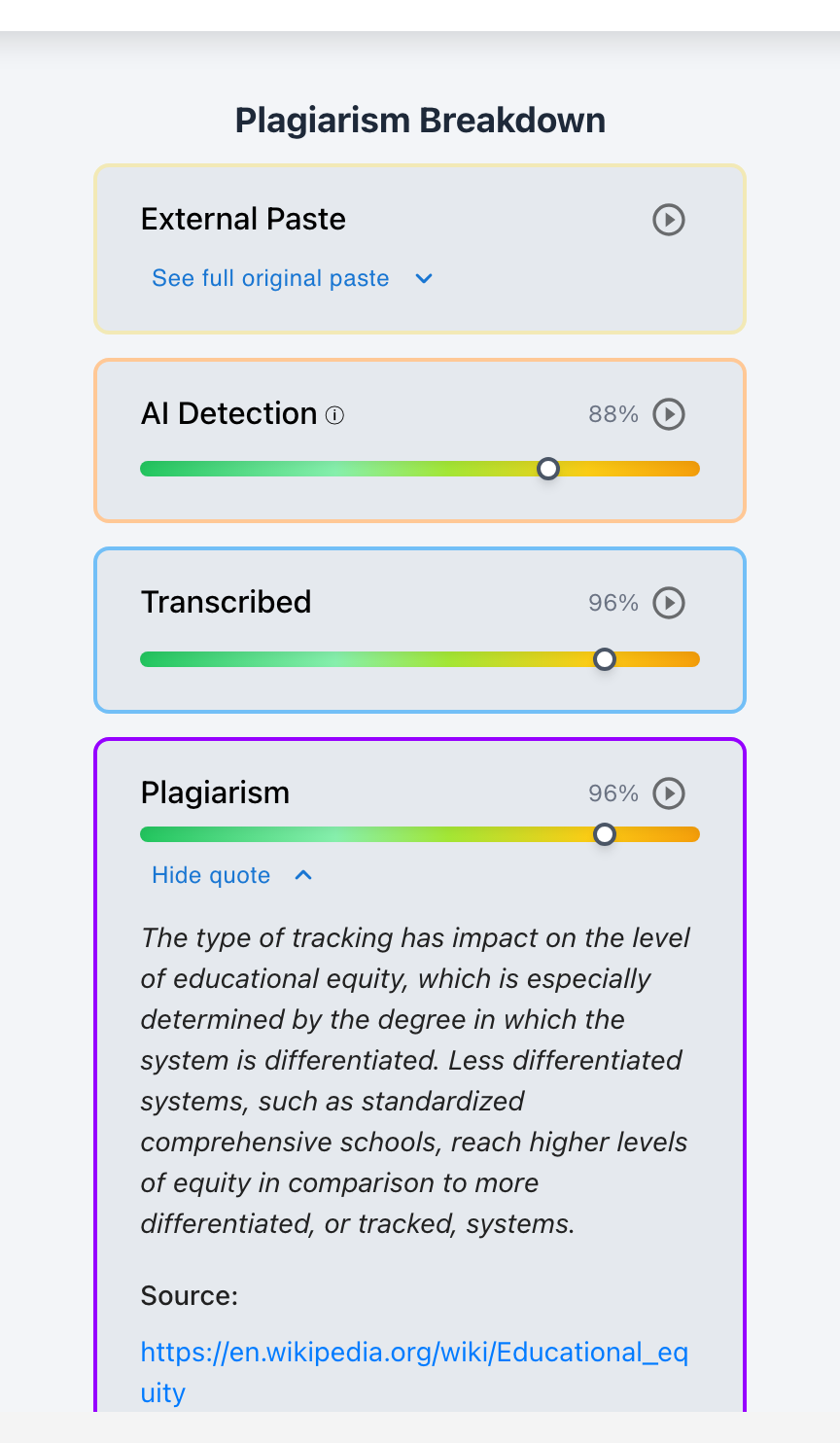
Essay Playback™
Keystroke-by-keystroke video replay (1x to 8x). Tracks typing cadences, formulation pauses, and external paste events.
Passage-Level AI Metrics
Confidence sliders per passage. Perplexity and burstiness evaluation with honest <150 word guardrails.
Defensible Plagiarism
Live web and academic database matching. Distinguishes citation formatting errors from intentional plagiarism.
1. Patent-Pending Essay Playback™ & Keystroke Telemetry
While traditional AI detectors rely solely on static linguistic probabilities, Checkmark captures temporal writing dynamics from native drafting environments (Google Docs, Canvas LMS embedded editors, Buzz LMS, and Microsoft Word):
- Keystroke-by-Keystroke Video Replay: Teachers and department chairs can scrub through the entire writing session at 1x to 8x speed, observing how the student constructed arguments, paused to reflect, restructured sentences, and revised paragraphs.
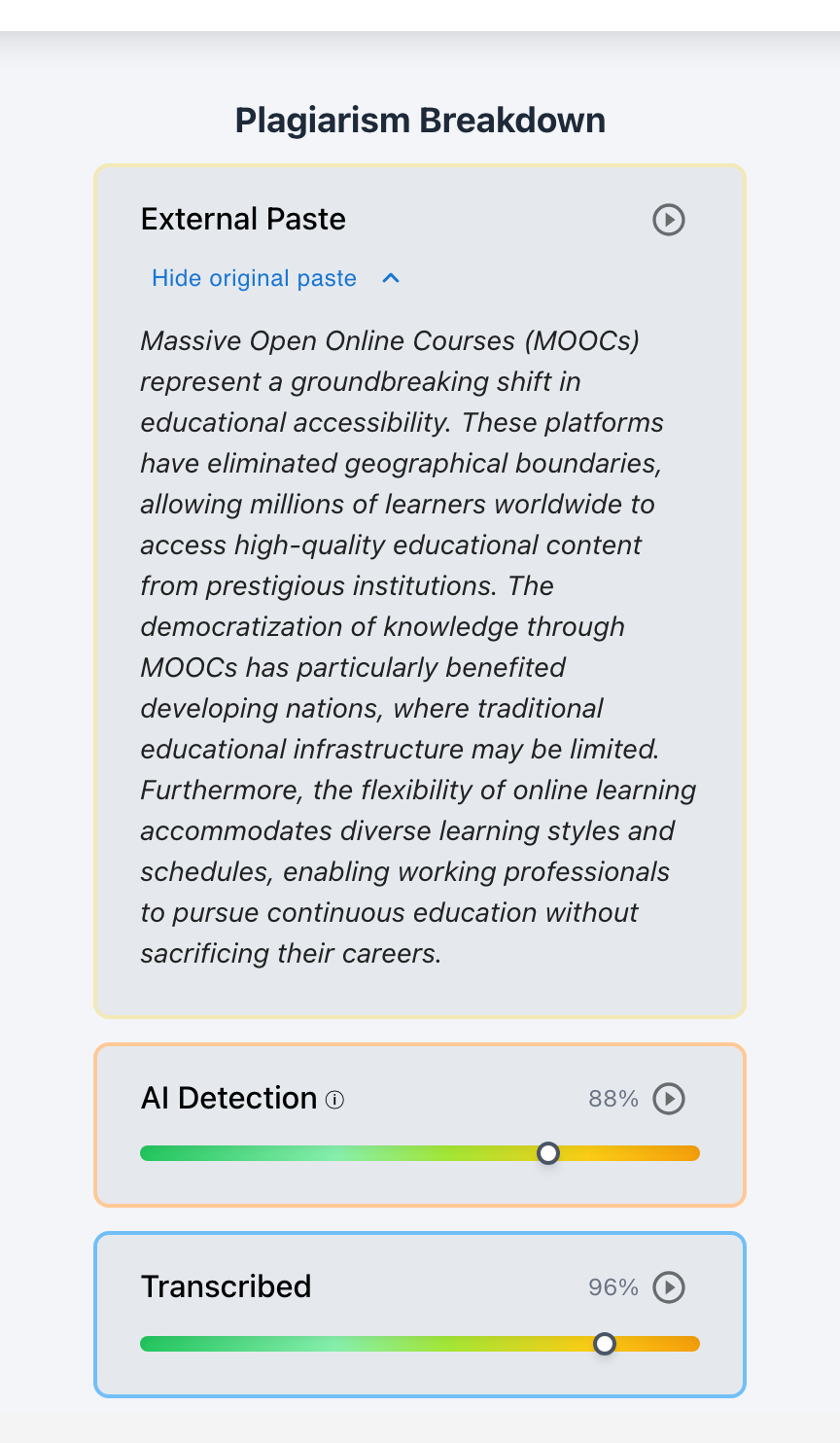
- External Paste Capture with Original Text Preservation: When a student pastes content from an external source, Checkmark records the exact timestamp, character count, and the complete pasted text. Even if the student subsequently edits every word or runs the passage through a paraphraser (e.g., QuillBot), Checkmark preserves the original pasted string and provides a direct “Jump to Playback” link.
- Transcription Detection (Phone/Second-Screen Retyping): When students manually type out AI-generated text displayed on a mobile phone or second monitor, they produce an unnatural keystroke signature: a steady, mechanical typing cadence with zero semantic pauses, zero structural reorganizations, and minimal backspacing. Checkmark flags these transcription patterns for educator review.
- Exonerating Honest Students: If an external black-box detector falsely flags an authentic student paper, the student’s rich revision history and keystroke dynamics serve as unassailable, definitive proof of human authorship.
2. Granular Passage-Level AI Writing Detection
Rather than outputting an opaque, arbitrary whole-paper percentage (e.g., “67% AI”), Checkmark provides passage-level granularity:
- Specific sentences are underlined directly within the essay text.
- Each flagged passage links to an individual sidebar evidence card displaying a calibrated confidence slider (Typical Human Writing Style ⟷ Typical AI Pattern).
- Analyzes core linguistic features: word predictability (perplexity), sentence length and structural variation (burstiness), rhythm, and transition patterns.
- Honest Guardrails: Submissions or paragraphs below ~150 words display
N/Ato prevent false accusations on insufficient sample sizes. - Educator-Only Flag Statuses: Flags (Flagged, Resolved, Not Flagged) are strictly private to teachers and administrators, preventing premature accusations and fostering supportive, non-punitive conversations.
3. Defensible Plagiarism & Peer Match Detection
Checkmark’s plagiarism engine scans billions of live web pages, open-access academic publications, digital encyclopedias, and internal school repositories:
- Two-Way Linked Evidence Cards: Clicking any highlighted passage in the essay scrolls directly to the source comparison card in the sidebar, displaying side-by-side quote matches and clickable URLs.
- Uncited Source Differentiation: Clearly distinguishes between deliberate copy-pasting and improperly formatted citations, enabling targeted academic coaching rather than punitive discipline.
- Student-to-Student Peer Match: Detects cross-section copying within the same school or district repository without exposing student identity or violating student privacy.
5. Real-World Departmental Case Studies
The following case studies demonstrate how diverse secondary and higher education institutions implemented Checkmark's AI-Assisted Rubric Calibration Framework to eliminate grading variance, elevate inter-rater reliability, and protect writing integrity.
| Institution Type | Primary Departmental Challenge | Calibrated Outcome |
|---|---|---|
| High School 9th Grade English PLC | Severe inter-rater variance (71% vs. 89% class means across 4 teachers) | Standard deviation narrowed from σ = 13.4 to σ = 4.2; appeals dropped 89% |
| High School AP English Language Team | Disagreement on 6-point AP rubric “Sophistication” band | Weighted Kappa increased from κ_w = 0.42 to κ_w = 0.86; AP pass rate +14.2% |
| College Expository Writing Program (FYC) | Mid-term grading fatigue & GTA/adjunct grading drift across 18 sections | Krippendorff’s α rose to 0.842; 41 hours saved per instructor across semester |
Case Study 1: 9th Grade English PLC (Secondary High School)
- Context: A suburban high school English department comprising 4 teachers, 14 class sections, and 420 students completing a common argumentative research paper.
- The Problem: Historical gradebook data revealed extreme variance. Teacher A (a 20-year veteran) averaged 71.2% (σ = 13.4), regularly failing 18% of students. Teacher D (a 2nd-year teacher) averaged 88.5% (σ = 5.2) with zero failing marks. Parent complaints and student counselor transfer requests (“section shopping”) were widespread.
- Implementation:
- Department Chair uploaded the district Common Core Argumentative Rubric into Checkmark, generating an AST schema.
- Before grading, the PLC conducted a 25-minute blind pre-moderation session using 3 anonymous anchor papers. The system revealed that Teacher A was penalizing formatting errors under the “Critical Argument” criterion, while Teacher D was ignoring missing counterclaims.
- Teachers graded submissions in the Checkmark console with quote-anchored AI draft suggestions.
- Results:
- Cross-section cohort mean converged to 81.4%, with section standard deviations narrowing to a healthy σ = 4.2 across all four instructors.
- Formal grade appeals dropped by 89%.
- Average grading time per teacher decreased from 42 hours to 9.5 hours, allowing teachers to conduct 1-on-1 writing conferences.
Case Study 2: High School AP English Language & Composition Team
- Context: 3 AP Lang teachers instructing 280 students preparing for the national exam, utilizing the College Board’s 6-Point Analytical Rubric (Row A: Thesis 0-1 pt; Row B: Evidence & Commentary 0-4 pts; Row C: Sophistication 0-1 pt).
- The Problem: The team struggled with severe scoring divergence on Row B (Score 2 vs. Score 3) and Row C (the elusive “Sophistication” point). Uncalibrated mock exams produced an inter-rater concordance of only κw = 0.42, making mock exam feedback an unreliable predictor of national exam performance.
- Implementation:
- The team configured Checkmark’s AP Lang rubric preset, defining explicit AST rules for Row B (requiring explicit explanation of how evidence supports the thesis) and Row C (requiring nuanced rhetorical contextualization or alternative perspectives).
- Checkmark’s quote-anchoring engine extracted specific textual clauses and matched them against Row B and C criteria.
- Pre-moderation blind calibration was conducted on 5 benchmark essays.
- Results:
- Weighted Kappa on mock exam scoring rose from κw = 0.42 to κw = 0.86, indicating near-perfect calibration.
- In the national AP examination, student pass rates (Score 3+) increased by 14.2%, driven by precise, calibrated formative feedback on evidence commentary throughout the academic year.
Case Study 3: College Expository Writing Program / First-Year Composition (FYC)
- Context: A university writing program comprising 18 sections of English 101 (450 students), staffed by 2 full-time faculty, 6 adjunct instructors, and 4 Graduate Teaching Assistants (GTAs).
- The Problem: Significant inter-rater disparity and mid-term grading fatigue. GTAs routinely awarded high grades to avoid conflict, while senior faculty graded with rigorous skepticism. Mid-term assessment data submitted for regional university accreditation was statistically unreliable.
- Implementation:
- The WPA deployed a standardized Canvas Blueprint Course linked to Checkmark via LTI 1.3 Advantage.
- The Checkmark administrative dashboard tracked real-time section means and standard deviations.
- During mid-term grading, the dashboard triggered an automated Outlier Drift Alert (±1.5σ) on two GTA sections whose average grades had drifted to 94.2%.
- The WPA conducted a supportive 15-minute calibration review, using Checkmark’s quote-anchored evidence cards to guide the GTAs in aligning their commentary with departmental expectations.
- Results:
- Program-wide Krippendorff’s Alpha reached α = 0.842, satisfying regional accreditation requirements for defensible student learning outcome (SLO) assessment.
- Faculty saved an average of 41 hours per instructor across the semester, eliminating grading backlogs and enabling rapid 48-hour feedback turnarounds.
6. The 5-Phase Departmental Calibration Protocol
To successfully deploy AI-assisted rubric calibration, department chairs should follow this systematic, 5-phase operational protocol:
| Phase | Core Objective | Key Departmental Actions | Primary Tool / Deliverable |
|---|---|---|---|
| Phase 1 | Standardization | AST rubric ingest; lock assignment settings in master shell | Canvas Blueprint / Buzz Master Shell |
| Phase 2 | Baseline Setup | Select 3-5 anchor papers; run AI quote-anchored baseline extraction | Checkmark AST Parser • Anchor Baseline Report |
| Phase 3 | Team Pre-Moderation | Independent blind scoring; 20-min delta consensus huddle on high-variance items | Checkmark Variance Matrix • κ & κ_w Report |
| Phase 4 | Calibrated Evaluation | Teacher-in-the-loop production grading; live chair drift telemetry | Telemetry Dashboard • ±1.5σ Outlier Alerts |
| Phase 5 | Publish & Gap Analysis | One-click LTI 1.3 AGS grade passback; cohort SLO heatmap analysis | SpeedGrader Sync • District SLO Heatmap |
7. Data Privacy, FERPA/COPPA Compliance & Zero Model Training Policy
Deploying AI within academic departments requires strict adherence to student privacy laws and data ethics. Commercial AI tools often compromise institutional privacy by utilizing submitted student writing to train underlying models.
Checkmark Plagiarism is engineered specifically for institutional enterprise compliance:
Student submissions are NEVER used to train, fine-tune, or develop AI models. Institutional intellectual property and student work remain strictly sovereign.
Full compliance with FERPA, COPPA, and Student Privacy Pledge standards. Data is protected by SOC 2 Type II controls.
TLS 1.3 in transit and AES-256 at rest. Seamless SAML 2.0, Google Workspace, and Microsoft Entra ID single sign-on with role-based access control.
By ensuring zero model training and strict data sovereignty, school boards and university IT departments can deploy Checkmark with total confidence.
8. Frequently Asked Questions (FAQ) for Department Chairs & Instructional Leads
Q1: How does AI-assisted calibration differ from traditional manual department norming sessions?
Traditional norming relies on a single, synchronous meeting where teachers debate a few anchor papers. While valuable for initial alignment, human calibration decays rapidly over the subsequent weeks of unmoderated grading. Checkmark’s AI-assisted calibration provides continuous, real-time calibration throughout the entire grading cycle. It normalizes rubrics into structured AST schemas, pre-populates objective quote-anchored evidence, and monitors cohort distributions for real-time drift (±1.5σ), ensuring that the 120th essay is evaluated with the exact same objective rigor as the 1st essay.
Q2: Does Checkmark replace teacher grading judgment or dictate final student grades?
No. Checkmark operates strictly on a teacher-in-the-loop architecture. AI autograding generates preliminary draft marks and quote-anchored justifications. The classroom teacher retains full professional authority to modify, override, personalize, or accept feedback. Checkmark eliminates the repetitive cognitive labor of manual evidence gathering and rubric cross-referencing, empowering educators to focus on meaningful pedagogical mentoring.
Q3: How does the system handle subjective rubric criteria like “Voice,” “Tone,” or “Sophistication”?
Subjective criteria are parsed through Checkmark's AST engine into observable linguistic conditions. For example, rather than treating “Sophistication” as a vague feeling, the system evaluates textual nuance, structural transitions, rhetorical device integration, and counter-perspective synthesis. It then extracts specific supporting quotes and presents them to the educator with a confidence rating, allowing the teacher to make a grounded, defensible evaluation.
Q4: What happens if a teacher's section triggers an Outlier Drift Alert (±1.5σ)?
An Outlier Drift Alert is an internal diagnostic notification visible only to the department chair and the instructor. It does not automatically alter student grades. Instead, it alerts the department chair that a section's score distribution is departing significantly from the departmental norm. The chair can review the instructor's quote-anchored justifications, identify whether the variance stems from grading severity, leniency, or unique student cohort demographics, and conduct a brief, supportive calibration touchpoint before grades are published.
Q5: Can Checkmark calibrate custom district rubrics or state-specific standards (e.g., Texas STAAR, Florida B.E.S.T., NY Regents)?
Yes. Checkmark's AST engine can ingest and normalize any standard analytic rubric, holistic scale, multi-trait framework, or state-specific scoring guide. Departments can upload existing rubrics via PDF, image, or text, or sync them directly from Canvas LMS, Buzz LMS, or Google Classroom.
Q6: How does Checkmark pass grades back into Canvas SpeedGrader and Agilix Buzz LMS?
Checkmark utilizes 1EdTech LTI 1.3 Advantage, specifically Assignment and Grade Services (AGS 2.0) and Names and Role Provisioning Services (NRPS 2.0). Once a teacher approves grades in the Checkmark calibration console, final numerical scores, criterion-by-criterion point breakdowns, and quote-anchored feedback comments sync directly back to Canvas SpeedGrader or Buzz LMS with a single click, eliminating manual data entry.
Q7: How does Essay Playback™ protect honest students during rubric calibration?
Generic AI detectors generate high false-positive rates on complex or ESL/ELL writing. If an authentic student paper is flagged by an external detector or questioned by a skeptical instructor, Essay Playback™ provides definitive, irrefutable proof of authorship. Educators can replay the entire writing session keystroke-by-keystroke, verifying authentic typing cadences, formulation pauses, drafting revisions, and organic text evolution—completely exonerating the student.
9. Conclusion: Moving from Subjective Guessing to Calibrated Trust
Eliminating grading variance across grade-level teams is essential for academic equity, departmental morale, and defensible institutional standards. Subjective grading disparities compromise student trust, distort district learning data, and burn out educators in unsustainable grading marathons.
By implementing Checkmark Plagiarism’s AI-Assisted Rubric Calibration Framework, department chairs and writing teams unite under a common, transparent, and evidence-grounded standard. With AST rubric normalization, grounded quote-anchored justifications, real-time drift telemetry, and patent-pending Essay Playback™ process verification, academic departments can stop guessing and start trusting—fostering fair, consistent, and transformative writing education for every student.
Transform Rubric Calibration in Your Department
Learn how Checkmark Plagiarism unifies writing teams, eliminates inter-rater grading variance, and integrates natively with Canvas and Buzz LMS.