
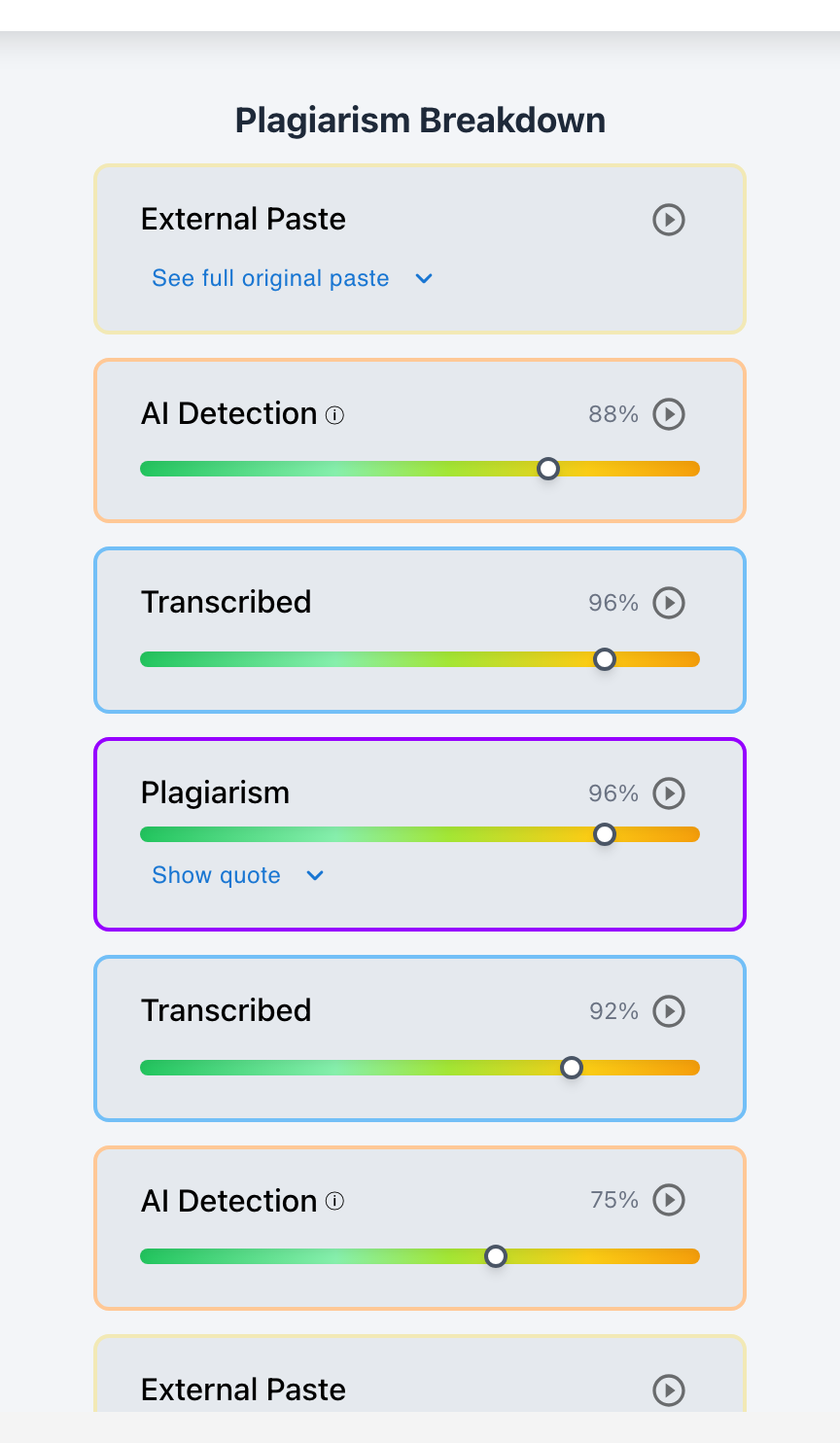
Administrators can identify patterns of AI use across courses by leveraging Checkmark Plagiarism's Cross-Course Administrative Heatmaps: 1) Assignment Prompt Vulnerability Audits (identifying generic essay prompts that trigger high AI generation rates across sections); 2) Temporal Deadline Panic Spikes (tracking midnight paste payloads clustered around Sunday 11:59 PM due dates); 3) Cross-Disciplinary Disparities (comparing AI rates between humanities, social sciences, and STEM lab reports); and 4) Departmental Telemetry Baselines.
AI use in a school is rarely evenly distributed. A single student might spend 5 hours authentically drafting their English thesis, but turn around and copy an entire ChatGPT response for their History DBQ or Biology lab discussion. When administrators only look at individual student disciplinary referrals, they miss the larger institutional picture: systemic patterns in curriculum design, assignment pacing, and prompt structure that unintentionally encourage AI shortcuts. Checkmark Plagiarism's Cross-Course Analytics illuminates these patterns, enabling proactive instructional leadership.
Below is a comprehensive guide for principals, curriculum directors, and academic deans on diagnosing and resolving cross-course AI patterns.
Checkmark Plagiarism maps institutional patterns by pairing AI detection with essay writing playback, plagiarism detection, autograding, and integrations with Canvas and Google Classroom.
The 4 Cross-Course Patterns Uncovered by Analytics
1. Assignment Prompt Vulnerability
Identifies generic prompts (e.g., "Discuss the themes of The Great Gatsby") that yield 60%+ AI scores, contrasting with localized, AI-resistant prompts.
2. Deadline Panic Clustering
Maps the exact hours when paste events occur: uncovers that 75% of AI payloads are inserted between 10:00 PM and 11:59 PM on Sunday nights.
3. Cross-Disciplinary Disparities
Reveals when students write authentically in primary ELA classes but resort to AI shortcuts in Science lab reports or Social Studies summaries.
4. Departmental Screening Equity
Tracks whether all departments are actively using writing playback and adhering to the school's Two-Pillar evidentiary standard.
How Leaders Use Pattern Data to Improve Curriculum
Transforming integrity data into proactive pedagogical improvements:
- Refining Vulnerable Prompts: If an 11th-grade US History essay shows a 45% AI risk across all sections, the department chair collaborates with teachers to redesign the prompt to incorporate specific primary source synthesis and in-class drafting checkpoints.
- Adjusting Assignment Pacing: Discovering that Sunday night deadlines create massive paste spikes encourages faculty to shift deadlines to in-class Friday checkpoints, reducing student panic.
- Supporting Non-ELA Writing: When STEM departments show high AI rates, administrators provide science teachers with targeted training on evaluating lab report discussions and citing experimental data.
Read more in how Checkmark writing process analysis works.
Comparison: Siloed Course Data vs. Checkmark Cross-Course Analytics
Checkmark Cross-Course Analytics (Systemic & Proactive)
- Cross-departmental integrity heatmaps in Canvas LMS.
- Identifies prompt vulnerability across courses.
- Maps temporal paste spikes to improve assignment pacing.
- Enables proactive curriculum and PLC support.
Siloed Course Data (Reactive & Fragmented)
- Each teacher manages integrity in total isolation.
- Leadership is blind to vulnerable assignment prompts.
- No visibility into cross-subject cheating disparities.
- Only catches individual students after disputes escalate.
A 5-Step Leadership Protocol for Cross-Course Audits
Cross-Course Integrity Pattern Checklist:
- 1. Open the Cross-Department Heatmap in Checkmark's Administrative Dashboard.
- 2. Filter by "Prompt Risk Rating" to identify assignments with elevated AI probability rates.
- 3. Inspect the "Submission Time Histogram" to locate deadline panic clusters.
- 4. Compare subject area risk rates: identify STEM or Social Studies courses needing prompt redesign support.
- 5. Lead a collaborative PLC workshop to redesign vulnerable prompts and introduce in-class draft checkpoints.
How Checkmark Plagiarism Powers Pattern Recognition
Checkmark Plagiarism combines **AI detection, essay writing playback, static AI detection, plagiarism detection, autograding, and Canvas/Google Classroom integrations** to give school leaders actionable institutional intelligence that transforms writing instruction.
Frequently Asked Questions
What is a 'vulnerable assignment prompt'?
A broad, generic essay question (e.g., "Summarize the causes of World War I") that ChatGPT can answer perfectly without referencing unique classroom discussions.
How can teachers make prompts more AI-resistant?
Incorporate specific in-class primary sources, require personal student synthesis, integrate rough draft checkpoints, and enable Checkmark Writing Playback.
Why do Sunday 11:59 PM deadlines cause high AI cheating rates?
Late-night weekend deadlines encourage procrastination and fatigue, leading students to panic at 11:30 PM and copy AI text to submit before the portal closes.
How does Checkmark Plagiarism integrate with Canvas LMS?
Checkmark aggregates cross-course data across your entire Canvas sub-account, generating unified visual heatmaps for department chairs and principals.
Can administrators identify if a student only cheats in one subject?
Yes. The student longitudinal view displays telemetry across English, History, and Science, showing whether misconduct is isolated to a single course.
How do cross-course analytics support Professional Learning Communities (PLCs)?
PLC teams review prompt vulnerability data to collaboratively refine essay assignments, share successful rubrics, and normalize grading standards.
Does pattern tracking help in teacher evaluations?
Pattern data is used formatively by curriculum leaders to provide instructional coaching on writing pedagogy, not for punitive teacher evaluations.
How does Autograder utilize cross-course pattern data?
Autograder benchmarks student growth across courses, highlighting consistent analytical strengths in student writing portfolios.
Can district administrators compare patterns across multiple high schools?
Yes. District-level dashboards provide comparative analytics across all campuses in the school district.
Why is cross-course pattern analysis essential for school improvement?
Because addressing systemic curriculum vulnerabilities prevents cheating before it happens, fostering a healthy, authentic culture of scholarship.
Transforming Systemic Insight into Instructional Excellence
Academic integrity is a reflection of curriculum design and instructional support. By utilizing Checkmark Plagiarism's cross-course pattern analytics, school leaders identify systemic vulnerabilities, support teachers with targeted professional development, and build an environment where authentic learning flourishes.
Checkmark Plagiarism supports this comprehensive approach with AI detection, essay writing playback, static AI detection, plagiarism detection, autograding, and integrations with Canvas and Google Classroom.
See how Checkmark provides cross-course pattern analytics and prompt vulnerability heatmaps in Canvas. View a sample report or request a demonstration.