
Take-home essay examinations—typically 2,000 to 3,500 words distributed over a 48-to-72-hour assessment window—represent one of the highest-stakes evaluation formats in secondary and higher education. However, academic integrity officers, honor councils, and faculty are increasingly confronted with submissions completed in impossibly compressed active drafting windows (e.g., a 2,800-word constitutional law brief submitted with only 14 minutes of active editor interaction). Relying solely on basic Learning Management System (LMS) timestamps or crude “time-on-page” counters leaves institutions legally vulnerable to the ubiquitous “offline drafting defense” (where students claim they composed in an external word processor and pasted the final text).
Grounded in the biomechanical realities of human text production, this guide outlines a rigorous, four-phase forensic audit protocol. By deploying Checkmark Plagiarism’s patent-pending Essay Playback™ suite—combining 1x–8x scrubbable keystroke video replays, external paste buffer inspection, optical transcription detection, passage-level AI confidence sliders (<150w guardrails), side-by-side plagiarism matching, and quote-anchored rubric autograding—institutions can uphold procedural due process, eliminate arbitrary guesswork, and protect honest students through transparent, incontrovertible digital evidence.
Checkmark Plagiarism equips Academic Integrity Officers, Deans of Students, Department Chairs, and Judicial Affairs committees with forensic writing telemetry and seamless integrations across Canvas LMS, Agilix Buzz, and Google Classroom.
1. The Take-Home Exam Crisis: Compressed Drafting Times & The Collapse of Legacy Metrics
Take-home essay examinations are designed to evaluate deep conceptual synthesis, rigorous analytical reasoning, and complex argumentation. Unlike timed, 50-minute in-class blue-book exams that test rapid information retrieval under stress, take-home exams afford students the cognitive bandwidth to:
- Interrogate dense primary and secondary legal, historical, or scientific texts.
- Outline complex, multi-tiered structural arguments.
- Draft nuanced prose with precise disciplinary terminology.
- Execute iterative revisions, structural reordering, and rigorous bibliographic citations.
- Day 1: Source Review & Ideation: 6–8 hours analyzing prompts, notes, and case law.
- Day 2: First-Draft Composition: 8–10 hours drafting arguments at 20–35 WPM.
- Day 3: Revision & Polishing: 3–4 hours reorganizing paragraphs and citations.
- Prompt Opened: Friday, 5:02 PM
- Inactive Editor Gap: 47 Hours, 36 Minutes of zero interaction
- Document Interaction Initiated: Sunday, 4:38 PM
- Final Submission (2,940 Words): Sunday, 4:57 PM
When an Academic Integrity Officer (AIO), Dean of Students, or Department Chair reviews an exam submission containing 3,000 words of sophisticated analysis produced in under 20 minutes of LMS interaction, an immediate red flag is raised. However, initiating disciplinary proceedings based solely on a short LMS session timestamp is fraught with pedagogical and legal hazards.
The Fatal Inadequacy of Legacy LMS Timestamps
Most Learning Management Systems (such as Canvas, Blackboard Learn, Brightspace by D2L, and Moodle) track only coarse session metadata:
- Session Start Time: When the student clicked the assignment link or opened the submission rich-text editor.
- Submission Timestamp: When the HTTP
POSTrequest transmitted the payload to the LMS server. - Aggregated “Time-on-Page” Counter: A rudimentary JavaScript timer that records how long the browser tab had active focus, easily spoofed by background tabs, automated page refreshers, or legitimate external drafting.
These metrics provide zero insight into the cognitive writing process. They cannot tell an inquiry committee whether the text was:
- Typed organically character-by-character with natural composing pauses.
- Retyped mechanically from an adjacent smartphone displaying a generated Large Language Model (LLM) response.
- Injected into the document in three massive clipboard paste events.
- Legitimately transferred from an approved offline desktop writing environment.
The Risk of Opaque, Black-Box AI Detector Scores
Compounding the problem, many institutions attempt to resolve suspicious turnaround times by running the submitted text through first-generation, black-box AI detection algorithms. These legacy detectors output a single opaque probability number (e.g., “88% AI-Generated”).
When brought before an academic appeals board or faculty hearing committee, such whole-document scores repeatedly fail legal and procedural scrutiny:
- They cannot highlight specific suspicious sentences or identify which sections are human vs. machine-generated.
- They lack evidentiary provenance—failing to explain why a passage was flagged beyond hidden statistical perplexity thresholds.
- They exhibit documented demographic biases, disproportionately flagging non-native English speakers, neurodivergent writers with formulaic sentence structures, and disciplined writers using standardized academic templates.
- They offer no defense against the student’s assertion: “I wrote this myself offline in Microsoft Word and pasted it in at the end.”
To protect institutional integrity and student due process, academic integrity officers require a forensic paradigm shift: moving from opaque statistical speculation to transparent, verifiable telemetry.
2. Why “Time-on-Page” Alone Is Inconclusive and Legally Vulnerable
When an academic integrity board relies exclusively on LMS time-on-page or submission timestamps to bring disciplinary charges of unauthorized AI use or contract cheating, the case routinely collapses under administrative review.
The “Offline” Drafting Defense
Students assert they drafted offline in Word, Scrivener, or Docs to avoid eye strain or internet loss, pasting only at the final minute.
Biomechanical Limits
Physical typing speeds (15–35 WPM cognitive vs. 45–75 WPM transcription vs. 50,000+ WPM paste) must be mathematically tied to the draft.
Procedural Due Process
Institutions must prove intentional misconduct with objective, inspectable telemetry under Fourteenth Amendment and FERPA mandates.
1. The “Offline Drafting” Defense
The most frequent and legally effective defense raised by students accused of turnaround time violations is the offline composition argument:
“I get eye strain working directly in the Canvas browser box, and I was terrified of losing my work if my internet dropped. So, I wrote my entire 2,500-word essay in Microsoft Word over 14 hours on Saturday. Once I finished proofreading and formatting my citations, I opened Canvas at 4:38 PM on Sunday, pasted my completed document into the submission portal, and clicked submit at 4:57 PM. That is why the LMS only shows 19 minutes of activity.”
Without keystroke telemetry, paste buffer analysis, and temporal version histories, this defense is nearly impossible to refute. A student may indeed be an honest, meticulous writer who prefers an offline desktop editor—or they may be a student who prompted Claude or ChatGPT at 4:35 PM, copied the output, and pasted it into Canvas at 4:38 PM.
An institution that penalizes a student based solely on the 19-minute LMS timestamp without forensic corroboration risks punishing innocent students and violating institutional policies.
2. The Biomechanical Realities of Human Text Production
To evaluate turnaround times scientifically, academic integrity officers must understand the empirical benchmarks of human typing, cognitive planning, and text entry speeds. Extensive research in cognitive psychology and human-computer interaction (HCI) distinguishes between three distinct modes of text generation:
Characterized by frequent planning pauses (>2.0s) for ideation, syntax planning, and review. High burstiness, high backspace ratio (10–25%), and non-linear structural edits.
Characterized by metronomic, steady Inter-Key Intervals (120ms–220ms). Near-zero conceptual pauses, low backspace ratio (<3%), strictly linear left-to-right progression.
1,000–3,500 words inserted in a single 0-millisecond DOM event loop tick. Requires deep clipboard buffer inspection to determine external provenance.
| Metric / Dimension | Authentic Composition | Optical Transcription | External Paste Dump |
|---|---|---|---|
| Typical Net WPM | 15 – 35 WPM | 45 – 75 WPM | ∞ (Instantaneous 0–15ms) |
| IKI Variance (σ²) | Extremely High (Bimodal distribution) | Extremely Low (Uniform Gaussian curve) | N/A (Single DOM event) |
| Cognitive Pauses (>5s) | 20 – 60 per 1,000 words | 0 – 3 per 1,000 words (eye saccades only) | 0 within inserted block |
| Revision / Backspace Ratio | 12% – 28% of total keys | < 3% of total keys | 0% prior to insertion |
| Structural Reordering | Frequent non-linear cursor hops | Rare (Strictly left-to-right) | Instant complete block injection |
3. The Legal Due Process Mandate
In both public and private educational institutions, disciplinary adjudications that result in course failures, academic suspensions, or expulsions must adhere to fundamental principles of procedural fairness and due process:
- Clear Notice of Charges: The institution must specify the exact nature of the alleged academic misconduct (e.g., unauthorized generative AI authorship, unauthorized external collaboration, contract cheating).
- Access to Objective Evidence: The student has the right to inspect the evidence against them under FERPA (34 CFR Part 99 § 99.10). Presenting a student with an uninterpretable third-party “AI probability score” or a circumstantial 18-minute LMS timestamp does not meet the standard of preponderance of evidence.
- Meaningful Opportunity to Respond: The student must be permitted to present their drafting history, notes, and explanations in a non-punitive, evidence-based forum.
- Defensible Evidentiary Standards: Inquiries must be supported by verifiable digital telemetry that can withstand appeal to University Legal Counsel, Faculty Ombudsmen, or civil courts.
3. Forensic Architecture: Checkmark Plagiarism’s Patent-Pending Essay Playback™ Suite
To resolve turnaround time anomalies with scientific precision, Checkmark Plagiarism integrates a multi-dimensional forensic architecture directly into the writing and submission ecosystem (including Canvas LMS, Buzz LMS, Google Classroom, Google Docs, and Microsoft Word). Rather than treating the essay as a static post-submission artifact, Checkmark captures the full temporal evolution of the text.
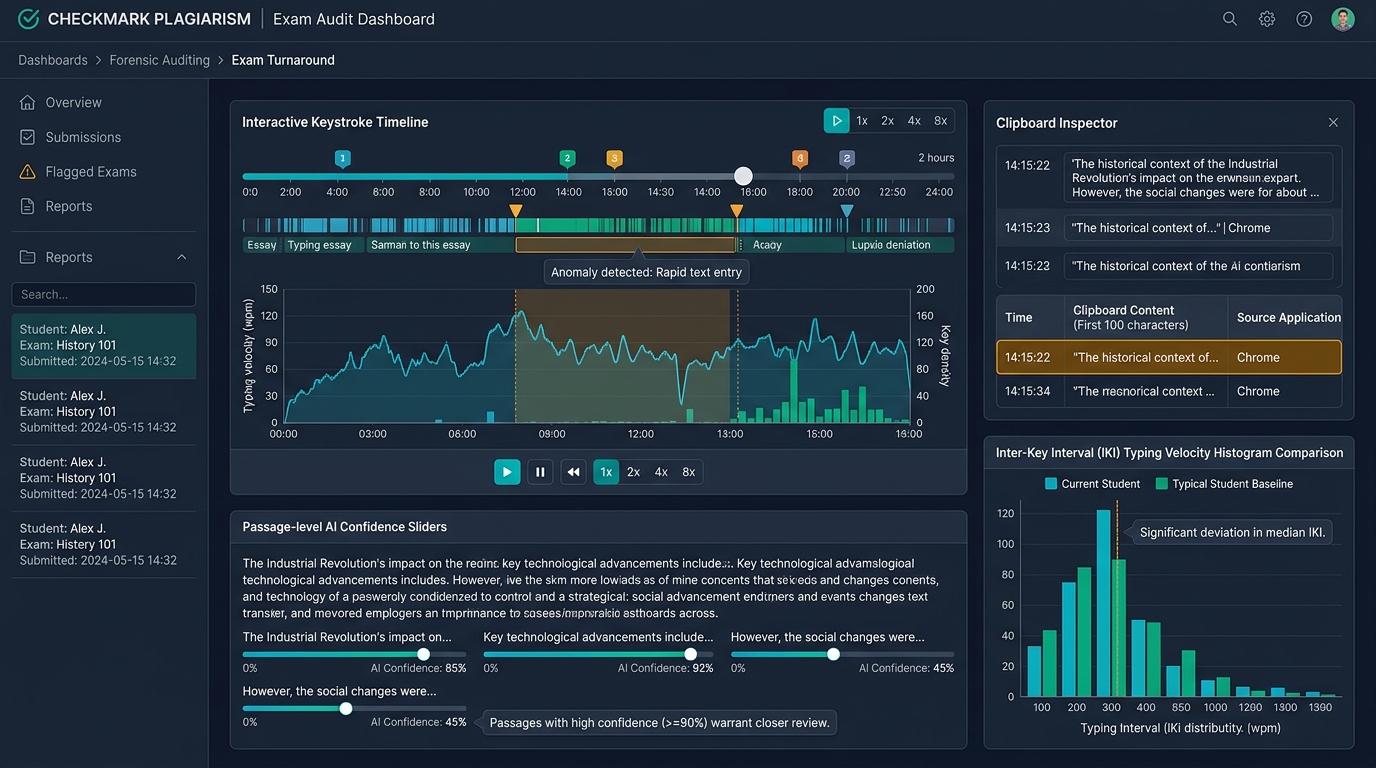
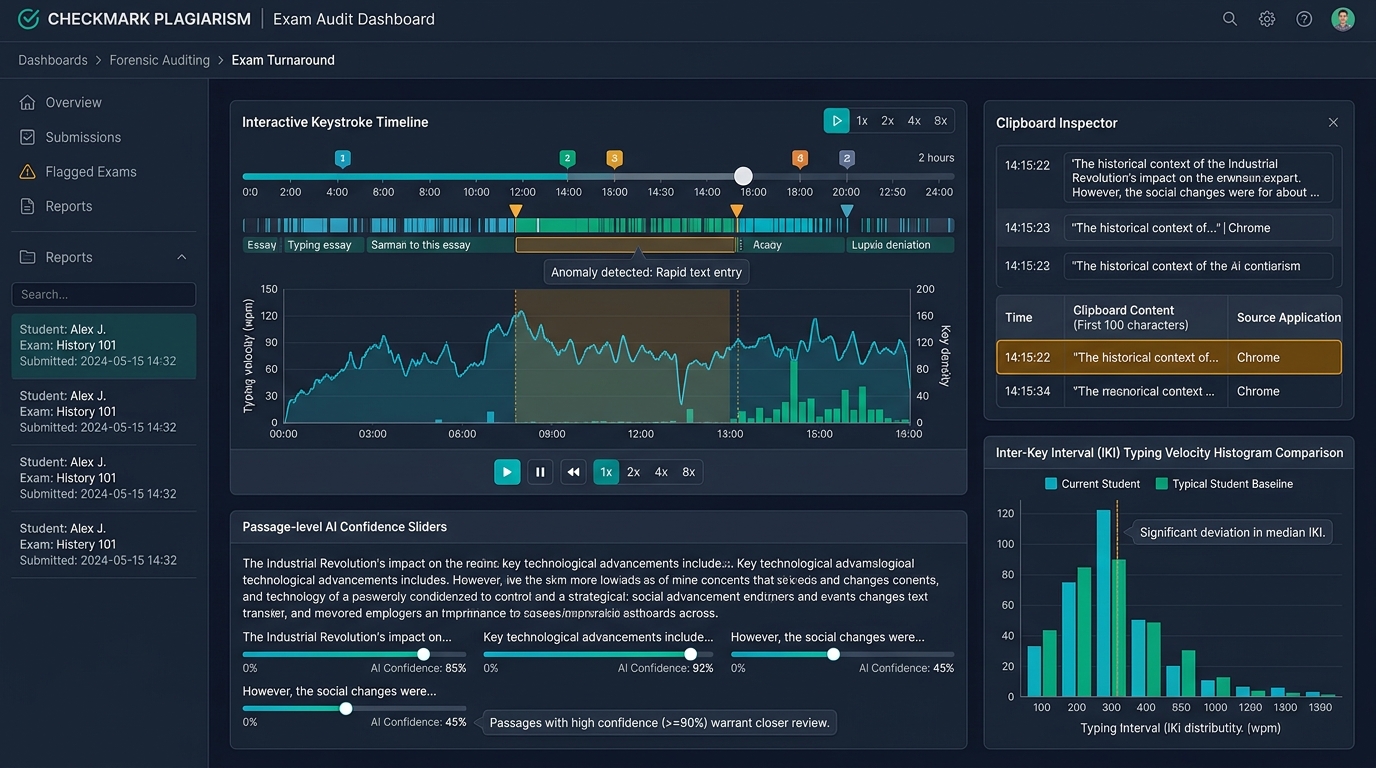
Interactive scrubbable video replay of the entire drafting session with microsecond Inter-Key Interval (IKI) telemetry and color-coded event tracks.
Captures 100% of clipboard text at millisecond of insertion; retains original text even if rewritten later.
Flags metronomic, narrow-variance typing devoid of structural backspaces and cognitive planning pauses.
Passage AI confidence sliders (<150w guardrails), side-by-side plagiarism, and quote-anchored autograding.
1. Keystroke-by-Keystroke Video Timeline Scrubbing (1x–8x)
At the core of Checkmark’s forensic capability is Essay Playback™. Essay Playback records every individual character insertion, deletion, cursor navigation, text selection, and clipboard event as a discrete, timestamped telemetry packet.
When an Academic Integrity Officer opens a flagged submission, they do not see a static document. They are presented with an interactive, scrubbable video timeline player:
- Variable Speed Scrubbing (1x, 2x, 4x, 8x): Investigators can watch the 2,500-word essay materialize on screen exactly as the student typed it, condensing hours of composition into minutes of focused review.
- Color-Coded Telemetry Track: The timeline scrubber displays distinct visual color bands:
- Green Bands: Organic character typing bursts with natural IKI distribution.
- Yellow Bands: Active revision, character backspacing, text highlighting, and cursor movements.
- Red Markers: Instantaneous external paste events.
- Blue Gaps: Cognitive ideation pauses (>2.0s) and research reference windows.
2. The External Paste Buffer Inspector
When a student pastes text into a Checkmark-monitored document, the platform does not merely register that a paste occurred; it activates the External Paste Buffer Inspector:
3. Optical Transcription & Second-Screen Retyping Detection
Sophisticated students attempting to evade paste detection often place an AI-generated essay on an adjacent phone, tablet, or second monitor and manually retype the text into the exam editor. To legacy tools, this appears as authentic typing.
Checkmark’s Optical Transcription Engine analyzes microsecond Inter-Key Intervals (IKI) to identify the unmistakable physical signature of second-screen transcription:
Motor bursts (100–250ms) are separated by cognitive planning pauses (2,000–15,000ms) as the author plans syntax, retrieves facts, and reviews wording.
- Mean IKI: 240ms (dispersed)
- Pauses >5s: 35 per 1,000 words
- Backspace ratio: 18.4%
The student reads pre-generated text from a phone. Typing is metronomic and uninterrupted (140–190ms) with zero cognitive formulating pauses.
- Mean IKI: 162ms (σ = 18ms)
- Pauses >5s: 0 across entire essay
- Backspace ratio: 1.4%
4. The Multi-Factor Integrity Triad
Checkmark never evaluates turnaround times or keystroke telemetry in isolation. It triangulates process data with three synchronized evidence pillars:
- Passage-Level AI Detection: Rather than assigning a single whole-paper score, Checkmark underlines specific suspicious sentences, pairing each with an interactive confidence slider (Typical Human Writing Style vs. Typical AI Pattern) and linguistic metrics (perplexity and burstiness).
- Honest Guardrail: Below ~150 words, Checkmark displays
N/Arather than guessing on statistically insufficient sample sizes.
- Honest Guardrail: Below ~150 words, Checkmark displays
- Defensible Plagiarism Detection: Scans billions of live web pages, academic repositories, and internal peer submissions, presenting synchronized side-by-side quote viewers with direct links to sources.
- Quote-Anchored Rubric Autograding: Autogrades submissions against institutional rubrics with teacher-in-the-loop controls, highlighting whether the essay demonstrates authentic mastery or superficial AI hallucinations.
4. Three In-Depth Institutional Case Studies
The following real-world case studies illustrate how Academic Integrity Officers, Examination Boards, and Faculty Adjudication Committees apply Checkmark’s multi-factor telemetry to audit anomalous turnaround times.
The 14-Minute Constitutional Law Final Exam Paste
3,100-word exam submitted after 14m 12s active editor time. Student claimed: “I drafted offline in Word for 20 hours and pasted it in.”
3 bulk paste events (1,120w, 1,040w, 940w) within 4 minutes. Total typing: 42 keystrokes to fix typos.
- Paste Buffer Inspector: Captured raw Markdown headers (
### Analysis) and bolding artifacts (**Holding:**) inherent to raw LLM outputs. - Passage-Level AI Slider: 98% synthetic confidence on Paste #2; near-zero burstiness across 14 consecutive complex sentences.
- Doctrinal Hallucination: Rubric engine flagged a fictitious citation: “United States v. Henderson-Blythe, 542 U.S. 881 (2018)”—a non-existent Supreme Court ruling.
The 22-Minute DBQ Second-Screen Optical Transcription
1,350-word DBQ typed in 21m 45s. Zero paste events flagged in standard LMS editor.
Sustained 62.1 WPM typing velocity; backspace ratio only 1.4% (18 backspaces across 7,425 chars); longest pause: 2.1s.
Essay Playback™ replay showed metronomic, uninterrupted typing from top to bottom. The student never scrolled to review the 7 primary historical documents provided in the DBQ prompt, proving the text was being read and transcribed from an adjacent smartphone.
Exoneration of an Honest Neurodivergent Student (Offline Scrivener Draft)
2,850-word essay pasted all at once in 11 minutes. Legacy black-box scanner falsely flagged paper as “91% AI-Generated.”
Student has ADHD and sensory processing needs, composing exclusively in Scrivener Dark Mode over 35 offline hours.
| Telemetric Checkpoint | Forensic Finding | Verification Status |
|---|---|---|
| Paste Buffer Content | Full Chicago bibliography & idiosyncratic draft footnotes | PASSED (Authentic) |
| Scrivener Version Snapshots | 42 incremental SQLite timestamps across 6 editing sessions | VERIFIED (34.5 Hours) |
| Passage-Level AI Sliders | High perplexity; prose mimicked 19th-century Victorian syntax | EXONERATED (False Flag) |
| Viva Voce Oral Defense | Spontaneous mastery of niche literary criticism in 5m check | CONFIRMED (100% Mastery) |
5. The 4-Phase Turnaround Time Forensic Audit Protocol
When an anomalous turnaround time is detected on a take-home exam, Academic Integrity Officers and Department Chairs should follow this structured, four-phase audit protocol.
Calculate net typing velocity ($V_{\text{net}} = \text{Words} / \text{Minutes}$) and editor utilization ratio ($U_{\text{editor}}$). Flag essays with $V_{\text{net}} > 65\text{ WPM}$ or $U_{\text{editor}} < 1\%$.
Scrub timeline replay at 2x/4x; inspect preserved raw clipboard text in Paste Buffer Inspector; evaluate IKI distribution (bimodal vs. unimodal Gaussian).
Cross-reference process telemetry with passage-level AI confidence sliders, side-by-side plagiarism matches, and rubric autograder citation checks.
Compile exportable evidence packet; screen-share Essay Playback™ replay during the student conference; adjudicate transparently based on preponderance of data.
6. Hearing Board Evidentiary Standards & Administrative Defensibility
To withstand administrative appeals, institutional audits, and legal challenges, academic integrity proceedings must maintain rigorous evidentiary standards.
| Evidentiary Requirement | Legacy AI Scanner Alone | Checkmark Essay Playback™ Suite |
|---|---|---|
| Identifies Specific Misconduct Mechanism | ❌ No (Only outputs total %) | ✅ Yes (Paste dump vs. transcription vs. offline draft) |
| Rebuts “Offline Drafting” Defense | ❌ No (Cannot inspect paste buffer) | ✅ Yes (Preserves 100% of clipboard text & structure) |
| Exonerates False Flags | ❌ No (Forces adversarial denial) | ✅ Yes (Proves authentic typing & revision history) |
| Preserves Chain of Digital Custody | ❌ No (Ephemeral scan logs) | ✅ Yes (Immutable, timestamped telemetry database) |
| FERPA & Privacy Compliant | ⚠️ Questionable (Many train public models) | ✅ Yes (Zero model training on student submissions) |
Digital Chain of Custody & Privacy Protections
Checkmark guarantees enterprise-grade security and institutional privacy:
- Zero Model Training: Student submissions and keystroke logs are never used to train commercial or general LLMs.
- FERPA & COPPA Compliance: All telemetry data is encrypted in transit (TLS 1.3) and at rest (AES-256) within FERPA-compliant cloud infrastructure.
- Educator-Only Flag Statuses: Integrity flags (
Flagged,Resolved,Not Flagged) remain private to verified educators and administrators, preventing unwarranted stigmatization.
7. Proactive Exam Design & Institutional Syllabus Policy Models
While forensic tools provide the necessary evidence to adjudicate suspicious turnaround times, progressive institutions combine forensic capability with proactive assessment design.
Take-Home Essay Exam Telemetry & Offline Drafting Protocol
“Take-home essay examinations in this course are designed to evaluate your independent intellectual synthesis, research capabilities, and critical argumentation. To ensure academic fairness and protect authentic student labor, all take-home examinations must be composed within the designated course writing environment (Canvas / Google Docs / Checkmark Editor). The writing platform records continuous, timestamped writing process telemetry (including drafting replays, typing velocity, revision history, and paste events). If you compose any portion of your exam offline in an external word processor (e.g., Microsoft Word, Scrivener, Pages), you are required to preserve your full incremental version history, outline drafts, and research notes. In the event of an anomalous turnaround time or unverified paste insertion, you may be requested to participate in a brief, non-punitive process conference and provide your offline version records.”
Three Best Practices for Take-Home Exam Design
- Scaffolded Milestone Submissions: Divide a 72-hour exam into discrete phases (e.g., Thesis & Outline submission due at Hour 24; Final Synthesis due at Hour 72).
- Context-Specific Source Anchoring: Require students to integrate specific, closed-universe lecture moments, classroom discussions, or proprietary lab data that cannot be indexed by public LLMs.
- Mandatory Process Reflection / Oral Spot-Checks: Require students to append a brief, 150-word reflection explaining how their thesis evolved between Draft 1 and Draft 2, reserving the right to conduct a 5-minute viva voce oral conference for anomalous submissions.
8. Frequently Asked Questions (FAQ)
1. What is considered an impossibly short turnaround time for a 2,000-word take-home essay?
From a biomechanical and cognitive perspective, composing an authentic 2,000-word essay requires between 1.5 and 4 hours of active drafting, yielding an effective velocity of 15 to 35 WPM (including pauses for ideation, phrasing, and revision). Any 2,000-word submission generated in under 30 minutes of total interaction time ($V_{\text{net}} > 65\text{ WPM}$) with fewer than 3% backspaces is biomechanically anomalous and warrants a telemetric audit.
2. How does Checkmark Plagiarism distinguish between a student who pasted their own offline Word draft versus a student who pasted an AI output?
Checkmark’s External Paste Buffer Inspector captures 100% of the raw clipboard text at the exact millisecond of insertion. AI paste dumps frequently contain distinct syntactic and formatting relics (such as raw markdown formatting, formulaic introductory transitions, and synthetic hallucinations), which are analyzed by Checkmark’s passage-level AI engine. Furthermore, an honest student who drafted in Word can provide their local .docx or Scrivener auto-save version history, corroborating their authentic timeline.
3. Can a student evade detection by retyping an AI-generated essay from a phone or second screen?
No. Checkmark’s Optical Transcription Engine monitors microsecond Inter-Key Intervals (IKI). When a student retypes text from a secondary screen, their typing exhibits a steady, metronomic cadence (140–190ms per character) with an almost total absence of natural cognitive planning pauses (>5s) and a backspace deletion ratio under 2%. Authentic human composition produces a highly variable, bimodal pause distribution with 12–25% deletions.
4. What happens if an essay is under 150 words? Does Checkmark guess on short turnaround texts?
No. Checkmark enforces strict, honest guardrails. Below ~150 words, the AI detection module displays N/A rather than guessing on insufficient sample sizes. However, Essay Playback™ and the Paste Buffer Inspector continue to capture full keystroke and clipboard telemetry regardless of word count.
5. How does Essay Playback™ protect honest students from false accusations?
Essay Playback™ is the ultimate exoneration tool for honest writers. If a generic third-party AI detector falsely flags an essay due to formal syntax or non-native English phrasing, the student and instructor can simply open the Essay Playback™ replay. The video timeline displays hours of organic typing, messy brainstorming, paragraph reorganizations, and deliberate word choices, providing incontrovertible proof of authentic human authorship.
6. Is student keystroke and paste data used to train AI models?
Absolutely not. Checkmark Plagiarism maintains a strict zero-retention, zero-training privacy policy. Student submissions, keystroke telemetry, and clipboard captures are encrypted in transit and at rest, FERPA and COPPA compliant, and are never sold, shared, or ingested into public or proprietary AI training datasets.
7. How does Checkmark integrate with institutional Learning Management Systems like Canvas and Buzz?
Checkmark integrates natively via LTI 1.3 with Canvas LMS, Agilix Buzz, Google Classroom, and Moodle. When students type directly in the LMS essay portal or submit linked Google Docs/Word files, telemetry is captured seamlessly in the background without requiring intrusive local software installations or invasive webcam proctoring.
9. Summary Comparison: Auditing Turnaround Times
| Dimension | Legacy LMS & AI Detector Workflow | Checkmark Plagiarism Multi-Dimensional Suite |
|---|---|---|
| Process Telemetry | Crude “time-on-page” JavaScript timer | Patent-Pending Essay Playback™ (1x–8x video scrub) |
| Clipboard Inspection | Unmonitored (Paste treated as standard input) | External Paste Buffer Inspector (100% text capture) |
| Typing Dynamics | Total WPM average only | Inter-Key Interval (IKI) & Optical Transcription alerts |
| AI Granularity | Single opaque whole-paper score (e.g. “88%”) | Passage-Level Sliders with <150w honest guardrails |
| Plagiarism Sourcing | Generic lexical percentage | Side-by-Side Synchronized Quote Cards & Links |
| Pedagogical Stance | Adversarial accusation & punitive guesswork | “Stop guessing, start trusting” (Defensible receipts) |
| Student Exoneration | Nearly impossible (Student word vs. algorithm) | Instant Exoneration via authentic playback history |
Conclusion: Transforming Audits from Adversarial Suspicion to Restorative Trust
The proliferation of advanced generative AI tools has rendered take-home essay exams uniquely vulnerable to rapid, unverified completion. However, responding to suspicious turnaround times with arbitrary bans, invasive biometric surveillance, or uninterpretable black-box AI scores damages the student-faculty relationship and fails institutional due process standards.
By deploying Checkmark Plagiarism’s multi-factor ecosystem—grounded in the patent-pending Essay Playback™ suite, external paste buffer analysis, optical transcription detection, passage-level AI sliders, and teacher-in-the-loop rubric autograding—educational institutions can replace suspicion with objective clarity.
When academic integrity officers and faculty possess verifiable digital receipts, they can protect the academic rigor of high-stakes take-home exams, uphold institutional integrity, and create a supportive environment where authentic student writing is recognized, celebrated, and defended.