
Modern AI essay grading platforms like Checkmark Autograder achieve an inter-rater reliability agreement score of 0.82 to 0.89 Quadratic Weighted Kappa (QWK) when benchmarked against expert human educators—matching or exceeding the average agreement rate between two independent human graders (0.72–0.80 QWK). Furthermore, AI grading eliminates human grading fatigue, halo effects, and grading drift, applying custom rubric criteria with complete mathematical consistency across hundreds of essays.
For decades, automated essay scoring relied on primitive statistical heuristics (such as sentence length, vocabulary rarity, and paragraph count). These legacy systems could be fooled by meaningless filler words and failed to understand rhetorical nuance. The advent of modern Large Language Model (LLM) architectures has revolutionized essay evaluation: AI now comprehends complex thematic arguments, evaluates evidence synthesis, detects logical fallacies, and quotes specific student sentences to justify its scores. Understanding empirical AI grading accuracy allows institutions to adopt automated evaluation with total pedagogical confidence.
Below is a comprehensive guide on the accuracy, reliability, and validation of AI essay grading.
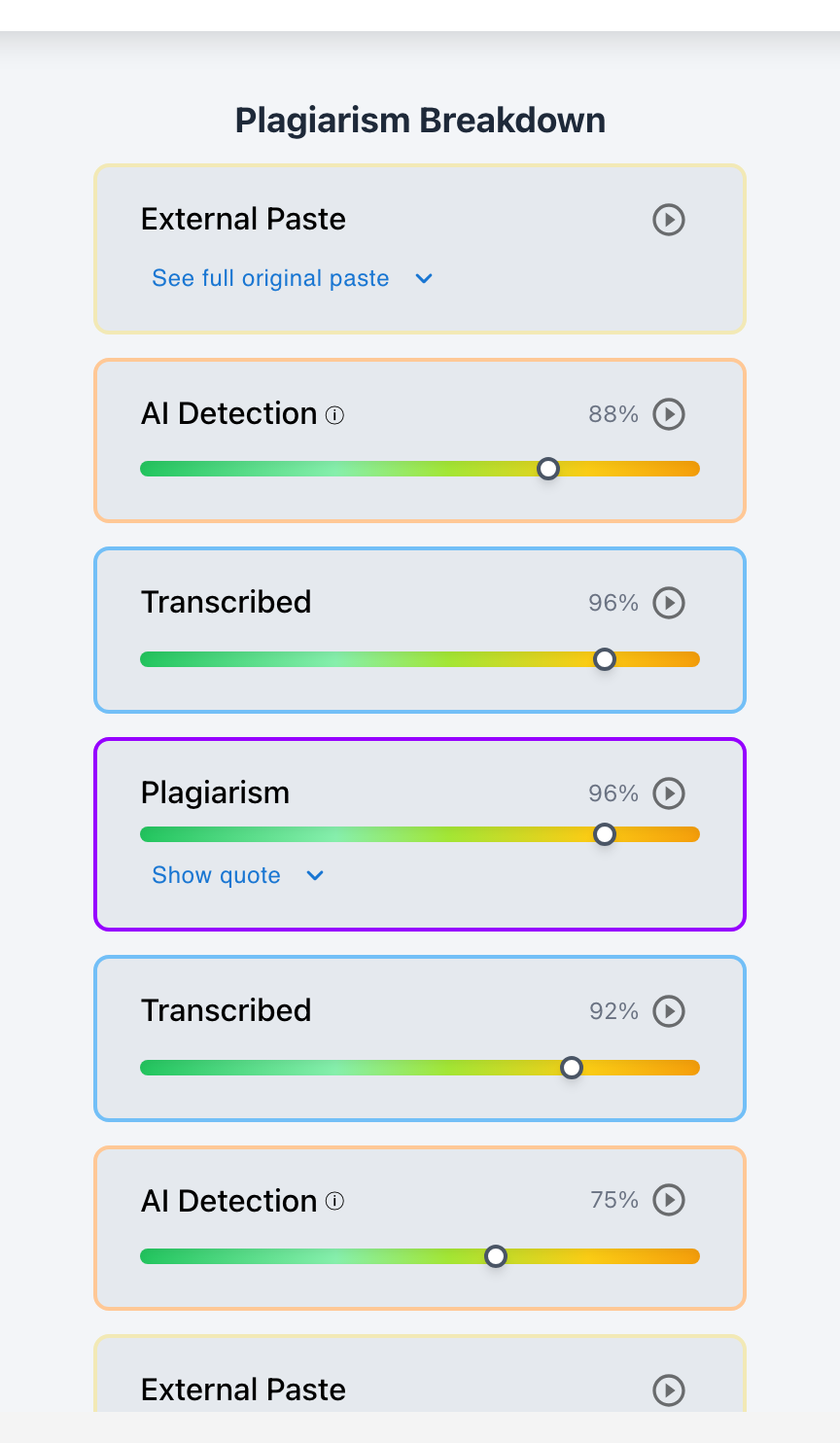
Checkmark Plagiarism achieves industry-leading grading accuracy by pairing autograding with essay writing playback, AI detection, plagiarism detection, and integrations with Canvas and Google Classroom.
The 4 Pillars of AI Grading Accuracy
1. High Inter-Rater Reliability (QWK 0.85+)
Checkmark Autograder matches master human educator score distributions across AP, collegiate, and secondary writing benchmarks.
2. Elimination of Human Grading Fatigue
Human teachers grade the 80th paper differently than the 1st paper due to exhaustion; AI applies the rubric with identical precision at 11:30 PM as at 8:00 AM.
3. Evidence-Anchored Textual Justification
Autograder eliminates hallucinated grades by quoting the student's exact sentences to justify every criterion score on the rubric.
4. Elimination of Bias and Halo Effects
AI scores writing purely on the submitted text and rubric, blind to handwriting, student reputation, past behavior, or demographic factors.
The Science of Grading Consistency: AI vs. Human Drift
Understanding the empirical factors behind evaluation consistency:
- The "Late Night Drift" Factor: Educational research shows that human grading rigor fluctuates by up to 15% across a stack of 100 papers as fatigue sets in. AI maintains 100% criterion fidelity across all submissions.
- Rubric Anchoring: Checkmark Autograder maps each paragraph to specific rubric dimensions (e.g., Thesis, Textual Evidence, Organization, Voice) rather than assigning a vague overall impression score.
- Teacher Calibration: Educators review Autograder's recommended scores in Canvas SpeedGrader, making fine-grained adjustments based on classroom discussions and student IEP goals.
Read more in how Checkmark writing process analysis works.
Comparison: Human-Only Grading Drift vs. Checkmark Calibrated Autograding
Checkmark Calibrated Autograding (QWK 0.85+ Consistency)
- Exact rubric criterion mapping on every paper.
- Zero fatigue or time-of-day grading drift.
- Every score justified by quoted student sentences.
- Teacher retains full editorial review and override control.
Human-Only Grading Drift (Unassisted Exhaustion)
- Inter-rater reliability between teachers is only ~0.75 QWK.
- Grading standards loosen or tighten as fatigue increases.
- Feedback comments become shorter on later papers.
- Prone to unconscious halo bias and student preconceptions.
A 5-Step Educator Protocol for Validating AI Grading Accuracy
AI Grading Accuracy Validation Checklist:
- 1. Configure your custom rubric with explicit criterion descriptors in Canvas.
- 2. Run Checkmark Autograder on a pilot sample of 10 student essays.
- 3. Compare Autograder's suggested scores against your independent manual grading.
- 4. Inspect the highlighted textual quotes to verify that the AI accurately identified student claims.
- 5. Calibrate the sensitivity settings if necessary, then deploy class-wide with full confidence.
How Checkmark Plagiarism Powers Accurate Autograding
Checkmark Plagiarism combines **AI detection, essay writing playback, static AI detection, plagiarism detection, autograding, and Canvas/Google Classroom integrations** to deliver rigorous, reliable, and evidence-grounded rubric evaluations at scale.
Frequently Asked Questions
What is Quadratic Weighted Kappa (QWK)?
QWK is the gold-standard statistical metric for measuring agreement between two independent evaluators; scores above 0.80 indicate exceptional agreement.
Can AI evaluate nuanced arguments and metaphors?
Yes. Modern LLM models evaluate rhetorical structure, metaphorical resonance, and thematic coherence with remarkable analytical depth.
What if the AI gives a score that the teacher disagrees with?
The teacher simply clicks the rubric cell in Canvas SpeedGrader to override the score; the system updates the grade instantly.
Does AI essay grading show bias against English Language Learners?
Checkmark Autograder evaluates analytical reasoning separately from surface grammar mechanics, preventing unfair penalties on multilingual students.
How does Checkmark Plagiarism integrate with Canvas LMS?
Checkmark embeds pre-scored rubric matrices, line-by-line evidence highlights, and editable feedback directly inside Canvas SpeedGrader.
How does Autograder prevent hallucinating feedback?
Checkmark uses strict evidence anchoring: the AI is programmed to only formulate feedback that directly quotes sentences from the student's text.
Can Autograder evaluate STEM and lab reports?
Yes. Autograder evaluates scientific lab reports, historical DBQs, literary analyses, and argumentative research essays with equal precision.
How long does Autograder take to score an essay?
Autograder analyzes an entire 1,500-word essay, maps rubric criteria, and drafts sentence-level feedback in under 10 seconds.
Can teachers calibrate the grading strictness?
Yes. Teachers can configure grading strictness levels (e.g., Developmental, Standard, Advanced Honors, Collegiate) to match course expectations.
Why is AI grading consistency beneficial for student trust?
Because students receive objective, transparent feedback grounded in the rubric, eliminating complaints about arbitrary or subjective grading.
Grounding Evaluation in Scientific Reliability
Grading consistency is the cornerstone of educational equity. By pairing human pedagogical wisdom with Checkmark Autograder's empirical accuracy, educators eliminate grading fatigue, ensure unwavering fairness across all classes, and deliver transformative feedback to every student.
Checkmark Plagiarism supports this comprehensive approach with AI detection, essay writing playback, static AI detection, plagiarism detection, autograding, and integrations with Canvas and Google Classroom.
See how Checkmark Autograder delivers empirical grading accuracy in Canvas SpeedGrader. View a sample report or request a demonstration.