
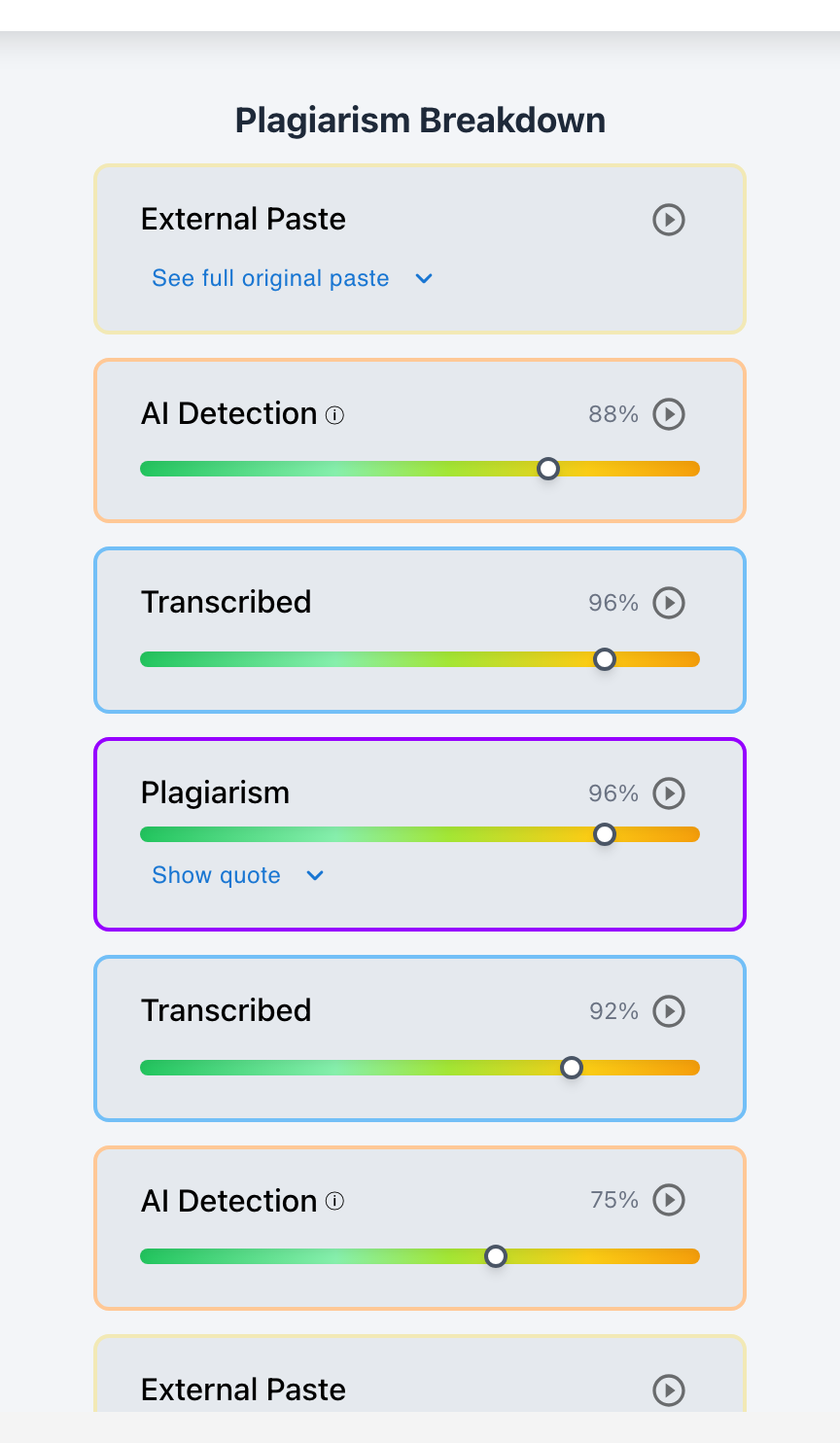
Yes. Active writing time is the single most critical, definitive piece of physical evidence when investigating suspected AI use—because while AI detectors make probabilistic guesses on static text, active drafting duration proves whether a human spent hours thinking, typing, and revising or whether the essay was generated in seconds.
In the post-ChatGPT classroom, relying solely on static AI probability percentages creates an unacceptable risk of false accusations. Articulate students, non-native English speakers, and advanced writers frequently trigger elevated AI scores due to formal vocabulary and clean syntax. In contrast, active writing time provides immutable physical proof: a student cannot fake 4.2 hours of active keyboard engagement, hundreds of backspaces, and natural cognitive thinking pauses. Writing time transforms AI investigations from subjective arguments into objective, evidence-based evaluations.
Below is a comprehensive guide on why writing duration is the ultimate arbiter in AI writing investigations.
Checkmark Plagiarism grounds AI investigations in physical evidence by pairing essay writing playback with AI detection, plagiarism detection, autograding, and integrations with Canvas and Google Classroom.
The 4 Reasons Writing Time Is the Ultimate Evidence
1. AI Is Instant; Human Drafting Takes Hours
Generating 1,500 words with ChatGPT takes 8 seconds. Composing 1,500 words as a human requires a biological minimum of 2.5 to 4.5 active hours of keyboard labor.
2. Conclusively Resolves Conflicting AI Scores
When Detector A says 85% and Detector B says 10%, 3.8 hours of active typing in Checkmark Playback immediately proves the high score is a false positive.
3. Exposes "Stealth AI" That Evaded Detectors
If a student uses an AI humanizer to achieve a 0% AI detector score, a 3-minute total drafting duration immediately reveals the external paste shortcut.
4. Unassailable Legal & Due Process Protection
During parent conferences and academic appeals, showing a timestamped video of 4 hours of typing provides undeniable proof of student innocence.
How Writing Time Outperforms Static AI Scores
Understanding why process telemetry is superior to static probability:
- Static AI Detectors Are Statistical Guesses: They evaluate word patterns, sentence burstiness, and perplexity. Highly structured human essays naturally exhibit lower perplexity, triggering false alarms.
- Writing Time Is Empirical Biomechanics: Every keystroke, deletion, and pause is a timestamped physical event. You cannot forge 4,000 keystrokes across 4 hours without actually doing the work.
- Eliminating Adversarial Confrontation: Showing a student an abstract percentage creates defensiveness; showing an accelerated 15-second video of their typing creates shared clarity.
Read more in how Checkmark writing process analysis works.
Comparison: Static AI Percentage vs. Multi-Signal Time Telemetry
Static AI Score Alone (High Risk of Error)
- "Detector flagged paper at 88% AI probability."
- Zero insight into whether text was typed or pasted.
- High false positive risk on articulate students.
- Easily overturned during student or parent appeals.
Checkmark Multi-Signal Time Telemetry (Conclusive)
- AI Score + 4.1 hours active typing + 23% backspaces.
- 15-second accelerated video replay of document evolution.
- Proves active drafting across multiple calendar sessions.
- Defensible, evidence-first due process for every case.
A 5-Step Educator Protocol for Time-Based AI Audits
Time-Based AI Audit Checklist:
- 1. Open the student's submission in Canvas SpeedGrader or Google Classroom.
- 2. Review the AI Probability Score alongside the Active Typing Duration metric.
- 3. If AI score is high (>50%) but active typing is 3+ hours with 15%+ backspaces, dismiss the alert immediately as a false positive.
- 4. If AI score is high and active typing is under 15 minutes, inspect the Paste Event Log.
- 5. Use the 15-second playback replay as the objective basis for any student conference.
How Checkmark Plagiarism Powers Evidence-First AI Audits
Checkmark Plagiarism combines **AI detection, essay writing playback, static AI detection, plagiarism detection, autograding, and Canvas/Google Classroom integrations** to ground every integrity evaluation in objective physical drafting evidence.
Frequently Asked Questions
Why is writing time better evidence than an AI detector score?
Because AI scores are statistical estimates on static text that can produce false positives, whereas writing time measures the physical reality of human keyboard labor.
Can a student with a 90% AI score be innocent?
Yes. Articulate human writers frequently score 80–90% on static detectors; verifying 3+ hours of active typing with backspaces conclusively proves their innocence.
What if an essay has a 0% AI score but was written in 3 minutes?
A 3-minute drafting duration proves the text was copied from an external source (such as an AI humanizer or peer essay) regardless of the low AI detector score.
What is considered normal writing time for a 1,500-word essay?
Authentic human composition requires an average of 2.8 to 4.5 active hours of keyboard engagement for 1,500 words.
How does Checkmark calculate active typing time?
Checkmark records active keystrokes and cursor movements, automatically pausing tracking when inactivity exceeds 60 seconds to eliminate open-tab inflation.
How does Checkmark Plagiarism integrate with Canvas LMS?
Checkmark provides certified LTI 1.3 integration, SpeedGrader sidebar embeds, two-way grade passback, and single sign-on (SSO).
Can students see their writing time in Canvas?
Yes. Students can view their drafting timeline in their Canvas submission view to track their writing habits and verify their work.
What role does writing time play in parent conferences?
Showing parents the exact active hours, session timestamps, and 15-second video replay provides objective proof that resolves disputes instantly.
Does Checkmark track backspaces along with writing time?
Yes. Checkmark measures character deletion rates (healthy baseline: 15–30%), providing another vital layer of proof of human cognitive drafting.
Why is multi-signal evidence the future of academic integrity?
Because combining linguistic AI detection with keystroke time tracking creates a 100% fair, accurate, and defensible evaluation system for every student.
The True Measure of Student Authorship
Technology should bring clarity, fairness, and truth to the classroom. By evaluating writing time and keystroke telemetry alongside AI detection in Checkmark Plagiarism, educators ensure that genuine effort is celebrated, false accusations are eliminated, and student due process is fiercely protected.
Checkmark Plagiarism supports this comprehensive approach with AI detection, essay writing playback, static AI detection, plagiarism detection, autograding, and integrations with Canvas and Google Classroom.
See how Checkmark pairs active writing time with multi-signal detection to investigate AI writing inside your LMS. View a sample report or request a demonstration.