
Using AI to generate an essay outline is considered cheating if the assignment specifically evaluates structural planning, argumentative design, or independent outlining skills—or if the course syllabus prohibits AI assistance. However, if the assignment evaluates prose drafting and critical synthesis, using AI as an organizational tool is often permitted as pre-writing assistance, provided it is transparently disclosed and the student drafts all final sentences independently.
Outlining is the structural skeleton of an essay: it establishes the thesis statement, determines the order of claims, and links evidence to counterarguments. When a student prompts ChatGPT to "generate a 5-paragraph outline for an argumentative essay on renewable energy subsidies," the AI does the foundational intellectual work of organizing the logical flow. Whether this constitutes academic misconduct depends entirely on what skills the teacher is evaluating. Checkmark Plagiarism helps educators track the entire trajectory of an assignment—from outline conception to final drafting—with transparent writing process telemetry.
Below is a comprehensive guide on evaluating AI outlining and setting clear pedagogical expectations.
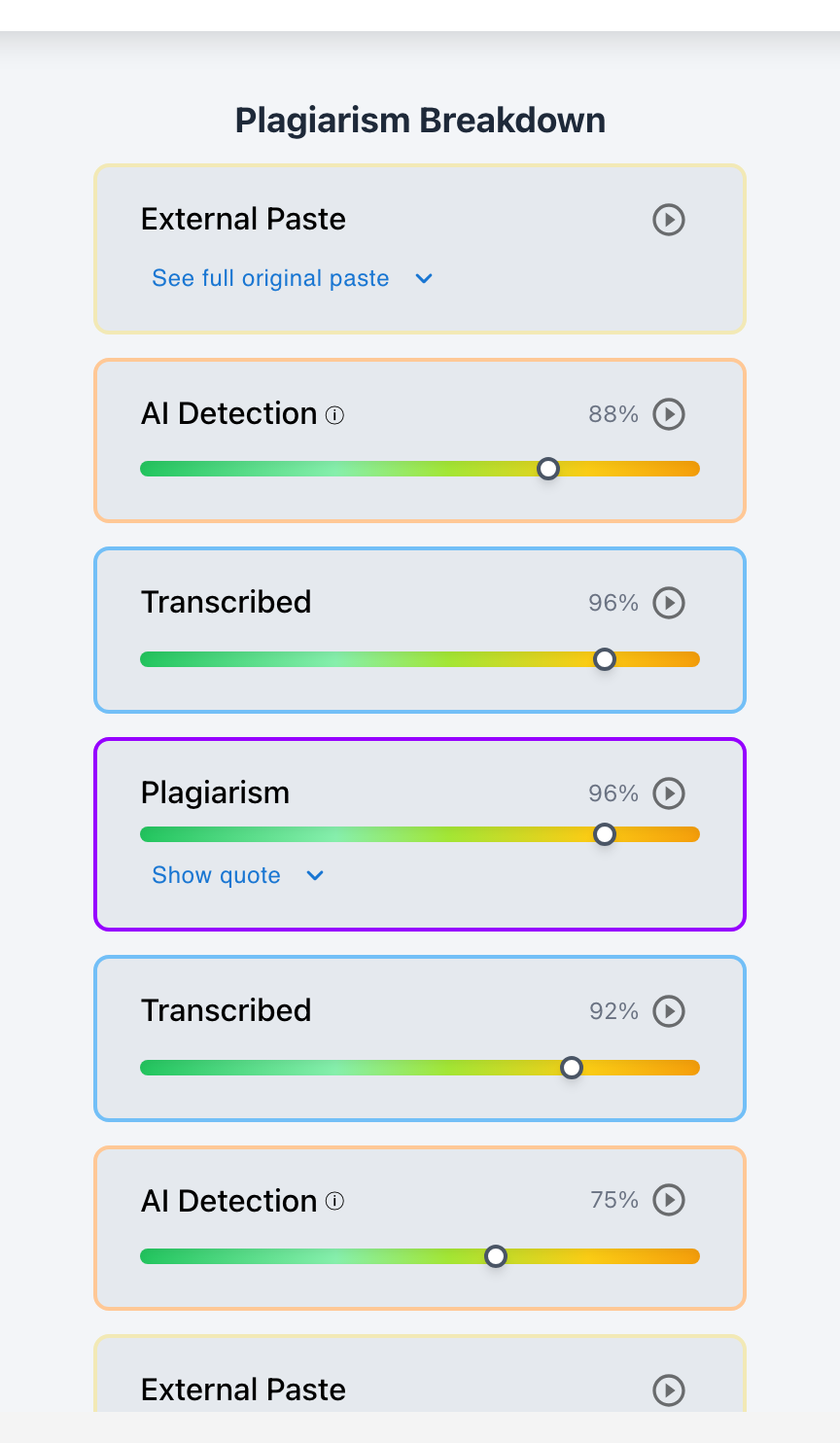
Checkmark Plagiarism analyzes outline-to-draft development by pairing AI detection with essay writing playback, plagiarism detection, autograding, and integrations with Canvas and Google Classroom.
The 4 Pedagogical Dimensions of AI Outlining
1. The Learning Objective Test
If the assignment rubric allocates points for "Argumentative Structure & Organization," outsourcing the outline to AI directly bypasses the assessed learning outcome.
2. The "Outline-to-Prose Expansion" Risk
Students often start with an AI outline, find drafting difficult, and take the second shortcut: asking AI to expand the bullet points into complete sentences.
3. The Generic Structure Trap
AI outlines default to predictable, formulaic structures (3 identical body paragraphs + counterargument) that stifle nuanced student creativity and originality.
4. The Requirement of Disclosure
If AI was used to organize thoughts, students must declare it transparently (e.g., "AI was consulted for initial outline structuring").
How Writing Playback Distinguishes Human Drafting from AI Expansion
Understanding what occurs after the outline is created:
- Authentic Human Drafting from AI Outline: The student pastes the AI outline into the document as notes, then spends 3+ hours typing original sentences below each bullet point, deleting the outline text as they go.
- AI Prose Expansion (Cheating): The student prompts ChatGPT to "write paragraph 1 from this outline," and pastes pre-formed 200-word blocks directly into the document in seconds.
- Telemetry Ground Truth: Checkmark Playback logs every keystroke, proving whether the student wrote the sentences or pasted machine-generated text.
Read more in how Checkmark writing process analysis works.
Comparison: Permissible AI Ideation vs. Prohibited AI Expansion
Permissible AI Pre-Writing (With Disclosure)
- AI suggests organizational ideas or section headers.
- Student modifies and refines the outline independently.
- Student writes 100% of final sentences by hand.
- Playback shows multi-hour keyboard composition.
Prohibited AI Expansion (Academic Misconduct)
- AI creates the outline AND writes the body paragraphs.
- Student copies and pastes machine-generated text.
- Writing Playback shows zero drafting hours.
- AI detector scores spike to 90%+ with uniform syntax.
A 5-Step Educator Protocol for AI Outlining Policies
AI Outlining Policy Checklist:
- 1. Explicitly clarify whether AI is permitted for outlining in the assignment instructions.
- 2. If permitted, require students to submit their initial outline draft alongside an AI disclosure note.
- 3. Open the final submission in Checkmark Plagiarism inside Canvas SpeedGrader.
- 4. Check Writing Playback to ensure the student drafted sentences organically rather than pasting AI text.
- 5. Hold a 2-minute conference: ask the student to explain why they ordered their arguments in that specific sequence.
How Checkmark Plagiarism Powers Process Transparency
Checkmark Plagiarism combines **AI detection, essay writing playback, static AI detection, plagiarism detection, autograding, and Canvas/Google Classroom integrations** to give educators full visibility into how an outline develops into a finished human essay.
Frequently Asked Questions
Is it cheating if I ask ChatGPT to organize my research notes into an outline?
If your instructor's syllabus allows AI pre-writing and you draft all the final sentences yourself, organizing notes with AI is generally considered ethical assistance with disclosure.
Can an AI outline cause an essay to be flagged as AI-written?
No. If you write all the prose yourself from scratch, your writing will have authentic human perplexity and burstiness, scoring near 0% AI probability.
What if the assignment is an outline checkpoint?
If the graded submission *is* the outline, using AI to generate it is direct cheating because you are submitting machine work for an outline grade.
How does writing playback show that I drafted the essay myself?
Playback records your real-time keystrokes, active hours, and backspaces, proving you composed every sentence manually from the outline.
How does Checkmark Plagiarism integrate with Canvas LMS?
Checkmark provides certified LTI 1.3 integration, SpeedGrader sidebar embeds, two-way grade passback, and single sign-on (SSO).
Why do AI outlines sound so predictable?
Because language models default to standard 5-paragraph structures with generic transitions ("Furthermore," "In conclusion") rather than inventive rhetorical designs.
What should a student write in an AI disclosure statement?
Example: "I used ChatGPT to brainstorm potential headings for my outline, but all arguments, research, and prose were drafted independently."
How does Checkmark Autograder evaluate organization?
Checkmark Autograder assesses logical argument flow, transition strength, and paragraph coherence against the teacher's rubric criteria.
Can teachers design assignments that make AI outlining less effective?
Yes. Ask students to structure essays around personal fieldwork, classroom debates, or localized community case studies that AI cannot predict.
Why is clear communication essential for AI pre-writing?
Because unambiguous guidelines eliminate student anxiety and ensure that technology is used ethically as an aid rather than a substitute for thought.
Fostering Intentional and Ethical Pre-Writing
Structuring ideas is a vital critical thinking skill. By establishing transparent outlining policies and using Checkmark Plagiarism to verify authentic sentence drafting, educators guide students to use modern tools thoughtfully while mastering the art of independent argumentation.
Checkmark Plagiarism supports this comprehensive approach with AI detection, essay writing playback, static AI detection, plagiarism detection, autograding, and integrations with Canvas and Google Classroom.
See how Checkmark pairs outline-to-draft tracking with writing playback to evaluate student pre-writing. View a sample report or request a demonstration.