
No. Pasting an entire essay into Google Docs does not, by itself, prove that a student used ChatGPT or another AI tool.
A large paste can certainly be worth investigating, especially if a nearly complete essay suddenly appears with little additional revision. But there are many legitimate reasons a student might paste an entire draft into Google Docs: drafting in Microsoft Word, using a personal Google Doc, writing in notes, or working across devices.
The better question is not: "Did this student paste an essay?" It is: "Where did the pasted essay come from, and does the student's explanation match the other available evidence?"
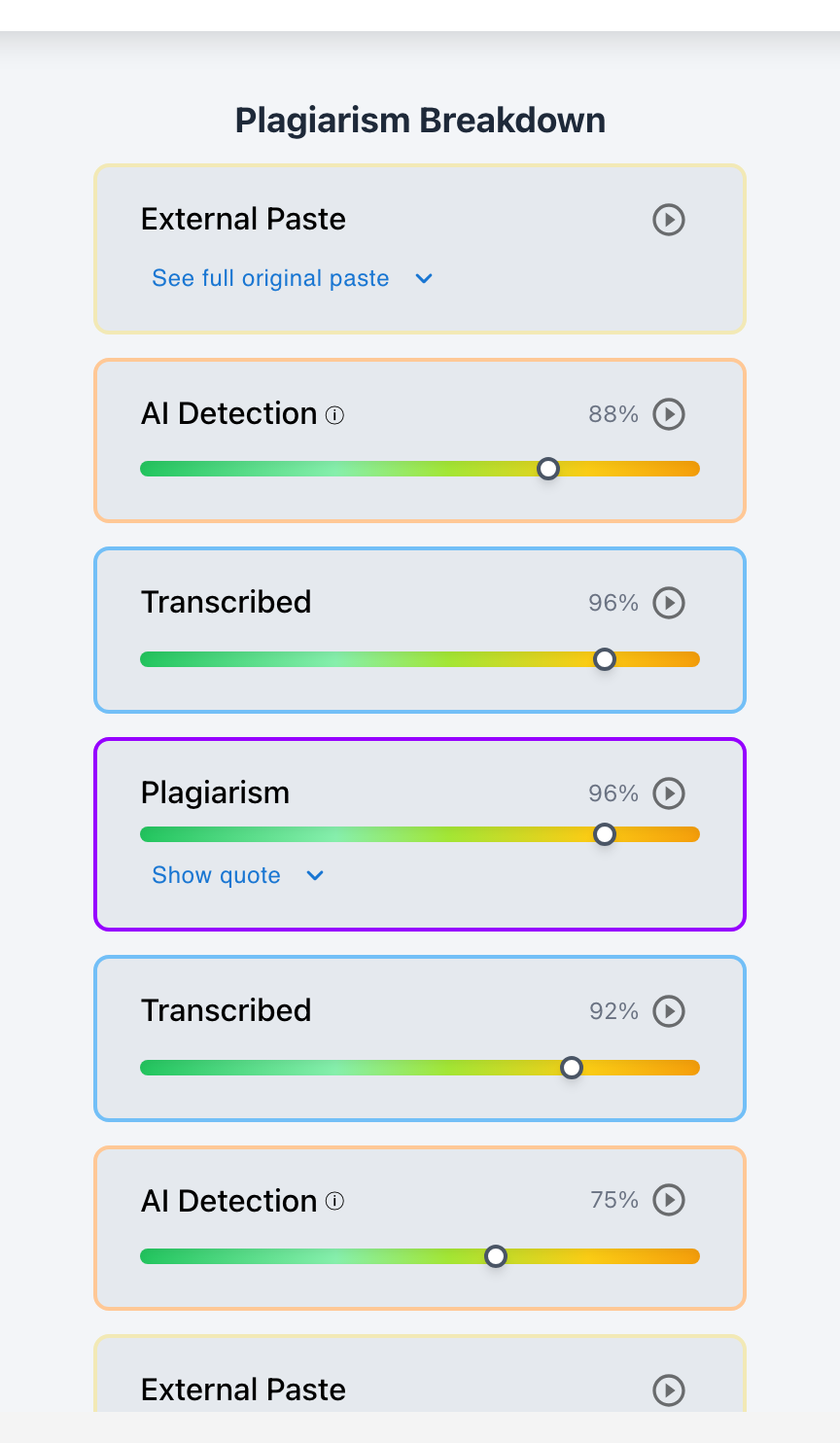
Checkmark Plagiarism's essay writing playback helps teachers examine how assignments develop alongside AI detection, static AI detection, plagiarism detection, autograding, and integrations with Canvas and Google Classroom.
Why Does a Full-Essay Paste Look Suspicious?
Opening a document to find a title and two lines followed by an instant 1,500-word polished essay with complete citations naturally raises questions. However, the history only proves: a large amount of text entered this document at once—it does not prove ChatGPT generated that text.
What Could a Full-Essay Paste Mean?
- Drafting in Microsoft Word: Many students prefer Word or desktop apps and paste the final draft into Google Docs solely for classroom submission.
- Personal Google Doc: A student may draft in a personal account before copying to the school-assigned document.
- Notes & Markdown Apps: Brainstorming and drafting in Notion, Apple Notes, or Obsidian before transferring.
- Working Across Devices: Transferring work between home desktops, phones, and school Chromebooks.
- Generative AI: The text may have been generated by ChatGPT or another LLM.
A Paste Shows Document Behavior, Not Authorship
A paste event indicates that content was imported rather than drafted directly in that browser tab. The appropriate next step is neutral inquiry: "I noticed most of the essay was added to this document at once. Where did you write the original draft?"
What If the Student Says They Wrote It in Word?
That is a common, legitimate workflow. Ask whether the original Word document is available. An authentic earlier draft often shows multiple revision timestamps, notes, thesis changes, and gradual development, completely resolving the paste inquiry.
Compare the Essay With Previous Student Writing
Compare vocabulary, sentence complexity, tone, grammar, and analysis with previous student work. If a pasted essay also sounds radically different from all past work, ask: "This essay is written differently from your previous assignments. What did you do differently this time?" Read more in how can I compare a student's assignment to their previous writing?
Ask the Student to Explain the Essay
A student who wrote an essay can discuss its central argument, key evidence, and sources in plain language. Inability to explain core ideas or define repeated vocabulary adds significant evidence to an investigation.
Verify the Citations
Check whether cited journal articles, book titles, author names, and quotes exist in academic indices. Unverifiable or hallucinated citations provide concrete, objective evidence of generative AI involvement.
What Does a Strongly Concerning Pattern Look Like?
Concerning Corroborating Pattern
- 1,500-word essay pasted in a single timestamp
- Zero subsequent edits or revisions
- Writing style diverges completely from past work
- AI detection raises severe flags on pasted text
- Multiple citations do not exist in academic databases
- Student cannot explain arguments or source origins
Valid External Drafting Pattern
- 1,500-word essay pasted from external Word doc
- Student provides earlier Word draft with multi-session logs
- Student fluently explains thesis, terms, & citations
- Citations are fully verified in academic databases
- Explanation completely resolves the initial paste question
What Does Essay Writing Playback Add?
Checkmark Plagiarism's essay writing playback lets teachers review how an assignment developed: multi-session drafting, large text additions, revisions, and deletions. This allows teachers to ask targeted, evidence-based questions: "I noticed almost the entire assignment appeared at once. Can you tell me where you were drafting before moving it here?" Read more in how Checkmark writing process analysis works.
Check for Plagiarism Too
Not every pasted essay involves AI. A wholesale paste may match an online database or peer submission. Checkmark Plagiarism combines comprehensive plagiarism detection with AI detection to evaluate all potential sources.
A Practical Process for Reviewing a Full-Essay Paste
A Practical 13-Step Full-Essay Paste Review Process:
- 1. Confirm what document history and writing playback actually show.
- 2. Avoid assuming the inserted text automatically originated from AI.
- 3. Ask the student neutrally where the original draft was written.
- 4. Give the student an opportunity to provide earlier draft files or version logs.
- 5. Compare the submission against previous student work baselines.
- 6. Ask the student to explain the thesis and key argumentative passages.
- 7. Verify cited sources, author names, and direct quotes in academic databases.
- 8. Review AI detection reports as one corroborating signal among several.
- 9. Check plagiarism detection results for traditional web/database source matches.
- 10. Inquire neutrally about generative AI tools, writing assistants, and tutoring support.
- 11. Compare the student's explanation with the observable document history.
- 12. Determine whether any outside assistance violated published course policy.
- 13. Follow established school academic-integrity procedures if concerns persist.
How Checkmark Plagiarism Helps Investigate Large Pasted Essays
Checkmark Plagiarism combines **essay writing playback, AI detection, static AI detection, plagiarism detection, autograding, and Canvas/Google Classroom integrations** to give educators complete context across both the document timeline and the finished submission.
Frequently Asked Questions
Does pasting an entire essay into Google Docs prove AI use?
No. The student may have written the essay in Microsoft Word, another Google Doc, or a notes application before pasting it into Google Docs for submission.
Is a full-document paste suspicious?
It can justify questions, especially when the text is polished and receives little revision afterward. But the paste itself does not reveal its original source.
Can Google Docs revision history tell whether text came from ChatGPT?
Revision history shows that text appeared, but it cannot establish that ChatGPT was the source.
What should I ask a student who pasted an entire essay?
Ask where the original draft was written and whether they can explain the work or provide the earlier version.
What if the student says they wrote it in Word?
That is a reasonable possibility. Ask whether the original Word document or an earlier draft with version history is available.
What if they cannot provide the earlier document?
Evaluate other evidence: previous writing baselines, conceptual understanding, citation validity, plagiarism results, and AI detection.
Does a large paste plus a high AI score prove ChatGPT was used?
Not necessarily. The combination warrants closer review, but neither signal alone establishes exactly how the text was created.
Can a student use AI without pasting large amounts of text?
Yes. They may use AI for brainstorming, outlining, sentence-level feedback, or manually retyping generated content.
Could a pasted essay be plagiarism instead of AI?
Yes. Plagiarism detection identifies whether pasted material matches existing web pages, journals, or student repositories.
How does Checkmark Plagiarism help investigate pasted essays?
Checkmark Plagiarism combines essay writing playback, AI detection, static AI detection, plagiarism detection, autograding, and Canvas and Google Classroom integrations.
A Full-Essay Paste Is a Question, Not an Answer
Pasting a complete essay into Google Docs indicates external creation, but does not prove academic misconduct. By examining previous writing, verifying citations, reviewing playback, and engaging students in dialogue, educators can reach fair and accurate determinations.
Checkmark Plagiarism supports this evidence-based approach with essay writing playback, AI detection, static AI detection, plagiarism detection, autograding, and integrations with Canvas and Google Classroom.
See how Checkmark pairs essay writing playback with multi-signal detection to investigate pasted assignments with complete evidence context. View a sample report or request a demonstration.