
No. Copying and pasting text into a document does not automatically indicate cheating—it is a routine, necessary part of standard academic research and drafting.
Every legitimate researcher copies and pastes direct quotations, complex statistical data tables, formatted bibliography entries, and URLs. Furthermore, writers routinely cut and paste their own paragraphs to reorganize argument flow, or transfer notes from an outline document into their main essay draft. Automatically penalizing a student simply because a paste event occurred would severely punish authentic scholarship.
The key to fair evaluation is pairing objective paste evidence with contextual educator review—evaluating the size, context, and intent of the paste alongside keystroke history and student dialogue.
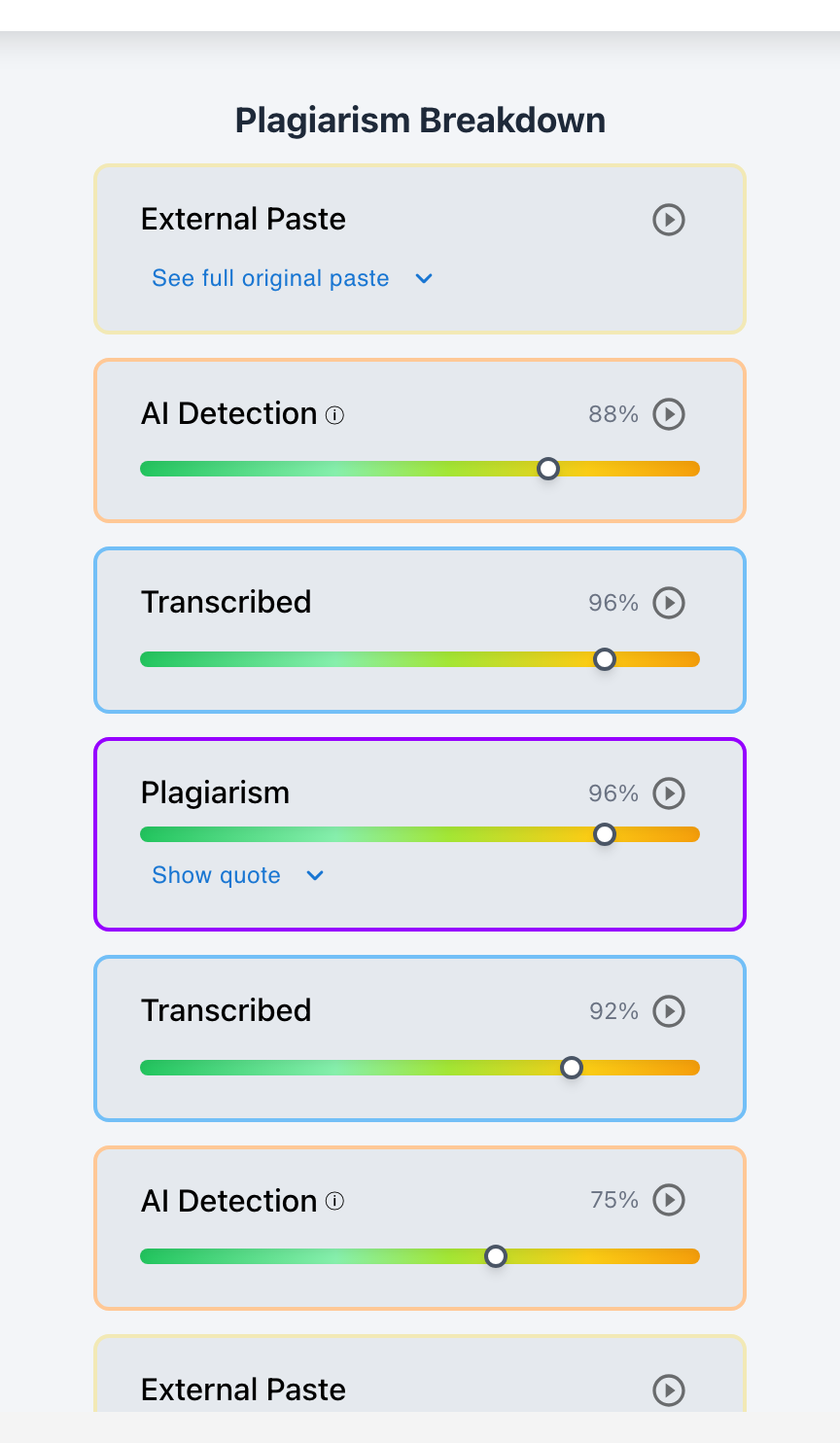
Checkmark Plagiarism supports this balanced approach by combining essay writing playback and paste evidence review with AI detection, plagiarism detection, autograding, and integrations with Canvas and Google Classroom.
4 Legitimate Reasons Students Copy and Paste
1. Properly Cited Direct Quotations
Pasting a 2-sentence passage from an academic journal directly between quotation marks with a corresponding in-text citation.
2. Formatted Bibliography Entries
Pasting complex APA/MLA citations, book titles, and DOI links exported directly from university library databases.
3. Internal Reorganization (Cut & Paste)
Moving an authentic paragraph from page 3 to page 1 to improve argument flow, which registers as an internal cut-and-paste event.
4. Offline Human Draft Transfer
Drafting notes in a personal notebook or offline Word doc and pasting them into the LMS editor before expanding them manually.
When Copying and Pasting IS an Integrity Violation
Paste events become red flags when they bypass authentic cognitive composition:
- Wholesale Body Text Pastes: Pasting 1,200 words of analysis or arguments into a blank document with zero keystroke history.
- Unquoted Text Theft: Pasting paragraphs from an external website or classmate's paper without quotation marks or attribution.
- Pasting ChatGPT Outputs: Copying AI-generated essays, outlines, or fake citations into the assignment under the student's name.
How Checkmark Combines Paste Evidence with Teacher Review
Checkmark Plagiarism provides teachers with a nuanced, contextual review workflow rather than rigid binary penalties:
- Contextual Paste Tagging: Checkmark distinguishes between internal document moves (cut-and-paste within doc) and external paste events.
- One-Click Payload Inspection: Teachers click any flagged paste block in SpeedGrader to inspect the raw text and check if quotation marks surround it.
- Teacher Review Modal: Instructors can dismiss legitimate quotation pastes with a single click or flag suspicious wholesale pastes for a student conference.
Read more in how Checkmark writing process analysis works.
Comparison: Legitimate Paste vs. Suspicious Paste Event
Legitimate Paste (Authentic Writing)
- Short length (30–80 words).
- Enclosed in quotation marks with citation.
- Surrounded by hours of active human typing.
- Student fluently explains the cited quote orally.
Suspicious Paste (Integrity Risk)
- Massive volume (500–1,500 words).
- Presented as the student's original argument.
- Occurs in an empty document with zero prior typing.
- Student cannot define vocabulary in the pasted text.
A 5-Step Educator Paste Review Protocol
Educator Paste Audit Checklist:
- 1. Open the essay writing playback report in Canvas or Google Classroom.
- 2. Review total active typing time: authentic essays show hours of active typing.
- 3. Inspect flagged paste blocks to check if they are quoted sources or Works Cited entries.
- 4. If a large unquoted paste exists, check dual AI and plagiarism database matches.
- 5. Hold a supportive conference asking the student to explain the drafting of the pasted section.
How Checkmark Plagiarism Powers Fair Educator Reviews
Checkmark Plagiarism combines **AI detection, essay writing playback, static AI detection, plagiarism detection, autograding, and Canvas/Google Classroom integrations** to give educators contextual paste evidence, preventing false accusations while upholding uncompromising academic rigor.
Frequently Asked Questions
Is pasting text into an essay considered cheating?
Not if you are pasting cited quotations, bibliography entries, or reorganizing your own writing. Pasting unquoted external text or AI-generated writing without attribution is cheating.
Can teachers see how much text I pasted?
Yes. Checkmark Plagiarism logs the exact character count, word count, and timestamp of every paste event.
What if I wrote my essay in Microsoft Word and pasted it in?
It will appear as a single paste event. Show your original Word document with version history to prove you typed the essay yourself.
How does writing playback distinguish an internal move from an external paste?
Internal cut-and-pastes match text already typed earlier in the document timeline, whereas external pastes insert completely new text from outside the browser.
Can a student be punished just for having a paste event?
No. Fair academic evaluation requires reviewing the context of the paste, checking for quotation marks, and holding a student conference before reaching conclusions.
What percentage of an essay is normally pasted?
In standard research papers, 5–15% of text consists of legitimate pasted quotes and bibliography entries. Authentic human drafting accounts for 85%+ of keystrokes.
How does teacher review prevent false accusations?
Teacher review allows educators to verify that flagged pastes are properly cited sources or formatted citations, dismissing false alarms instantly.
What should a student do if they need to paste rough notes?
Paste notes at the bottom of the document as a rough workspace, and compose your final essay sentences above them keystroke-by-keystroke.
How does Checkmark Plagiarism integrate with Canvas LMS?
Checkmark Plagiarism embeds visual writing playback timelines, one-click paste review modals, and dual AI/plagiarism reports directly inside Canvas SpeedGrader.
Why is combining paste evidence with human review essential?
Because software cannot evaluate human intent; pairing automated forensic data with teacher judgment ensures accurate, supportive, and fair academic standards.
Context and Judgment Protect Academic Rigor
Copying and pasting is a tool—what matters is how and why it is used. By combining objective paste evidence with thoughtful teacher review and student dialogue, educators celebrate authentic research practices while defending academic integrity.
Checkmark Plagiarism supports this comprehensive approach with AI detection, essay writing playback, static AI detection, plagiarism detection, autograding, and integrations with Canvas and Google Classroom.
See how Checkmark pairs essay writing playback with multi-signal detection to provide clear, contextual paste evidence inside your LMS. View a sample report or request a demonstration.