
In most cases, AI-generated writing does not show up as traditional plagiarism on standard similarity checkers.
Traditional plagiarism detection software works by cross-referencing submitted text against an indexed database of published web pages, scholarly articles, and student papers to locate identical word matches. Because generative AI tools like ChatGPT, Claude, and Gemini synthesize brand-new sentences token-by-token using mathematical probabilities, the generated text does not exist in any database.
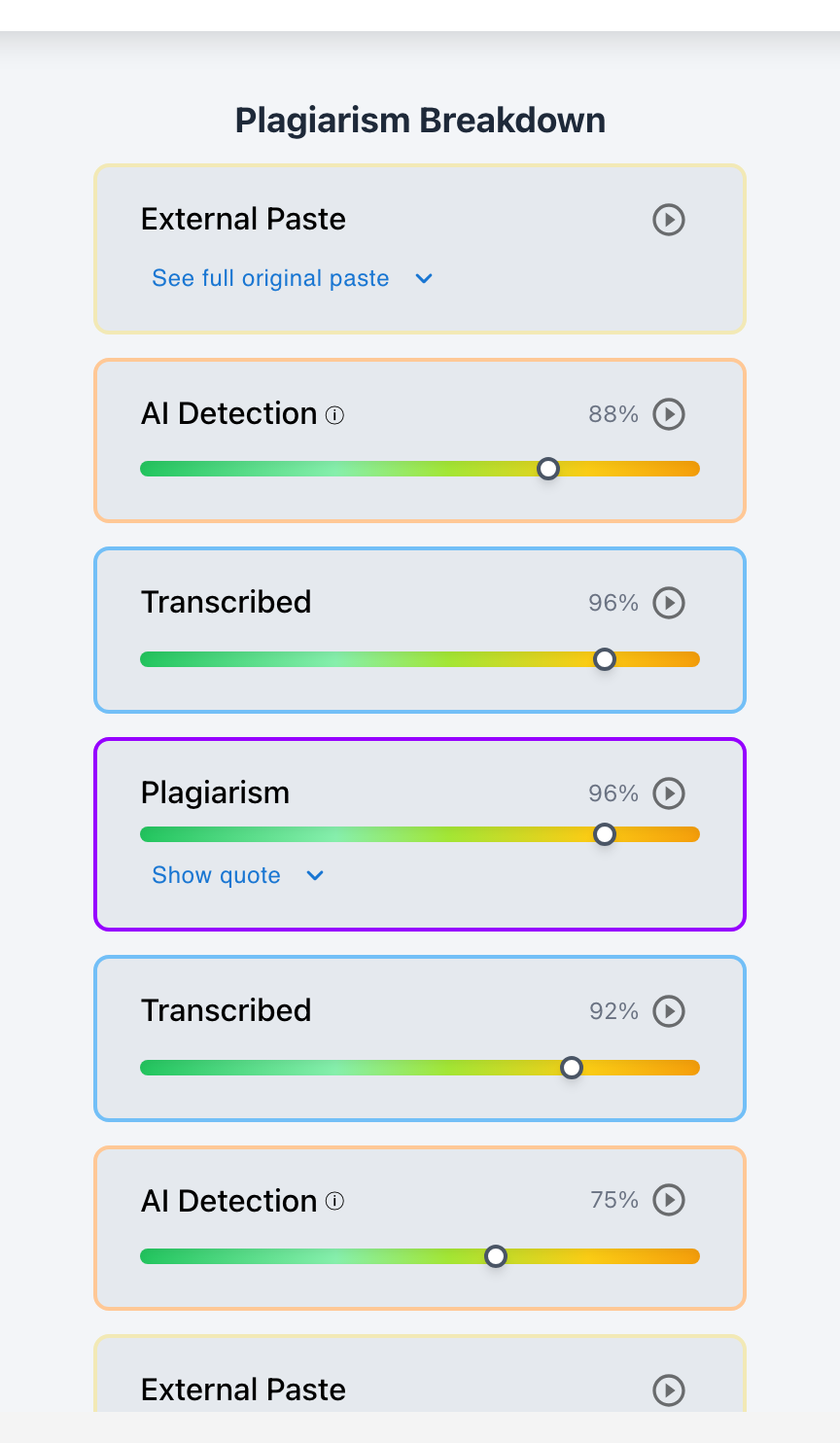
As a result, pure AI-generated essays almost always return a 0% similarity score on legacy plagiarism scanners. However, there are critical exceptions where AI writing *does* trigger plagiarism alerts, and modern multi-signal integrity platforms easily catch AI text through writing playback timelines and statistical language modeling.
Checkmark Plagiarism solves this dual challenge by integrating plagiarism detection with AI detection, essay writing playback, static AI detection, autograding, and integrations with Canvas and Google Classroom.
Why AI Writing Bypasses Traditional Plagiarism Scanners
Traditional Plagiarism Checkers
Rely on exact n-gram string matching: finding 8–12 consecutive identical words copied from an existing published webpage or repository.
Generative AI Language Models
Predict the most likely next word based on billions of parameters, producing novel sentence structures that have never been indexed on the web.
Because there is no pre-existing source document on the internet for the scanner to flag, the legacy checker gives the essay a clean bill of health. Read more in AI detection vs. plagiarism detection.
When AI Writing DOES Trigger Plagiarism Checkers
While base AI generation typically evades plagiarism scanners, there are three common scenarios where AI text *does* trigger direct similarity matches:
1. Verbatim Training Data Regurgitation
When prompted about famous historical documents, well-known literary quotes, scientific definitions, or legal statutes, large language models frequently output word-for-word passages memorized during training, triggering exact web matches.
2. Code Snippet Duplication
In computer programming assignments, AI models routinely generate identical functions, algorithms, and variable structures copied directly from public GitHub repositories without proper attribution.
3. AI Patchwriting and Rewriting
If a student pastes a copyrighted article into ChatGPT and asks it to "rephrase this lightly," the AI often retains enough consecutive sentence structures to trigger mosaic plagiarism alerts.
Why Missing Plagiarism Alerts Doesn't Make AI Ethical
A 0% similarity score does not prove authentic student writing. In academic scholarship, submitting text generated by an AI model under your own name is authorship fraud and contract cheating. The student is claiming credit for analysis, syntax, and argumentation performed entirely by an algorithm.
How Modern Platforms Catch AI Writing That Passes Plagiarism
1. Essay Writing Playback Timelines
Checkmark Plagiarism's essay writing playback tracks the physical creation of the document:
- Wholesale Paste Events: Capturing 1,200 words appearing in one instant paste timestamp.
- Active Typing Duration: Showing that a complex 5-page research paper had only 7 minutes of active typing time.
- Lack of Revisions: Revealing zero keystroke development, backspacing, or multi-session drafting.
Read more in how Checkmark writing process analysis works.
2. Statistical AI Predictability Scanners
AI detectors analyze perplexity (word predictability) and burstiness (sentence rhythm variation). AI writing exhibits smooth, uniform sentence cadences that trigger high AI probability heatmaps.
3. Citation Authentication Audits
Searching academic databases (JSTOR, Google Scholar) quickly catches hallucinated journal titles and dead DOIs invented by AI. Read more in can ChatGPT cite sources that don't exist?
Comparison: Traditional Plagiarism vs. AI Detection
Plagiarism Scanners (Web Matching)
- Detects copied text from published websites.
- Reports 0% match on raw AI generation.
- Requires an exact matching source URL.
Checkmark Multi-Signal System
- Combines plagiarism checks with AI detection.
- Captures visual essay writing playback of keystrokes.
- Audits citations for non-existent sources.
How Checkmark Plagiarism Delivers Full Integrity Coverage
Checkmark Plagiarism combines **AI detection, essay writing playback, static AI detection, plagiarism detection, autograding, and Canvas/Google Classroom integrations** to give schools a unified platform that catches both traditional plagiarism and generative AI text seamlessly.
Frequently Asked Questions
Does ChatGPT show up on plagiarism checkers?
Usually no. ChatGPT generates new combinations of words that do not match existing web pages, resulting in a 0% similarity score on traditional plagiarism checkers.
Can an essay have 0% plagiarism and still be written by ChatGPT?
Yes. A 0% similarity score only confirms that the text was not copied from a published website; it does not prove a human student wrote it.
Why does AI writing sometimes trigger plagiarism?
If the AI reproduces memorized training text (like famous historical speeches, code, or common definitions), it can trigger exact text-matching alerts.
What is the difference between an AI detector and a plagiarism checker?
Plagiarism checkers search databases for identical matching text. AI detectors analyze statistical language patterns (perplexity and burstiness) to identify machine-generated phrasing.
Can teachers tell if an essay was written by AI if plagiarism is 0%?
Yes. Teachers review essay writing playback timelines (paste events and typing speed), audit citations for hallucinations, and test oral conceptual comprehension.
Is using AI considered plagiarism by universities?
Yes. Submitting work you did not author as your own intellectual product is classified as plagiarism, contract cheating, and academic misconduct across all major institutions.
How does writing playback catch AI text that passes plagiarism checkers?
Writing playback proves that the text was pasted wholesale into the document in seconds rather than typed keystroke-by-keystroke over multiple drafting sessions.
Can paraphrasing AI text trigger plagiarism?
If a student uses AI to lightly rephrase an existing article, it can trigger patchwriting or mosaic plagiarism alerts on standard scanners.
What should a teacher do if an essay passes plagiarism but looks like AI?
Inspect the essay writing playback log, verify cited sources in academic databases, and invite the student to discuss their research journey in a conference.
How does Checkmark Plagiarism protect educators from AI shortcuts?
Checkmark Plagiarism pairs database plagiarism matching with visual essay writing playback, static AI analysis, and LMS integrations to provide complete verification.
Defend Academic Integrity with Multi-Signal Verification
Because generative AI writing slips past legacy plagiarism filters, educators need tools that evaluate the creation process itself. By combining traditional plagiarism detection with essay writing playback and citation audits, schools protect true scholarship.
Checkmark Plagiarism supports this comprehensive approach with AI detection, essay writing playback, static AI detection, plagiarism detection, autograding, and integrations with Canvas and Google Classroom.
See how Checkmark pairs essay writing playback with multi-signal detection to catch AI writing that passes legacy plagiarism tools. View a sample report or request a demonstration.